

Rule-based chatbots have become prevalent in customer service and e-commerce over the past decade, but they’ve not been as popular with consumers as the rate of deployment might suggest. Generative AI revolutionizes the consumer-chatbot experience and brings AI-driven “conversational commerce” to the fore.
Gartner figures from a survey of B2B and B2C customers between December 2022 and February 2023 found only 8% of customers used a chatbot in their most recent customer service experience, and only 25% would use the chatbot again. Gartner doesn’t say whether these are rule-based chatbots, but it’s reasonably safe to assume they were.
Experts from Boston Consulting Group (BCG) penned “The Chatbot Is Dead—Long Live the Chatbot,” explaining that “most consumers dislike chatbots—less than a third of online customers use them” based on the group’s latest research.
However, it’s conversational commerce, using generative AI, that is expected to reduce customer service costs by 30% and become a revenue-generating tool by delivering personalized customer experiences and augmented marketing and sales.
The Evolution of the Chatbot
Chatbots really began to evolve to serve customers with the development of SmarterChild, used by AOL and MSN in 2001. Then Apple’s Siri in 2010 and Microsoft’s Cortana and Amazon’s Alexa in 2014. Over the past few years, rule-based chatbots have, quite literally, begun to pop up on every website, offering to answer customer inquiries and product questions.
Rule-based chatbots rely on predefined if/then logic and decision tree functionality. They work reasonably well when asked common questions by consumers because they can be pre-programmed to answer FAQs in certain ways. However, they fall short when consumers ask questions that a rule-based chatbot doesn’t have the pre-programmed answers for and can’t answer complex multi-faceted queries or understand context.
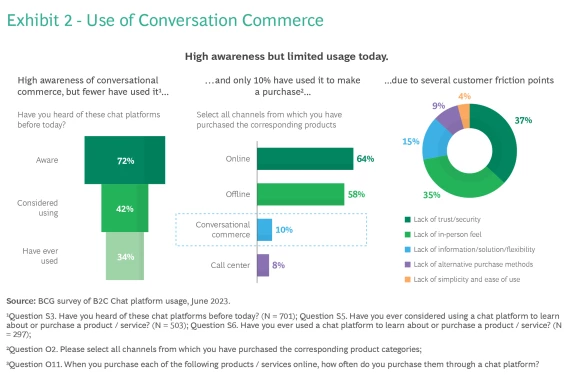
Source: BCG
BCG isn’t wrong. We didn’t like rule-based chatbots all that much. A US Consumer Financial Protection Bureau (CFPB) study published in mid-2023 found all the top ten U.S. commercial banks had deployed chatbots, and by 2022, 37% of customers had interacted with a bot. CFPB’s review of customer complaints found:
“People experience significant negative outcomes due to the technical limitations of chatbot functionality across different types of chatbots. There are many kinds of negative outcomes for the customer, including wasted time, feeling stuck and frustrated, receiving inaccurate information, and paying more in junk fees. These issues are particularly pronounced when people are unable to obtain tailored support for their problems.”
Even so, the Bureau estimates that using chatbots instead of human agents saves $8 billion per annum or approximately $0.70 per customer interaction. It notes that the banking industry has begun to adopt chatbots for generative AI-powered customer service. Goldman Sachs said it would start working on a large language model (LLM) in April 2023. Wells Fargo is using a chatbot “virtual assistant” using an LLM and Google Cloud. Morgan Stanley said it was testing a chatbot powered by ChatGPT-4 to generate scripts for financial advisors.
On the e-commerce front, 76% of online retailers have implemented or plan to implement chatbots into their customer service strategies, and 71% of Gen Z shop through bot interactions. Statistics are still emerging for generative AI chatbot adoption, but some point to around 57% of businesses already using the technology. New research from Deloitte suggests as many as 91% of companies plan to use generative AI in some way.
Will Consumers Actually Like GenAI Chatbots?
The statistics are still relatively sparse. But it is obvious that generative AI’s conversational and contextual understanding abilities, not to mention how easy custom GPT chatbots are to train on company data, mean they are being implemented at astounding rates as companies rush to take advantage of the benefits. The question is will consumers like generative AI chabots?
McKinsey’s Where is customer care in 2024? suggests:
“The transition from a care paradigm dominated by human agents to one steered by AI technologies may be the biggest disruption in the history of customer service.”
Customers, particularly younger generations, are becoming more accepting of using live chat or messaging services.

Source: McKinsey
Respondents in the McKinsey study reporting better-than-expected customer care performances have high levels of digital adoption. Businesses are already using AI tools, including chatbots and automated email response systems, for customer service. It cites the example of one firm that replaced its rule-based chatbot with a generative AI chatbot and discovered it was 20% more effective within seven weeks.
Making Conversational Commerce a Success
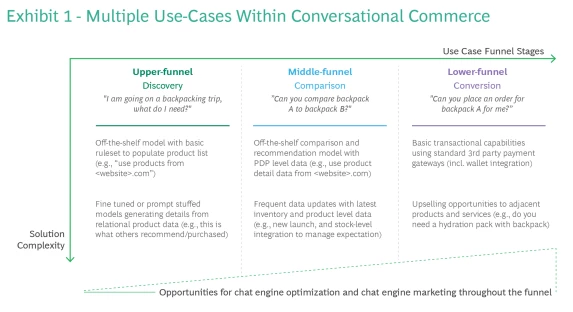
Conversational commerce, says BCG, can guide customers through a typical e-commerce funnel “from discovery to conversion.” However, to achieve this, companies must focus on data and technology as well as employee and process changes. BCG’s survey discovered that 66% of US consumers expressed strong interest in trying generative AI-powered conversational commerce. If companies manage risks and create use cases that appeal, they can reap the benefits.
A typical conversational commerce scenario can involve a consumer looking for suggestions from a chatbot, being supported through detailed product comparison, making a purchase, and then being presented with further purchase opportunities via the bot’s upselling.
Source: BCG
Generative AI’s “human-like, proactive and interactive” conversational style and, once trained, its understanding of customer needs powered by natural language processing (NLP) and data integration abilities will deliver a competitive advantage and immense revenue-generating opportunities at scale.
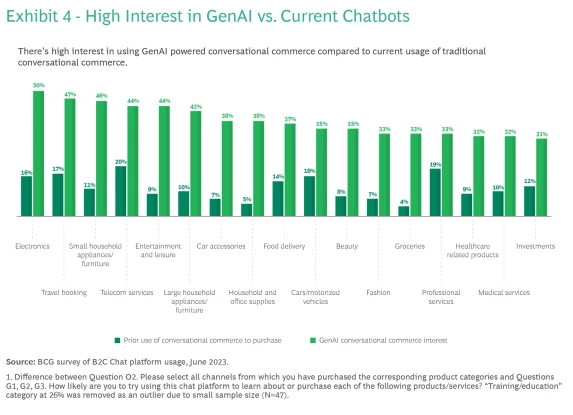
BCG says the rewards are substantial for early adopters harnessing evident consumer enthusiasm for conversational commerce driven by AI (at two to three times higher than interest in traditional conversational commerce).
Source: BCG
There are four aspects to effective generative AI or conversational commerce integration, according to this consultancy company. They are:
Strategy—First articulate the benefits to all stakeholders, then identify customer needs, plan for the future as well as invest in a data foundation.
Technology—Conduct a build vs. buy partner analysis to determine the route to conversational commerce. Aspects to consider include budget, expertise, and capabilities, as well as the language model, platform, customization, ecosystems, and integration. Then, for implementation, data, rules, training, risks, monitoring, and managing are all considerations.
People and processes—BCG says organizations should be “bold” in rethinking processes and functions and that solid change management is critical. Vital aspects are assessing operating models, skill gaps, hiring and training, and assigning new roles. Employees will be trained to manage and interact with technologies, and their roles will become “more strategic and value-adding.”
Governance – The all import risk and risk protection element of AI. BCG says a responsible AI framework begins with “ethical principles, risk taxonomy, and tolerance.” Then comes governance over processes, technology, tools and culture and alignment with company purpose as well as values.
Find out how AI impacts employee roles with What is Human-in-the-Loop (HITL), and Why Does it Matter? and Enhancing Customer Experience with Human-in-the-Loop Strategies in Generative AI to learn more about ensuring the best human-AI collaboration for customer service. Or discover The Future Unveiled: 5 AI-Driven Employment Opportunities Soon to Emerge
Related Resources
These articles expand on how AI is reshaping customer support and the broader service experience.
- AI Support Predictions — A forward-looking take on the biggest ways AI was expected to transform customer support in 2024.
- Generative AI In CX — An overview of how generative AI is improving customer experience through faster, more personalized interactions.
- Future Of Customer Service — A practical look at where AI-powered service is headed and what it means for teams adopting tools like CustomGPT.ai.
Frequently Asked Questions
What is the difference between a rule-based chatbot and a generative AI chatbot?
A rule-based chatbot follows predefined if/then paths, so it works best for narrow, predictable questions. A generative AI chatbot interprets natural-language requests, retrieves relevant information from approved sources, and creates a contextual answer. That makes generative AI better suited to conversational commerce, where shoppers often ask multi-part questions about fit, shipping, returns, or product comparisons instead of following a fixed menu.
Will shoppers actually use a generative AI chatbot?
Yes—if it is fast and genuinely useful. Bill French, Technology Strategist, said, u0022They’ve officially cracked the sub-second barrier, a breakthrough that fundamentally changes the user experience from merely ‘interactive’ to ‘instantaneous’.u0022 Speed matters because older chatbot experiences performed poorly: Gartner found only 8% of customers used a chatbot in their most recent customer service experience, and only 25% said they would use one again. Shoppers are more likely to use conversational AI when it answers buying questions quickly instead of forcing them through a script.
Can generative AI chatbots increase sales outside business hours?
Yes. Online Legal Services Limited reported a 100% sales increase after deploying 24/7 AI customer-service chatbots across 3 legal websites. Mark Keenan, CEO u0026 Founder, said, u0022Custom GPT has allowed us to build a series of AI assistants for our legal businesses at speed without having to build them ourselves at great cost. We now deploy AI customer-service chatbots outside of office hours on 3 websites and have seen a massive increase in leads and sales during these times.u0022 For commerce teams, the takeaway is simple: when buyers can get answers after hours, fewer purchases stall until the next business day.
How do you stop a generative AI chatbot from giving inaccurate answers?
Start by grounding the chatbot in approved sources such as product pages, policy documents, and help content. Then use retrieval-augmented generation so it pulls only relevant passages, and enable citation support so answers can be traced back to source material. Joe Aldeguer, IT Director at the Society of American Florists, said, u0022CustomGPT.ai knowledge source API is specific enough that nothing off-the-shelf comes close. So I built it myself. Kudos to the CustomGPT.ai team for building a platform with the API depth to make this integration possible.u0022 Strong source control is important for accuracy, and the platform also outperformed OpenAI in a RAG accuracy benchmark.
Can generative AI handle complex customer questions without rigid flows?
Yes. Generative AI is built for open-ended questions, so it can respond to layered requests in a customer’s own words instead of forcing every interaction into a decision tree. Stephanie Warlick, Business Consultant, described the value this way: u0022Check out CustomGPT.ai where you can dump all your knowledge to automate proposals, customer inquiries and the knowledge base that exists in your head so your team can execute without you.u0022 In support and commerce, that means you can answer nuanced questions that would otherwise require many rigid branches.
When should you keep rules instead of switching fully to generative AI?
Keep rules when the interaction is narrow, repetitive, and must follow a fixed path. Rule-based chatbots work reasonably well for common questions that can be pre-programmed, while generative AI is better for complex, multi-faceted questions that require context. In practice, many teams keep rules for simple FAQs or fixed workflows and use generative AI for product questions, comparisons, and troubleshooting.