
Artificial intelligence (AI) is reshaping partner marketing agency by giving agencies granular insight into audience behaviour, campaign performance and partner fit.

Make Money With AI
Join our Partner Programs!
Boost your reputation, drive revenue and grow your business with CustomGPT.ai.
Keeping a modern marketing program on track can feel like juggling knives in a windstorm—there are always new channels to learn, fresh content to create, and mountains of data waiting for answers.
Instead of adding more late-night coffee runs to the mix, smart teams are turning to a handful of AI tools that quietly handle the grind.
These tools can draft on-brand copy, whip up scroll-stopping visuals, spot patterns hidden in the numbers, and even chat with customers around the clock using the company’s own knowledge base.
This guide explains how AI is reshaping partner marketing agencies and shows you how to boost ROI.
AI’s Expanding Role in Partner Marketing Agency
Partner programmes succeed when agencies can match the right collaborators to the right audiences at the right moment.
McKinsey’s 2024 Global AI survey notes that organisations embedding generative-AI tools into everyday workflows are already recording measurable bottom-line gains, signalling a clear shift from experimentation to value capture.
Meanwhile, Adobe’s Experience Cloud ecosystem illustrates how large-scale enterprises are operationalising AI across content supply chains.
In one Adobe–Pfizer pilot, AI-assisted workflows cut marketing production time by more than 50 %, underlining how automation frees teams to focus on strategy rather than manual execution.
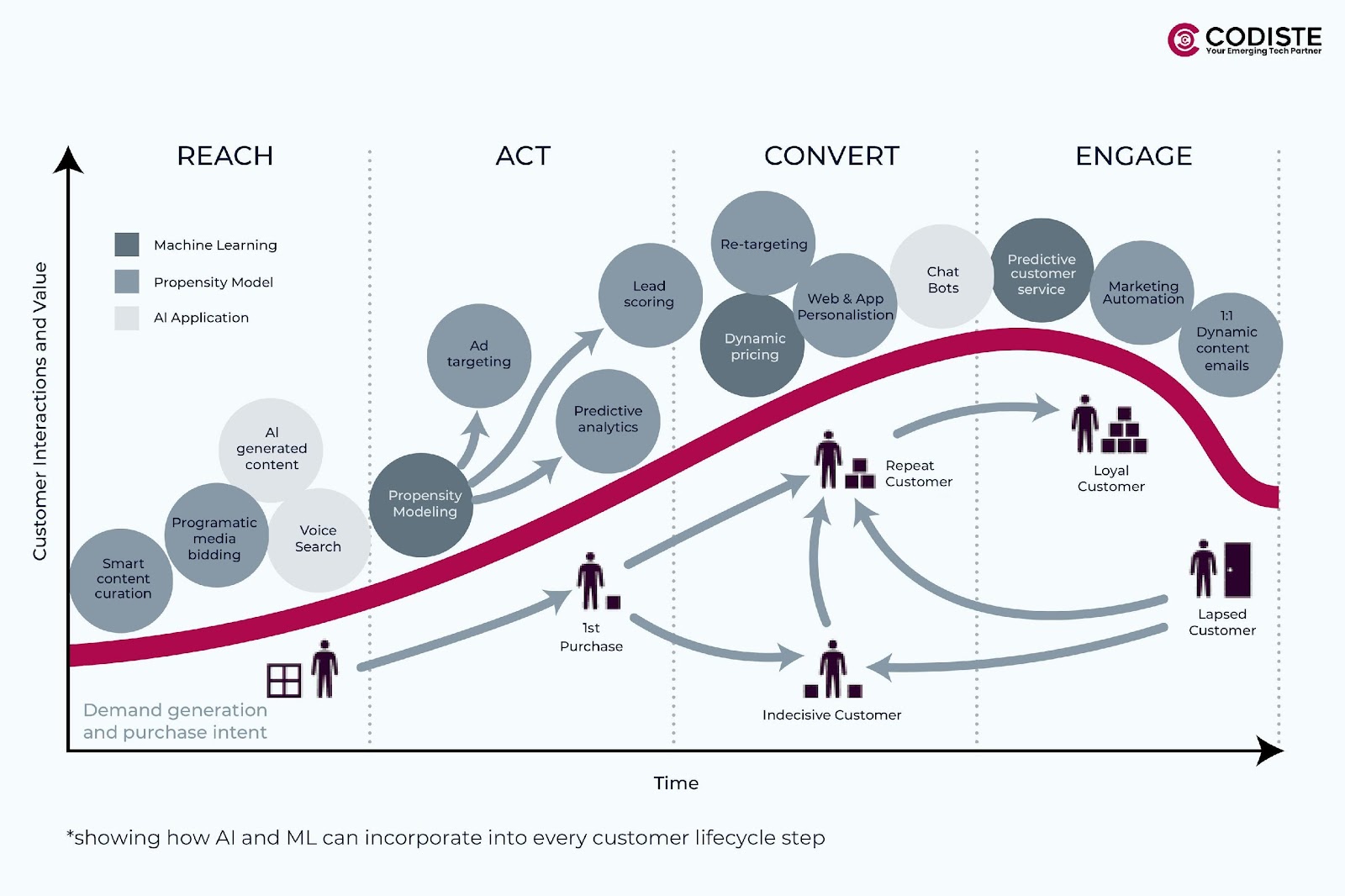
The Undeniable Advantages of Multiple Marketing Channels
Leveraging several channels (email, social, search, mobile, and in-store) lets you meet customers wherever they prefer to browse or buy, strengthening brand presence and revenue resilience.
- Broader reach: Capture shoppers who move fluidly between online and offline touchpoints.
- Higher customer value: Multi-channel buyers purchase more often and have larger lifetime spend.
- Better engagement: Repeated, consistent messaging across platforms reinforces recall and trust.
- Richer data: Diverse interaction signals feed smarter personalization and targeting.
- Risk diversification: If one platform’s costs spike or an algorithm changes, other channels keep performance steady.
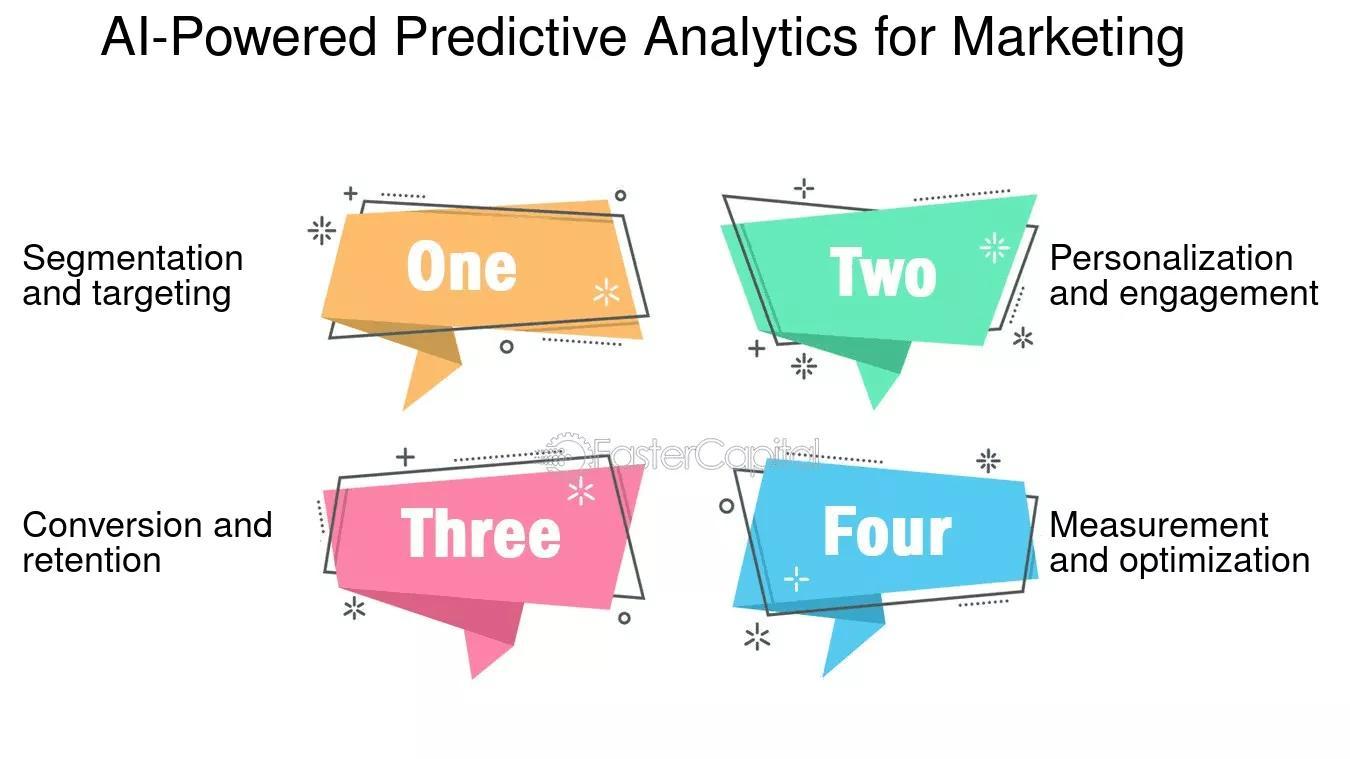
Core AI Technologies Driving Campaign Optimization
A handful of well-proven AI techniques power most modern marketing gains. Each solves a different problem, but together they create a closed loop of prediction, action, and learning.
- Supervised learning: Classifies or predicts outcomes such as conversion likelihood or expected revenue.
- Unsupervised learning: Clusters customers by behavior, uncovering new segments and cross-sell paths.
- Natural-language processing (NLP): Analyzes sentiment, automates chat, and generates persuasive copy.
- Computer vision: Tags creative assets, evaluates visual performance, and supports shoppable images.
- Generative AI: Produces text, graphics, and short video that stay on brand while accelerating production.
- Reinforcement learning: Continuously optimizes bids, budgets, and creative choices based on live feedback.
- Graph algorithms: Maps influencer or partner networks to spot high-value collaboration routes.
| Capability | How it Improves Partner Marketing | Example & Source |
| Predictive analytics | Forecasts partner performance, identifies optimal budget splits and flags early under-performance. | Adobe’s AI agents recommend real-time channel reallocations inside Experience Cloud. |
| Machine-learning segmentation | Clusters audiences by behaviour rather than static demographics, enabling nuanced messaging. | AI-driven segmentation delivers 26 % better ad targeting and 32 % higher conversions across paid channels. |
| Natural-language generation (NLG) | Produces on-brand creative variations at scale, reducing content bottlenecks for multi-channel campaigns. | Generative-AI statistics show 93 % of marketers now rely on AI to speed content creation. |
How AI Enhances Key Aspects of Marketing Campaigns
Artificial intelligence brings speed, precision, and scalability to every stage of a campaign. It uncovers patterns too complex for manual analysis, personalizes experiences in real time, and keeps budgets focused on the highest-value opportunities.
Personalisation and Audience Targeting
Modern multi-channel campaigns must adapt to fragmented consumer journeys. AI solution enables two critical advances:
- Continuous micro-segmentation
Tools such as advanced clustering algorithms update audience cohorts in real time, ensuring each partner message reflects the user’s latest behaviour. The AllAboutAI 2025 benchmark confirms that such adaptive grouping is now the norm for 88 % of marketing teams.
- Dynamic content adaptation
Rather than pre-assigning creative to segments, AI systems monitor signals such as dwell time, scroll depth and recency of purchase to select—or even generate—the most relevant offer at the delivery moment.
When fused with journey orchestration platforms, this approach maintains consistency across email, social, search and partner channels without manual retagging.
Real-Time Campaign Optimisation
AI excels at spotting early indicators of drift—rising costs per lead, declining click-through rates, or shifts in sentiment—then triggering automated adjustments:
- Budget reallocation: Algorithms forecast marginal returns by channel and divert spend to higher-yield placements before waste accumulates.
- Creative iteration: Vision-language models test fresh ad variants against historical engagement benchmarks, accelerating the cycle from insight to launch.
- Partner alignment: Performance dashboards rank partners by contribution to shared goals, enabling agencies to scale high-value collaborations quickly
Because these corrections occur continuously, campaigns run closer to the efficiency frontier than possible with periodic, manual reviews.
Predictive Insights for Partner Selection
Selecting collaborators once depended on reputation and anecdotal fit. Today, predictive scores combine historic campaign metrics, audience overlap, market reach and compliance posture to rank potential partners objectively.
Marketing agencies thus negotiate from a data-driven view of mutual upside, reducing onboarding cycles and post-launch surprises. Many companies now turn to CustomGPT as their partner solution to streamline discovery and comparison of collaborators.
Governance, Privacy and Ethics
AI momentum brings fresh responsibilities:
- Data minimisation and protection: Collect only the attributes necessary for targeting, and apply techniques such as differential privacy or federated learning when sensitive data is involved.
- Explainability: Stakeholders need clear rationales for AI recommendations, especially when partner budgets or brand safety are at stake.
- Bias checks: Regular audits of training data mitigate the risk of systematic exclusion or unfair weighting across partner tiers or audience segments.
Building these controls into the deployment pipeline prevents downstream re-engineering and supports regulatory compliance from day one.
Step-by-Step Framework for AI-Powered Campaign Optimization
For marketing agencies, successful adoption requires a structured approach that aligns data, technology, and governance. Following a clear sequence reduces risk and speeds time to value.
- Define goals and KPIs
Agree on clear targets such as CPA, ROAS, or lead-quality scores.
- Audit and unify data
Merge CRM, web-analytics, ad-platform, and offline datasets; resolve duplicates and secure permissions.
- Select appropriate models
Match each problem to a proven algorithm (e.g., propensity scoring for targeting, reinforcement learning for bidding).
- Train, validate, and document
Split historical data into training and test sets, perform cross-validation, and record assumptions.
- Run a controlled pilot
Launch the AI approach in a limited channel, geography, or audience segment; compare against business-as-usual.
- Deploy at scale with real-time monitoring
Promote successful pilots to broader rollout; set alerts for performance drift or data anomalies.
- Iterate and govern
Schedule regular retraining, bias checks, and stakeholder reviews; feed learnings into future briefs.
Metrics to Measure Success of Campaign Optimization
AI should improve both efficiency and customer value. Tracking a balanced scorecard confirms whether the technology is delivering on its promise.
- Efficiency: Cost per acquisition, cost per lead, customer-acquisition cost.
- Revenue impact: Return on ad spend, overall marketing ROI, incremental lift versus control.
- Engagement: Click-through rate, dwell time, repeat visits.
- Conversion: Funnel completion rate, cart-to-purchase ratio, form-fill rate.
- Model quality: Uplift over control, mean absolute percentage error, area under the curve.
- Customer value: Average order value, lifetime value, churn or retention rate.
- Operational speed: Test-cycle duration, time from insight to decision.
- Data health: Coverage, freshness, and error rate across key fields.
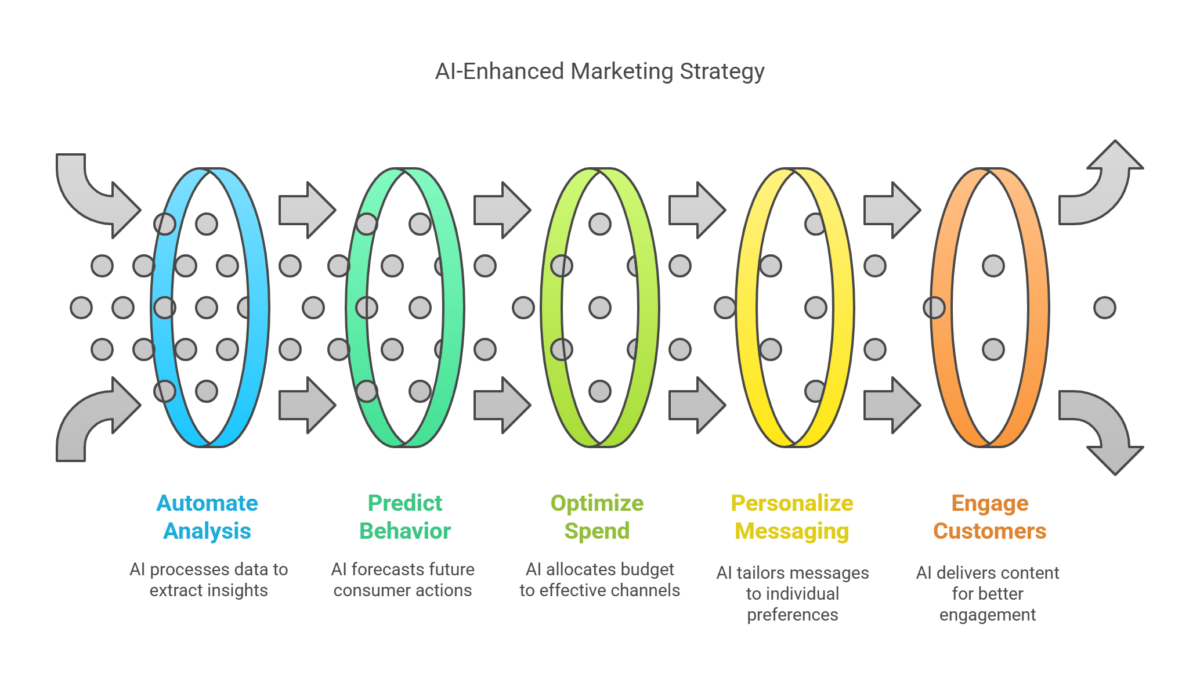
Five Must-Have AI Tools for Modern Marketers
Each platform below brings a distinct capability—content, chat, social, design, AI partner, or all-in-one automation—making them a powerful starter stack for any data-driven team.
1. CustomGPT.ai
A drag-and-drop service that turns your own documents, webpages, and knowledge bases into a private GPT bot you can embed on sites, landing pages, or support portals. Marketers use it to power lead-capture chat widgets, train sales reps on product specs, and even spin up niche affiliate-marketing assistants without writing code.
Why it matters
- Builds brand-specific answers instead of generic web-wide responses
- Connects to 100+ data sources for up-to-date product and campaign info
- Deploys in minutes, keeping budgets light and technical debt low
2. Jasper AI
One of the most widely adopted generative-content platforms, Jasper produces blog posts, ads, landing pages, and email sequences and now offers brand-voice controls, SEO insights, and workflow templates. Its 2025 “State of AI Marketing” study shows rapid expansion from copywriting into full-funnel strategy support.
Why it matters
- Speeds creative production while enforcing message consistency
- Lets teams A/B-test dozens of variants without ballooning costs
- Integrates with CMS and ad managers for one-click publishing
3. HubSpot AI
HubSpot has layered AI across every hub—marketing, sales, service—to suggest email subject lines, score leads, and auto-generate campaign assets. Spring-2025 updates added “Breeze Agents” that recommend next-best actions based on buyer behavior, keeping SMB teams competitive without extra headcount.
Why it matters
- Combines CRM data and AI generation inside a single interface
- Automates tedious tasks like contact deduplication and deal forecasting
- Provides transparent guardrails for ethical content creation
4. Hootsuite OwlyWriter AI
Built into the Hootsuite dashboard, OwlyWriter drafts platform-specific captions, repurposes top-performing posts, and supplies copy formulas (AIDA, WIIFM, HOOK) for ads or landing pages—saving social teams hours per week.
Why it matters
- Generates fresh ideas to combat “creative fatigue” on busy calendars
- Tailors tone, length, and hashtags to each network automatically
- Works within existing Hootsuite workflows, so no new logins required
5. Canva Magic Design / Magic Studio
Canva’s AI suite auto-generates layouts, images, and even short videos from a text prompt, then fine-tunes brand colors and fonts on the fly. A new integration lets you build designs directly inside ChatGPT or other assistants, making it easy to spin up ads or slide decks without leaving your chat window.
Why it matters
- Delivers on-brand visuals in minutes, not days
- Eliminates context switching between copywriting and design tools
- Offers team folders and brand kits to maintain consistency as you scale
Practical Next Steps for Marketing Agencies
- Audit data readiness: Map existing partner, audience and performance data. Address silos, quality gaps and consent permissions before layering on AI.
- Select a high-impact pilot: Focus first on a discrete pain point—e.g., budget reallocation or real-time creative testing—where success metrics are obvious and partner stakeholders are engaged.
- Implement governance early: Establish transparent model-validation criteria, bias-testing protocols and escalation paths.
- Scale via modular architecture: Choose platforms with open APIs so that future AI capabilities (e.g., next-gen NLG or predictive identity resolution) plug in without re-platforming.
- Upskill teams: Pair technical training on AI tools with strategic workshops so marketers understand both the possibilities and the guardrails.
FAQs
How does AI super-charge partner marketing campaigns?
1. Hyper-targeting: AI analyzes partner and customer data to identify high-value segments and look-alike audiences.
2. Real-time optimization: Automated budget shifts and creative adjustments based on live performance signals keep ROI on track.
3. Predictive insights: Forecasting models surface the most promising channel-partner combinations before you invest.
4. Scalable personalization: Dynamic content adaptation tailors offers and messaging per user across every partner touchpoint.
What deliverables can agencies white-label?
1. Chatbots & virtual assistants: Branded, on-site or in-app bots powered by your partner’s knowledge base.
2. Content assets: AI-generated blogs, emails, ad copy, social posts and even short-form video scripts.
3. Dashboards & reports: Custom analytics portals with real-time partner campaign metrics.
4. Interactive tools: Quizzes, calculators, recommendation engines and NLP-driven FAQs.
How are performance fees structured?
1. Revenue-share: Agency earns a percentage of incremental sales or conversions driven by partner campaigns.
2. Tiered bonuses: Higher KPIs (e.g., exceeding target CPA or ROAS) unlock escalating fee rates.
3. Hybrid models: A modest retainer plus a success fee—aligning agency incentives with campaign outcomes.
Which AI use-cases drive the quickest wins?
1. Content generation: Rapidly produce and test multiple headlines, email variants or social captions to find top performers.
2. Intent-based targeting: Leverage AI-driven intent signals (browsing or download behavior) to prioritize high-conversion audiences.
3. Automated reporting: Eliminate manual data pulls and pivot tables with self-updating dashboards that highlight anomalies instantly.
How are privacy & brand-safety concerns addressed?
1. Data minimization: Collect and process only the fields necessary for targeting or modeling.
2. Anonymization & differential privacy: Strip identifiers or inject noise to prevent personal data exposure.
3. Content filters & whitelists: AI-powered moderation ensures partner assets and ad placements align with brand guidelines.
4. Transparent governance: Document model decisions and maintain audit logs so stakeholders can trace recommendations back to compliant data sources.
Conclusion
AI is no longer a speculative add-on for partner marketing; it is rapidly becoming the operating system that underpins multi-channel ROI.
Agencies that pair robust data foundations with disciplined governance are already compressing campaign cycles, deepening partner relationships and outperforming peers on revenue efficiency.
Those that hesitate risk ceding ground as autonomous systems move from pilot to standard practice.
Ready to unlock AI-driven partner marketing success? Explore CustomGPT.ai’s Partner Programs for Agencies.