
RAG AI Systems: The Left Brain and Right Brain of AI
A large language model is a strong writer and a quick thinker. It can draft, summarize, reason, and hold a natural conversation. What it cannot do on its own is know your latest policy, your current pricing, or the exact wording of a contract you signed last week. That gap is why a general-purpose LLM is not enough for enterprise knowledge work, and it is exactly the gap that RAG AI systems close.
Enterprise users do not want a clever guess. They want an answer grounded in internal documentation, policies, support articles, product manuals, contracts, and reports, with a source they can check. This guide explains how RAG AI systems deliver that, using a simple left-brain and right-brain analogy to make the idea clear for both technical and non-technical readers.
Direct Answer: What Are RAG AI Systems?
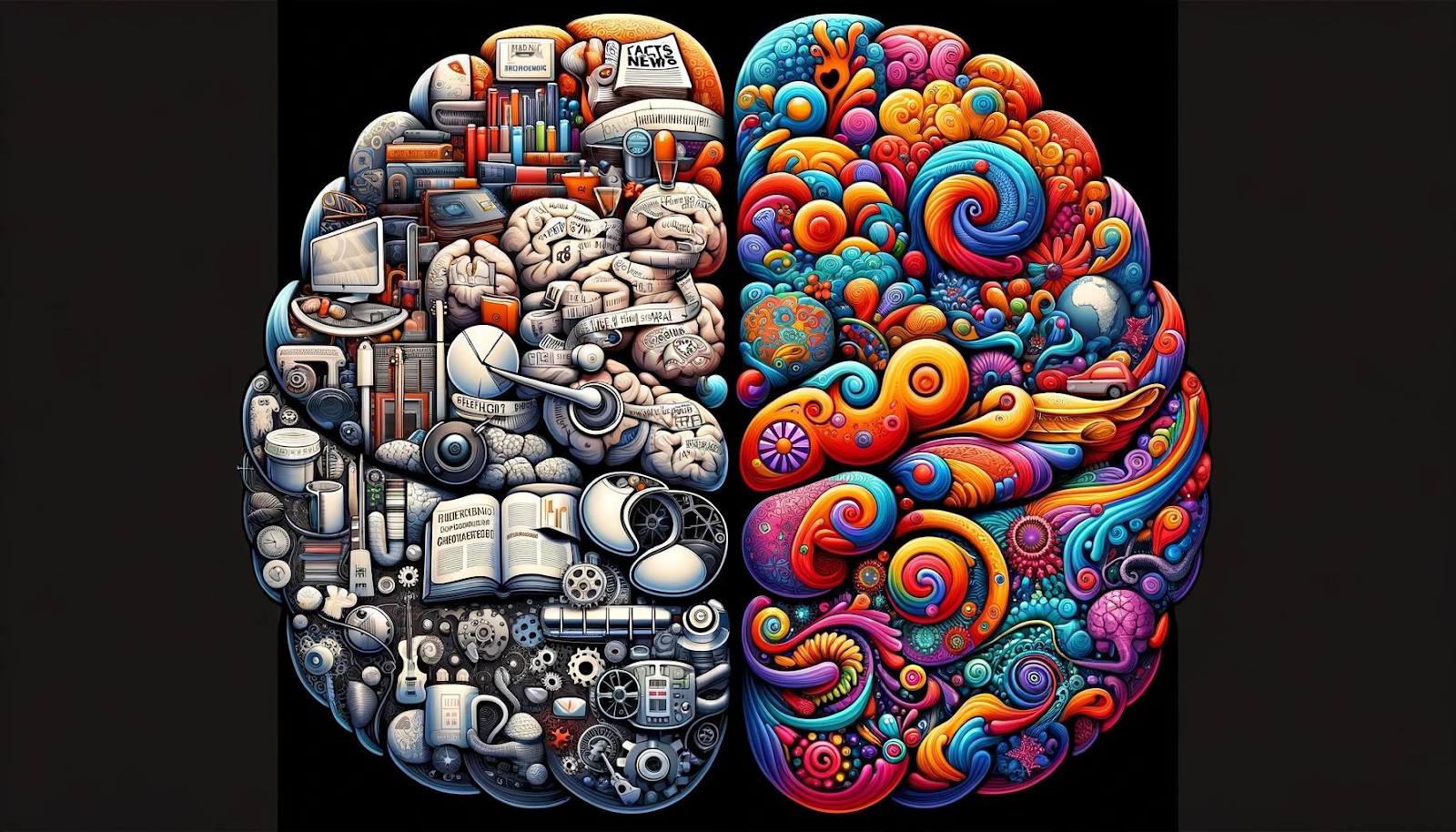
RAG AI systems combine the creative language ability of large language models with the factual grounding of retrieval. In a left-brain and right-brain analogy, the LLM acts like the right brain by generating natural, fluent answers, while retrieval acts like the left brain by supplying trusted facts, documents, and citations. Instead of relying only on model memory, a RAG AI system retrieves relevant content from your own knowledge sources first, then generates an answer grounded in that content, often with citations back to the source. This makes RAG AI systems well suited to enterprise knowledge assistants, customer support, compliance, education, legal, associations, and other workflows where answers must be accurate and verifiable.
The Left Brain / Right Brain Analogy for RAG AI Systems
The popular idea that people are strictly left-brained or right-brained is a myth, not neuroscience. As a plain metaphor for how AI systems work, though, it is genuinely useful. Treat it as a mental model, not a scientific claim.
The right brain, in this analogy, is the LLM: language, reasoning, synthesis, and conversation. It is fluent and creative, and it can explain things in natural language. Left on its own, it can also sound confident while being wrong.
The left brain, in this analogy, is retrieval: facts, sources, verification, documents, and permissions. It does not write elegant prose, but it knows exactly which policy applies and where the answer came from.
RAG is the bridge between the two. It gives the LLM access to the right knowledge before it answers, so the fluent right-brain response is anchored to left-brain facts. The result is an AI system that reasons well and stays grounded.
| AI System Layer | Role in the Analogy | What It Does | Why It Matters |
|---|---|---|---|
| LLM generation | Right brain | Reasons, summarizes, and writes fluent natural-language answers | Turns retrieved facts into a clear, usable response |
| Retrieval layer | Left brain | Finds relevant content from trusted knowledge sources | Supplies the facts the answer is built on |
| Vector search | Left brain | Matches meaning using embeddings | Captures semantically related content, not just keywords |
| Keyword search | Left brain | Matches exact terms, IDs, and names | Handles policies, SKUs, dates, and legal phrasing precisely |
| Hybrid search | Left brain | Combines keyword and vector retrieval | Balances exact precision with semantic recall |
| Reranking | Left brain | Orders retrieved results by relevance | Ensures the strongest evidence reaches the model |
| Citation layer | Left brain | Attaches sources to each answer | Lets users verify and trust the response |
| Guardrails | Bridge between both sides | Limits answers unsupported by retrieved content | Keeps creative generation anchored to facts |
| Analytics and evaluation | Feedback for both sides | Measures accuracy, gaps, and usage | Drives continuous improvement over time |
| Managed RAG platform | The nervous system connecting both | Runs ingestion, retrieval, generation, and deployment | Delivers the full system without a from-scratch build |
What Is a RAG AI System?
RAG stands for Retrieval-Augmented Generation. A RAG AI system retrieves trusted content before generating an answer, rather than answering from model memory alone.
In practice, a RAG AI system:
- Retrieves relevant content from your trusted knowledge sources
- Can use vector search, keyword search, hybrid search, metadata filtering, and reranking
- Sends the most relevant context to the LLM
- Generates an answer grounded in that retrieved content
- Can cite the specific sources behind the answer
- Can reduce hallucinations when retrieval and grounding are done well
This is different from plain semantic search, which returns documents rather than answers, a distinction covered in RAG vs vector search. Major vendors describe the same retrieval-then-generate pattern, including IBM, AWS, and NVIDIA. For a full foundation, see the complete guide to RAG, the components of a RAG system, and the common RAG architecture patterns.
Why LLMs Alone Are Not Enough for Enterprise Knowledge
A general LLM is trained on public data up to a point in time. That creates real limits for business use:
- It may not know your private company information at all
- It may not know your latest documents, prices, or policies
- It can produce confident answers that are not supported by any source
- Business users need answers they can verify against a document
- Regulated workflows require traceability back to the original text
- Knowledge changes over time, and static model memory goes stale
- Company-specific answers require company-specific content
Retrieval solves these by grounding answers in your current content instead of the model’s training memory. The difference between a model recalling training data and reasoning over retrieved facts is explored in LLM reasoning vs memorization, and the trade-off of simply pasting everything into a giant prompt is covered in long context windows vs RAG.
How a RAG AI System Works
A RAG AI system follows a simple flow from question to grounded answer:
User asks a question
  -> System retrieves relevant trusted content
  -> Retrieval results are filtered and reranked
  -> LLM receives grounded context
  -> LLM generates an answer
  -> System attaches citations
  -> User receives a source-cited response
The quality of the final answer depends heavily on the middle steps. Good retrieval and reranking decide what evidence the model sees, and the citation step is what turns a plausible answer into a verifiable one.
RAG AI Systems vs Traditional and General LLM Chatbots
| Feature | Traditional Chatbot | General LLM Chatbot | RAG AI System |
|---|---|---|---|
| Knowledge source | Scripted rules and intents | Model training data | Your trusted content plus the model |
| Answer style | Fixed, menu-like replies | Fluent but ungrounded | Fluent and grounded in sources |
| Source citations | None | Rarely, and often invented | Yes, tied to retrieved content |
| Ability to use company content | Very limited | Limited without retrieval | Core strength of the system |
| Hallucination risk | Low but rigid | Higher without grounding | Lower when retrieval is strong |
| Enterprise trust | Low for complex questions | Mixed without verification | Higher through citations and control |
| Best use case | Simple, predictable flows | General writing and brainstorming | Knowledge answers from your own data |
| Maintenance | Manual rule updates | Prompt tuning only | Update content, not the model |
| Scalability | Hard to scale rules | Scales as a generic tool | Scales with your growing knowledge base |
Benefits of RAG AI Systems
- More accurate answers drawn from trusted content
- Source citations that let users verify each answer
- Stronger enterprise trust in AI responses
- Reduced support burden through accurate self-service
- Better customer and employee self-service experiences
- Faster access to knowledge that would otherwise be buried
- Useful for private and internal content the model was never trained on
- Easier to update knowledge by changing content, not retraining a model
- A better fit for compliance-sensitive workflows that need traceability
- A stronger foundation for AI knowledge base chatbots and assistants
Limitations of RAG AI Systems
RAG is powerful, but it is not automatic. Its accuracy depends on doing the work well:
- Retrieval quality matters, since a wrong document leads to a wrong answer
- Poor or messy source documents create poor answers
- Chunking and metadata choices directly affect accuracy
- The system still needs monitoring and evaluation after launch
- Latency can be higher than a simple chatbot because of retrieval and generation
- Building RAG from scratch can be expensive and time-consuming
- Permissions and security must be handled carefully in multi-user settings
Why the Best RAG AI Systems Use Hybrid Retrieval
Vector search alone can miss exact terms, and keyword search alone can miss meaning. The best RAG AI systems combine both:
- Vector search captures semantic meaning and paraphrased questions
- Keyword search captures exact names, IDs, policies, SKUs, legal terms, and dates
- Metadata filtering narrows answers by product, region, department, or permission
- Reranking pushes the most relevant evidence to the top
- Citations give users a source to trust and verify
This hybrid approach is why enterprise-grade retrieval tends to outperform single-method search. The full method is detailed in hybrid keyword and vector search for better accuracy, and the embeddings and indexing behind it are documented in the OpenAI embeddings guide, the Pinecone vector database learning center, and Google Vertex AI Vector Search.
Where RAG AI Systems Deliver the Most Value
| Use Case | Why RAG Helps | Example Outcome |
|---|---|---|
| Customer support | Answers from current help content instead of guesses | Fewer tickets through accurate self-service |
| Internal knowledge base | Employees get grounded answers from company documents | Faster onboarding and less repeated questions |
| Compliance assistant | Answers stay traceable to the source policy | Lower risk from unsupported guidance |
| Legal document Q&A | Retrieves exact clauses across many documents | Faster review with citations to the contract |
| Association member knowledge | Members query gated standards and resources, as in AI for associations | Higher member value from existing content |
| Education or non-profit support | Grounded answers from course and program material, echoed in AI for non-profits | Round-the-clock help without added staff |
| SaaS documentation assistant | Handles exact API names and semantic questions | Users solve problems without waiting on support |
| Government or public-service chatbot | Secure answers from official information | Faster resident service at lower cost |
| HR policy assistant | Retrieves the correct policy by region and role | Consistent answers employees can trust |
| Product knowledge assistant | Grounds answers in current specs and manuals | Accurate product guidance at scale |
How CustomGPT.ai Helps Teams Build RAG AI Systems
CustomGPT.ai is a managed RAG platform, not just a chatbot tool. It runs the retrieval-and-generation pipeline so teams can focus on their content and their users. With the platform, teams can:
- Upload or connect trusted business content
- Create AI assistants trained on their own company knowledge
- Generate source-cited answers users can verify
- Deploy website chatbots for customers and visitors
- Support internal knowledge assistants for employees
- Deflect repetitive support questions, as covered in ticket deflection
- Set everything up with a no-code workflow
- Retrieve enterprise knowledge securely, backed by SOC 2 Type 2 certification
- Use analytics for continuous improvement
- Run managed RAG infrastructure without building it from scratch
Teams that need stricter control can review options like multi-tenant RAG for secure AI assistants and private cloud or on-prem deployment. For the underlying approach, see custom RAG solutions and custom RAG.
Should You Build a RAG AI System or Use a Managed Platform?
Building your own RAG AI system gives full control, and it can be the right choice for teams with dedicated AI engineering resources. Those teams take ownership of ingestion, parsing, chunking, embeddings, retrieval, reranking, prompts, citations, evaluation, security, deployment, and monitoring, and they maintain all of it over time. The engineering reality is covered in building production RAG pipelines and implementing RAG.
A managed platform reduces time to value by handling that pipeline for you. For many teams, that is the difference between shipping a reliable assistant this quarter and staffing a long build. CustomGPT.ai is a strong fit for teams that want secure, source-cited AI assistants without building the full RAG stack themselves. The full trade-off is laid out in this RAG build vs buy guide. Microsoft’s Azure AI Search RAG overview describes similar managed-retrieval building blocks.
Real-World Examples of RAG AI Systems in Action
These CustomGPT.ai deployments show how RAG AI systems turn trusted content into direct, useful, source-grounded answers.
- GEMA, one of the world’s largest music rights societies, resolved 248,000+ queries, saved 6,000+ working hours, reached an 88% success rate, and estimated cost avoidance of roughly 182,000 to 211,000 euros. Read the GEMA case study.
- Bernalillo County handled 114,836 AI contacts at about $0.99 per AI contact versus $4.59 for a staff-assisted contact, reaching 4.81x ROI and an estimated $108,143.75 in net savings. Read the Bernalillo County case study.
- BQE Software answered 180,000 support questions, reached an 86% AI resolution rate, and had 64% of help center queries handled by AI. Read the BQE Software case study.
- MIT’s Martin Trust Center built ChatMTC, a no-code AI knowledge assistant offering 24/7 access in 90+ languages with grounded, source-based answers. Read the MIT ChatMTC case study.
In each case, the value came from grounding: the system answered from trusted content and pointed to the source, rather than guessing from model memory.
Four Practical Examples
Example 1: Subscription cancellation
A customer asks, “How do I cancel my subscription?” A general LLM may guess at the steps. A RAG AI system retrieves the current cancellation policy and gives a cited answer.
Example 2: Regional HR policy
An employee asks, “What is the parental leave policy in Germany?” A RAG AI system retrieves the correct HR policy by region and answers with sources.
Example 3: Association standards
A member of an association asks, “What does this standard say about certification renewal?” A RAG AI system searches the association’s gated knowledge base and returns a grounded answer.
Example 4: Support documentation
A support team asks, “Which article explains API rate limits?” A RAG AI system finds the relevant documentation and summarizes the answer with a link to the source.
This same left-brain/right-brain pairing appears in compliance AI automation, where retrieval grounds the answer and generation turns the evidence into usable guidance.
Frequently Asked Questions
What are RAG AI systems?
RAG AI systems are AI systems that retrieve trusted content before generating an answer. They combine an LLM’s language ability with retrieval from your own knowledge sources, producing grounded, often source-cited answers instead of relying on model memory alone.
How does RAG make AI systems more accurate?
RAG grounds each answer in retrieved content from trusted sources rather than the model’s training memory. By supplying the right facts before generation and citing them, it reduces guesswork and gives users a source they can verify.
What does the left brain/right brain analogy mean for RAG?
It is a simple metaphor, not neuroscience. The LLM is like the right brain, handling language and reasoning, while retrieval is like the left brain, supplying facts and sources. RAG bridges the two so answers are both fluent and grounded.
Is RAG better than a general LLM chatbot?
For questions about your own content, yes. A general LLM chatbot answers from training data and can sound confident while being wrong. A RAG AI system answers from your current documents and can cite the source, which matters for enterprise trust.
Why do businesses need RAG instead of only an LLM?
An LLM does not know your private, current, or company-specific information and cannot verify its own answers. RAG retrieves that information from your trusted content, so answers reflect your real policies, products, and documents.
Does RAG reduce hallucinations?
It can, when implemented well. Grounding answers in retrieved sources, reranking for relevance, and applying guardrails all reduce unsupported answers. Weak retrieval or loose grounding can still allow errors, so evaluation matters.
What is the difference between RAG and vector search?
Vector search is a retrieval method that finds semantically similar content. RAG is a full system that retrieves content, often using vector or hybrid search, then generates a grounded answer from it. Vector search finds content; RAG produces the answer.
What content can a RAG AI system use?
It can use documents, help center articles, product manuals, policies, contracts, reports, PDFs, and other trusted sources you provide. The system indexes that content so answers stay grounded in your own knowledge.
What are the limitations of RAG AI systems?
Accuracy depends on retrieval quality, document preparation, chunking, and metadata. RAG also needs monitoring and evaluation, can add latency, requires careful permissions, and can be costly to build entirely from scratch.
Should enterprises build or buy RAG AI systems?
Building gives control but requires engineering resources to create and maintain the full pipeline. Buying a managed platform reduces time to value and is often the better fit for teams that want secure, source-cited assistants without owning the stack.
How does CustomGPT.ai support RAG AI systems?
CustomGPT.ai is a managed RAG platform that handles ingestion, retrieval, citations, permissions, analytics, and deployment. Teams upload or connect content and build secure, source-cited AI assistants for support, internal knowledge, and enterprise search.
What industries benefit most from RAG AI systems?
Knowledge-heavy and regulated fields benefit most, including customer support, compliance, legal, education, associations, SaaS, government, and healthcare, where accurate, verifiable answers from trusted content are essential.
Build a Source-Cited RAG AI System with CustomGPT.ai
If you need an AI assistant that answers from your own knowledge rather than guesses, CustomGPT.ai gives you a managed platform built for enterprise knowledge retrieval. With it, you can:
- Turn trusted content into an AI assistant
- Give users direct answers with citations they can verify
- Reduce support burden through accurate self-service
- Improve customer and employee access to knowledge
- Deploy without building RAG infrastructure from scratch
- Rely on a managed platform designed for secure, source-cited answers
Start building your source-cited RAG AI system with CustomGPT.ai.