

Indeed, the adoption of RAG-based solutions is on the rise as businesses recognize the profound impact it can have on the accuracy and reliability of AI applications. However, when it comes to implementing RAG, organizations are faced with a crucial decision, should they build RAG from scratch or opt for pre-built solutions that offer RAG integration out of the box?
In our previous blog posts, we explained RAG and how to build RAG and implement the RAG framework into AI applications and its benefits in various industries. Now in this blog post, we will explain the considerations associated with each approach, exploring the advantages and challenges of building RAG versus buying pre-built solutions such as CustomGPT.ai. By weighing these factors, businesses can make informed decisions that align with their strategic goals and resource constraints.
Building RAG Programmatically
Building RAG (Retrieval-Augmented Generation) programmatically involves a systematic approach that requires the utilization of various resources and tools, as well as a deep understanding of natural language processing (NLP) principles. Let’s explore the key components and steps involved in programming RAG into applications, along with the associated challenges:
Resources and Tools Required
Before building RAG following resources are required:
- NLP Libraries/Frameworks: You have to install the programming environment and utilize libraries such as Hugging Face’s Transformers, OpenAI’s GPT (Generative Pre-trained Transformer), or Google’s BERT (Bidirectional Encoder Representations from Transformers) to leverage pre-trained models for language understanding and generation.
- Data Sources: A large number of datasets are required that will be used for training and fine-tuning the RAG model. This may include text corpora, domain-specific documents, or publicly available knowledge repositories.
- Computing Resources: Depending on the scale and complexity of the RAG model, you have access to sufficient computational resources, such as GPUs or TPUs, which may be necessary for training and inference tasks.
Steps Involved in Programming RAG
Building a RAG framework includes the following steps:
- Data Preprocessing: Clean and preprocess the raw text data, including tasks such as tokenization, sentence segmentation, and normalization, to prepare it for training the RAG model.
- Model Training: Fine-tune the pre-trained language model using the collected data to adapt it to the specific context and requirements of the application. This involves training the model on relevant tasks, such as passage retrieval and response generation.
- Integration into Applications: Integrate the trained RAG model into the target application or platform, ensuring seamless interaction and compatibility with existing systems.
- Testing and Validation: Thoroughly test the implemented RAG system to validate its performance, accuracy, and reliability across different use cases and scenarios.
Challenges and Considerations
The following are the challenges associated with building RAG from scratch:
- Expertise Requirement: Building RAG programmatically requires expertise in NLP, machine learning, and software development, which may pose challenges in terms of skill availability and training.
- Development Time: Building RAG involves an iterative process of data collection, preprocessing, model training, evaluation, and refinement. Each iteration may require significant time and effort to achieve satisfactory results.
- Complexity of Tasks: Training RAG models for tasks such as passage retrieval and response generation can be complex, requiring meticulous tuning of hyperparameters and model architectures.
- Data Management: Managing and curating the data used for training and fine-tuning RAG models requires ongoing efforts to ensure data quality, relevance, and integrity.
- Resource Intensiveness: Training and deploying RAG models require significant computational resources, including high-performance hardware and storage infrastructure.
- Maintenance and Updates: Continuous maintenance and updates are necessary to keep the RAG model up-to-date with evolving language patterns and domain-specific knowledge.
- Cost Considerations: Acquiring and maintaining the necessary hardware infrastructure can incur significant costs, especially for organizations with budget constraints.
Overall, while building RAG programmatically offers flexibility and control, it requires substantial expertise, resources, and time commitment. Organizations must carefully weigh these factors against their strategic objectives and resource constraints before embarking on the journey of in-house RAG development.
Buying RAG: CutomGPT with build in RAG solution
Purchasing pre-built RAG solutions like CustomGPT offers several advantages over building RAG programmatically.

Here’s an overview of CustomGPT.ai and its RAG capabilities, along with the benefits, ease of use, accessibility, and cost considerations associated with buying CustomGPT.ai:
Overview of CustomGPT.ai and its RAG Capabilities
- CustomGPT.ai is an AI-powered platform that incorporates advanced Retrieval-Augmented Generation (RAG) technology.
- RAG in CustomGPT.ai enhances the AI’s ability to generate responses by leveraging external knowledge sources, ensuring that the generated content is contextually relevant and grounded in real-world information.
- CustomGPT.ai offers a user-friendly interface and comprehensive features for creating, training, and deploying AI-powered chatbots and content generation systems.
Steps for creating a RAG based Chatbot with CustomGPT.ai
Here are the steps for creating a RAG-based chatbot with CustomGPT.ai:
- Begin by signing up for an account on the CustomGPT.ai platform.
- Define the objectives and goals of your chatbot. Determine the purpose it will serve and the audience it will interact with.
- Now gather the data you want your chatbot to build on.
- Login to your account and click on Dashboard.
- Click on Create New Agent.

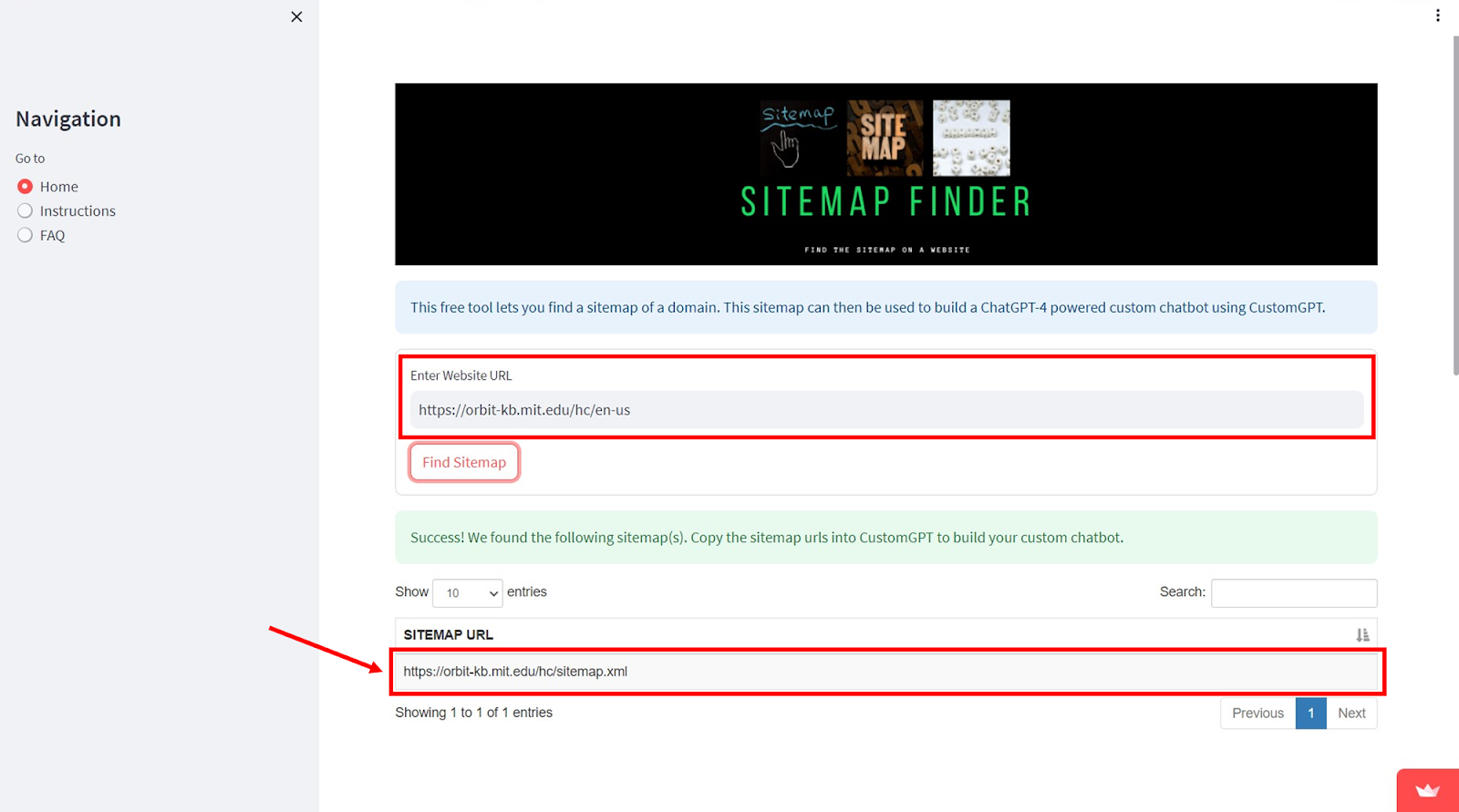
- Insert a Sitemap or website URL. Use this CustomGPT tool to generate a sitemap.

- Add File to an existing project Through Upload Doc. Go to ‘My Agents’ –> Click on ‘Data’. Click on Upload Button —> Click on Upload Files

- .You can create a chatbot based on your website content by creating a sitemap of the whole website. For creating a sitemap use the free sitemap tool offered by CustomGPT.ai. Place the link to the website. The tool will generate the sitemap within seconds.
These were the steps for creating a Chatbot on external data sources in minutes with CustomGPT.ai.
Benefits of buying pre-built RAG solutions like CustomGPT.ai
Benefits of buying pre-built RAG solutions like CustomGPT.ai include:
- Ease of Use: CustomGPT.ai offers a user-friendly interface where users can simply upload datasets. The platform seamlessly links the chatbot to external data sources without the need for coding or technical expertise.
- No Resources and Data Management Required: With CustomGPT.ai, organizations can skip the complexities of managing resources and data. The platform handles all data ingestion and management tasks, freeing up valuable time and resources.
- No Training and Fine-Tuning Required: Unlike building RAG from scratch, CustomGPT.ai comes pre-trained and optimized. Users can deploy the chatbot immediately without the need for time-consuming training or fine-tuning processes.
- No Computational Resources and Machine Learning Experts Required: CustomGPT.ai eliminates the need for extensive computational resources and machine learning expertise. The platform handles all the computational heavy lifting, allowing users to focus on leveraging the AI capabilities without worrying about infrastructure or specialized skills.
- Cost-Effective Pricing Plans: CustomGPT.ai offers cost-effective pricing plans tailored to different organizational needs. Users can choose a plan that fits their budget and requirements, ensuring maximum value for their investment.
- Ready-to-Use Solutions: With CustomGPT.ai, organizations get ready-to-use solutions that are immediately deployable. There’s no need to wait for development cycles or spend time configuring and customizing the system.
- Fast and Efficient: CustomGPT.ai streamlines the content creation process, delivering fast and efficient results. The AI-powered chatbots generated with CustomGPT.ai are capable of providing contextually relevant responses in real time, enhancing user engagement and satisfaction.
Comparison and Insights: Building RAG vs Buying RAG
This comparison provides a concise analysis of the pros and cons of building RAG versus buying a pre-built solution like CustomGPT.ai.
| Aspects | Building RAG | Buying RAG |
| Control and customization | Complete control over customization | Limited customization options |
| Cost savings | Potential cost savings in the long term | Cost-effectiveness through subscription |
| Tailored solutions | Tailored solutions to specific needs | Ready-to-use solutions |
| Technical expertise | Requires specialized expertise | No technical expertise or coding required |
| Resource and data management | Extensive time and resources required | No resources and data management required |
| Training and fine-tuning | Extensive training and fine-tuning required | No training and fine-tuning required |
| Computational resources | High computational resources required | High computational resources required |
| Upfront development costs | High upfront development costs | No upfront development costs |
| Time and resources | Extensive time and resources required | Immediate access and scalability |
| Flexibility and scalability | Limited flexibility and scalability | Scalability and ease of use |
Conclusion
In summary, the comparison between building and buying RAG solutions underscores the advantages of opting for pre-built options like CustomGPT.ai. For organizations seeking efficiency, accessibility, and cost-effectiveness, purchasing a ready-made RAG solution proves highly advantageous. With no need for extensive expertise or investment in resources, buying RAG streamlines the implementation process, providing immediate access to advanced AI capabilities. In an evolving business marketplace, the convenience and effectiveness of buying RAG solutions can position a business as a valuable asset for driving innovation and achieving strategic objectives.
Frequently Asked Questions
Should you build a RAG system in-house or buy a pre-built platform?
It depends on your goals and resources. Building in-house can offer more control, while buying a pre-built RAG platform can reduce implementation effort by providing RAG integration out of the box. A practical choice comes from matching the approach to your strategic priorities and team capacity.
What does building a RAG system programmatically require?
Building RAG programmatically requires a systematic approach, multiple tools and resources, and strong natural language processing (NLP) understanding. This typically means the work is technically involved and should be planned as an engineering initiative rather than a quick setup.
Why are businesses adopting RAG-based solutions?
Businesses are adopting RAG because it can improve the accuracy and reliability of AI applications. That is a key reason teams evaluate whether to build their own RAG system or use a pre-built solution.
What is the main benefit of buying a pre-built RAG solution?
The main benefit is faster access to RAG capabilities through out-of-the-box integration. This can lower setup burden compared with starting from scratch, especially for teams with limited resources.
What trade-offs should you compare in a build-vs-buy RAG decision?
Compare the advantages and challenges of each path against your strategic goals and resource constraints. In practice, the decision is a balance between customization needs and implementation complexity.
How can teams make a more informed RAG build-vs-buy decision?
Use a structured evaluation: define business goals, assess available technical resources, and map those constraints to either building in-house or adopting a pre-built platform. This helps ensure the final choice aligns with both strategy and execution capacity.