

AI project management for agencies is no longer a niche skill—it’s a core capability for teams delivering AI-driven solutions to clients.

Make Money With AI
Join our Partner Programs!
Boost your reputation, drive revenue and grow your business with CustomGPT.ai.
Managing these projects successfully requires balancing technical complexity with clear timelines, defined outcomes, and client confidence.
As agencies take on more AI-powered work, project managers must turn abstract models and automation into tangible business value.
This guide explores how to plan, execute, and scale AI projects smoothly while keeping stakeholders aligned and expectations firmly under control.
Shifting Traditional Agency Workflows for AI Projects
AI projects don’t fit neatly into the linear workflows most marketing agencies are used to managing. Unlike campaign launches or website builds, AI work evolves continuously, making flexibility and iteration essential parts of delivery.
For effective AI project management for agencies, project managers must adapt existing processes to handle experimentation, changing data inputs, and evolving client expectations.
This starts by rethinking how projects are scoped, planned, and reviewed across their lifecycle.
From Linear Timelines to Iterative Planning
AI initiatives rarely succeed with fixed scopes and rigid deadlines. Project managers need to embrace phased planning that allows learning and refinement as models are tested and data quality improves.
Why iterative planning works better for AI projects
- Allows room for experimentation without constant scope creep
- Supports faster validation of assumptions and early feedback
- Reduces risk by identifying issues before full-scale deployment
By shifting to iterative planning, agencies can deliver progress consistently while maintaining flexibility.
Redefining Discovery and Scoping for AI Work
Discovery for AI projects goes beyond client goals and timelines—it must include data readiness, integration constraints, and success metrics. A stronger upfront scoping phase sets realistic expectations and prevents downstream delays.
Key elements to include in AI project discovery
- Data availability, quality, and ownership
- Model complexity and automation requirements
- Clear definitions of success tied to business outcomes
A more detailed discovery phase creates alignment and protects both the agency and the client.
Estimation in AI Projects Requires Built-In Uncertainty
Traditional time-and-cost estimation methods often fall short for AI initiatives. Unknowns around data quality, model performance, and iteration cycles must be accounted for early.
| Estimation Area | Traditional Projects | AI Projects |
| Scope stability | High | Variable |
| Testing cycles | Limited | Ongoing |
| Timeline risk | Predictable | Moderate–High |
Planning with buffers and phased estimates helps agencies stay profitable while remaining transparent.
Aligning Internal Teams Around AI Delivery
AI projects often involve cross-functional collaboration between strategists, data specialists, developers, and client teams. Clear ownership and communication structures are critical to avoid bottlenecks.
Best practices for internal alignment
- Define clear roles across technical and non-technical teams
- Establish regular review checkpoints tied to iterations
- Centralize documentation and decisions
When teams are aligned around how AI work actually unfolds, delivery becomes smoother and more predictable.

Image source: linkedin.com
Setting Clear Client Expectations for AI Projects
Client expectations can make or break an AI project, especially when outcomes are probabilistic rather than guaranteed. Project managers must proactively educate clients on how AI differs from traditional marketing deliverables and why iteration is part of success.
Strong expectation-setting builds trust and supports smoother AI delivery for AI marketing agencies by reducing friction when timelines shift or models need refinement. This begins with transparent communication from kickoff through post-launch.
Explaining AI Outcomes in Business Terms
Clients often expect AI to deliver instant, perfect results. Project managers need to reframe AI outcomes as improvements over time rather than one-time deliverables.
How to communicate AI value clearly
- Focus on trends, efficiency gains, and performance lift
- Set benchmarks instead of promising fixed results
- Tie model improvements to real business KPIs
When clients understand progress as measurable improvement, conversations stay constructive. By anchoring discussions in business value, agencies can avoid unrealistic expectations.
Defining Success Metrics Early
AI success is ambiguous without clearly defined metrics. Establishing these upfront helps align internal teams and clients on what “working” actually means.
| Metric Type | Example |
| Performance | Accuracy, response quality, conversion lift |
| Efficiency | Time saved, automation rate |
| Business impact | Revenue influence, cost reduction |
Clear metrics reduce subjectivity and give clients confidence in the project’s direction.
Managing Change Without Scope Creep
AI projects naturally evolve, but unmanaged change can derail timelines and budgets. Project managers must distinguish between productive iteration and uncontrolled scope expansion.
Ways to control AI scope effectively
- Separate core functionality from enhancement phases
- Use change logs tied to business value
- Revisit scope at predefined iteration points
This approach protects margins while still allowing innovation. Structured change management keeps projects flexible without becoming chaotic.
Building Client Confidence Through Regular Updates
Silence creates uncertainty, especially in technically complex projects. Frequent, structured updates reassure clients that progress is happening—even when outcomes are still evolving.
Effective AI project updates include
- What was tested and learned
- What changed and why
- What comes next
Consistent communication reinforces trust and positions the agency as a strategic partner, not just a vendor.
Structuring Teams and Roles for AI Project Success
AI projects introduce new responsibilities that don’t always align with traditional agency roles. Without clear ownership, tasks can stall between strategy, data, and execution teams.
For scalable AI implementation in agencies, project managers must define roles early and ensure collaboration flows smoothly across disciplines. This clarity keeps momentum high and accountability intact.
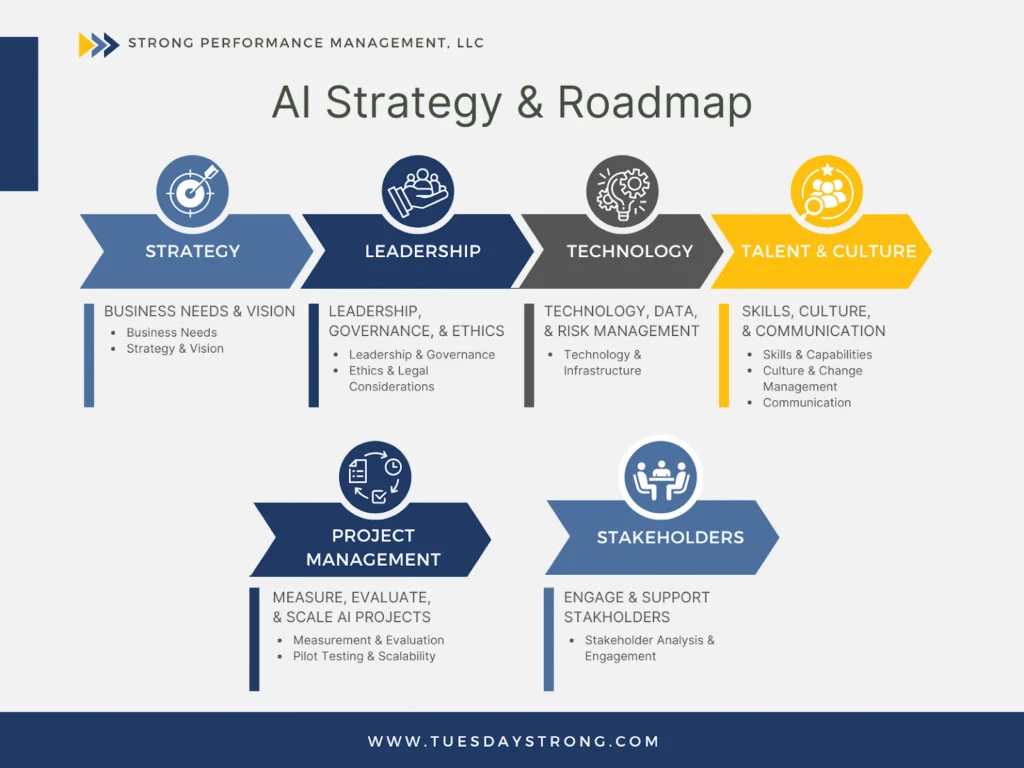
Image source: tuesdaystrong.com
Clarifying Ownership Across AI Workstreams
AI initiatives often involve overlapping responsibilities, which can slow decision-making. Assigning clear ownership ensures progress doesn’t get stuck in handoffs.
Key AI project roles to define
- Project manager as delivery and communication lead
- Technical lead responsible for model and integrations
- Client stakeholder for approvals and priorities
Clear ownership reduces friction and speeds up delivery.
Balancing Technical and Non-Technical Teams
Marketing agencies often blend creative, strategic, and technical talent. AI projects require tighter coordination between these groups to translate capabilities into outcomes.
Best practices for cross-team collaboration
- Align technical milestones with campaign or business goals
- Use shared documentation for decisions and assumptions
- Encourage regular check-ins between teams
When teams understand each other’s constraints, collaboration becomes more effective.
Resourcing AI Projects Realistically
Under-resourcing AI work leads to delays and burnout. Project managers must plan capacity around experimentation, testing, and iteration—not just final delivery.
| Resource Area | Common Pitfall | Better Approach |
| Data work | Underestimated | Allocate dedicated time |
| Testing | Rushed | Plan multiple cycles |
| PM oversight | Minimal | Ongoing involvement |
Realistic resourcing protects quality and timelines.
Creating Feedback Loops That Drive Improvement
AI systems improve through feedback, and project teams are no different. Structured internal feedback helps identify issues early and refine delivery processes.
Effective feedback loops include
- Retrospectives after major iterations
- Clear documentation of lessons learned
- Adjustments to future timelines and scope
Continuous improvement strengthens both current and future AI projects.
Managing Delivery, Iteration, and Continuous Improvement
AI projects don’t truly end at launch—they evolve through ongoing learning and refinement. Project managers must treat delivery as a milestone, not a finish line, and plan for post-launch iteration from the start.
Successful AI project execution for agencies depends on structured iteration cycles that balance experimentation with client value. This ensures improvements continue without disrupting operations or budgets.
Planning for Iteration Before Launch
Iteration should be baked into the project plan, not introduced reactively. When clients expect ongoing refinement, delivery feels intentional rather than unfinished.
How to plan iteration effectively
- Define post-launch optimization phases upfront
- Set timelines for reviews and model updates
- Allocate budget specifically for iteration work
Proactive planning makes iteration a strength, not a surprise.
Handling Feedback Without Disrupting Progress
Feedback is essential for improving AI performance, but unmanaged input can slow momentum. Project managers must filter feedback through agreed-upon success metrics.
Ways to manage AI feedback efficiently
- Group feedback into performance, usability, and enhancement categories
- Prioritize changes tied to business impact
- Schedule updates within iteration cycles
This keeps teams focused while still responding to client needs.
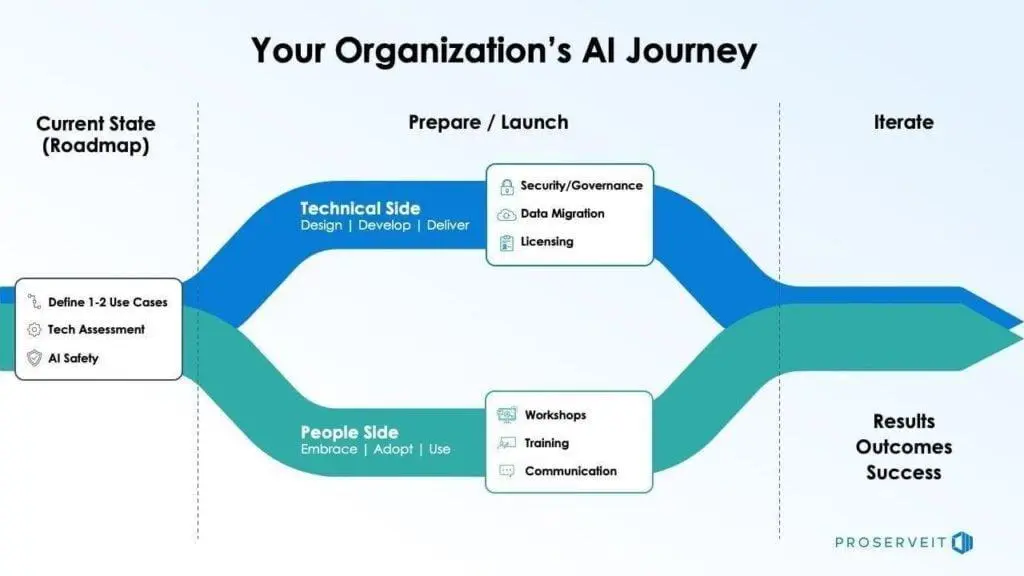
Image source: proserveit.com
Measuring Progress Beyond Initial Delivery
Unlike static deliverables, AI success is measured over time. Tracking performance trends helps agencies demonstrate value and justify continued investment.
| Measurement Area | What to Track |
| Model performance | Accuracy, relevance, consistency |
| Usage | Adoption rates, frequency |
| Business outcomes | Leads, conversions, efficiency gains |
Ongoing measurement turns AI into a long-term asset.
Turning Iteration Into a Long-Term Partnership
When managed well, iteration creates opportunities for expansion rather than frustration. Agencies that position AI as an evolving solution often strengthen client relationships.
How iteration supports retention
- Regular performance reviews with insights
- Roadmaps for future enhancements
- Clear recommendations based on data
By framing iteration as continuous improvement, agencies move from one-off projects to lasting partnerships.
Scaling and Standardizing AI Project Management Across the Agency
Once agencies successfully deliver a few AI projects, the next challenge is consistency. Without standard processes, scaling AI work can strain teams, reduce margins, and create uneven client experiences.
To mature AI project management for agencies, project managers must document what works, standardize workflows, and build repeatable frameworks that support growth without sacrificing quality.
Creating Repeatable AI Project Frameworks
Every AI project will differ, but the structure around them shouldn’t. Repeatable frameworks help teams move faster while maintaining clarity and control.
Core components of a scalable AI framework
- Standardized discovery and scoping templates
- Defined iteration and review cycles
- Clear approval and handoff processes
Frameworks reduce guesswork and make onboarding new projects easier. A consistent structure allows flexibility without chaos.
Documenting Learnings and Best Practices
AI projects generate valuable insights that shouldn’t live only in individual teams. Centralized documentation helps agencies improve delivery over time.
What to document after each AI project
- What worked and what didn’t
- Common risks and how they were handled
- Time and effort benchmarks
Shared knowledge strengthens future estimates and planning.
Training Project Managers for AI-Specific Challenges
Managing AI work requires different skills than traditional campaigns. Agencies must invest in training project managers to understand AI constraints and possibilities.
| Training Focus | Why It Matters |
| AI fundamentals | Improves client communication |
| Data awareness | Reduces planning risks |
| Iterative delivery | Supports realistic timelines |
Better-trained project managers lead to smoother AI delivery.
Building AI Into Long-Term Agency Offerings
AI projects shouldn’t remain experimental add-ons. Agencies that productize AI services create predictable revenue and clearer positioning.
Ways to productize AI offerings
- Package AI as ongoing optimization retainers
- Bundle AI capabilities with existing services
- Define tiered AI solutions by complexity
Standardization turns AI from a risk into a competitive advantage.

Image source: linkedin.com
Turning AI Project Management Into a Competitive Advantage
Managing AI projects successfully isn’t just about delivery—it’s about positioning your agency for long-term relevance. Project managers who master AI workflows help agencies move faster, reduce risk, and create stronger client relationships.
When done right, AI project management for agencies becomes a differentiator that supports profitability, retention, and scalable growth. The key is treating AI as a process-driven service, not a one-off experiment.
Connecting AI Delivery to Agency Profitability
AI projects can be highly valuable, but only if they’re managed with financial discipline. Clear scopes, phased estimates, and iteration planning protect margins while still allowing flexibility.
Ways AI project management supports profitability
- Fewer overruns through realistic estimation
- Better change control tied to business value
- Higher lifetime value through ongoing optimization
Strong delivery practices turn complex projects into predictable revenue.
Positioning Project Managers as Strategic Leaders
AI elevates the role of the project manager from coordinator to strategist. Clients rely on PMs to translate technical complexity into confident decision-making.
How PMs add strategic value in AI projects
- Guiding clients through uncertainty
- Framing progress in outcomes, not features
- Recommending next steps based on performance
This builds trust and strengthens the agency’s advisory role.
Making AI a Core Part of Agency Operations
AI succeeds when it’s embedded into everyday workflows, not treated as a side offering. Standardized processes make AI easier to sell, deliver, and scale.
Steps to operationalize AI in your agency
- Integrate AI workflows into existing PM systems
- Align sales, delivery, and iteration models
- Treat AI as an evolving service line
Operational maturity reduces friction and increases confidence.
Preparing for the Future of Agency Project Management
AI will continue to reshape how agencies work, and project managers are at the center of that change. Those who adapt early will define best practices for years to come.
By embracing iteration, transparency, and structured flexibility, agencies can turn AI complexity into a lasting competitive advantage.
FAQ
Q: How do you prevent scope creep in AI projects?
A: Scope creep is managed by separating core functionality from enhancements. Changes are reviewed at planned checkpoints. Each change is evaluated against agreed success metrics. Unplanned changes should be documented and approved.
Q: What role does data play in AI project delivery?
A: Data quality directly impacts AI performance. Incomplete or biased data limits results. Data access and ownership must be clarified early. Poor data can delay or block delivery.
Q: How long does it take for an AI system to perform well?
A: Timelines vary based on complexity, data quality, and feedback volume. Some systems improve in weeks, others take months. There is no guaranteed timeline. Expectations should reflect this variability.
Q: How do agencies decide when to stop iterating an AI project?
A: Iteration usually stops when performance meets agreed thresholds or returns diminish. Budget and timelines also matter. Perfection is rarely achievable. Clear stopping criteria prevent endless work.
Q: What signals that an AI project is off track?
A: Missed iteration goals, unclear metrics, and poor data quality are common signals. Client confusion is another indicator. Early detection allows correction. Ignoring signals increases recovery cost.
Conclusion
Managing AI projects for clients requires a shift in mindset, structure, and execution—from flexible scoping and realistic estimation to iterative delivery and long-term optimization.
Agencies that adapt their project management processes to the realities of AI are better positioned to reduce risk, deliver consistent value, and build stronger client partnerships over time.
If you’re looking to formalize this approach and turn AI services into a scalable, profitable offering, a clear roadmap makes all the difference. Explore a practical AI business plan for agencies to help structure your services, pricing, and delivery model with confidence.
Manage Client AI Projects With Confidence.
Apply AI project management for agencies to deliver client projects on time and with impact.
Trusted by thousands of organizations worldwide


