
Advancements and Innovations in ChatGPT-Driven Research
In the realm of modern research, where data-driven decision-making is so important, innovative AI tools are emerging as game-changers. One such tool that has taken center stage is ChatGPT. Imagine having a virtual assistant at your fingertips, tirelessly gathering, sorting, and analyzing data in seconds, all while seamlessly engaging with participants in natural conversations. The potential of ChatGPT and AI chatbots in research is nothing short of revolutionary, promising to transform the way we collect information, gain insights, and make informed choices.
In this blog post, we delve into ChatGPT’s two most exciting new features – code interpreter and plugins – and explore how they are breaking barriers, amplifying efficiency, and ushering in a new era of data-driven exploration. Whether you’re an academic researcher, a market analyst, or a curious mind, join us on a journey to uncover the boundless possibilities that these digital allies bring to the realm of research.
Defining ChatGPT’s Role
It’s important that prior to prompting any tasks to ChatGPT, you make it aware of the role you want it to play. For example, if I’m using it to help me find specific articles or journals related to a project I’m working on, I’ll tell it to act as a research assistant.
When conducting research, the precision and integrity of methodologies and tools are important, and this extends to the utilization of AI language models like ChatGPT. Prompting it to fill a specific role within the context of your project or work will help it better understand its boundaries and will minimize hallucinations.
Code Interpreter
One of the most impressive things about ChatGPT is the new code interpreter feature. Not only can this feature be used to run code for you, but it can also be used to analyze different formats of data. This includes things like research papers, academic journals, and case studies in common formats like PDF and Word Documents. It’s like having a tenured professor at your fingertips, ready and willing to answer any questions you might have. When you ask the ChatGPT code interpreter about a specific article or journal that you have uploaded, it will give you detailed answers and potentially save hours of your time.
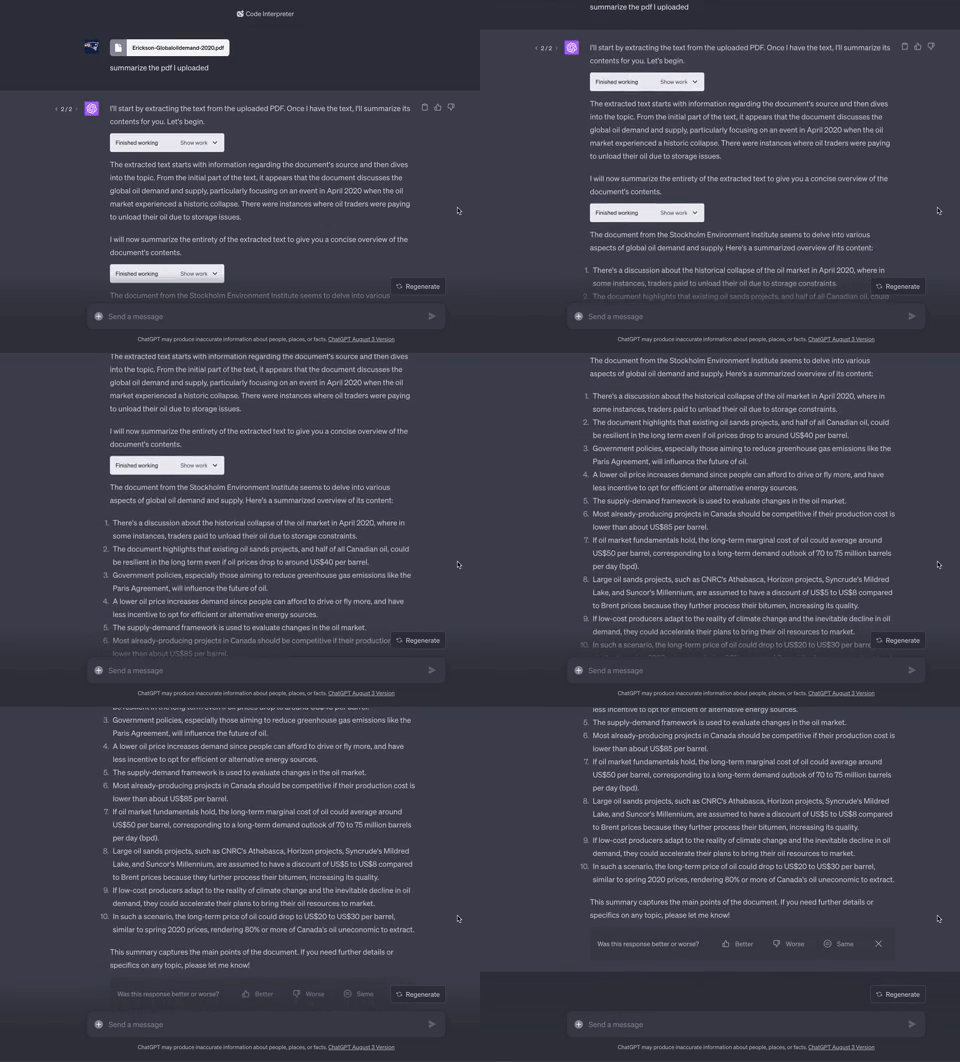
It’s important to note that code interpreter is still in its beta phase, and is only available to ChatGPT Plus subscribers.
Plugins
Another revolutionary feature from ChatGPT which you can utilize for research is the plugins feature. The plugin store contains several useful plugins which will help you conduct high-quality research and find useful information from various reputable sources.
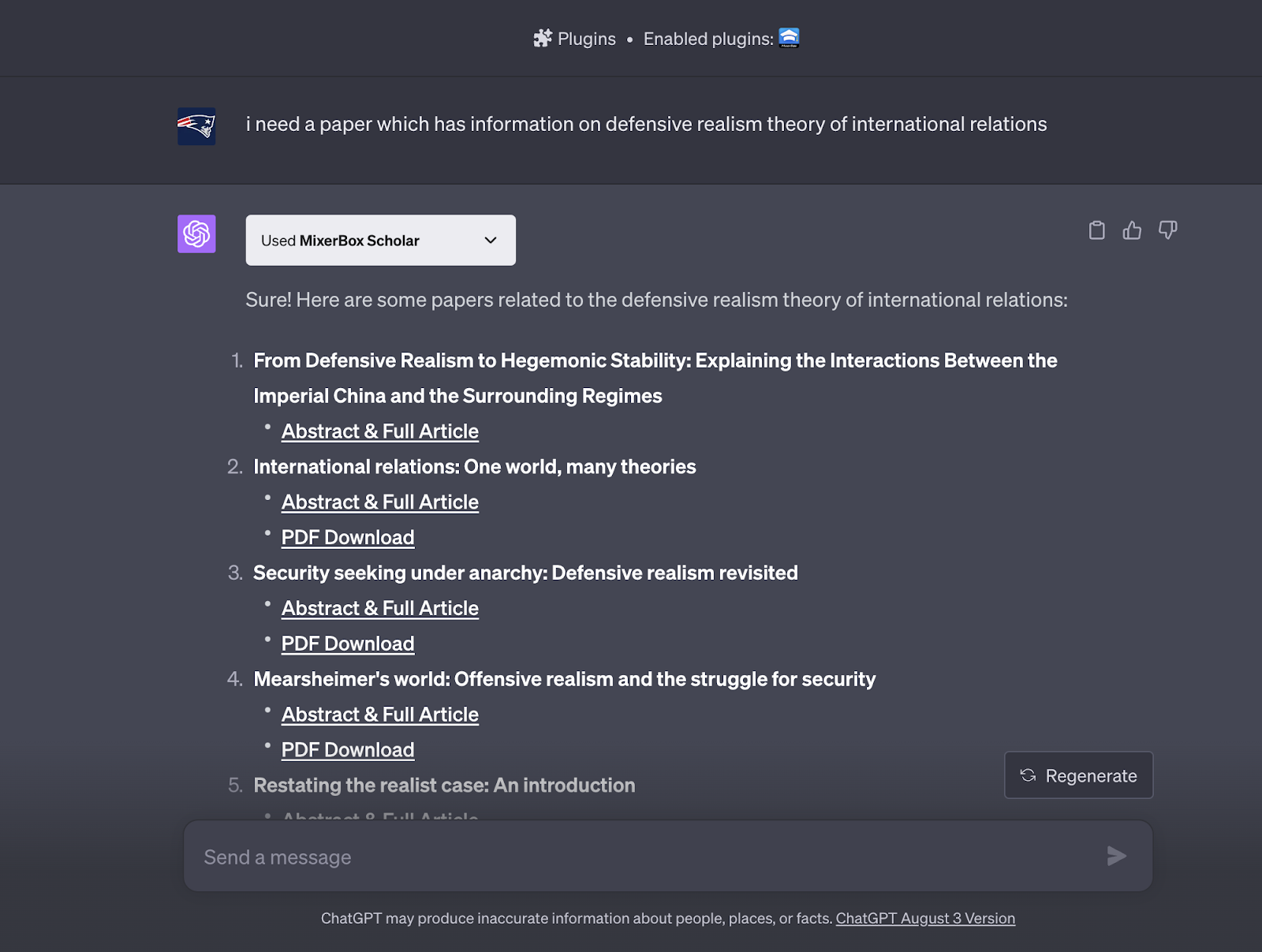
As an example, I’ll use the MixerBox Scholar plugin to find a paper. All I have to do is enable the plugin, then type in a simple prompt. The results come up in seconds:
Plugins are also a feature that, at the moment, is still in in beta and is only available to ChatGPT Plus subscribers.
If you are interested in potentially developing your own plugin for ChatGPT, at CustomGPT we offer a No-Code Plugin Builder which makes the process of developing a plugin easy. These plugins can be powerful tools to help increase your productivity in a multitude of ways.
Frequently Asked Questions
How do I make ChatGPT a more reliable research assistant?
Start by giving it a clear role and restricting it to approved sources. Role prompting helps define boundaries, but reliability improves most when answers are grounded in a controlled knowledge base instead of general model memory. Joe Aldeguer, IT Director at Society of American Florists, said, "CustomGPT.ai knowledge source API is specific enough that nothing off-the-shelf comes close. So I built it myself. Kudos to the CustomGPT.ai team for building a platform with the API depth to make this integration possible." In practice, source control and retrieval matter more than clever prompt wording alone.
Can ChatGPT analyze PDFs or large research files without coding?
Yes. ChatGPT's code interpreter can analyze research papers, journals, case studies, PDFs, and Word documents. If your project spans many files, a no-code RAG tool can also ingest PDFs, DOCX, TXT, CSV, HTML, XML, JSON, audio, video, and URLs, with files up to 100MB each. Stephanie Warlick said, "Check out CustomGPT.ai where you can dump all your knowledge to automate proposals, customer inquiries and the knowledge base that exists in your head so your team can execute without you." For research, the main advantage is searchable ingestion across many sources instead of pasting one file into a single chat.
Do plugins make ChatGPT more accurate for research?
Not automatically. Plugins mainly extend access to outside tools and databases, which can improve coverage and speed. Accuracy depends more on whether the system retrieves and ranks trustworthy sources well. In the provided benchmark, CustomGPT.ai outperformed OpenAI on RAG accuracy, which suggests retrieval quality matters more than simply turning on a plugin. Use plugins when you need live tools or external databases; use a grounded document set when you need repeatable, source-backed answers.
How much faster can AI make research-heavy work?
There is no universal speed multiplier, but AI usually saves the most time on repetitive steps such as gathering sources, summarizing documents, and drafting first passes. Dlubal Software uses an AI assistant that supports 130,000+ users across 132 countries in 10 languages, and George Dlubal said, "The assistant has enabled us to offer 24/7 support while improving accuracy and speed of response. This has led to a noticeable increase in customer satisfaction and even faster support." In research settings, the biggest gains usually come when a human still reviews conclusions while AI handles the repeatable groundwork.
Can I build a research chatbot for a specialized field like tax law or case law?
Yes. A specialized research chatbot works best when it is grounded in your own source set, such as statutes, case law, policies, papers, or internal memos, rather than relying on general web knowledge. Evan Weber said, "I just discovered CustomGPT, and I am absolutely blown away by its capabilities and affordability! This powerful platform allows you to create custom GPT-4 chatbots using your own content, transforming customer service, engagement, and operational efficiency." For niche research, that same approach is usually more dependable than asking a general model such as ChatGPT or Gemini to recall specialized material from memory.
Is it safe to use ChatGPT for confidential or participant-facing research?
It can be, but only if the tool meets your security and data-handling requirements. The provided credentials list SOC 2 Type 2 certification, GDPR compliance, and a policy that customer data is not used for model training. For confidential or participant-facing research, you should also verify access controls, retention policies, and whether answers stay tied to approved sources instead of open-web guesses. Security protects the data; grounding protects the research quality.
Conclusion
The integration of ChatGPT as a research assistant has unveiled a new horizon for information discovery. In the realm of academic exploration, ChatGPT emerges as a transformative asset. By seamlessly navigating through academic papers and journals, ChatGPT streamlines the process of discovering valuable insights. This synergy between AI and research not only accelerates information retrieval but also unearths connections that might otherwise remain hidden. As researchers embrace ChatGPT as their partner in knowledge discovery, they unlock a more efficient and insightful path toward advancing human understanding.