
Custom GPT RAG API + R: Integrating AI Chatbot Capabilities for Advanced Data Analysis and User Interactivity

CustomGPT.ai offers a versatile AI integration solution for businesses seeking to enhance their applications with AI custom chatbot capabilities through its enterprise RAG API. In this blog, we will explain integrating CustomGPT.ai with the R programming language, providing developers with an opportunity to leverage AI technology in their projects. By combining CustomGPT.ai’s advanced AI capabilities with the flexibility of R, developers can enhance data analysis, natural language processing, and more.
With CustomGPT.ai’s user-friendly RAG API and comprehensive documentation, developers can easily incorporate the CustomGPT.ai chatbot into their R applications, enhancing user experiences and their application functionality without complexity.
Introduction to R Programming Language
R is a programming language and environment primarily used for statistical computing and graphics. It provides a wide variety of statistical and graphical techniques and is highly extensible.
Following are some key points related to this programming language:
Purpose and Usage of R
R is widely used in various fields such as data analysis, statistical modeling, machine learning, and data visualization. Its flexibility and extensive libraries make it a preferred choice for statisticians, data analysts, researchers, and data scientists.
Support for External APIs
R offers support for integrating with external APIs, allowing users to fetch data, perform analyses, and generate insights from various sources such as web services, databases, and cloud platforms.
Applications of R
R finds applications in diverse domains, including finance, healthcare, marketing, social sciences, and bioinformatics, where AI document analysis can be part of broader data workflows. It is used for tasks such as data mining, predictive modeling, time series analysis, and exploratory data analysis.
CustomGPT.ai Features and Integrations
CustomGPT.ai is an AI platform that provides advanced custom chatbots with natural language processing capabilities, including text generation, summarization, and conversation management. It offers seamless integration capabilities, allowing users to incorporate CustomGPT.ai’s features into their applications, including those developed using R and through JavaScript API integration.

Following are some key points related to CustomGPT.ai in this API complete guide:
RAG API Integrations with R
CustomGPT.ai provides well-documented RAG APIs that enable easy integration with R. Developers can leverage these RAG APIs to interact with CustomGPT.ai’s features directly from their R scripts or applications.
Benefits of Using CustomGPT.ai Chatbot in R Applications
By integrating CustomGPT.ai’s chatbot capabilities into R applications
- Users can enhance the interactivity and user experience of their applications.
- CustomGPT.ai’s chatbots can assist users in performing various tasks, such as answering queries, providing recommendations, and generating text based on user inputs.
- With CustomGPT.ai, R applications can offer conversational interfaces that enable users to interact with data and analyses more intuitively and naturally.
This integration can open up a wide range of possibilities for R users, allowing them to create powerful and interactive applications that leverage the capabilities of both R and CustomGPT.ai.
Integrating CustomGPT.ai with R: A Practical Example
In the example of integrating CustomGPT.ai with R, we’ll demonstrate how to retrieve a list of projects using an example from CustomGPT.ai documentation. The GET RAG API endpoint returns a sorted list of projects based on their creation date, with the most recent projects appearing first. The RAG API is paginated, meaning you can use the ‘page’ parameter to fetch subsequent pages of projects.

Here’s a brief explanation of the provided R code example.
The above R code snippet utilizes the HTTP library to send an HTTP GET request to the specified CustomGPT.ai RAG API endpoint (https://app.customgpt.ai/api/v1/projects) with the provided query parameters. The response from the RAG API is then extracted and printed, displaying the list of projects in JSON format.
Test and Run the Code in CustomGPT.ai Browser
To test and run the code in the CustomGPT.ai browser, follow these steps:
- Sign up for an account on the CustomGPT.ai platform if you haven’t already done so.
- Once signed in, navigate to your account profile to access your RAG API key. Click on the Generate API key. This key will be used to authenticate your requests to the CustomGPT.ai RAG API.

- Copy the RAG API key and ensure it is securely stored.
- Open the CustomGPT.ai browser environment where you can test and run code snippets.
- Paste the RAG API key that we generated in the previous step.
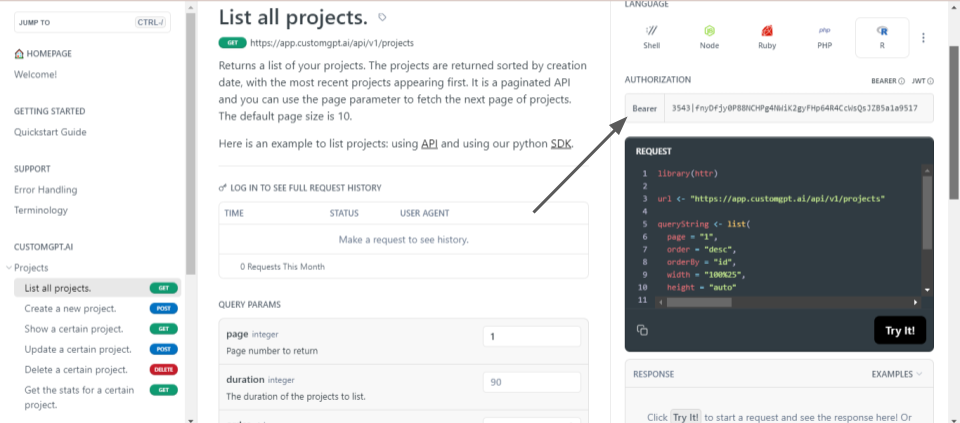
- Click on the “Try it” button to execute the code.
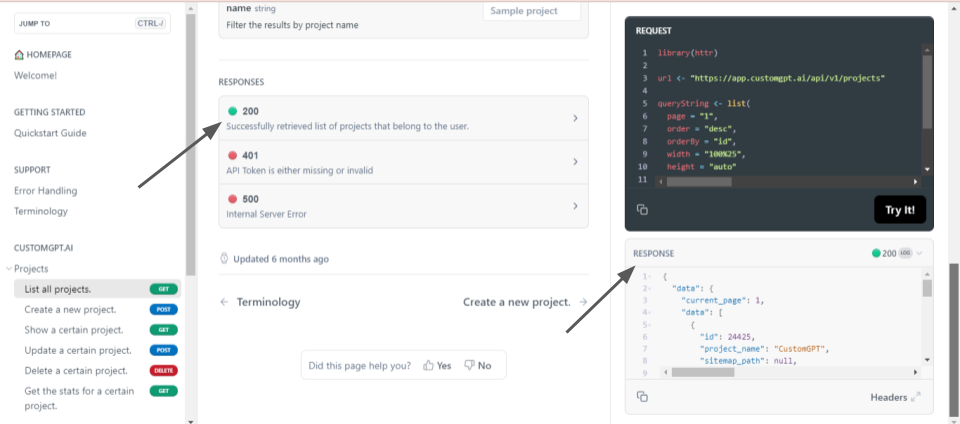
- The response “200” shows that the list is retrieved successfully.
- Monitor the output displayed in the browser environment to verify the code’s functionality and performance.
By following these steps, you can effectively test and run code snippets within the CustomGPT.ai browser environment, leveraging the platform’s features and capabilities to develop and optimize your applications.
Conclusion
By leveraging CustomGPT.ai’s features, users can enhance their R applications with accurate and contextually relevant responses. The RAG API integration between CustomGPT.ai and R empowers users to create highly personalized chatbots tailored to their specific needs. This integration marks a significant step forward in leveraging AI technologies to augment R applications, offering users a versatile toolset for enhancing their data-driven workflows.
Frequently Asked Questions
Can R make direct API calls to a RAG chatbot, or do I need a special package?
Yes. R can call the chatbot directly because the API is an OpenAI-compatible REST endpoint at /v1/chat/completions and uses API key-based authentication. You can send JSON over HTTPS and parse the response in R, so a special R SDK is not required to build a working prototype. That setup is especially useful for retrieval-based use cases, and the platform reports outperforming OpenAI in a RAG accuracy benchmark.
Can I white-label the chatbot in a website or Shiny app without making users log into ChatGPT?
Yes. Deployment options include an embed widget, live chat, search bar, and API access, and the platform supports custom personas and branding. That means you can place the chatbot inside your own website or Shiny app so the experience stays inside your UI and access flow. Bill French, Technology Strategist, said, “They’ve officially cracked the sub-second barrier, a breakthrough that fundamentally changes the user experience from merely ‘interactive’ to ‘instantaneous’.” Fast responses matter when you want the chatbot to feel native inside an app rather than bolted on.
How do I keep the API key and private data secure in an R or Shiny chatbot?
Use the integration through secured backend code and authenticate with an API key rather than exposing credentials broadly. For governance, the platform is SOC 2 Type 2 certified, GDPR compliant, and states that customer data is not used for model training. If your R or Shiny app works with private documents, keep the chatbot limited to approved sources and route requests through your controlled application environment.
Can one R integration answer from both my private files and website content?
Yes. The ingestion system supports both websites and documents, including URLs, PDF, DOCX, TXT, CSV, HTML, XML, JSON, audio, and video, so one chatbot can answer from mixed approved sources. Stephanie Warlick, Business Consultant, said, “Check out CustomGPT.ai where you can dump all your knowledge to automate proposals, customer inquiries and the knowledge base that exists in your head so your team can execute without you.” In practice, your R app can send one question to the API and let retrieval pull from the indexed sources you have connected.
Why does a RAG chatbot sometimes answer correctly and then miss a similar question later?
Because a RAG system depends on retrieval, not just generation. If a slightly different prompt retrieves a different source passage, the answer can change even when the questions look similar. Source coverage, document quality, and retrieval tuning all affect consistency. Brendan McSheffrey, Managing Partner & Founder of The Kendall Project, said, “We love CustomGPT.ai. It’s a fantastic Chat GPT tool kit that has allowed us to create a ‘lab’ for testing AI models. The results? High accuracy and efficiency leave people asking, ‘How did you do it?’ We’ve tested over 30 models with hundreds of iterations using CustomGPT.ai.” Citation support can help you inspect what was retrieved and improve repeatability over time.
When does it make sense to add a chatbot to an R app instead of only showing charts and tables?
Add a chatbot when users need natural-language help alongside analysis, such as answering questions, providing recommendations, summarizing material, or generating text from your approved content. Keep charts and tables for trends, distributions, and diagnostics. Evan Weber, Digital Marketing Expert, said, “I just discovered CustomGPT, and I am absolutely blown away by its capabilities and affordability! This powerful platform allows you to create custom GPT-4 chatbots using your own content, transforming customer service, engagement, and operational efficiency.” In an R app, chat is most useful when people need interpretation and guided exploration, not just static outputs.
Related Resources
These pages offer useful context if you’re extending your R workflow with CustomGPT.ai.
- CustomGPT.ai RAG API — Explore the API for building retrieval-augmented generation workflows with your own data.
- Introducing The CustomGPT.ai API — Get an overview of the API’s purpose, core capabilities, and common use cases.
- How CustomGPT.ai Works — Learn how CustomGPT.ai processes, retrieves, and serves answers from connected knowledge sources.
- Available Integrations — Review the platforms and tools CustomGPT.ai connects with to support broader deployment.