
Introduction
Custom RAG is a tailored Retrieval-Augmented Generation system that connects a language model to selected knowledge sources, retrieval rules, and answer controls so the AI can generate more relevant, grounded responses for a specific business use case. Where a generic setup retrieves from broad content with default settings, a custom RAG system adapts the sources, chunking, retrieval logic, prompts, and evaluation to one domain or workflow. For the broader concept, see RAG: The Ultimate Guide.
For a legal workflow example, see how legal document RAG systems ground answers in contracts, case files, policies, and citations.
For the retrieval-quality layer that sits after first-pass search, see our guide to RAG reranking techniques.
Customization matters because answer quality depends on how well the system finds and uses the right evidence. Two businesses can use the same model and get very different results based on content quality, chunking, and retrieval tuning. Tailoring those layers to your domain is what turns a generic assistant into a dependable one.
Custom RAG improves AI answers by giving the model relevant, approved context at query time and by constraining it to respond from that context. This grounds responses in real source material and makes them easier to verify, especially when citations are shown.
A business should consider custom RAG when it needs answers from proprietary, domain-specific, or frequently changing content that a general model does not know. If the goal is grounded answers for support, internal knowledge, documentation, or compliance, custom RAG is usually the right pattern. The open question is whether to build it from scratch or use a managed platform, which this guide covers in the build vs buy section and in the companion piece on custom RAG solutions.
Key Takeaways
- Custom RAG adapts retrieval, generation, and evaluation to a specific use case rather than using generic defaults.
- RAG helps language models answer from external knowledge instead of relying only on training data.
- Custom RAG quality depends on content quality, chunking, retrieval, grounding, citations, and monitoring, not just the model.
- Fine-tuning and RAG solve different problems: RAG retrieves knowledge at query time, while fine-tuning shapes model behavior.
- Building custom RAG gives control but adds engineering complexity, cost, and ongoing maintenance.
- Managed RAG platforms can reduce engineering overhead for many common business use cases.
- CustomGPT.ai can help teams create AI agents from approved business content without building every layer of the RAG pipeline manually, while the team keeps ownership of content quality, testing, and governance.
What Is Custom RAG?
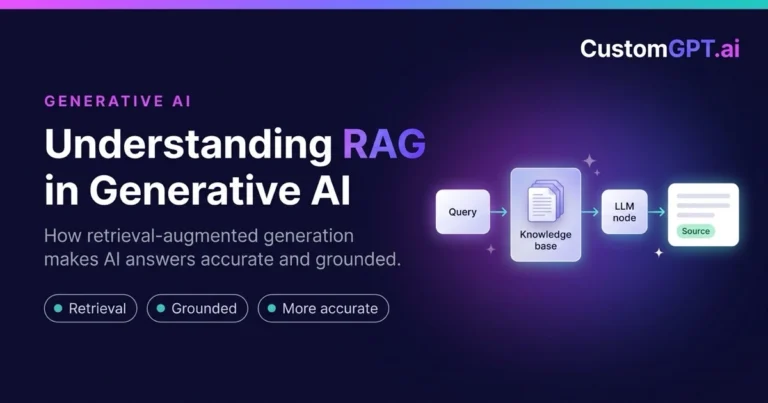
Custom RAG is a tailored Retrieval-Augmented Generation system adapted to a specific domain, content set, and workflow. RAG stands for Retrieval-Augmented Generation, and standard RAG connects a large language model to external knowledge so it can answer from sources rather than memory alone.
Custom RAG goes further by adapting the knowledge sources, retrieval logic, chunking, metadata, prompts, evaluation, and answer behavior to one use case. Instead of generic settings, the system is tuned so that the right evidence is retrieved and the model answers within defined boundaries. If you are new to the underlying idea, RAG for Beginners is a good starting point, and Understanding RAG in Generative AI covers the mechanics.
Custom RAG is most useful when a business needs answers from proprietary, domain-specific, or frequently changing content. It can support customer support, internal knowledge, research, documentation, compliance, onboarding, and sales enablement, all grounded in approved material.
How RAG Works Before Customization
Baseline RAG works as a simple retrieve-then-generate loop, and understanding it makes the value of customization clearer. The steps below describe the standard flow before any tuning.
- A user asks a question.
- The system searches approved knowledge sources.
- The retriever finds relevant passages.
- Retrieved passages are added to the prompt.
- The language model generates an answer.
- The system may show citations or source references.
- The answer is evaluated or improved over time.
Summary: RAG improves AI answers by giving the model relevant context at query time. Customization then improves how well that context is selected, formatted, and constrained for a specific use case.
What Makes RAG “Custom”?
RAG becomes custom when its layers are tuned to a specific domain instead of left at generic defaults. The table below shows what can be customized and why each layer matters.
| Customizable layer | What can be customized | Why it matters | Example |
|---|---|---|---|
| Knowledge sources | Which documents, sites, and systems are indexed | Defines what the AI can answer from | Index only approved product docs and policies |
| Data ingestion | How and how often content is pulled in | Keeps the knowledge base current | Auto-sync a help center on a schedule |
| Document cleaning | Removing boilerplate, duplicates, and noise | Cleaner input improves retrieval | Strip navigation text from crawled pages |
| Chunking strategy | Chunk size and boundaries | Right-sized chunks raise relevance | Split by section instead of fixed length |
| Metadata | Tags such as product, team, or date | Enables filtering and precision | Filter answers to the current product version |
| Embeddings | Choice of embedding model | Affects semantic match quality | Use a model suited to your domain language |
| Retrieval rules | Top-k, filters, hybrid search | Controls what evidence is fetched | Combine keyword and semantic retrieval |
| Reranking | Reordering retrieved results | Surfaces the best evidence first | Rerank to the top three passages |
| Prompt templates | How context and instructions are framed | Shapes grounded, on-brand answers | Require source-based answers only |
| Answer style | Tone, length, and format | Fits the audience and channel | Concise answers for a support widget |
| Citations | Whether and how sources are shown | Makes answers verifiable | Show clickable source links per claim |
| Fallback behavior | What happens when evidence is missing | Prevents confident wrong answers | Reply “not in our sources” and stop |
| Security and access control | Who can retrieve which sources | Protects sensitive content | Restrict HR docs to HR users |
| Evaluation metrics | What quality signals are tracked | Catches problems before users do | Measure faithfulness and citation accuracy |
| Monitoring and feedback loops | How usage and quality are reviewed | Supports ongoing improvement | Review unknown answers weekly |
Core Components of a Custom RAG System
A custom RAG system is built from connected components, and weakness in any one of them can lower answer quality. The table summarizes each part. For a technical deep dive, see The Key Components of a RAG System.
| Component | What it does | Why it matters |
|---|---|---|
| Knowledge base | Holds the approved content to answer from | Sets the boundary of what the AI can know |
| Ingestion pipeline | Pulls content from files, sites, and connectors | Keeps the knowledge base complete and current |
| Document parser | Extracts clean text from mixed formats | Clean input leads to better retrieval |
| Chunking layer | Splits documents into retrievable passages | Right-sized chunks improve relevance |
| Embedding model | Converts text into vectors for search | Enables semantic matching across content |
| Vector database or search index | Stores and searches chunk vectors | Powers fast, relevant retrieval |
| Retriever | Finds the most relevant chunks per query | Determines what evidence the model sees |
| Reranker | Reorders results to surface the best evidence | Improves precision on ambiguous queries |
| Prompt builder | Assembles the query plus retrieved context | Shapes how grounded the answer is |
| LLM or generator | Produces the final answer from the prompt | Controls fluency and synthesis quality |
| Citation layer | Maps answers back to source passages | Makes answers verifiable for users |
| Evaluation system | Tests retrieval and answer quality | Catches silent failures before users do |
| Security controls | Govern access and permission-aware retrieval | Protect sensitive data and meet policy needs |
| Analytics and monitoring | Track usage, quality, and unknown answers | Support ongoing improvement after launch |
Custom RAG Architecture
Custom RAG architecture is a pipeline that moves a question through retrieval and grounded generation, then feeds results back for improvement. The overall flow is:
Knowledge sources to ingestion to cleaning to chunking to embeddings to vector index or search index to retriever to reranker to prompt builder to LLM to grounded answer to citations to evaluation to feedback loop.
Knowledge sources and ingestion define and gather the content the system can use. Clear ownership and reliable syncing keep this layer trustworthy.
Cleaning and chunking turn raw documents into well-formed passages. Good chunk boundaries preserve ideas so retrieval can match them.
Embeddings and the vector or search index make content searchable by meaning. The index is where retrieval speed and relevance are won, so teams comparing storage options should also review the compare vector database options for RAG.
Retriever and reranker select and order the strongest evidence for each query. Hybrid retrieval and reranking improve precision, a pattern covered in RAG Architecture Patterns.
Prompt builder and LLM combine the question with retrieved context and generate the answer. Prompt design controls how tightly the answer stays on source.
Citations, evaluation, and the feedback loop make answers verifiable and drive continuous improvement. For design tradeoffs, see RAG System Design and Building Production RAG Pipelines.
Diagram description: If you add a visual, show a user query flowing into the retriever, then to the vector index, then to the relevant chunks, then through reranking, prompt building, and LLM generation, ending with citation display and monitoring that loops back to content and retrieval settings.
Custom RAG Pipeline: Step-by-Step
This is a practical sequence for implementing a custom RAG pipeline from use case to ongoing operation. For an implementation-level walkthrough, see Implementing RAG.
- Define the business use case and what success looks like.
- Identify approved knowledge sources.
- Clean and organize documents.
- Choose a chunking strategy.
- Add metadata such as product, team, and date.
- Generate embeddings.
- Store content in a vector database or search index.
- Configure retrieval and reranking.
- Build prompt templates.
- Define answer rules and fallback behavior.
- Add citations or source references.
- Test with real user questions.
- Monitor quality and update content over time.
Custom RAG vs Generic RAG
Custom RAG and generic RAG use the same core idea, but custom RAG tunes each layer to one domain while generic RAG relies on defaults. The table compares them.
| Category | Generic RAG | Custom RAG | Why it matters |
|---|---|---|---|
| Knowledge sources | Broad or mixed content | Curated, approved sources | Focused sources reduce noise and wrong answers |
| Retrieval logic | Default top-k semantic search | Tuned filters, hybrid search, reranking | Better evidence selection raises relevance |
| Domain fit | General-purpose | Adapted to one domain | Domain tuning improves accuracy on niche topics |
| Prompt behavior | Standard prompts | Source-constrained, on-brand prompts | Tighter grounding lowers off-source drift |
| Evaluation | Basic or informal | Metric-driven on real questions | Measurement catches silent failures |
| Security controls | Minimal | Permission-aware retrieval and governance | Protects sensitive content by user and source |
| Maintenance | Ad hoc | Owned, with refresh and review cadence | Sustained quality over time |
| Best use case | Quick demos and general Q&A | Business-critical, domain-specific workflows | Matches the system to real stakes |
Custom RAG vs Fine-Tuning
Custom RAG retrieves business knowledge at query time, while fine-tuning changes how a model behaves based on training examples. RAG is usually better for current or proprietary knowledge, and fine-tuning is usually better for style, classification, or repeated task behavior. Many teams combine both.
| Approach | What it changes | Best for | Limitations | When to use |
|---|---|---|---|---|
| Custom RAG | Adds retrieved knowledge at query time | Current or proprietary facts with provenance | Needs content, retrieval, and evaluation work | You need grounded, source-backed answers |
| Fine-tuning | Adjusts model behavior and style | Consistent tone, formatting, or classification | Does not add fresh facts on its own | You need behavior shaping, not new knowledge |
| RAG plus fine-tuning | Combines retrieval with behavior shaping | Facts from RAG with a tailored style | More moving parts to build and maintain | You need both grounding and a specific style |
| Managed RAG platform | Provides the RAG pipeline as a service | Common use cases and faster launch | Less control over low-level internals | You want grounded answers with less overhead |
For more on the RAG side of this comparison, see CRAG vs RAG: The Evolution of RAG.
Why Businesses Use Custom RAG
Businesses use custom RAG to ground AI answers in their own knowledge and reduce reliance on generic model output. The motivations below are the most common.
- Domain-specific answers: Tailor retrieval to specialized vocabulary and topics.
- Proprietary knowledge access: Answer from internal content the model never saw in training.
- Better source grounding: Tie answers to approved evidence.
- Support automation: Deflect repetitive questions with grounded answers, as in a customer support AI.
- Employee self-service: Help staff find policies and runbooks via enterprise knowledge search.
- Faster onboarding: Let new hires self-serve from handbooks and training.
- Research and analysis: Pull evidence from large document sets with provenance.
- Compliance and policy support: Surface the latest approved guidance.
- Product documentation assistance: Turn manuals into a searchable assistant.
- Sales enablement: Give reps consistent answers from approved collateral.
- Reduced reliance on generic AI answers: Keep responses inside trusted sources.
Custom RAG Use Cases by Industry and Team
Custom RAG delivers value wherever a team maintains knowledge that people need to access quickly and accurately. The table maps common use cases to sources and example questions.
| Industry or team | Use case | Knowledge sources | Example question |
|---|---|---|---|
| Customer support | Grounded agent and customer answers | Help center, product docs, policies | “What is the refund window for this plan?” |
| SaaS | Product and onboarding assistant | Docs, changelogs, FAQs, fit for startups and SaaS AI | “How do I configure single sign-on?” |
| Ecommerce | Product and order assistance | Catalog, policies, shipping info | “Does this item ship internationally?” |
| HR | Policy and benefits self-service | Handbooks, benefits guides, policies | “How many vacation days do I accrue?” |
| Legal | Clause and policy lookups | Templates, contracts, internal guidance, see professional services AI | “Which NDA template applies to vendors?” |
| Compliance | Policy questions with sources | Regulatory summaries, internal policies | “What is our data retention requirement?” |
| Financial services | Grounded answers from approved material | Product terms, policy documents, FAQs | “What documents are needed to open an account?” |
| Healthcare | Guidance and documentation lookups | Approved protocols, internal documentation | “What is the intake process for new patients?” |
| Education | Course and learner assistants | Course content, study guides, FAQs, see education AI | “When is the assignment due and how is it graded?” |
| Government | Constituent and staff information access | Public guidance, internal procedures, see government AI | “How do I apply for this permit?” |
| Associations and member organizations | Member knowledge and resource search | Member resources, bylaws, FAQs, see member associations AI | “What are my member benefits this year?” |
| Engineering | Documentation and architecture search | API docs, design docs, wikis | “How does the auth service handle retries?” |
| Sales | Fast answers from approved collateral | Battlecards, pricing notes, FAQs | “How do we compare on enterprise security?” |
| Marketing | On-brand content support | Brand guidelines, case studies, blog library | “What is our approved messaging for this feature?” |
Benefits of Custom RAG
Custom RAG offers practical benefits when retrieval is strong and content is well maintained. These benefits hold when the system is configured correctly and monitored over time.
- More relevant answers tuned to your domain and audience.
- Better use of proprietary knowledge that a general model does not have.
- Easier content updates than model retraining, since you change sources rather than weights.
- Improved answer grounding in approved evidence.
- More control over which source content the AI can use.
- Better fit for domain-specific workflows and vocabulary.
- Potentially lower hallucination risk when retrieval is strong and answers are constrained to sources.
- More transparent source review when citations are shown. CustomGPT.ai describes its grounding approach on the anti-hallucination page.
Custom RAG does not guarantee accuracy. It reduces certain risks when configured well, but evaluation, governance, and human review remain important.
Challenges of Custom RAG
The hardest parts of custom RAG involve content, retrieval quality, security, and maintenance. Most disappointing results trace back to these issues rather than the model.
- Messy content in mixed, inconsistent formats.
- Poor chunking that fragments ideas.
- Irrelevant retrieval that surfaces the wrong passages.
- Duplicate documents that create conflicting answers.
- Stale content that no longer reflects current guidance.
- Weak metadata that limits filtering and precision.
- Hallucinations from thin or off-topic context.
- Permission boundaries that are hard to enforce.
- Security and governance across users and sources.
- Evaluation difficulty, especially for faithfulness at scale.
- Latency in multi-step pipelines under load.
- Infrastructure maintenance for embeddings, indexes, and hosting.
- Cost management across embeddings, storage, and model usage.
- Need for specialized engineering skills that are in short supply.
| Challenge | Why it matters | How to reduce risk |
|---|---|---|
| Messy content | Weak input produces weak retrieval | Clean and standardize before indexing |
| Poor chunking | Fragmented ideas lower relevance | Test chunk sizes against real questions |
| Irrelevant retrieval | Wrong evidence yields wrong answers | Add reranking and hybrid retrieval, then evaluate |
| Stale or duplicate content | Conflicting answers erode trust | Schedule refreshes and remove duplicates |
| Permission gaps | Sensitive data can be exposed | Apply permission-aware retrieval and governance, see security |
| Weak evaluation | Silent failures reach users | Build a test set of real questions before launch |
| High maintenance | Quality drifts when unmanaged | Assign an owner and a review cadence |
How to Evaluate a Custom RAG System
You evaluate a custom RAG system by measuring retrieval quality, faithfulness, and real user outcomes, not just whether answers sound fluent. The signals below give a complete picture.
- Retrieval precision: share of retrieved chunks that are relevant.
- Retrieval recall: share of relevant chunks successfully retrieved.
- Faithfulness: whether the answer stays true to sources.
- Groundedness: whether answers come from approved content.
- Citation accuracy: whether citations match the claims.
- Answer relevance: whether the answer addresses the question.
- Unknown-answer behavior: whether the system declines safely when unsure.
- Latency: how fast answers return.
- User satisfaction: whether users find answers useful.
- Escalation rate: how often answers route to a human.
- Human review pass rate: quality of sampled answers on review.
A practical evaluation workflow:
- Create a test set of real questions.
- Identify the expected source documents for each.
- Define acceptable and unacceptable answers.
- Test retrieval before generation.
- Review citations for accuracy.
- Track failed answers and patterns.
- Update content and retrieval settings, then retest.
Build vs Buy: Custom RAG Options
Build custom RAG when you need full control over infrastructure, retrieval logic, data pipelines, and product-specific workflows. Use a managed RAG platform when you want grounded AI answers from business content without maintaining every layer of the RAG stack yourself. The right choice depends on use case complexity, engineering resources, data sensitivity, and long-term ownership.
| Option | Best for | Pros | Cons | Typical team |
|---|---|---|---|---|
| Build custom RAG from scratch | Specialized retrieval or proprietary infrastructure | Full control and deep customization | High cost, long timeline, heavy maintenance | Engineering-led teams with RAG expertise |
| Use a managed RAG platform | Common use cases and faster launch | Lower setup effort, less infrastructure to maintain | Less control over low-level internals | Lean teams that want speed and governance |
| Hybrid approach | Standard pipeline plus custom logic | Balance of control and speed | Requires coordination across both layers | Teams using a platform with custom add-ons |
| Start managed, customize later | Validating value before heavy investment | Fast proof of value, lower upfront risk | May need migration work if you outgrow it | Teams testing a use case before scaling |
For a deeper build vs buy treatment, see the companion guide on custom RAG solutions. Developers who want a hybrid path can use the RAG API or a hosted MCP server to add custom logic on top of a managed pipeline.
When a Managed RAG Platform Makes Sense
A managed RAG platform often makes sense when the use case is common and speed and maintainability matter more than owning every layer of the stack. The following signals point toward a managed approach.
- The team wants to launch quickly.
- The use case is common, such as customer support, internal knowledge, website chat, onboarding, documentation, or sales enablement.
- The business does not want to maintain embeddings, vector infrastructure, hosting, and retrieval evaluation manually.
- The team still wants answers grounded in approved business content.
- The organization can define clear content ownership, governance, and testing workflows.
If several of these apply, starting managed and revisiting custom work later is usually the lower-risk path. You can compare options on the pricing page and review real deployments in customer stories.
How CustomGPT.ai Helps With Custom RAG
CustomGPT.ai helps teams create AI agents and chatbots from approved business content so users can get grounded answers from uploaded, connected, or approved knowledge sources. For many teams, this can reduce the need to build and maintain every layer of a custom RAG system from scratch.
- Teams can use approved business content as the knowledge base.
- Teams can create AI agents for internal or customer-facing workflows, including a website AI chatbot or an internal assistant connected to Slack channels.
- A managed RAG approach can reduce engineering overhead by handling much of the ingestion, retrieval, and hosting work.
- Teams should still validate answers, keep content updated, review sources, and monitor performance.
CustomGPT.ai is best positioned as a practical path for teams that want business-ready RAG without owning every infrastructure layer. To see how it fits together, review How It Works, the no-code agent builder, the RAG API, and the developer documentation. Content can come from uploads or connectors such as Google Drive and the wider integrations library.
On retrieval quality, an independent point of reference exists: in a 2024 RAG evaluation, Tonic.ai compared CustomGPT.ai’s out-of-the-box retrieval with OpenAI using its Tonic Validate framework on a 55-question benchmark drawn from a Paul Graham essay corpus, and reported a higher mean answer-similarity score for CustomGPT.ai (4.4 versus 3.5). As with any single benchmark, results depend on the dataset and setup, so teams should still validate quality on their own content. CustomGPT.ai does not claim to guarantee perfect accuracy or remove the need for human review.
30-Day Custom RAG Implementation Plan
This 30-day plan moves a custom RAG project from use case definition to a monitored pilot in four focused weeks.
Week 1: Use case definition and content audit
- Goal: Lock one high-value use case and confirm source readiness.
- Tasks: Define the audience, list real questions, inventory approved sources, remove duplicates, set success metrics.
- Deliverables: Use case brief, source inventory, metric definitions.
- Success criteria: A single agreed use case with clean, owned sources and clear metrics.
Week 2: Knowledge base setup and prototype
- Goal: Build a working prototype on prepared content.
- Tasks: Clean and standardize documents, configure ingestion, add metadata, test chunking and retrieval, assemble a first prompt.
- Deliverables: Prepared knowledge base, working prototype, initial retrieval settings.
- Success criteria: The prototype answers core questions with traceable sources.
Week 3: Testing, evaluation, and answer quality review
- Goal: Validate quality before exposing real users.
- Tasks: Build an evaluation set, measure faithfulness and relevance, test unknown-answer behavior, review citations, run a stakeholder review.
- Deliverables: Evaluation report, fixes log, review sign-off.
- Success criteria: Quality metrics meet the bar and high-risk gaps are addressed.
Week 4: Pilot launch, feedback, and optimization
- Goal: Launch to a limited audience and improve from real usage.
- Tasks: Ship the pilot, monitor quality and deflection, collect feedback, review sampled answers, tune content and retrieval.
- Deliverables: Live pilot, monitoring dashboard, optimization notes.
- Success criteria: Stable quality, useful deflection, and a clear plan to scale.
Custom RAG Checklist
This checklist groups the practical steps for a reliable custom RAG launch.
Strategy
- Define one high-value use case and its success metrics.
- Identify the audience and the questions they actually ask.
- Decide build, buy, or hybrid based on resources and complexity.
Content readiness
- Inventory approved sources and confirm ownership.
- Remove stale or duplicate content.
- Standardize formats and clean messy documents.
Retrieval quality
- Test chunk sizes against real questions.
- Add metadata for filtering and precision.
- Use reranking or hybrid retrieval where it helps.
Prompt and answer behavior
- Constrain answers to retrieved sources.
- Define tone, length, and format for the audience.
- Set clear fallback behavior for unknown answers.
Security and governance
- Apply role-based access and permission-aware retrieval.
- Separate sensitive sources and define retention policies.
- Document a review workflow for high-risk topics.
User experience
- Show citations or source references where available.
- Make declined answers helpful, not abrupt.
- Match the channel, such as a widget, Slack, or internal tool.
Testing
- Build an evaluation set of real questions.
- Measure faithfulness, relevance, and unknown-answer handling.
- Run a stakeholder review before launch.
Monitoring
- Track quality, deflection, and unknown answers.
- Review sampled answers on a regular cadence.
- Update content and retrieval settings based on results.
Common Mistakes to Avoid
These mistakes account for most disappointing custom RAG results, and each one is avoidable.
- Starting with too many use cases instead of one focused win.
- Uploading unapproved or outdated content.
- Ignoring content structure and formatting.
- Skipping metadata that would enable filtering.
- Using poor chunking that fragments ideas.
- Measuring only answer fluency instead of source accuracy.
- Ignoring unknown-answer behavior.
- Over-indexing sensitive documents without access controls.
- Not testing with real user questions.
- Forgetting ongoing maintenance and content refresh.
- Assuming custom RAG removes all hallucination risk.
Conclusion
Custom RAG helps businesses ground AI answers in selected knowledge sources so responses are more relevant and easier to verify. The strongest systems combine clean content, strong retrieval, grounded generation, evaluation, and governance, rather than relying on the model alone.
Building custom RAG from scratch gives control but adds cost and maintenance across many layers. Managed platforms can help many teams launch faster and carry less operational load for common use cases. The right path depends on use case complexity, engineering resources, data sensitivity, and long-term ownership.
For many teams, the best first step is to define one use case, clean the content, test retrieval quality, and choose the simplest architecture that meets the need. If a managed approach fits, CustomGPT.ai can help teams create AI agents from approved business content without building every layer of the RAG pipeline manually, while the team keeps ownership of content quality, testing, and governance.
Frequently Asked Questions
What is custom RAG?
Custom RAG is a tailored Retrieval-Augmented Generation system that connects a language model to selected knowledge sources, retrieval rules, and answer controls so the AI can generate more relevant, grounded responses for a specific business use case. It adapts sources, chunking, retrieval, prompts, and evaluation to one domain, rather than relying on generic defaults, which improves accuracy on proprietary or domain-specific questions.
What does RAG mean?
RAG means Retrieval-Augmented Generation, an approach where an AI system retrieves relevant information from external sources before it generates an answer. A simple way to remember it is retrieve, add context, then generate. This pattern lets a model respond using current or proprietary content instead of relying only on what it learned during training, which makes answers more relevant and easier to verify.
How does custom RAG work?
Custom RAG works as a tuned pipeline. It ingests approved sources, cleans and chunks them, creates embeddings, and stores them in a vector database or search index. When a user asks a question, a tuned retriever and reranker select the best evidence, a prompt builder frames it, and the language model answers within defined boundaries, often with citations. Teams then evaluate quality and update content over time.
What makes RAG custom?
RAG becomes custom when its layers are tuned to a specific domain instead of left at defaults. Customizable layers include knowledge sources, ingestion, document cleaning, chunking, metadata, embeddings, retrieval rules, reranking, prompt templates, answer style, citations, fallback behavior, security and access control, evaluation metrics, and monitoring. Tuning these to one use case is what turns a generic assistant into a dependable, domain-specific system.
What are the components of a custom RAG system?
The components include a knowledge base, an ingestion pipeline, a document parser, a chunking layer, an embedding model, a vector database or search index, a retriever, a reranker, a prompt builder, the language model, a citation layer, an evaluation system, security controls, and analytics and monitoring. Each part affects the others, so weak retrieval or messy content can lower quality even with a strong model.
Is custom RAG better than generic RAG?
Custom RAG is usually better than generic RAG for business-critical, domain-specific work because it tunes sources, retrieval, prompts, and evaluation to one use case. Generic RAG relies on defaults and broad content, which is fine for demos and general questions. For proprietary knowledge, compliance, or support where accuracy matters, the tuning in custom RAG produces more relevant, grounded, and verifiable answers.
Is custom RAG better than fine-tuning?
Custom RAG and fine-tuning solve different problems, so neither is universally better. Custom RAG retrieves business knowledge at query time and suits current or proprietary facts. Fine-tuning changes model behavior, tone, or task style based on training examples and suits consistent formatting or classification. Many teams combine both, using RAG for facts and provenance and light fine-tuning for style and structure.
What is a custom RAG chatbot?
A custom RAG chatbot is a conversational assistant that answers from a tailored Retrieval-Augmented Generation pipeline connected to approved business content. Instead of relying on general model memory, it retrieves relevant passages from your sources and answers within defined boundaries, often with citations. This makes it well suited to customer support, internal knowledge, documentation, and onboarding where grounded, verifiable answers matter.
Why do businesses use custom RAG?
Businesses use custom RAG to ground AI answers in their own knowledge and reduce reliance on generic model output. Common goals include domain-specific answers, proprietary knowledge access, support automation, employee self-service, faster onboarding, research, compliance support, product documentation help, and sales enablement. The shared aim is relevant, source-backed answers that are easier to trust and verify than general AI responses.
What are the challenges of custom RAG?
The main challenges of custom RAG involve content, retrieval quality, security, and maintenance. Teams struggle with messy documents, poor chunking, irrelevant retrieval, duplicate or stale content, weak metadata, permission boundaries, evaluation difficulty, latency, infrastructure cost, and ongoing upkeep. Building a custom pipeline also needs specialized engineering skills. Most failures trace back to content and process issues rather than the language model itself.
How do you evaluate custom RAG quality?
You evaluate custom RAG quality by measuring retrieval and answer quality on real questions, not just fluency. Useful measures include retrieval precision and recall, faithfulness, groundedness, citation accuracy, answer relevance, unknown-answer behavior, latency, user satisfaction, escalation rate, and human review pass rate. A practical workflow is to build a test set, define acceptable answers, test retrieval before generation, review citations, and update settings.
Should I build or buy a custom RAG system?
Build a custom RAG system when you need full control over infrastructure, retrieval logic, data pipelines, and product-specific workflows. Buy or use a managed RAG platform when you want grounded answers from business content without maintaining every layer yourself. A common path is to start managed to prove value, then add custom components only where they create clear differentiation, balancing control against speed and maintenance.
What is a managed RAG platform?
A managed RAG platform provides the Retrieval-Augmented Generation pipeline as a service, so teams can create AI agents from approved content without assembling ingestion, retrieval, hosting, and maintenance infrastructure from scratch. It can reduce engineering overhead for common use cases such as support, documentation, and internal knowledge. Teams still need to prepare content, validate answers, review sources, and maintain governance after launch.
How does CustomGPT.ai help with custom RAG?
CustomGPT.ai helps teams create AI agents and chatbots from approved business content so users can get grounded answers from uploaded, connected, or approved knowledge sources. For many teams, this can reduce the need to build and maintain every layer of a custom RAG system from scratch. It is designed to handle much of the retrieval work, though teams should still validate answers, keep content current, and monitor performance.
Can custom RAG reduce hallucinations?
Custom RAG can reduce hallucinations when retrieval is strong and answers are constrained to approved sources, especially when citations are shown so claims can be verified. It does not remove the risk entirely, since weak retrieval, stale content, or poor prompts can still produce wrong answers. Pairing strong retrieval with evaluation, source governance, and human review for high-risk topics is the most reliable approach.
What content should I use for custom RAG?
Use approved, current, and well-structured content that reflects how users ask questions. Good sources include product documentation, help center articles, policies, handbooks, FAQs, and approved knowledge bases. Remove duplicates and outdated material, add metadata such as product and date, and confirm ownership so content stays fresh. Clean, focused content is one of the strongest drivers of custom RAG answer quality.