
Custom RAG Solutions: Build vs Buy Guide for Enterprise AI

Introduction
Custom RAG solutions are AI systems that connect a language model to a company’s own knowledge sources so the model can retrieve relevant information before generating an answer. Instead of relying only on what a model learned during training, a custom Retrieval-Augmented Generation system looks up approved content first, then writes a response grounded in that content. For a deeper primer, see RAG: The Ultimate Guide. If your RAG roadmap includes selecting the model-building platform, compare custom AI model tools.
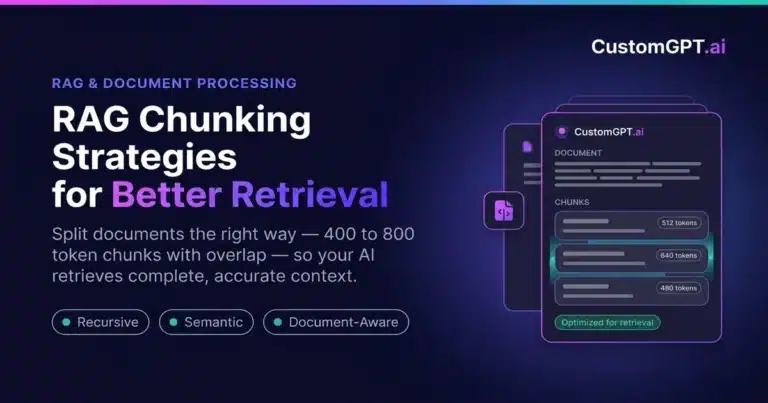
Enterprise RAG projects should define enterprise RAG chunking strategies early, especially for PDFs, manuals, tables, and policy documents.
Businesses build custom RAG solutions to give AI access to proprietary, current, and domain-specific knowledge that a general model does not have. Common goals include answering support questions from product documentation, helping employees search internal policies, and grounding answers in approved sources so the output is easier to verify.
Custom RAG systems are hard to maintain because they are not a one-time build. Content changes, connectors break, retrieval quality drifts, and security and governance need ongoing attention. A custom pipeline also requires engineering, infrastructure, evaluation, and monitoring across many layers.
A RAG chatbot platform for business content often makes more sense when speed, maintainability, security review, and lower engineering overhead matter more than owning every layer of the stack. For many common use cases, a managed approach can reduce the work needed to ingest content, retrieve it, host the system, and keep it running.
Key Takeaways
- Custom RAG connects large language models to proprietary knowledge so answers come from approved company sources rather than model memory alone.
- RAG quality depends on content quality, chunking, retrieval, grounding, and evaluation, not just on the language model.
- Building a custom RAG system from scratch requires engineering, infrastructure, security, monitoring, and ongoing maintenance across many layers.
- Custom RAG can be worth it for highly specialized retrieval logic, proprietary infrastructure, or deep product integration.
- Managed RAG platforms can reduce setup and maintenance for common business use cases such as support, documentation, and internal knowledge search.
- Enterprise teams should evaluate accuracy, security, cost, speed, and governance before deciding to build or buy.
- CustomGPT.ai can help teams create AI agents and chatbots from approved business content without building every layer of the RAG stack manually.
- The strongest first step for most teams is to define one use case, clean the content, test retrieval quality, and choose the simplest architecture that meets the need.
What Are Custom RAG Solutions?
Custom RAG solutions are AI systems that connect a language model to selected business knowledge sources so the system retrieves relevant content before it answers. RAG stands for Retrieval-Augmented Generation, and the core idea is simple: retrieve, add context, then generate.
A custom RAG solution links a large language model to your chosen sources, such as documentation, help center articles, policies, or knowledge bases. When a user asks a question, the system first finds the most relevant passages, then asks the model to answer using that retrieved content. This helps the AI respond from approved sources instead of relying only on general model training. If you are new to the concept, RAG for Beginners explains the fundamentals, and Understanding RAG in Generative AI covers the mechanics in more depth.
Custom RAG is useful for enterprise AI chatbots, internal knowledge assistants, customer support bots, documentation search, compliance support, research workflows, and sales enablement. The common thread is that users want a direct answer grounded in trusted material.
Short example: A customer support team can connect product documentation, help center articles, and policy documents to a RAG chatbot so agents can ask questions and receive grounded answers based on approved content. See how this maps to a customer support AI use case.
How Custom RAG Works
A custom RAG system works as a pipeline that moves from raw content to a grounded answer in a series of clear steps. Understanding the flow helps teams see where quality is won or lost. For an implementation-level walkthrough, see Implementing RAG.
- Collect approved knowledge sources.
- Clean and prepare documents.
- Split documents into chunks.
- Create embeddings.
- Store chunks in a vector database or search index.
- Receive a user question.
- Retrieve relevant chunks.
- Build a grounded prompt.
- Generate an answer with a large language model.
- Add citations or source references where available.
- Evaluate answer quality.
- Update content and retrieval settings over time.
Summary: A RAG system is only as reliable as the content it retrieves and the controls used to evaluate its answers. Strong retrieval and disciplined evaluation matter as much as the model itself.
Core Components of a Custom RAG System
A custom RAG system is made of interconnected components, and a weak link in any one of them can lower answer quality. The table below breaks down the main parts. For a technical deep dive, see The Key Components of a RAG System.
| Component | What it does | Why it matters | Common challenge |
|---|---|---|---|
| Knowledge sources | Holds the approved content the system can answer from | Defines the boundary of what the AI can know | Sources are scattered, outdated, or inconsistent |
| Data ingestion | Pulls content from files, sites, and connectors | Keeps the knowledge base current and complete | Connectors break or sync on irregular schedules |
| Document parsing | Extracts clean text from mixed formats | Clean input leads to better retrieval | PDFs, tables, and scans parse poorly |
| Chunking | Splits documents into retrievable passages | Right-sized chunks improve relevance | Chunks are too large, too small, or split mid-idea |
| Embedding model | Converts text into numerical vectors | Enables semantic search across content | Wrong model choice weakens matching |
| Vector database or search index | Stores and searches chunk vectors | Powers fast, relevant retrieval | Index tuning and scaling add complexity |
| Retriever | Finds the most relevant chunks for a query | Determines what evidence the model sees | Retrieval misses key passages |
| Reranker | Reorders results to surface the best evidence | Improves precision on ambiguous queries | Adds latency and tuning effort |
| Prompt builder | Assembles the query plus retrieved context | Shapes how grounded the answer is | Poor prompts let the model drift off-source |
| LLM or generator | Produces the final answer from the prompt | Controls fluency and synthesis quality | Fluent answers can still be wrong if retrieval is weak |
| Citation layer | Maps answers back to source passages | Makes answers verifiable for users | Citation mapping can be incomplete |
| Evaluation system | Tests retrieval and answer quality | Catches silent failures before users do | Hard to measure faithfulness at scale |
| Security and governance | Controls who can retrieve which sources | Protects sensitive data and meets policy needs | Permission-aware retrieval is complex |
| Monitoring and analytics | Tracks usage, quality, and unknown answers | Supports ongoing improvement | Teams often skip monitoring after launch |
Why Businesses Build Custom RAG Solutions
Businesses build custom RAG solutions to give AI grounded access to knowledge a general model does not have. The motivation is usually a mix of accuracy, control, and the need to use proprietary content.
- Proprietary knowledge access: Answer from internal documents the model never saw in training.
- Domain-specific answers: Tailor retrieval to a niche industry or specialized vocabulary.
- Internal knowledge search: Help employees find policies, runbooks, and project history quickly. This overlaps with enterprise knowledge search.
- Customer support automation: Deflect repetitive questions with grounded, source-backed answers.
- Compliance and policy questions: Surface the latest approved guidance instead of stale copies.
- Product documentation assistance: Turn manuals and release notes into a searchable assistant.
- Sales enablement: Give reps fast, consistent answers from approved collateral.
- Employee onboarding: Help new hires self-serve from handbooks and training material.
- Research and analysis: Pull evidence from large document sets with provenance.
- Controlled answer generation: Keep responses inside a defined set of trusted sources.
Custom RAG Use Cases by Team
Custom RAG solutions deliver value across many teams because almost every department maintains knowledge that employees and customers need to access quickly. The table below maps common use cases to example sources and business value.
| Team | Use case | Example knowledge sources | Business value |
|---|---|---|---|
| Customer support | Grounded answers for agents and customers | Help center, product docs, policies | Faster resolution and consistent answers, as with a customer support AI |
| Sales | Quick answers from approved collateral | Battlecards, pricing notes, FAQs | Shorter ramp and consistent messaging |
| Marketing | On-brand content support from source material | Brand guidelines, case studies, blog library | Faster drafting with fewer factual errors |
| HR | Self-service answers on policy and benefits | Handbooks, benefits guides, policy docs | Fewer repetitive tickets for the HR team |
| IT | Internal help desk and runbook search | Runbooks, setup guides, knowledge base | Faster internal support and onboarding |
| Legal | Clause and policy lookups with sources | Templates, contracts, internal guidance, via professional services AI | Faster review with traceable citations |
| Compliance | Policy questions grounded in current guidance | Regulatory summaries, internal policies | Easier access to the latest approved guidance |
| Product | Answers from specs and release notes | PRDs, specs, changelogs | Quicker cross-team alignment |
| Engineering | Documentation and architecture search | API docs, design docs, wikis | Less time lost hunting for context |
| Education and training | Course and material assistants | Course content, study guides, FAQs | Personalized support, as with education AI |
| Associations or member organizations | Member knowledge and resource search | Member resources, bylaws, FAQs | Better member self-service, see member associations AI |
SaaS teams often combine several of these in one deployment, which fits the startups and SaaS AI use case, and many start with a website AI chatbot before expanding internally.
The Biggest Challenges of Building Custom RAG
The biggest challenges of building custom RAG come from data, retrieval quality, security, and the ongoing maintenance the system needs after launch. Most failures trace back to content and controls rather than the model. For production-grade guidance, see Building Production RAG Pipelines.
- Complex data integration: Connecting many sources and keeping them in sync is non-trivial.
- Messy documents and inconsistent formats: Mixed PDFs, tables, and scans are hard to parse cleanly.
- Poor chunking: Badly sized chunks fragment ideas and hurt retrieval.
- Retrieval quality problems: If the system retrieves the wrong passages, the answer suffers.
- Stale or duplicate content: Outdated copies produce conflicting or wrong answers.
- Permission and access-control complexity: Different users should see different sources.
- Security and compliance risk: Sensitive data needs careful handling and review.
- Hallucination risk from weak retrieval: A fluent answer built on thin evidence can still be wrong.
- Evaluation difficulty: Measuring faithfulness and groundedness at scale is hard.
- Latency and scalability: Multi-step pipelines can get slow under real load.
- Infrastructure cost: Embeddings, storage, and model usage add up.
- Ongoing maintenance: Content, connectors, and settings need continuous attention.
- Need for specialized engineering talent: RAG engineering skills are in short supply.
| Challenge | Why it happens | Business impact | How to reduce risk |
|---|---|---|---|
| Messy source content | Documents come in mixed, inconsistent formats | Weak retrieval and wrong answers | Clean and standardize content before indexing |
| Poor chunking | Default chunk settings split ideas badly | Lower relevance and missed context | Test chunk sizes against real questions |
| Weak retrieval | Embedding or index choices miss key passages | Hallucination risk and low trust | Add reranking and hybrid retrieval, then evaluate |
| Stale content | No refresh process for changing sources | Conflicting or outdated answers | Schedule syncs and remove duplicates |
| Access-control gaps | Permission-aware retrieval is hard to build | Sensitive data exposure | Apply role-based access and source governance, see security and trust |
| No evaluation | Teams ship before defining quality metrics | Silent failures reach users | Build an evaluation set before launch |
| High maintenance load | RAG is treated as a one-time build | Quality drifts over time | Assign a clear owner and review cadence |
Why Custom RAG Projects Fail
Custom RAG projects usually fail for process and content reasons, not because RAG itself does not work. Recognizing these patterns early prevents most of them.
- Treating RAG as a one-time build instead of an ongoing system.
- Uploading unclean or outdated content and expecting clean answers.
- Measuring only answer fluency instead of source accuracy and groundedness.
- Ignoring how the system behaves when the answer is unknown.
- Over-indexing sensitive information without access controls.
- Lacking a clear owner responsible for quality and updates.
- Not testing with real user questions before launch.
- Building before defining success metrics.
- Underestimating connector maintenance and sync reliability.
- Ignoring governance and human review workflows for high-risk topics.
Build vs Buy: Should You Build a Custom RAG Solution?
Build a custom RAG solution when you need highly specialized retrieval logic, proprietary infrastructure, or deep product integration that a managed platform cannot support. Buy or use a managed RAG platform when speed, maintainability, security review, and lower engineering overhead matter more than owning every layer of the stack. The deciding factors are use case complexity, security needs, engineering resources, and governance requirements.
| Option | Best for | Pros | Cons | Typical team |
|---|---|---|---|---|
| Build custom RAG from scratch | Specialized retrieval or proprietary infrastructure | Full control and deep customization | High cost, long timeline, heavy maintenance | Engineering-led teams with RAG expertise |
| Use a managed RAG platform | Common use cases and faster launch | Lower setup effort, less infrastructure to maintain | Less control over low-level internals | Lean teams that want speed and governance |
| Hybrid approach | Standard pipeline plus custom logic | Balance of control and speed | Requires coordination across both layers | Teams using a platform with custom add-ons |
| Start with managed RAG and build custom later | Validating value before heavy investment | Fast proof of value, lower upfront risk | May need migration work if you outgrow it | Teams testing a use case before scaling |
A practical pattern is to start with a managed approach to prove value, then build custom components only where they add clear differentiation. Many teams use CustomGPT.ai for the core pipeline while adding custom logic through the RAG API. For architecture options, see RAG Architecture Patterns, RAG System Design, and RAG vector database selection.
Custom RAG Cost Factors
Custom RAG cost depends on engineering time, infrastructure, and the ongoing work of keeping the system accurate. Exact prices vary by scope, so it helps to think in terms of cost drivers rather than fixed numbers.
| Cost area | What drives cost | Build-from-scratch consideration | Managed-platform consideration |
|---|---|---|---|
| Engineering time | Pipeline design, build, and debugging | Largest cost driver for custom builds | Reduced, since the pipeline is provided |
| Data preparation | Cleaning and structuring content | Required regardless of approach | Still required, but ingestion is handled |
| Embedding and model usage | Volume of content and queries | You manage and optimize usage directly | Usage is bundled or managed by the platform |
| Vector database or search infra | Index size and query load | You provision, tune, and scale it | Provided as part of the platform |
| Hosting and scaling | Traffic and reliability targets | You run and scale the infrastructure | Handled by the platform |
| Security review | Compliance and access requirements | You design and document controls | Review the platform’s posture, see security |
| Connector maintenance | Number and stability of sources | Ongoing engineering burden | Reduced where connectors are maintained for you |
| Evaluation and QA | Depth of testing and metrics | You build evaluation tooling | You still validate answers and quality |
| Monitoring and analytics | Visibility and alerting needs | You build dashboards and alerts | Often included, but you still review results |
| Ongoing updates | Content and settings changes | Continuous internal effort | Lower operational load, content work remains |
Custom RAG Security Considerations
Security in RAG is not only about where data is stored. It is also about which users and prompts can retrieve which knowledge sources. A strong security posture treats retrieval itself as a control surface.
- Access control: Restrict who can use the system and what they can ask.
- Permission-aware retrieval: Ensure users only retrieve sources they are allowed to see.
- Sensitive data separation: Keep high-risk content isolated from general indexes.
- Auditability: Log who accessed what and when for review.
- Source governance: Approve, version, and retire sources deliberately.
- Human review for high-risk topics: Route sensitive answers through people.
- Secure connectors: Use trusted, well-maintained integrations, see data connectors.
- Data retention policies: Define how long data and logs are kept.
- Compliance review: Align with the policies your organization must follow.
- Token and API key protection: Store credentials securely and rotate them.
- Role-based administration: Separate admin, editor, and viewer permissions.
For LLM-specific risks, the OWASP Top 10 for LLM Applications is a useful reference, and the NIST AI Risk Management Framework offers a structured way to govern AI risk. CustomGPT.ai publishes its own posture on the security and trust page.
Custom RAG Evaluation Metrics
Custom RAG evaluation should measure retrieval quality, faithfulness, and real user outcomes, not just whether answers sound fluent. Untested RAG creates silent failures that only surface when users lose trust.
| Evaluation area | What to test | Example metric |
|---|---|---|
| Retrieval precision | Whether retrieved chunks are relevant | Share of retrieved chunks that are on-topic |
| Retrieval recall | Whether the system finds the needed evidence | Share of relevant chunks successfully retrieved |
| Faithfulness | Whether the answer stays true to sources | Rate of claims supported by retrieved evidence |
| Groundedness | Whether answers come from approved content | Share of answers traceable to sources |
| Citation accuracy | Whether citations match the claims | Rate of correct citation mapping |
| Answer relevance | Whether the answer addresses the question | Human or model relevance score |
| Unknown-answer rate | How often the system declines when unsure | Share of out-of-scope questions handled safely |
| Escalation rate | How often answers route to a human | Share of sessions escalated |
| Latency | How fast answers return | Median and tail response time |
| User satisfaction | Whether users find answers useful | Thumbs-up rate or survey score |
| Deflection rate | Share of questions resolved without a human | Self-service resolution rate |
| Human review pass rate | Quality of sampled answers on review | Share of reviewed answers marked acceptable |
Pairing strong retrieval with disciplined evaluation is the most reliable way to reduce wrong answers. CustomGPT.ai describes its grounding approach on the anti-hallucination page, though teams should still validate answers themselves.
Custom RAG vs Fine-Tuning vs Generic AI Chatbots
Custom RAG, fine-tuning, and generic chatbots solve different problems, and many teams combine them. Fine-tuning changes model behavior or task style, RAG retrieves external knowledge at query time, generic chatbots may not know current or proprietary content, and managed RAG platforms reduce the need to assemble infrastructure manually.
| Approach | What it does | Best for | Limitations | When to use |
|---|---|---|---|---|
| Custom RAG | Retrieves your knowledge at query time, then generates | Grounded answers from proprietary content | Requires content, retrieval, and evaluation work | You need current, source-backed answers |
| Fine-tuning | Adjusts model behavior, tone, or task style | Consistent style or specialized task formatting | Does not add fresh facts on its own | You need behavior shaping, not new knowledge |
| Generic AI chatbot | Answers from general training data | Broad, general questions | May miss current or proprietary details | The task does not need your private content |
| Managed RAG platform | Provides the RAG pipeline as a service | Common use cases and faster launch | Less control over low-level internals | You want grounded answers with less overhead |
A common pattern is RAG for facts and provenance, plus light customization for tone and structure. For a deeper comparison, see Mastering Custom RAG.
Custom RAG vs Enterprise Search
Custom RAG and enterprise search are complementary, not interchangeable. Enterprise search returns documents or links, while RAG retrieves evidence and generates a natural-language answer.
- Enterprise search returns a ranked list of documents or links.
- RAG retrieves relevant evidence, then writes a direct answer grounded in it.
- RAG is useful when users want an answer, not just a list of results.
- Search remains valuable for discovery, verification, and reviewing full sources.
- Strong systems often combine search, retrieval, citations, and answer generation so users can both get an answer and check the source. This blended model fits many enterprise knowledge search deployments.
When a Managed RAG Platform Makes More Sense
A managed RAG platform often makes more sense when the use case is common and speed and maintainability matter more than owning every layer of the stack. The following signals point toward a managed approach.
- The team wants to launch quickly.
- The use case is common, such as support, documentation, internal knowledge, onboarding, or website chat.
- The team lacks deep RAG engineering resources.
- The content sources are standard documents, websites, help centers, or business knowledge bases.
- The business wants grounded answers without maintaining every layer of the retrieval stack.
- Governance, monitoring, and content updates matter after launch.
If several of these apply, starting with a managed platform and revisiting custom work later is usually the lower-risk path. You can compare options on the CustomGPT.ai pricing page and review real deployments in customer stories.
How CustomGPT.ai Helps With Custom RAG Solutions
CustomGPT.ai helps teams create AI agents and chatbots from approved business content so users can receive grounded answers from company knowledge sources. Instead of building every layer of a custom RAG pipeline manually, teams can use CustomGPT.ai to move faster while still focusing on content quality, testing, governance, and monitoring.
- Teams can use approved business content as the knowledge base.
- Teams can create AI agents and chatbots for internal or customer-facing use cases.
- A managed RAG approach can reduce the need to build ingestion, retrieval, hosting, and maintenance infrastructure from scratch.
- Teams should still validate answers, keep content updated, and monitor performance over time.
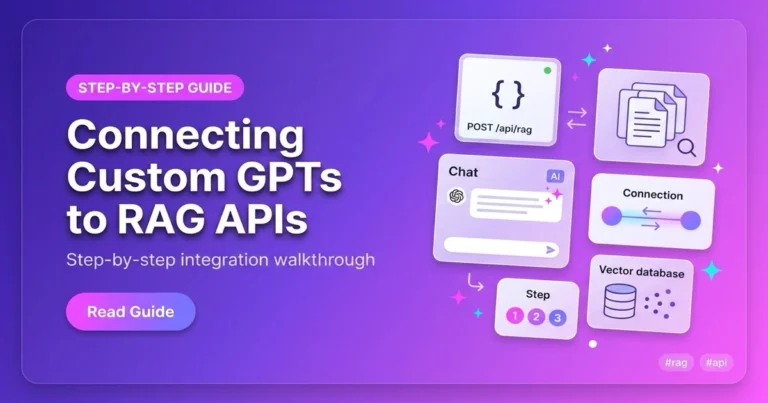
CustomGPT.ai is designed to handle much of the retrieval pipeline so teams can focus on the content and the outcomes. To see how the platform fits together, review How It Works, the RAG API for custom integrations, and the developer documentation. For larger rollouts, the Enterprise AI platform page covers governance and scale. CustomGPT.ai does not claim to guarantee perfect accuracy or remove the need for human review, so grounding, testing, and governance remain the team’s responsibility.
Custom RAG Implementation Checklist
This checklist groups the practical steps for launching a reliable custom RAG solution, from strategy through monitoring.
Strategy
- Define one high-value use case and the success metrics for it.
- Identify the audience and the questions they actually ask.
- Decide build, buy, or hybrid based on resources and complexity.
Content readiness
- Inventory approved sources and remove stale or duplicate content.
- Standardize formats and clean messy documents.
- Confirm content ownership and an update cadence.
Retrieval quality
- Test chunk sizes against real questions.
- Add reranking or hybrid retrieval where it helps.
- Verify that retrieved evidence supports the answers.
Security and governance
- Apply role-based access and permission-aware retrieval.
- Separate sensitive sources and define retention policies.
- Document a review workflow for high-risk topics.
User experience
- Define fallback behavior for unknown answers.
- Show citations or source references where available.
- Set a clear, helpful tone for declined questions.
Testing
- Build an evaluation set of real user questions.
- Measure faithfulness, relevance, and unknown-answer handling.
- Run a stakeholder review before launch.
Launch
- Start with a scoped pilot and a limited audience.
- Brief the owner and support team on escalation paths.
- Communicate what the assistant can and cannot do.
Monitoring
- Track quality, deflection, and unknown answers after launch.
- Review sampled answers on a regular cadence.
- Update content and retrieval settings based on results.
30-Day Custom RAG Launch Plan
This 30-day plan moves a custom RAG project from use case definition to a monitored pilot in four focused weeks.
Week 1: Use case definition and content audit
- Goal: Lock one high-value use case and confirm source readiness.
- Tasks: Define the audience, list real questions, inventory approved sources, remove duplicates, set success metrics.
- Deliverables: Use case brief, source inventory, metric definitions.
- Success criteria: A single agreed use case with clean, owned sources and clear metrics.
Week 2: Knowledge base preparation and prototype
- Goal: Build a working prototype on prepared content.
- Tasks: Clean and standardize documents, configure ingestion, test chunking and retrieval, assemble a first prompt.
- Deliverables: Prepared knowledge base, working prototype, initial retrieval settings.
- Success criteria: The prototype answers core questions with traceable sources.
Week 3: Testing, evaluation, and stakeholder review
- Goal: Validate quality before exposing real users.
- Tasks: Build an evaluation set, measure faithfulness and relevance, test unknown-answer behavior, run a stakeholder review.
- Deliverables: Evaluation report, fixes log, review sign-off.
- Success criteria: Quality metrics meet the bar and high-risk gaps are addressed.
Week 4: Pilot launch, monitoring, and optimization
- Goal: Launch to a limited audience and improve from real usage.
- Tasks: Ship the pilot, monitor quality and deflection, review sampled answers, tune content and retrieval.
- Deliverables: Live pilot, monitoring dashboard, optimization notes.
- Success criteria: Stable quality, useful deflection, and a clear plan to scale.
Common Mistakes to Avoid
These mistakes account for most disappointing custom RAG results, and each one is avoidable with a little discipline.
- Starting with too many use cases at once instead of one focused win.
- Indexing everything without governance or access controls.
- Ignoring source quality and indexing messy or outdated documents.
- Skipping evaluation and shipping on gut feel.
- Using outdated documents that conflict with current guidance.
- Not defining fallback behavior for unknown answers.
- Ignoring access control and permission-aware retrieval.
- Assuming RAG removes all hallucination risk on its own.
- Underestimating ongoing maintenance and connector upkeep.
- Launching without a clear owner accountable for quality.
Best Practices for Reliable Custom RAG
Reliable custom RAG comes from focus, clean content, and continuous evaluation. These practices keep quality high after launch.
- Start with one high-value use case and expand from there.
- Use approved source content and confirm ownership.
- Remove stale or duplicate documents before indexing.
- Define clear answer boundaries and out-of-scope behavior.
- Use citations where possible so answers are verifiable.
- Test with real user questions, not idealized ones.
- Track unknown answers and improve coverage over time.
- Route high-risk topics through human review.
- Keep source content updated on a regular schedule.
- Monitor answer quality continuously and act on the data.
Conclusion
Custom RAG solutions can help businesses create grounded AI systems that answer from proprietary knowledge instead of model memory alone. Done well, they improve accuracy, provenance, and trust across support, internal knowledge, and many other workflows.
Building a custom RAG system from scratch gives control, but it adds complexity, cost, risk, and ongoing maintenance across many layers. Managed RAG platforms can help many teams launch faster and carry less operational load for common use cases. The right choice depends on use case complexity, security needs, engineering resources, and governance requirements.
For many teams, the best first step is to define the use case, clean the content, test retrieval quality, and choose the simplest architecture that meets the business need. If a managed approach fits, CustomGPT.ai can help teams create AI agents from approved business content without building every layer of the RAG stack manually, while the team keeps ownership of content quality, testing, and governance.
Frequently Asked Questions
What are custom RAG solutions?
Custom RAG solutions are AI systems that connect a language model to a company’s own knowledge sources so the system retrieves relevant content before generating an answer. RAG stands for Retrieval-Augmented Generation. The retrieval step lets the AI answer from approved documents, policies, and knowledge bases rather than relying only on general model training, which makes responses easier to ground and verify.
What does RAG mean in AI?
RAG means Retrieval-Augmented Generation, an approach where an AI system looks up relevant information from external sources before it writes an answer. A simple way to remember it is retrieve, add context, then generate. This pattern helps the model produce responses informed by current or proprietary data, instead of depending only on what it learned during training.
How does a custom RAG system work?
A custom RAG system works as a pipeline. It collects approved sources, prepares and chunks the content, creates embeddings, and stores them in a vector database or search index. When a user asks a question, the system retrieves the most relevant chunks, builds a grounded prompt, and generates an answer with a language model, often adding citations. Teams then evaluate quality and update content over time.
Why do businesses use custom RAG solutions?
Businesses use custom RAG solutions to give AI grounded access to proprietary, current, and domain-specific knowledge. Common goals include automating customer support, helping employees search internal policies, assisting with product documentation, and keeping answers inside a set of approved sources. The result is responses that are more relevant to the business and easier to verify than general model output.
What are the main components of a custom RAG system?
The main components include knowledge sources, data ingestion, document parsing, chunking, an embedding model, a vector database or search index, a retriever, an optional reranker, a prompt builder, the language model, a citation layer, an evaluation system, security and governance, and monitoring. Each part affects the others, so weak retrieval or messy content can lower answer quality even with a strong model.
Is custom RAG better than fine-tuning?
Custom RAG and fine-tuning solve different problems, so neither is universally better. RAG retrieves external knowledge at query time and is well suited to grounding answers in current or proprietary content. Fine-tuning adjusts model behavior, tone, or task style but does not add fresh facts on its own. Many teams combine both, using RAG for facts and light customization for tone and structure.
How much does it cost to build a custom RAG solution?
The cost of building a custom RAG solution varies widely by scope, so it helps to think in terms of cost drivers. Major factors include engineering time, data preparation, embedding and model usage, vector database and hosting infrastructure, security review, connector maintenance, evaluation, and ongoing updates. Building from scratch usually carries higher engineering and maintenance costs than a managed platform for common use cases.
How long does it take to build a custom RAG system?
Timelines depend on scope, content readiness, and team experience. A focused pilot on clean content can move quickly, while a fully custom enterprise pipeline with deep integrations and strict governance takes longer. A practical approach is a roughly 30-day plan: define the use case and audit content, prepare the knowledge base and prototype, test and review, then launch a monitored pilot and optimize.
What are the biggest challenges of custom RAG development?
The biggest challenges of custom RAG development involve data, retrieval quality, security, and maintenance. Teams struggle with messy documents, poor chunking, weak retrieval, stale content, permission-aware access control, evaluation difficulty, latency, infrastructure cost, and the ongoing upkeep the system needs. Most failures trace back to content and process issues rather than the language model itself.
Should I build or buy a RAG solution?
Build a custom RAG solution when you need highly specialized retrieval logic, proprietary infrastructure, or deep product integration a platform cannot support. Buy or use a managed RAG platform when speed, maintainability, security review, and lower engineering overhead matter more than owning every layer. A common path is to start managed to prove value, then build custom components only where they add clear differentiation.
What is a managed RAG platform?
A managed RAG platform provides the retrieval-augmented generation pipeline as a service, so teams can create AI agents from approved content without assembling ingestion, retrieval, hosting, and maintenance infrastructure from scratch. It can reduce setup and operational load for common use cases such as support, documentation, and internal knowledge. Teams still need to prepare content, validate answers, and maintain governance.
How do you evaluate a custom RAG system?
You evaluate a custom RAG system by measuring retrieval quality, faithfulness, and real user outcomes, not just fluency. Useful measures include retrieval precision and recall, groundedness, citation accuracy, answer relevance, unknown-answer rate, latency, deflection rate, and human review pass rate. Building an evaluation set of real questions before launch helps catch silent failures before they reach users.
How do custom RAG solutions reduce hallucinations?
Custom RAG solutions can reduce hallucinations by grounding answers in retrieved evidence from approved sources rather than relying on model memory alone. Strong retrieval, citations, and a clear fallback for unknown answers all help. RAG does not remove hallucination risk entirely, especially when retrieval is weak or content is stale, so evaluation, source governance, and human review for high-risk topics remain important.
What security risks matter in custom RAG?
Security in RAG is not only about where data is stored. It is also about which users and prompts can retrieve which sources. Key risks include weak access control, missing permission-aware retrieval, over-indexed sensitive data, insecure connectors, and poor auditability. Useful references include the OWASP Top 10 for LLM Applications and the NIST AI Risk Management Framework, alongside role-based administration and human review.
What teams benefit most from custom RAG?
Teams that maintain knowledge people need to access quickly benefit most, including customer support, sales, HR, IT, legal, compliance, product, engineering, and education or member organizations. The shared pattern is that users want a direct, grounded answer from trusted material instead of a list of documents. Support and internal knowledge use cases are often the highest-value starting points.
How does CustomGPT.ai help with custom RAG solutions?
CustomGPT.ai helps teams create AI agents and chatbots from approved business content so users can receive grounded answers from company knowledge sources. Instead of building every layer of a RAG pipeline manually, teams can use CustomGPT.ai to move faster while focusing on content quality, testing, governance, and monitoring. It is designed to handle much of the retrieval work, though teams should still validate answers and keep content current.