RAG Architecture Patterns: From Basic to Enterprise-Grade
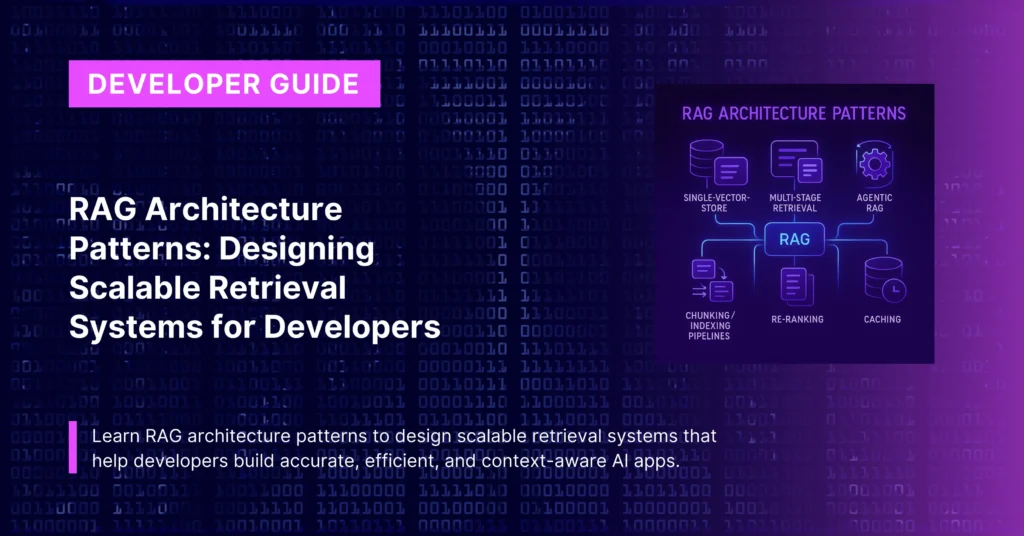
RAG is not a single design. It is a family of RAG architecture patterns that combine retrieval, grounding, generation, evaluation, citations, permissions, and deployment into working systems. Many teams start with a simple retrieve-and-generate pipeline, then discover that production needs far more: ingestion, chunking, indexing, hybrid retrieval, reranking, permission-aware access, citations, evaluation, monitoring, and guardrails.
For teams still choosing the right retrieval layer, start with the RAG vs semantic search architecture comparison.
The framework you choose influences which architecture patterns are practical to maintain. Our open source RAG framework guide compares where LangChain, LlamaIndex, Haystack, and managed RAG platforms fit.
This guide explains the main RAG architecture patterns, how they differ, what components each one requires, the trade-offs involved, and how to choose the right pattern for customer support, internal knowledge, compliance AI workflows, legal, education, and enterprise search.
Direct Answer: What Are the Main RAG Architecture Patterns?
RAG architecture patterns define how a system retrieves trusted information, passes it to an LLM, and generates grounded, source-cited answers. The most common patterns are basic RAG, advanced RAG, hybrid RAG, corrective RAG (CRAG), agentic RAG, multi-hop RAG, graph RAG, multimodal RAG, multi-tenant RAG, private or on-prem RAG, and managed RAG platforms. Basic RAG retrieves context and generates an answer. Production RAG adds hybrid search, reranking, metadata filtering, citations, access control, evaluation, and analytics. The right pattern depends on data complexity, accuracy requirements, security needs, latency, cost, and the specific use case the system serves.
What Is RAG Architecture?
RAG architecture is the end-to-end design that turns your trusted content into grounded answers. At an enterprise level, a complete RAG system does the following:
- Ingests trusted documents and knowledge sources
- Prepares content through parsing, cleaning, chunking, and metadata tagging
- Indexes content using embeddings, keyword indexes, or hybrid retrieval
- Retrieves the most relevant context for each query
- Reranks or filters retrieved context to improve precision
- Passes grounded context to the LLM
- Generates an answer from that context
- Cites the sources behind the answer
- Evaluates answer quality against expected results
- Monitors performance and continuously improves retrieval
The retrieve-and-generate core is simple. The difference between a demo and a production system lives in the layers around it. Vendor references describe the same core pattern, including IBM, AWS, and NVIDIA. For the underlying building blocks, see the components of a RAG system and the complete guide to RAG.
RAG Architecture Flow
A production RAG pipeline generally moves through these stages:
User Query
  -> Query Understanding
  -> Retrieval Layer
  -> Hybrid Search / Vector Search / Keyword Search
  -> Metadata Filtering
  -> Reranking
  -> Context Assembly
  -> LLM Generation
  -> Citation Layer
  -> Guardrails
  -> Final Source-Cited Answer
  -> Analytics and Evaluation
Simpler patterns collapse several of these stages. Enterprise patterns keep them separate so each layer can be tuned, secured, and measured. The embeddings behind the retrieval layer are explained in OpenAI’s embeddings guide, and vector indexing is documented by Google Vertex AI Vector Search and the Pinecone learning center.
RAG Architecture Patterns Compared
| RAG Architecture Pattern | How It Works | Best For | Main Trade-Off |
|---|---|---|---|
| Basic RAG | Retrieves top-k chunks and sends them to an LLM to generate an answer | Simple knowledge bases and prototypes | Weak retrieval and higher hallucination risk if context is poor |
| Advanced RAG | Adds query rewriting, better chunking, metadata, reranking, and citations | Production knowledge assistants | More components to build and maintain |
| Hybrid RAG | Combines keyword and vector search, then reranks | Enterprise content needing precision and recall | Requires tuning both retrieval methods |
| Corrective RAG (CRAG) | Evaluates retrieval quality and retries or withholds when evidence is weak | Trust-sensitive and compliance workflows | Added latency and evaluation logic |
| Agentic RAG | An agent decides which tools, sources, and retrieval steps to use | Complex tasks needing reasoning plus retrieval | Higher complexity and stronger guardrails needed |
| Multi-hop RAG | Retrieves and combines facts across multiple documents or steps | Research, legal, and policy analysis | More latency and harder evaluation |
| Graph RAG | Uses relationships between entities and knowledge nodes | Connected, relationship-heavy knowledge | Requires data modeling and maintenance |
| Multimodal RAG | Grounds answers in text, PDFs, images, slides, audio, and video | Training, product docs, and mixed-media knowledge | Depends on parsing and extraction quality |
| Multi-tenant RAG | Isolates data and access across customers, departments, or roles | SaaS, agencies, and regulated enterprises | Requires strict isolation and auditability |
| Private or on-prem RAG | Runs inside a controlled environment so data stays in place | Regulated industries, government, and security teams | Deployment and maintenance overhead |
| Managed RAG platform | A platform handles ingestion, retrieval, citations, and deployment | Teams needing production RAG without building it | Less low-level control than a custom build |
Basic RAG Pattern
Basic RAG is the starting point. It retrieves the top-k most relevant chunks for a query, sends them to an LLM, and generates an answer.
It works well for simple knowledge bases, internal prototypes, and low-risk questions. Its limitations show up quickly at scale: retrieval can be weak, there is usually no reranking or metadata filtering, and answers carry more hallucination risk when the retrieved context is thin or off-target. Basic RAG is the right way to learn the pattern, and the wrong way to run a trust-sensitive system. To ground the fundamentals, see the complete guide to RAG and the components of a RAG system.
Advanced RAG Pattern
Advanced RAG is what most production systems actually need. It keeps the retrieve-and-generate core and adds the layers that make answers reliable:
- Better ingestion and cleaner source preparation
- Deliberate chunking strategies suited to the content
- Metadata tagging for filtering and routing
- Query rewriting to improve retrieval
- Reranking to surface the best context before generation
- Citations that tie each answer to a source
- An evaluation loop to catch regressions
This pattern trades simplicity for accuracy and control. The engineering reality is covered in building production RAG pipelines and the step-by-step RAG implementation guide.
Hybrid RAG Pattern
Hybrid RAG combines keyword search and vector search in the retrieval layer. Keyword search nails exact terms such as IDs, policy names, SKUs, and legal clauses. Vector search captures semantic meaning and related concepts. A reranking step then merges and orders the results so the strongest context reaches the LLM.
This pattern fits enterprise content where both precision and recall matter, which is most real-world knowledge. The full approach is detailed in hybrid keyword and vector search for better accuracy.
Corrective RAG (CRAG) Pattern
Corrective RAG adds a retrieval evaluator. Before generating, the system checks whether the retrieved context is actually good enough to answer the question. If retrieval is weak, it can reformulate the query, retrieve again, or decline to produce an unsupported answer.
This reduces confident-but-wrong responses, which makes it valuable for trust-sensitive workflows such as compliance, legal, and regulated support. The pattern and its trade-offs are compared in CRAG vs RAG.
Agentic RAG Pattern
Agentic RAG uses an agent or workflow to decide how to answer. Instead of one fixed retrieval step, the agent can choose tools, call APIs, search multiple systems, and break a complex task into sub-steps, each grounded in retrieval.
It suits workflows that need reasoning plus retrieval, but it is more complex and demands stronger guardrails so the agent stays grounded and governed. See LLM-based AI agent development and how hosted MCP servers connect RAG-powered agents to trusted tools and data.
Multi-hop RAG Pattern
Multi-hop RAG retrieves information across multiple documents or reasoning steps, then combines it into one answer. It is useful when a single chunk cannot answer the question and the system must connect facts from different sources.
This fits research, legal analysis, technical support, and policy questions. The trade-off is more latency and more complex evaluation, since correctness now depends on several retrieval hops working together.
Graph RAG Pattern
Graph RAG uses the relationships between entities, topics, documents, and knowledge nodes rather than treating each chunk in isolation. By following connections in a knowledge graph, it can answer questions that depend on how things relate.
It is well suited to research-heavy or relationship-heavy domains. The cost is upfront and ongoing: graph RAG requires strong data modeling and maintenance to keep the relationships accurate.
Multimodal RAG Pattern
Multimodal RAG retrieves and grounds answers from more than text. It can draw on PDFs, images, slides, audio, video transcripts, and tables.
This fits education, training, product documentation, research, and mixed-media enterprise knowledge bases. Its quality depends heavily on parsing and extraction, since an answer is only as good as the content the system managed to read from each format.
Multi-tenant Enterprise RAG Pattern
Multi-tenant RAG supports many customers, departments, workspaces, or roles on shared infrastructure while keeping each tenant’s data isolated. It is critical for SaaS products, enterprises, agencies, and regulated companies.
The defining requirements are isolation, access control, auditability, analytics, and secure deployment, so one tenant can never retrieve another tenant’s content. The architecture is detailed in multi-tenant RAG platforms for secure AI assistants.
Private or On-prem RAG Pattern
Private or on-prem RAG runs inside a controlled environment when data cannot leave it. This applies to regulated industries, government, legal, healthcare, finance, and security-conscious enterprises.
It gives teams data sovereignty and tight control, in exchange for deployment responsibility: security reviews, access management, monitoring, and maintenance all sit with the organization. The deployment options are covered in deploying a RAG chatbot on private cloud or on-prem.
Managed RAG Platform Pattern
A managed RAG platform handles the hard parts: ingestion, chunking, retrieval, reranking, citations, deployment, analytics, and ongoing improvement. It is the right pattern for teams that need production-ready RAG without building and maintaining the full pipeline themselves.
CustomGPT.ai is a managed RAG platform for teams that want secure, source-cited AI assistants trained on their own content. Teams weighing this route can review custom RAG solutions, the fundamentals of custom RAG, and the RAG build vs buy breakdown. Enterprise deployments benefit from platform-level security such as SOC 2 Type 2 certification. Microsoft also documents the managed retrieval pattern in its Azure AI Search RAG overview.
Which RAG Architecture Pattern Should You Use?
| Use Case | Recommended RAG Pattern | Why |
|---|---|---|
| Customer support chatbot | Advanced or hybrid RAG | Needs accurate, cited answers from help content, as in ticket deflection |
| Internal knowledge assistant | Advanced RAG with permissions | Employees need grounded answers scoped to what they can access |
| Legal document Q&A | Multi-hop or hybrid RAG | Answers often span multiple contracts and exact clauses |
| Compliance assistant | Corrective RAG | Withholding weak answers matters more than always answering |
| Association knowledge base | Advanced RAG | Members expect instant answers from association content, per membership organization AI search |
| Education or non-profit assistant | Multimodal RAG | Learning content spans documents, slides, and video, per AI for non-profits |
| SaaS documentation assistant | Hybrid RAG | Product terms and semantic questions both appear, as in AI knowledge base chatbots |
| Government or public service chatbot | Private or on-prem RAG | Data control and compliance requirements drive deployment |
| Research assistant | Graph or multi-hop RAG | Connected facts and relationships need to be combined |
| Enterprise search | Hybrid RAG | Precision on exact terms plus recall on meaning |
| Multi-customer SaaS AI assistant | Multi-tenant RAG | Each customer must query only their own documents |
Production RAG Architecture Checklist
Before shipping a RAG system to real users, confirm the architecture covers each layer:
- Reliable ingestion from your real sources
- Clean parsing across every file type you support
- Smart chunking suited to the content structure
- A metadata strategy for filtering and routing
- Hybrid retrieval combining keyword and vector search
- Reranking to prioritize the strongest context
- Source citations on every answer
- Permission-aware retrieval so users see only what they should
- Guardrails to limit unsupported answers
- An evaluation framework with expected results
- Analytics on questions, gaps, and performance
- A human feedback loop to improve retrieval
- Monitoring after launch, not just before
- Security and compliance controls
- A deployment model that fits your data rules
- Cost and latency controls
Common RAG Architecture Mistakes
Most RAG failures trace back to a small set of avoidable mistakes:
- Treating vector search as the entire RAG system, when it is one retrieval layer, a point explored in RAG vs vector search
- Ignoring document preparation and feeding the system messy content
- Using a poor chunking strategy that splits meaning apart
- Shipping with no metadata, so filtering and routing are impossible
- Skipping reranking and letting weak context reach the LLM
- Providing no citations, which erodes trust and makes review impossible
- Running with no evaluation framework, so quality drifts silently
- Ignoring permission-aware retrieval in multi-user environments
- Overusing long context windows instead of good retrieval, a trade-off covered in long context windows vs RAG
- Doing no monitoring after launch
- Building from scratch without accounting for maintenance cost, which relates to how models reason versus memorize
Should You Build RAG Architecture Yourself or Use a Managed Platform?
Building your own RAG architecture gives full control, and it fits teams with the engineering resources to own it. Those teams take on ingestion, embeddings, retrieval, reranking, evaluation, monitoring, security, and maintenance as ongoing work, not a one-time project.
A managed platform reduces time-to-value by handling those layers for you. CustomGPT.ai is built for teams that want secure, no-code, source-cited AI assistants trained on their own content, without assembling and maintaining the full pipeline in-house. The full comparison is in the RAG build vs buy breakdown.
Real-World Examples of Production RAG Architecture
These CustomGPT.ai deployments show what happens when teams move from simple retrieval to production-ready, source-cited RAG.
- GEMA, one of the world’s largest music rights societies, resolved 248,000+ queries, saved 6,000+ working hours, reached an 88% success rate, and estimated cost avoidance of roughly 182,000 to 211,000 euros. Read the GEMA case study.
- Bernalillo County handled 114,836 AI contacts at about $0.99 per AI contact versus $4.59 for a staff-assisted contact, reaching 4.81x ROI and an estimated $108,143.75 in net savings. Read the Bernalillo County case study.
- BQE Software answered 180,000 support questions, reached an 86% AI resolution rate, and had 64% of help center queries handled by AI. Read the BQE Software case study.
- MIT’s Martin Trust Center built ChatMTC, a no-code AI knowledge assistant offering 24/7 access in 90+ languages with grounded, source-based answers. Read the MIT ChatMTC case study.
In each case, the value came from the architecture around retrieval: grounding, citations, permissions, and evaluation turned a search index into a trustworthy answer engine.
Four Practical Examples
Example 1: Support with hybrid RAG
A support chatbot uses hybrid RAG to answer product questions. Keyword search matches exact feature and error names, vector search captures the intent, and the answer cites the exact help article.
Example 2: Legal with multi-hop RAG
A legal team uses multi-hop RAG to answer questions that span several contracts and policy documents, combining clauses from different sources into one grounded response.
Example 3: Compliance with corrective RAG
A compliance team uses corrective RAG so that when the retrieved evidence is weak, the system retries or declines rather than producing an unsupported answer.
Example 4: SaaS with multi-tenant RAG
A SaaS company uses multi-tenant RAG so each customer’s assistant can query only that customer’s documents, with strict isolation and audit trails.
A high-stakes enterprise pattern is RAG-backed compliance automation, where retrieval, citations, access control, and review logs work together for regulated teams.
Frequently Asked Questions
What are RAG architecture patterns?
RAG architecture patterns are proven designs for building retrieval-augmented generation systems. They combine retrieval, grounding, generation, citations, evaluation, permissions, and deployment in different ways to fit different accuracy, security, and cost needs.
What is the most common RAG architecture?
Basic RAG is the most common starting point: retrieve the top matching chunks and generate an answer. Most production systems move to advanced or hybrid RAG to add reranking, metadata filtering, and citations.
What is the difference between basic RAG and advanced RAG?
Basic RAG retrieves context and generates an answer with little tuning. Advanced RAG adds query rewriting, better chunking, metadata, reranking, citations, and evaluation, which makes it far more reliable for production use.
What is hybrid RAG architecture?
Hybrid RAG combines keyword search and vector search, then reranks the results. Keyword search handles exact terms and identifiers, vector search handles semantic meaning, and reranking prioritizes the strongest context for generation.
What is corrective RAG?
Corrective RAG, or CRAG, adds a retrieval evaluator that checks whether the retrieved context is good enough before generating. If evidence is weak, it can reformulate the query, retrieve again, or avoid an unsupported answer.
What is agentic RAG?
Agentic RAG uses an agent to decide which tools, data sources, and retrieval steps to use for a task. It can call APIs, search multiple systems, and break complex work into grounded sub-steps, at the cost of more complexity.
What is multi-hop RAG?
Multi-hop RAG retrieves and combines information across multiple documents or reasoning steps. It suits questions that no single chunk can answer, such as research, legal, and policy analysis, and it adds latency and evaluation complexity.
What is graph RAG?
Graph RAG uses relationships between entities, topics, and documents in a knowledge graph. It answers questions that depend on how information connects, and it requires strong data modeling and ongoing maintenance.
What is multi-tenant RAG?
Multi-tenant RAG serves many customers, departments, or roles on shared infrastructure while isolating each tenant’s data. It is essential for SaaS and regulated organizations and requires access control, isolation, and auditability.
What components are required in production RAG architecture?
Production RAG needs reliable ingestion, clean parsing, smart chunking, metadata, hybrid retrieval, reranking, citations, permission-aware retrieval, guardrails, evaluation, analytics, monitoring, and a deployment model that meets security and compliance requirements.
Should enterprises build or buy RAG architecture?
Building gives full control but requires engineering resources to maintain ingestion, retrieval, evaluation, monitoring, and security. A managed platform reduces time-to-value by handling those layers, which suits teams that want production RAG without owning the full pipeline.
How does CustomGPT.ai support production RAG architecture?
CustomGPT.ai is a managed RAG platform that handles ingestion, retrieval, reranking, citations, deployment, and analytics. It lets teams build secure, no-code, source-cited AI assistants trained on their own content for support, internal knowledge, and enterprise search.
Build a Production-Ready RAG Assistant with CustomGPT.ai
If you are mapping RAG architecture patterns because you need grounded answers rather than a search index, CustomGPT.ai gives you the production layers without the build. With a managed RAG platform, you can:
- Turn trusted content into a source-cited AI assistant
- Deploy without building RAG infrastructure from scratch
- Support customers, employees, members, or users with grounded answers
- Improve knowledge access across teams and channels
- Reduce support burden through accurate self-service
- Use a platform built for secure enterprise knowledge retrieval
Start building your production-ready RAG assistant with CustomGPT.ai.