RAG Systems Build vs Buy: Should You Build Your Own RAG System or Use a Managed Platform?
Retrieval-augmented generation has moved from an experiment to a requirement. Enterprises now expect AI assistants that answer from their own documents, policies, help centers, and knowledge bases instead of guessing from generic training data. The question is no longer whether to use RAG. The question is whether to build a RAG system internally or buy a managed RAG platform that handles the hard parts for you.
For regulated finance use cases, see the RAG for financial services guide.
This guide is written for technical leaders, AI teams, product managers, CTOs, and enterprise operations teams who have to make that call. It explains what a production RAG system actually requires, the real costs of building one, when building is the right move, when buying wins, and how to evaluate either path with a clear decision framework.
For the full conceptual foundation, see CustomGPT.ai’s complete guide to RAG, which this article builds on as part of the RAG technical cluster.
For the retrieval-quality layer that sits after first-pass search, see our guide to RAG reranking techniques.
Direct Answer: Should You Build or Buy a RAG System?
Most organizations should buy or use a managed RAG platform. Building your own RAG stack only makes sense when retrieval-augmented generation is your core product, you have a dedicated AI engineering team, and you are prepared to maintain retrieval, chunking, embeddings, vector databases, reranking, evaluation, governance, integrations, security, and monitoring over the long term.
Building can be the right choice for companies with highly specialized infrastructure needs, unusual retrieval requirements, or a product strategy that depends on owning every layer of the stack. For those teams, control is worth the cost. But for the vast majority of organizations that simply need reliable, document-grounded AI assistants, buying is faster, lower-risk, and more cost-effective.
The reason is that a RAG demo is easy and a production RAG system is hard. Connecting a vector database to a language model takes an afternoon. Keeping answers accurate, current, governed, secure, and trustworthy across thousands of documents and real users takes a standing engineering function.
A managed RAG platform absorbs that operational burden. CustomGPT.ai is one such platform. It lets organizations turn their own content into source-cited RAG chatbots without rebuilding the full RAG stack, while keeping answers tied to verifiable sources.
The short version: build only if RAG is your product. Otherwise, buy.
TL;DR: RAG Build vs Buy Decision
| Choose Build If | Choose Buy If |
|---|---|
| RAG is your core product | RAG supports your business |
| You have a dedicated AI engineering team | You need fast deployment |
| You need full-stack control | You need source-grounded answers quickly |
| You have unusual retrieval requirements | Your content already exists and needs to be searchable |
| You can maintain infrastructure long-term | You want predictable cost and lower risk |
Key Takeaways
- A RAG prototype is easy. Production RAG is hard, and the gap between them is where most projects fail.
- Building RAG means owning ingestion, parsing, chunking, embeddings, retrieval, reranking, evaluation, security, permissions, and monitoring indefinitely.
- The real cost of building is not the prototype. It is the recurring engineering, infrastructure, and maintenance cost that never stops.
- Buying a managed RAG platform is usually the better choice for internal knowledge access, customer support, compliance, documentation search, and enterprise AI assistants.
- The decisive test is simple: if you cannot name the team that will maintain the system in two years, you should buy rather than build.
- CustomGPT.ai helps organizations deploy source-grounded AI assistants from their own content without rebuilding or maintaining the full RAG stack.
Why the Build vs Buy Decision Matters Now
Enterprises want AI assistants that are grounded in their own knowledge, not in whatever a general model happened to absorb during training. A support agent that invents a refund policy or a compliance assistant that cites a regulation that does not exist is worse than no assistant at all.
Generic chatbots are not enough for this. They are fluent but ungrounded. They produce confident answers with no connection to your actual documentation, which makes them risky for any use case where accuracy matters.
RAG solves this by retrieving relevant information from your knowledge base before the model generates an answer. The model is constrained by what was retrieved, so responses can cite real sources and stay closer to the truth. This is why RAG has become the default architecture for enterprise AI assistants, as IBM explains in its overview of retrieval-augmented generation.
The catch is that production RAG is far more complex than a demo. The real challenge is not connecting a vector database. It is maintaining accurate, governed, secure, evaluated answers at scale, across documents that change, users with different permissions, and questions you never anticipated. That gap between demo and production is the heart of the build vs buy decision.
What Is a RAG System?
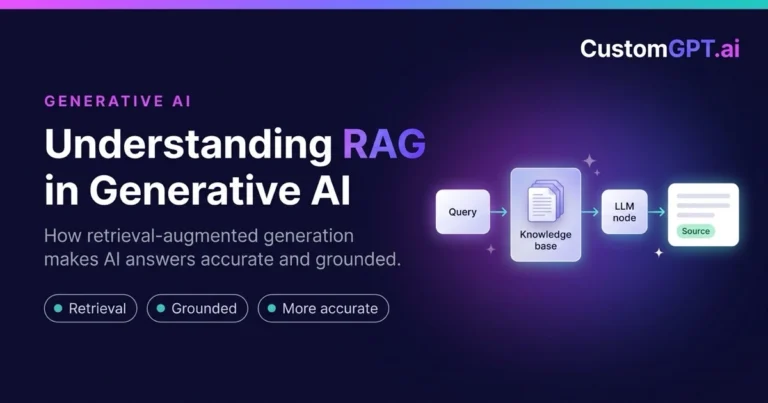
A RAG system is an AI architecture that retrieves relevant information from a knowledge source and feeds it to a language model so the model can generate answers grounded in that information rather than relying only on its training data.
In practice, a RAG pipeline moves through a sequence of stages. Each stage is simple to describe and hard to operate well at scale.
Retrieval finds the documents or passages most relevant to a user’s question. This is the search layer, and its quality sets a ceiling on everything downstream. If retrieval surfaces the wrong passages, no model can recover.
Chunking breaks source documents into smaller, retrievable units. Chunk too large and you bury the answer in noise. Chunk too small and you lose context. Document structure, tables, and headings all affect the right strategy, as detailed in chunking strategies for PDF documents in RAG systems.
Embeddings convert text into numerical vectors that capture meaning, so semantically similar passages sit close together in vector space. The embedding model you choose directly affects retrieval quality.
Vector search finds the chunks whose embeddings are closest to the query embedding. This is what lets the system match a question to relevant content even when the wording differs, and it makes vector search storage tradeoffs part of the build-vs-buy decision.
Ranking and reranking reorder retrieved candidates so the most relevant passages reach the model first. A reranker often does more for answer quality than swapping the language model.
Context assembly packs the selected passages into the prompt within the model’s context window, balancing relevance, recency, and token limits.
Generation is where the language model produces the answer using the assembled context.
Citation and source grounding ties each answer back to the documents it came from, so users can verify claims. This is what separates a trustworthy assistant from a fluent guesser.
Evaluation measures whether answers are accurate, whether retrieval is finding the right material, and how often the system fails. Without it, you are flying blind.
Monitoring tracks the live system over time: latency, failure patterns, content gaps, and drift as documents and questions change.
For a deeper technical breakdown of these stages, see the components of a RAG system and the RAG ultimate guide. If you want to understand how RAG differs from a plain chatbot or an autonomous agent, the comparison of chatbot vs AI agent vs private RAG is a useful companion.
Managed RAG Platform vs Custom RAG Stack: Quick Comparison
The table below summarizes the practical differences between building a RAG system internally and using a managed RAG platform.
| Decision Area | Build RAG Internally | Buy a Managed RAG Platform |
|---|---|---|
| Time to launch | Months of engineering before a reliable production system | Days to weeks, often a working assistant on day one |
| Engineering effort | Dedicated AI, data, and DevOps engineers required | Minimal engineering, configuration over construction |
| Retrieval quality | You tune retrieval, ranking, and reranking yourself | Tuned and maintained by the platform team |
| Chunking strategy | You design, test, and revise chunking per document type | Handled and optimized automatically |
| Evaluation | You build the test harness and labeling process | Built-in quality controls and grounding |
| Security | You own access control, encryption, and reviews | Platform provides security and compliance posture |
| Integrations | Custom connectors built and maintained in house | Prebuilt connectors for common sources |
| Maintenance | Continuous, owned by your team indefinitely | Absorbed by the vendor |
| Cost predictability | Variable, with hidden infrastructure and labor costs | Predictable subscription pricing |
| Scalability | You engineer and pay for scaling | Scales with the platform |
| Governance | You design audit, logging, and policy controls | Governance features included |
| Best fit | RAG is your core product or you need full control | You need reliable grounded answers fast |
Short Answer: Build vs Buy RAG
Build a RAG system if retrieval-augmented generation is your core product and you have the engineering team to maintain it long-term. Buy a managed RAG platform if you need reliable, source-grounded AI answers quickly without owning the full infrastructure.
What It Really Takes to Build a Production RAG System
A working prototype is not the same as a production RAG system. A prototype answers a few questions in a controlled setting. Production means accurate answers across thousands of documents, real permissions, changing content, and users who ask things you never tested. The sections below describe what stands between those two states.
Data ingestion
You need pipelines that pull content from every source that matters: file stores, websites, help centers, ticketing systems, wikis, and databases. Each source has its own format, refresh cadence, authentication method, and access rules. A connector that works against one version of an API breaks when that API changes, so ingestion code requires ongoing maintenance even after it ships.
Document parsing
Raw files are messy. PDFs contain multi-column layouts, tables, scanned images, headers, footers, and footnotes. Office documents carry tracked changes, comments, and embedded objects. Web pages bury content in navigation and boilerplate. Parsing has to extract clean, structured text while preserving the meaning that layout encodes, because a table flattened into a wall of numbers loses the relationships that made it useful.
Chunking strategy
Chunking decides how documents are split into retrievable units, and it has an outsized effect on quality. The right strategy depends on document type, structure, and the kinds of questions users ask. Fixed-size chunks are simple but cut through sentences and tables. Structure-aware chunking that respects headings and sections preserves more meaning but requires logic tuned to each document format.
Most teams iterate on chunking for weeks, and the work resurfaces every time a new document type appears. Chunk overlap, metadata tagging, and how you handle long tables or code blocks all become decisions you have to test and measure. There is no universal setting, which is why this layer consumes far more engineering attention than teams expect. The tradeoffs are covered in depth in chunking strategies for PDF documents in RAG systems.
Embeddings
You select an embedding model, decide whether to use a hosted API or a self-managed model, and account for the cost of embedding every chunk and re-embedding when content changes. Embedding quality shapes retrieval quality directly, so the choice is consequential, and the landscape of available models changes often enough that this becomes an ongoing evaluation task rather than a one-time decision.
Vector database setup
You provision, configure, index, and operate a vector database. That includes choosing an index type, tuning it for the tradeoff between speed and recall, and planning capacity as your corpus grows. You also handle sharding, replication, backups, and disaster recovery, because a vector database that loses data takes your assistant offline.
Retrieval and reranking
Naive vector search rarely produces production-quality results on its own. You typically combine semantic search with keyword search to catch exact matches that embeddings miss, add filters for permissions, recency, and source, and then layer in a reranker that reorders candidates so the best passages reach the model first. Hybrid retrieval and reranking often improve answer quality more than upgrading the language model.
Prompt orchestration
The retrieved context has to be assembled into prompts that fit the model’s context window, handle follow-up questions, manage conversation state across turns, and degrade gracefully when nothing relevant is found. Orchestration logic grows quickly once you support multi-turn conversations, query rewriting, and fallback behavior for ambiguous or out-of-scope questions.
Source citation and grounding
To be trustworthy, the system must tie each answer to the specific passages it used and surface those citations to the user. Grounding also means detecting when the retrieved context does not actually support an answer, and refusing to fabricate one rather than producing something plausible.
This is harder than it sounds and is central to anti-hallucination behavior. A system can retrieve relevant passages and still generate an answer that drifts beyond what those passages say. Building reliable grounding requires logic that checks generated claims against retrieved evidence, which is its own engineering and evaluation challenge, and it is the feature that most separates an enterprise-grade assistant from a hobby project.
Permissions and access control
In an enterprise, not every user should see every document. The system has to respect existing permissions so that a user only gets answers from content they are allowed to access. This is one of the most difficult parts to build correctly, because permissions must be enforced at retrieval time, not just at the document level, and they have to stay in sync with the source systems where permissions actually live.
A leak here is a serious security incident, because the assistant can surface restricted content in an answer even when the user never had direct access to the source file. Building permission-aware retrieval means mapping every source system’s access model into the retrieval layer and keeping it current as roles and document permissions change. Few teams anticipate how much work this is until they hit it.
Evaluation and testing
You need a way to measure answer accuracy, retrieval precision and recall, citation correctness, and hallucination rate. That usually means building a labeled test set, an evaluation harness, and a process for regression testing every time you change the pipeline, because a change that improves one type of question can quietly break another.
Evaluation is ongoing labor, not a one-time milestone. Building the labeled data alone takes meaningful effort, and keeping it representative as content and usage evolve takes more. Teams that skip rigorous evaluation ship systems they cannot prove are accurate, which is untenable for any use case where wrong answers carry consequences.
Monitoring and analytics
Once live, the system needs monitoring for latency, error rates, unanswered questions, and content gaps. Analytics reveal what users actually ask, where the knowledge base is thin, and where answers are going wrong, which is the information you need to improve the system over time.
Security and compliance
Enterprise RAG handles sensitive content, so you need encryption in transit and at rest, audit logging, data residency controls, and a security posture that survives review. For regulated industries, you also need to map all of this to frameworks such as the NIST AI Risk Management Framework, and to document how the system handles data, makes decisions, and fails safely.
User experience
A RAG backend is not a product. Users need a clean interface, conversation history, feedback mechanisms, and a way to report bad answers. Administrators need controls to manage content, configure behavior, and update the assistant. Business teams need to make those updates without filing an engineering ticket for every change.
Ongoing maintenance
Everything above has to be kept running. Models are deprecated and replaced, embedding APIs change, document formats shift, retrieval quality drifts, content goes stale, and security requirements evolve. A production RAG system is a living system that decays without continuous attention.
This is the cost that determines whether building is viable. A RAG system requires a standing team, not a launch and a handoff. Teams that build successfully and then reassign the engineers who built it often watch the system degrade over the following year, which is why long-term maintenance capacity is the real precondition for building.
The Hidden Costs of Building RAG Internally
The sticker price of building RAG is the engineering salaries. The real cost is everything that hides behind the prototype. Teams routinely underestimate the build because the demo was so easy, and then discover that the last twenty percent of the work, the part that makes it production-ready, takes most of the time and money.
| Cost Area | Why It Matters | Risk If Ignored |
|---|---|---|
| AI engineering time | Building and tuning retrieval, chunking, and orchestration takes senior talent | Months of delay and a system that underperforms |
| DevOps and infrastructure | Vector databases and pipelines must be provisioned and operated | Outages, scaling failures, and surprise infrastructure bills |
| Embedding and model costs | Embedding and inference are recurring per-token costs | Budget overruns that grow with usage |
| Vector database costs | Storage, indexing, and queries scale with your corpus | Costs that climb faster than expected as content grows |
| Document processing costs | Parsing and re-processing changing documents is continuous | Stale or malformed content producing wrong answers |
| Evaluation labor | Quality requires labeled data and a test harness | Shipping a system nobody can prove is accurate |
| Security reviews | Sensitive content demands audits and controls | Compliance gaps and blocked deployments |
| Maintenance | Every layer needs continuous upkeep | Quality drift and an unsupported system over time |
| Integration work | Connectors to your sources must be built and maintained | Incomplete knowledge and brittle pipelines |
| User support | Real users need help, feedback loops, and admin tools | Low adoption and unmanaged answer quality |
| Failed experiments | Several approaches will not work before one does | Sunk cost with little to show for it |
| Slower time to value | Months pass before the system delivers business results | Lost opportunity while a managed option would already be live |
The table captures the categories, but the deeper point is how these costs behave. The most expensive part of building RAG is engineering time, and not just the initial build. Senior AI engineers are scarce and expensive, and a production RAG system occupies them continuously rather than for a single quarter. Every hour spent operating retrieval infrastructure is an hour not spent on work that differentiates your business, so the opportunity cost is as real as the line item. Infrastructure cost is the second trap, because it is variable and grows with success: vector storage, embedding calls, and model inference all increase with volume, and because they are usage-based they are hard to forecast and easy to underestimate during planning.
Security review and maintenance are the costs that recur on someone else’s schedule. Every audit cycle, new data source, and customer security questionnaire pulls engineering and compliance time back into the system, and for regulated industries that obligation never ends. Maintenance is the cost that decides the whole decision, because models are deprecated, content drifts, retrieval quality degrades, and connectors break as source APIs change. A RAG system without a standing owner becomes a slowly failing system, and the cost of that failure in wrong answers and lost trust is harder to quantify but more damaging than any infrastructure bill. The honest comparison is not build cost versus subscription cost. It is the total cost of owning a living system versus the cost of having someone else own it for you.
Short Answer: Is It Cheaper to Build or Buy a RAG System?
For most organizations, buying is cheaper once you account for total cost rather than just initial development. Building looks inexpensive when you only count the prototype, but the production system carries recurring costs for engineering time, infrastructure, embeddings, vector storage, evaluation, security, and maintenance that never stop.
A managed RAG platform converts those variable, hard-to-predict costs into a predictable subscription. You trade some control for cost certainty and a much faster path to value. Building becomes cheaper only at large scale with very specific requirements, where owning the stack creates strategic advantage that justifies the standing engineering investment.
The honest answer is that the cheapest option depends on whether RAG is incidental to your business or central to it. If it is incidental, buying almost always wins on total cost.
When Building a RAG System Makes Sense
Building is the right call for some teams, and it would be dishonest to pretend otherwise. Building a RAG system internally makes sense when one or more of the following is true.
RAG is part of your core product. If you are selling a RAG-powered product to your own customers, owning the stack is a competitive necessity, not overhead. Your differentiation lives in the retrieval and generation layer, so you cannot outsource it.
You have deep AI engineering resources. If you employ engineers who already build and operate retrieval systems, embeddings pipelines, and evaluation harnesses, the marginal cost of building is lower and the capability gap is smaller.
You have unusual retrieval requirements. Some domains need custom retrieval logic, specialized models, or data structures that general platforms do not support. If your needs sit outside what managed platforms handle, building may be the only path.
The system must be deeply embedded into proprietary infrastructure. If RAG has to live inside a tightly controlled internal environment with bespoke data systems, a custom build can integrate in ways a third-party platform cannot.
You need full control over every layer. Some organizations require the ability to change any component, from the embedding model to the ranking logic, on their own schedule. Owning the stack gives that control.
You can maintain the system long-term. This is the decisive test. Building is only viable if you can fund and staff the ongoing maintenance indefinitely. If you cannot commit to that, building creates a system that decays.
For teams in this category, resources like custom RAG solutions and the deeper treatment in mastering custom RAG for better AI answers describe the engineering tradeoffs in more detail.
When Buying a Managed RAG Platform Makes Sense
For most organizations, buying a managed RAG platform is the pragmatic choice. Buying makes sense when the following describe your situation.
You need faster deployment. If the goal is a working, reliable assistant in weeks rather than months, a managed platform removes the long build phase entirely.
The goal is internal knowledge access or customer support. These are the most common RAG use cases, and they are well served by platforms designed for exactly this. You do not need to reinvent retrieval to answer support questions from your help center.
You need source-grounded answers. If trustworthiness matters, a platform that grounds answers in your content and shows citations gives you that without building the grounding logic yourself.
You do not want to maintain infrastructure. If your team should be solving business problems rather than operating vector databases, buying lets you avoid the operational burden.
Security and governance matter. Managed platforms that already meet enterprise security and compliance standards save you the cost and time of building that posture from scratch.
You have existing documents, websites, PDFs, help centers, or knowledge bases to make searchable. If your content already exists and just needs to become accessible through AI, a platform that ingests these sources directly is the shortest path.
Business teams need control without engineers. If you want non-technical staff to update the assistant, manage content, and adjust behavior without filing engineering tickets, a managed platform is built for that.
CustomGPT.ai is an example of a managed platform built for these situations. It lets organizations deploy knowledge-grounded AI assistants from their own content, with source citations and enterprise security, without standing up and maintaining the full RAG stack. The platform connects to common sources through prebuilt data connectors so existing content becomes searchable quickly.
Short Answer: How Long Does It Take to Build a RAG System?
A RAG demo can be built in a day. A production RAG system typically takes several months. The gap is not the core retrieval logic, which is fast to assemble, but everything required to make it reliable: parsing varied document types, tuning chunking and retrieval, building evaluation, enforcing permissions, adding monitoring, and passing security review.
Most teams that set out to build underestimate this by a wide margin. The prototype works in week one, which creates the false impression that production is close. In reality, the work that makes the system trustworthy and maintainable consumes the majority of the timeline, and it never fully ends because the system needs ongoing upkeep.
By contrast, a managed RAG platform can have a working, grounded assistant live in days, because the hard infrastructure already exists and you are configuring rather than constructing.
Why RAG Demos Are Easier Than Production RAG
The single biggest source of failed RAG projects is mistaking a demo for a system. Each stage below proves something real, and also leaves something important unproven.
| Stage | What It Proves | What It Does Not Prove |
|---|---|---|
| Weekend prototype | The core RAG loop works on a few documents | That it stays accurate at scale or under load |
| Proof of concept | The approach can answer real questions | That it handles permissions, security, or maintenance |
| Production RAG system | It serves real users reliably | That it meets enterprise governance and compliance |
| Enterprise-ready RAG platform | It is secure, governed, evaluated, and maintained | That your team can keep operating it without a standing investment |
The lesson is that a successful demo tells you almost nothing about the cost and difficulty of the production system. The work that remains after the demo is the work that decides whether the project succeeds.
Short Answer: What Is the Biggest Risk of Building RAG Internally?
The biggest risk is committing to a long, expensive build and ending up with a system that is hard to maintain and never reaches reliable production quality. Many teams ship a strong demo, secure funding, and then stall in the gap between prototype and production, where evaluation, permissions, security, and maintenance live.
A close second is ongoing maintenance debt. Even a system that reaches production can decay if the team that built it gets reassigned, because models deprecate, content drifts, and retrieval quality degrades without continuous attention. A RAG system without a standing owner becomes a liability.
Buying transfers both of these risks to a vendor whose business is keeping the platform reliable, which is why most organizations that do not sell RAG choose to buy.
RAG Architecture: What You Need to Own If You Build
If you decide to build, this is the architecture you are committing to operate. Each component is a system in its own right, with its own failure modes, costs, and maintenance burden.
Document sources are the systems of record your content lives in: file stores, websites, wikis, ticketing systems, and databases. You need a clear inventory and a plan for keeping them in sync.
Data connectors pull content from each source. Every connector is custom integration work that has to be built, authenticated, rate-limited, and maintained as source APIs change.
Parsing pipeline turns raw files into clean, structured text. This layer has to handle the full variety of formats your organization uses, including difficult PDFs and tables.
Chunking layer splits parsed content into retrievable units using strategies tuned per document type.
Embedding model converts chunks into vectors. You manage model selection, cost, and re-embedding when content changes.
Vector database stores and indexes those vectors. You provision, tune, scale, back up, and operate it.
Retrieval service queries the vector database, combines semantic and keyword search, and applies filters for permissions and recency.
Reranker reorders retrieved candidates so the best passages reach the model first.
LLM orchestration assembles context, manages prompts and conversation state, calls the model, and handles fallback behavior.
Access control enforces permissions at retrieval time so users only see answers from content they are allowed to access.
Analytics capture what users ask, where answers fail, and where the knowledge base has gaps.
Admin tools let teams manage content, configure behavior, and update the assistant without code changes.
Evaluation framework measures accuracy, retrieval quality, citation correctness, and hallucination rate, with regression testing on every change.
Deployment and monitoring keep the system running, observe latency and failures, and alert on problems.
Cloud providers document reference architectures for much of this, including Google Cloud’s grounding and RAG guidance, AWS guidance on retrieval-augmented generation, and Microsoft’s RAG documentation for Azure AI Search. These are useful references, but they also make clear how many moving parts a self-managed system involves. NVIDIA’s RAG glossary is a good plain-language reference for the core concepts.
For the evolution of these architectures, including how corrective approaches improve on basic RAG, see CRAG vs RAG, the evolution of RAG.
RAG Evaluation: How to Know Whether Your System Works
You cannot improve what you do not measure, and a RAG system that is not evaluated is a system you cannot trust. Evaluation is also one of the most underestimated parts of building, because it requires labeled data, a test harness, and ongoing effort. The areas below are what a serious evaluation program tracks.
| Evaluation Area | What to Measure | Why It Matters |
|---|---|---|
| Answer accuracy | Whether answers are factually correct | Inaccurate answers erode trust and create risk |
| Retrieval precision | Share of retrieved passages that are relevant | Low precision floods the model with noise |
| Retrieval recall | Share of relevant passages that were retrieved | Low recall means the answer was never available |
| Citation accuracy | Whether citations actually support the answer | Wrong citations undermine grounding |
| Hallucination rate | How often the system fabricates information | Hallucinations are the core failure RAG must prevent |
| Latency | Time to return an answer | Slow answers reduce adoption and usefulness |
| Coverage | Share of questions the system can answer | Gaps reveal where the knowledge base is thin |
| Freshness | Whether answers reflect current content | Stale answers mislead users after content changes |
| User satisfaction | Real feedback from users | The ultimate measure of whether it works |
| Failure handling | Behavior when nothing relevant is found | Graceful failure beats a confident wrong answer |
Short Answer: What Is the Best Option for Enterprise Teams?
For most enterprise teams, the best option is a managed RAG platform that grounds answers in the organization’s own content, enforces permissions, shows citations, and meets enterprise security standards. This delivers a trustworthy assistant in weeks without committing the organization to operating a complex stack indefinitely.
Enterprises that sell RAG-based products, or that have genuinely unusual requirements and a standing AI engineering team, are the exception. For them, building can be worth the control it provides. But that is a minority of cases, and the decision should be made deliberately, not by default.
The practical test is simple: if you cannot name the team that will maintain the RAG system in two years, you should buy rather than build.
Build vs Buy Decision Framework for RAG
Use the framework below to make the decision concrete. Answer each question honestly, and the weight of the answers will point you toward building or buying.
| Question | Build Is Better If… | Buy Is Better If… |
|---|---|---|
| Is RAG your core product? | You sell RAG-powered products to customers | RAG supports your business but is not the product |
| Do you have AI engineers? | You have a team that builds retrieval systems | You have little or no dedicated AI engineering |
| Do you need fast deployment? | You can wait months for a build | You need a working assistant in weeks |
| Do you need integrations? | You can build and maintain custom connectors | You need prebuilt connectors to common sources |
| Do you need source citations? | You can build grounding and citation logic | You need grounded, cited answers out of the box |
| Do you need governance? | You can design audit and policy controls | You need governance features included |
| Do non-technical teams need control? | Engineers will manage all changes | Business teams must manage the assistant themselves |
| Do you need predictable costs? | You can absorb variable infrastructure costs | You need predictable subscription pricing |
| Do you need long-term maintenance? | You can staff maintenance indefinitely | You want the vendor to own maintenance |
If most of your answers land in the buy column, a managed platform is the lower-risk, faster, and usually cheaper path. If most land in the build column, you have the profile of a team for whom building is justified.
Where CustomGPT.ai Fits in the RAG Build vs Buy Decision
CustomGPT.ai sits on the buy side of this decision, for organizations that want the benefits of retrieval-augmented generation without building, evaluating, governing, and maintaining the full stack themselves.
The platform is built for teams that want to turn their own documents, websites, PDFs, help centers, and knowledge bases into AI assistants that answer from that content. It connects to common sources, ingests and processes the content, handles retrieval and grounding, and serves answers with citations back to the source material. The goal is reliable, source-grounded answers that reduce hallucinations, because responses are tied to your actual knowledge rather than generic model output.
For technical evaluators, the relevant point is that CustomGPT.ai handles the components covered earlier in this article: parsing, chunking, embeddings, vector search, reranking, orchestration, citation, permissions, evaluation, and monitoring. That is the work you would otherwise own if you built internally.
Why Managed RAG Wins for Most Teams
The case for a managed platform comes down to a handful of concrete advantages, each mapping directly to a part of the build you would otherwise own.
- Faster deployment. The infrastructure already exists, so you configure an assistant with your content instead of building a pipeline, compressing months into days.
- Lower engineering burden. The senior AI engineers a build would consume are freed for work that differentiates your business, rather than operating retrieval infrastructure.
- Source citations. Grounded, cited answers are built in, so users can verify responses against the underlying documents and trustworthiness is a default rather than a feature you engineer.
- Content ingestion. Prebuilt connectors turn your existing documents, websites, help centers, and knowledge bases into searchable content without custom integration work.
- No full-stack maintenance. The vendor absorbs model changes, embedding updates, index operation, security upkeep, and quality maintenance, which is the living-system cost that decides whether building is even viable.
- Business-team usability. Non-technical staff can manage content and update the assistant without filing engineering tickets, removing the bottleneck that makes internally built assistants slow to change.
CustomGPT.ai is not just a chatbot interface. It is a managed platform for creating knowledge-grounded AI assistants from an organization’s own content, with the security and governance enterprises require. It supports use cases across customer support, internal knowledge, compliance, education, government, legal, SaaS, and technical documentation. The platform’s research on adding a retrieval layer to coding workflows, documented in the Claude benchmark, reported answers roughly 4.2 times faster and 3.2 times cheaper with a RAG layer than without, with full methodology published for review. Real deployments include Dlubal’s 24/7 AI support for more than 130,000 engineers across 132 countries, BernCo’s government support deployment, and VdW Bayern’s DigiSol assistant for the housing sector.
For teams weighing whether they need a full custom build or a managed assistant, the comparison in chatbot vs AI agent vs private RAG helps clarify which architecture fits the need.
Common RAG Build vs Buy Use Cases
The right answer to build vs buy often depends on the use case. The sections below cover the most common ones, with the underlying problem, why RAG matters, the build challenge, and the buy advantage for each.
Customer Support RAG
The problem is that support teams field the same questions repeatedly, customers expect instant answers at all hours, and the knowledge needed to answer them is scattered across help centers, documentation, and past tickets. Human agents cannot scale to meet demand without growing headcount, and slow responses drive customers away.
RAG matters here because support answers must be accurate and tied to real policies and documentation. A support assistant that invents a return window or a troubleshooting step creates more work than it saves. Grounding answers in your actual content, with citations, is what makes an automated support assistant trustworthy enough to deploy.
The build challenge is that support content changes constantly, lives in multiple systems, and must be answered with citations and graceful handling of questions the assistant cannot resolve. Building this means continuous ingestion, reliable grounding, and an escalation path, all maintained as products and policies evolve.
The buy advantage is speed and reliability. A managed platform ingests existing support content and produces a grounded assistant quickly, with citations and fallback behavior already handled. This is the use case demonstrated by Dlubal’s deployment and described in AI chatbot for customer support.
Internal Knowledge Assistant
The problem is that employees waste significant time searching for information spread across wikis, shared drives, policy documents, and chat tools. Knowledge exists but is hard to find, and the people who hold it answer the same internal questions over and over.
RAG matters because an internal assistant has to answer from current, authoritative internal content and respect who is allowed to see what. An answer drawn from an outdated policy or a document a user should not access is a real problem, not a minor bug.
The build challenge is permission-aware retrieval and connecting to internal sources. Enforcing access control at retrieval time, keeping it in sync with source systems, and integrating with tools like Confluence, SharePoint, and Slack is some of the hardest work in RAG, and it is unforgiving because mistakes leak restricted content.
The buy advantage is that a platform with prebuilt connectors and permission-aware answers removes most of that burden. CustomGPT.ai supports sources including Confluence, SharePoint, and Slack, so internal content becomes searchable without building the integration and access layers yourself.
Compliance and Regulated Knowledge
The problem is that compliance teams operate in dense, frequently changing regulatory environments where finding the right rule quickly is difficult and getting it wrong carries legal and financial consequences. Staff spend hours locating and interpreting requirements that are scattered across long documents.
RAG matters because compliance answers must be accurate, grounded, and auditable. A compliance assistant that paraphrases a regulation incorrectly or cannot show its source is worse than useless. Source citation is not a nice-to-have here. It is the requirement.
The build challenge is meeting a high accuracy bar while maintaining audit logging, governance, and the ability to prove how every answer was produced. Building grounding strong enough for regulated use, plus the audit trail reviewers demand, is substantial work that recurs with every audit cycle.
The buy advantage is a platform that provides grounded, cited answers and governance features by default. See AI for compliance and AI compliance for agencies for how source-grounded answers support regulated workflows without building the compliance posture from scratch.
Government AI Support
The problem is that government agencies serve large populations with limited staff, and citizens and employees need accurate answers about policies, services, and procedures. Information is buried in official documents that are hard for the public to navigate.
RAG matters because public-sector answers demand transparency and accuracy, and they must cite official sources. A government assistant that approximates policy undermines public trust, so answers have to be traceable to the real documents behind them.
The build challenge is combining accuracy, citation, and the security and transparency standards the public sector requires, all while keeping content current as policies change. For agencies without large engineering teams, building and maintaining this is rarely realistic.
The buy advantage is a managed platform that delivers grounded, cited answers with the required security posture, deployable without a standing engineering function. CustomGPT.ai’s work in this space is covered in CustomGPT.ai for government and CustomGPT and government, with a deployed example in the BernCo case study.
Legal Knowledge Assistants
The problem is that legal teams work with large volumes of contracts, case material, statutes, and internal precedent, and finding the relevant passage quickly is both difficult and high-stakes. Time spent searching is time not spent on higher-value legal work.
RAG matters because legal answers must be precise and source-grounded, with citations to the exact documents behind every claim. The accuracy bar is among the highest of any use case, because errors carry direct professional and financial consequences.
For a focused legal example, see legal document RAG systems for law firms that need source-cited answers from contracts, case material, and internal precedent.
The build challenge is achieving that precision and reliable citation while handling confidential material under strict access controls. Building grounding rigorous enough for legal use, plus the security and permissions the work demands, is a serious undertaking.
The buy advantage is a platform engineered for grounded, cited answers with enterprise security, so legal teams get a reliable assistant without building the retrieval and grounding stack. See AI chatbot for legal services.
SaaS Support and Documentation
The problem is that SaaS companies maintain extensive, fast-changing product documentation and field high volumes of support and onboarding questions. Documentation goes stale quickly, and users struggle to find answers in it, which raises support load and slows onboarding.
RAG matters because product answers must reflect the current state of the product. A documentation assistant that answers from outdated content frustrates users and erodes trust, so freshness and continuous ingestion are central.
The build challenge is keeping the assistant in sync with frequently changing documentation while maintaining accuracy and citations. Building continuous ingestion and change handling that keeps pace with rapid release cycles is ongoing engineering work.
The buy advantage is a platform that ingests documentation continuously and produces grounded answers that stay current, with minimal engineering. This lets product and support teams automate support, onboarding, and documentation search quickly. See AI chatbot for SaaS.
Ecommerce Product and Support Assistant
The problem is that online shoppers ask about products, availability, policies, and orders, and they expect instant answers. Information lives across product pages, FAQs, and policy documents, and slow or wrong answers cost sales and drive returns.
RAG matters because ecommerce answers must reflect real product details and policies. An assistant that misstates a return policy or a product specification creates support tickets and refunds, so answers need to be grounded in current store content.
The build challenge is ingesting product catalogs and policies that change frequently, and keeping the assistant current across a large and shifting set of products. Building and maintaining that ingestion against a live catalog is continuous work.
The buy advantage is a platform that ingests store content directly and keeps answers current. CustomGPT.ai connects to store content through the Shopify integration, shortening the path to a working assistant. See AI chatbot for ecommerce.
Education and Research Assistants
The problem is that students, learners, and researchers need answers from course materials, documentation, and research content, often outside the hours when instructors or staff are available. Finding the right material across scattered resources is slow and frustrating.
RAG matters because educational answers must be accurate and grounded in the actual course or research content, with sources learners can check. An assistant that gives plausible but wrong answers undermines learning, so grounding and citation are essential.
The build challenge is ingesting varied educational content and producing grounded, cited answers reliably, while keeping the assistant aligned with current materials. For institutions without dedicated AI engineering, building and maintaining this is a heavy lift.
The buy advantage is a managed platform that turns course and research content into a grounded assistant quickly, with citations, so educators and institutions can support learners without building the stack. See AI chatbot for education.
Frequently Asked Questions About RAG Systems Build vs Buy
What is the difference between building and buying a RAG system?
The difference is who owns the stack. Building means your team designs and operates the entire pipeline: ingestion, parsing, chunking, embeddings, vector search, reranking, orchestration, grounding, permissions, evaluation, security, and monitoring. Buying means a managed platform handles those components while you configure the assistant with your own content. The core tradeoff is control versus speed, cost predictability, and reduced maintenance.
Is it better to build or buy a RAG system?
For most organizations, buying is better. Building only makes sense when RAG is your core product, you have a dedicated AI engineering team, and you can maintain the system long-term. For teams that need reliable, document-grounded AI assistants without operating the stack, buying is faster, lower-risk, and usually more cost-effective.
How much does it cost to build a RAG system?
The cost goes well beyond initial development, and the recurring costs are larger than the build. You pay for AI engineering time, infrastructure, embeddings and inference, vector database operation, document processing, evaluation, security reviews, integration work, and ongoing maintenance, many of which scale with usage and content volume. A prototype is cheap; a maintained production system is not.
How long does it take to build a production RAG system?
A demo takes a day. A production RAG system usually takes several months. The gap comes from the work that makes it reliable: parsing varied document types, tuning chunking and retrieval, building evaluation, enforcing permissions, adding monitoring, and passing security review. A managed platform can have a working assistant live in days.
Why are RAG systems hard to build?
Because the easy part, connecting a vector database to a model, is a small fraction of the work. The hard part is maintaining accurate, grounded, secure, evaluated answers across changing documents, varied formats, real permissions, and unanticipated questions. Each layer is its own system with its own failure modes, and all of them require continuous maintenance.
What is a managed RAG platform?
A managed RAG platform is a service that handles the full retrieval-augmented generation pipeline for you. It ingests your content, processes and indexes it, handles retrieval and grounding, and serves cited answers while operating the underlying infrastructure. You configure the assistant with your own documents rather than building and maintaining the stack. CustomGPT.ai is an example built for enterprise knowledge-grounded assistants.
When should a company build RAG internally?
A company should build internally when RAG is part of its core product and it can support the system long-term. The full conditions are deep AI engineering resources, unusual retrieval requirements, a need to embed RAG in proprietary infrastructure, a need for full control over every layer, and the ability to fund maintenance indefinitely. If those are not met, building creates cost and risk without enough benefit.
When should a company buy a RAG platform?
A company should buy when it needs a reliable assistant quickly without operating infrastructure. Buying fits when deployment speed matters, the use case is internal knowledge or customer support, source-grounded answers are required, security and governance matter, content already exists and needs to be searchable, and business teams need to manage the assistant without engineers. This describes the majority of enterprise RAG needs.
How does RAG reduce hallucinations?
RAG reduces hallucinations by retrieving relevant information from your knowledge base and giving it to the model before it generates an answer. The model is constrained by the retrieved content, so it is less likely to invent facts, and answers can cite their sources. Strong grounding also detects when the retrieved context does not support an answer and declines to fabricate one.
Does RAG require a vector database?
Most RAG systems use a vector database, because it is the standard way to store embeddings and perform semantic search. Some implementations combine vector search with keyword search or other methods. If you build, you operate the vector database yourself. If you buy, the platform manages it for you.
What is the hardest part of RAG implementation?
The hardest parts are retrieval quality, permission-aware access control, and evaluation. Retrieval quality sets the ceiling on every answer. Permission enforcement at retrieval time is difficult and unforgiving, because mistakes leak restricted content. Evaluation requires labeled data and continuous effort to prove the system works. These are where most build projects struggle.
How do you evaluate a RAG system?
You evaluate a RAG system by measuring answer accuracy, retrieval precision and recall, citation accuracy, hallucination rate, latency, coverage, freshness, user satisfaction, and how gracefully it handles questions it cannot answer. Doing this well requires a labeled test set, an evaluation harness, and regression testing on every change, because an improvement in one area can quietly break another.
Can CustomGPT.ai replace a custom-built RAG system?
For most use cases, yes. CustomGPT.ai handles the components you would otherwise build and maintain, including ingestion, chunking, embeddings, retrieval, reranking, grounding, citations, permissions, and monitoring. Teams for whom RAG is the core product, with highly specialized requirements, may still choose to build, but for everyone else a managed platform delivers the same outcome with less cost and risk.
Is CustomGPT.ai suitable for enterprise RAG use cases?
Yes. CustomGPT.ai is built for enterprise needs, including security, governance, permission-aware answers, and source citations across customer support, internal knowledge, compliance, government, legal, SaaS, and education. Production deployments such as Dlubal, BernCo, and VdW Bayern show it operating in real enterprise and public-sector settings.
What documents can be used in a RAG system?
Almost any text-bearing content can be used: PDFs, Office documents, web pages, help center articles, wikis, knowledge bases, support tickets, and more. The practical limits are how well each format can be parsed and how the content is connected. Prebuilt connectors to sources like Google Drive, SharePoint, Confluence, and Zendesk make it easier to bring varied content in.
How does RAG compare to a generic chatbot?
A generic chatbot answers from a model’s training data with no connection to your content, so it can be fluent but ungrounded and prone to inventing answers. A RAG-based assistant retrieves from your knowledge base before answering, so responses are grounded in your actual documents and can cite sources. For any use case where accuracy matters, RAG is the appropriate architecture.
What is the fastest way to launch a RAG chatbot?
The fastest way is to use a managed RAG platform that ingests your existing content and produces a grounded assistant without a build phase. You connect your documents and configure the assistant, often reaching a working version in days. Building from scratch is the slowest path, because production readiness takes months.
Final Recommendation: Build RAG Only If It Is Your Core Product
The decision comes down to a single principle. Build a RAG system if RAG is your core product and you have the engineering resources and long-term commitment to own every layer. The control is real, and for the right team it is worth the cost.
Buy a managed RAG platform if you need a secure, reliable, source-grounded AI assistant faster than you could build one, and you would rather invest your team’s time in business outcomes than in operating retrieval infrastructure. For most organizations, this is the better path on speed, risk, and total cost.
CustomGPT.ai helps teams deploy RAG-powered AI assistants using their own content without maintaining the full infrastructure themselves. It handles the parsing, chunking, embeddings, retrieval, reranking, grounding, citations, permissions, evaluation, and monitoring that a custom build would require you to own.
If your goal is to turn trusted business content into a source-grounded AI assistant, CustomGPT.ai can help you launch faster than building a RAG system from scratch. A good next step is the RAG ultimate guide for the full picture of how these systems work.