
RAG for Financial Services: Building Compliant AI Document Systems
TLDR
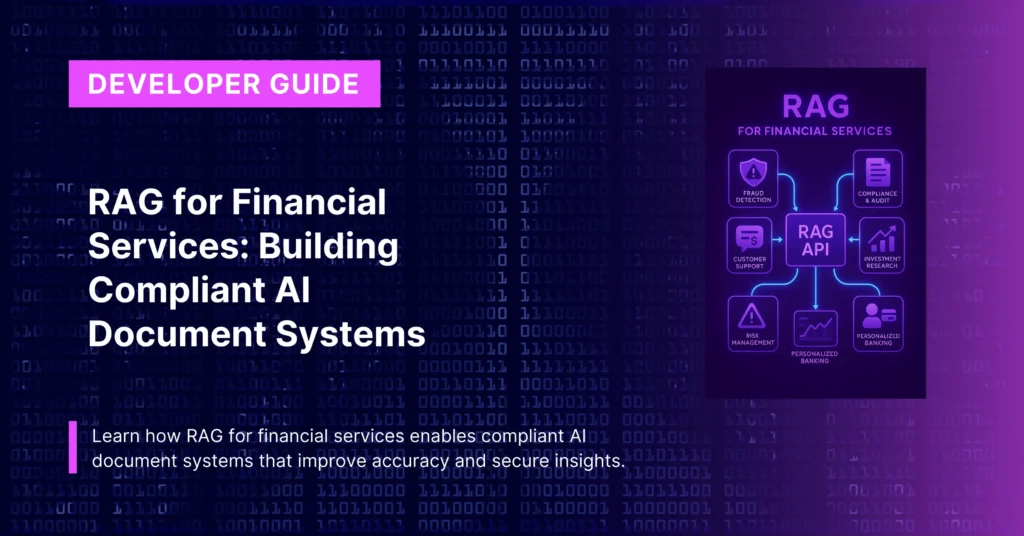
RAG for financial services enables regulatory compliance, risk assessment, and client service while meeting strict security requirements.
CustomGPT.ai’s SOC-2 certified platform processes financial documents, regulatory texts, and client data with enterprise-grade security. A governed implementation can reduce manual research loops and accelerate compliance workflows with full audit trails.
Financial services organizations handle the world’s most sensitive data under intense regulatory oversight. Yet most still rely on manual document searches, inconsistent policy interpretations, and time-consuming compliance processes that slow business operations.
RAG technology offers financial institutions a path to modernize these processes while exceeding regulatory requirements. The key is understanding how to implement RAG systems that work within financial services’ unique constraints.
Why Financial RAG Requires Special Considerations
Financial services can’t simply adopt any AI solution. Every system must meet stringent requirements:
- Regulatory Compliance: Systems must comply with SOX, Basel III, MiFID II, FINRA, and data protection laws like GDPR while maintaining complete audit trails.
- Data Security: Client information, trading data, and risk assessments require enterprise-grade security with encryption, access controls, and SOC-2 Type 2 compliance.
- Auditability: Regulators must understand AI decision-making processes. RAG systems must provide clear source citations and decision trails.
- Real-time Performance: Trading systems and fraud detection need sub-second responses without compromising accuracy or compliance.
Financial Services RAG Applications
1. Regulatory Compliance Research
The Compliance Challenge
Compliance teams at major financial institutions spend significant time researching regulatory requirements across thousands of evolving documents. Different departments often interpret the same regulation differently, creating compliance risks.
RAG Solution for Compliance
CustomGPT.ai’s RAG API transforms regulatory research by instantly searching across all regulatory documents, internal policies, and precedent decisions. When compliance officers ask “What are the latest Basel III operational risk capital requirements?” the system provides specific answers with exact source citations.
Implementation Example:
Using CustomGPT’s OpenAI-compatible API:
from openai import OpenAI
client = OpenAI(
    api_key="CUSTOMGPT_API_KEY",
    base_url="https://app.customgpt.ai/api/v1/projects/{compliance_project_id}/"
)
response = client.chat.completions.create(
    model="<supported_model>",
    messages=[{
        "role": "user",
        "content": "What are current FINRA requirements for client suitability assessments in equity trading?"
    }]
)
Compliance Benefits:
- Reduced manual regulatory research time
- Consistent interpretation across all departments
- Automatic tracking of regulatory changes
- Complete audit trail for regulatory examinations
2. Client Document Analysis and KYC
The KYC Challenge
Investment advisors manually analyze thousands of client documents for Know Your Customer (KYC) compliance, suitability assessments, and risk profiling. This process is slow, error-prone, and inconsistent across advisors.
RAG-Powered Client Analysis
CustomGPT.ai processes financial statements, tax returns, investment portfolios, and identity documents with automatic extraction of relevant compliance information. The platform supports 1400+ data formats for ingestion, including complex financial documents.
Financial institutions can process client documents more consistently when answers are grounded in approved financial documents and review workflows.
Key Capabilities:
- Automated KYC Processing: Identity verification and risk scoring from uploaded documents
- Suitability Analysis: Investment recommendation compliance based on client profiles
- AML Screening: Transaction pattern analysis and suspicious activity detection
- Beneficial Ownership: Corporate structure analysis for complex entities
3. Risk Assessment and Portfolio Analysis
Risk Management Challenge
Risk teams need real-time insights across multiple data sources for comprehensive risk assessment. Traditional approaches involve manual analysis of market data, financial statements, and industry reports.
Intelligent Risk Analysis
RAG systems provide automated risk assessment by analyzing current financial statements, market conditions, industry reports, and historical performance data simultaneously.
Using CustomGPT’s native SDK:
from customgpt_client import CustomGPT
import uuid
CustomGPT.api_key = "API_KEY"
session_id = uuid.uuid4()
risk_response = CustomGPT.Conversation.send(
    project_id="<RISK_ASSESSMENT_PROJECT>",
    session_id=session_id,
    prompt="Analyze credit risk for Acme Corp based on Q3 financials and current market conditions"
)
Risk Management Benefits:
- Real-time risk scoring with supporting evidence
- Consistent risk methodology across all assessments
- Integration with existing risk management systems
- Comprehensive audit trails for regulatory reporting
4. Trading Compliance and Pre-Trade Checks
Trading Compliance Challenge
Trading desks need instant access to position limits, client restrictions, regulatory requirements, and internal policies before executing trades. Manual checks slow trading and create compliance risks.
Automated Trading Compliance
RAG systems provide real-time trading compliance checks by analyzing client profiles, position limits, regulatory restrictions, and internal policies. Integration with trading systems enables automated pre-trade compliance validation.
The CustomGPT starter kit includes APIs for real-time compliance checking that can be embedded directly into trading platforms.
5. Customer Service and Account Management
Client Service Challenge
Client service representatives need instant access to account information, product details, regulatory disclosures, and transaction history while maintaining compliance with all applicable regulations.
Enhanced Client Service
RAG-powered customer service provides instant access to client account details, investment performance, product information, and regulatory disclosures—all with appropriate compliance controls and audit logging.
Implementation for Financial Services
Security-First Architecture
Financial RAG implementation starts with security requirements:
- Data Encryption: CustomGPT.ai provides end-to-end encryption with data encrypted at rest and in transit
- Access Controls: Role-based permissions ensuring only authorized personnel access specific information
- Audit Logging: Complete logging of all queries, responses, and user interactions for regulatory compliance
- Compliance Certifications: SOC-2 Type 2 certified with GDPR compliance
Regulatory Documentation Processing
CustomGPT.ai automatically processes complex financial documents:
- Regulatory Texts: SEC filings, FINRA rules, Basel III requirements
- Internal Policies: Trading procedures, compliance manuals, risk policies
- Client Documents: Financial statements, tax returns, investment agreements
- Market Data: Research reports, earnings calls, industry analysis
The platform handles automatic OCR, document parsing, and content extraction without manual preprocessing.
Integration with Core Banking Systems
Financial institutions can integrate RAG capabilities with existing systems using multiple approaches:
- API Integration: Direct integration using CustomGPT’s REST API
- OpenAI Compatibility: Drop-in replacement for existing OpenAI implementations
- MCP Support: Integration with agent frameworks using Model Context Protocol
Deployment Options
- Cloud Deployment: Fully managed service with enterprise SLAs
- Private Cloud: Dedicated instances for enhanced security
- Cloud and private-cloud architecture: Keep governed financial content in controlled CustomGPT.ai cloud or private-cloud environments while applying role-based access and audit trails.
Performance and Compliance Monitoring
Audit Trail Requirements
Every RAG interaction generates comprehensive audit logs:
- User identification and role verification
- Query content and classification
- Response sources and confidence levels
- Compliance validation results
- Access control verification
Real-Time Compliance Checking
Financial RAG systems include built-in compliance validation:
- Automatic redaction of sensitive information
- Role-based response filtering
- Regulatory requirement verification
- Policy compliance confirmation
Performance Metrics
Operational Efficiency:
- Time spent on regulatory research
- Document review throughput
- Client onboarding cycle time
- Average response time for compliance questions
Quality Metrics:
- Accuracy against approved source documents
- Citation coverage for regulatory answers
- Audit-ready evidence capture
- Internal user feedback and escalation rate
Implementation Roadmap
Phase 1: Pilot Implementation (Weeks 1-4)
- Account Setup: Create your CustomGPT.ai account and configure security settings
- Document Ingestion: Upload regulatory documents, policies, and procedures
- User Configuration: Set up role-based access controls for compliance team
- Testing: Validate responses against known regulatory requirements
Phase 2: Department Rollout (Weeks 5-8)
- Expanded Content: Add client documents, market research, and internal procedures
- Integration: Connect with existing compliance and risk systems using APIs
- Training: User workshops on effective prompting and compliance procedures
- Monitoring: Implement audit logging and performance tracking
Phase 3: Enterprise Deployment (Weeks 9-12)
- Multi-Agent Architecture: Separate agents for different business lines
- Advanced Analytics: Usage patterns and compliance reporting
- Voice Integration: Hands-free operation for trading floors and field personnel
- Continuous Improvement: Regular model updates and optimization
Regulatory Compliance Features
Built-in Compliance Controls
CustomGPT.ai includes features specifically designed for financial services:
- Source Attribution: Every response includes exact document citations
- Confidence Scoring: Reliability indicators for all AI-generated content
- Version Control: Track changes to regulatory documents and policies
- Access Auditing: Complete logs of who accessed what information when
Multi-Jurisdiction Support
Global financial institutions need compliance across multiple regulatory environments:
- Regional Agents: Separate RAG agents for different jurisdictions
- Regulatory Mapping: Automatic identification of applicable regulations
- Cross-Border Compliance: Coordination across multiple regulatory frameworks
Getting Started with Financial RAG
Immediate Implementation
- Create Pilot Agent: Sign up at app.customgpt.ai and create a compliance-focused agent
- Upload Key Documents: Start with most frequently referenced regulatory documents
- Configure Security: Set up role-based access and audit logging
- Deploy Interface: Use the starter kit for custom deployment
Technical Integration
For custom implementations, leverage CustomGPT’s comprehensive API:
# Example compliance query with audit logging
from customgpt_client import CustomGPT
import datetime
def compliant_query(user_id, query, project_id):
    # Log query initiation
    audit_log = {
        'timestamp': datetime.utcnow(),
        'user_id': user_id,
        'query_hash': hash(query),
        'project_id': project_id
    }

    response = CustomGPT.Conversation.send(
        project_id=project_id,
        session_id=f"audit_{user_id}_{datetime.utcnow().timestamp()}",
        prompt=query
    )

    # Log response with sources
    audit_log.update({
        'response_id': response.id,
        'sources_count': len(response.sources),
        'confidence_score': response.confidence
    })

    return response, audit_log
Advanced Features
- Voice Integration: Deploy voice-enabled interfaces for trading floors
- Mobile Access: Secure mobile apps for field personnel and client meetings
- Real-Time Alerts: Automated notifications for regulatory changes
- Performance Analytics: Comprehensive usage and efficiency reporting
Cost-Benefit Analysis
Implementation Investment
Initial Costs:
- CustomGPT.ai subscription: Starting at $99/month for basic features
- Implementation services: Scope depends on integrations, governance requirements, and internal rollout support
- Integration development: Timeline depends on data sources, approvals, and workflow complexity
Ongoing Costs:
- Platform fees: Based on usage and features
- Maintenance: Ongoing review of source freshness, permissions, and compliance workflows
- Compliance monitoring: Included in platform features
Return on Investment
Quantifiable Benefits:
- Compliance research time savings from faster document retrieval and cited answers
- Reduced regulatory risk through more consistent answers and audit-ready evidence
- Faster client onboarding from reusable, source-grounded document review workflows
- Improved accuracy: Reduced errors and associated costs
Financial institutions should calculate ROI from their own baseline research time, onboarding cycle time, error rates, and compliance-review workload.
Ready to modernize your financial services compliance and risk management? Start with a pilot at app.customgpt.ai or explore enterprise solutions at customgpt.ai.
For more RAG API related information:
- CustomGPT.ai’s open-source UI starter kit (custom chat screens, embeddable chat window and floating chatbot on website) with 9 social AI integration bots and its related CustomGPT.ai starter kit setup tutorials.
- CustomGPT.ai API sample code snippets are available in the cookbook.
- Our RAG API’s Postman hosted collection – test the APIs on postman with just 1 click.
- Use the CustomGPT.ai API documentation.
- CustomGPT.ai API explainer videos and the CustomGPT.ai developer playlist.
- Join CustomGPT.ai bi-weekly developer office hours or watch CustomGPT.ai Dev Office Hours recordings.
CustomGPT.ai API endpoints are OpenAI compatible: replace the API key and endpoint to use your RAG data in an OpenAI-compatible project. Use the CustomGPT.ai OpenAI compatibility guide for implementation details.
For Hosted MCP setup, follow the CustomGPT.ai MCP deployment docs.
Frequently Asked Questions
How is RAG for financial services different from a standard RAG setup?
Financial services RAG must be built for strict compliance and security, not just answer relevance. Teams typically need support for regulatory frameworks such as SOX, Basel III, MiFID II, FINRA, and GDPR, plus complete audit trails for reviews and examinations.
What business problem does RAG solve in financial services?
It helps replace manual document searches, reduce inconsistent policy interpretation, and speed up compliance-heavy workflows. This is valuable for teams working under intense regulatory oversight where slow research can delay operations.
Can financial RAG support KYC, risk assessment, and client-service workflows?
Yes. Financial RAG is used for compliance-focused work such as risk assessment and client service while handling financial documents, regulatory texts, and client data under strict security requirements.
What security baseline should you look for in a financial RAG platform?
Look for enterprise-grade security controls, SOC 2 certification, and full audit-trail support. In regulated environments, these are core requirements for handling sensitive client and financial data safely.
What measurable impact can financial RAG deliver for compliance teams?
Financial RAG can reduce manual regulatory research and speed up compliance workflows when audit evidence is built into the process.
Does financial RAG fully replace compliance and risk professionals?
Financial RAG is best treated as a system for modernizing document-intensive compliance work, not removing governance obligations. Financial organizations still operate under strict regulatory oversight, so AI outputs must fit controlled compliance processes.