
Chatbot vs AI Agent vs Private RAG: Which Enterprise AI Architecture Is Right for You?
The difference between a chatbot, an AI agent, and a private RAG system comes down to what each one is designed to do. A chatbot holds a conversation. An AI agent takes actions and completes multi-step tasks. A private Retrieval-Augmented Generation (RAG) system answers questions using your own verified knowledge, with citations back to the source documents.
Most enterprise AI failures happen because organizations pick the wrong architecture for the job, usually deploying a generic chatbot where they needed grounded, auditable knowledge.
Here is the executive summary in plain terms. A chatbot is a conversational interface, often powered by a large language model, that responds to user input. It is fast to deploy and good for simple interactions, but it generates answers from a fixed model and tends to hallucinate when asked about specific or proprietary information.
An AI agent adds autonomy: it can plan, reason across multiple steps, call tools and APIs, and execute workflows such as booking, routing, or updating records.
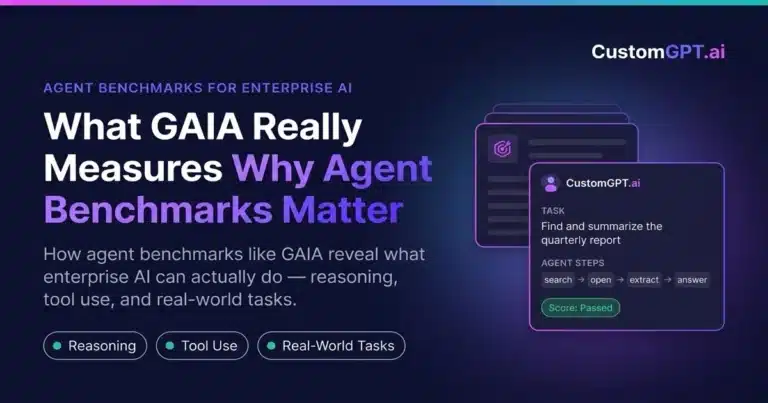
If you want to compare how agent systems are evaluated beyond basic chat, the GAIA benchmark for AI agents is a useful next read.
Agents are powerful, but they amplify whatever knowledge they are given, so an agent working from ungrounded data simply makes confident mistakes faster.
A private RAG system retrieves relevant passages from your controlled knowledge base, then uses a language model to compose an answer grounded in those retrieved sources, complete with citations. This is why regulated enterprises increasingly treat private RAG as the foundation, with conversational and agentic layers built on top of it.
For a deeper technical foundation on the retrieval architecture behind this approach, see the RAG Ultimate Guide, the pillar resource referenced throughout this page.
The rest of this guide defines each architecture precisely, compares them across the dimensions enterprise buyers care about (accuracy, security, hallucination risk, citations, governance, and compliance), maps them to ten enterprise use cases and eight industries, and gives you a decision framework for choosing the right approach.
What Is an AI Chatbot?
An AI chatbot is a software interface that simulates conversation with a user, interpreting natural-language input and returning natural-language responses. Modern AI chatbots are usually powered by a large language model (LLM), which lets them handle open-ended questions rather than only scripted menus.
The key limitation is that a standalone chatbot answers from the model’s trained parameters and any short context it is given, so it has no reliable, governed connection to your organization’s current, proprietary knowledge.
How do AI chatbots work?
An AI chatbot receives a user message, converts it into tokens, and passes it to a language model that predicts the most probable response based on patterns learned during training.
Some chatbots add a system prompt or a small set of canned documents to steer behavior. The model does not look anything up in a verified repository unless retrieval is explicitly added. That is the crucial distinction: a plain chatbot is a prediction engine, not a knowledge engine.
What are typical chatbot use cases?
Chatbots work well for first-line customer engagement, FAQ deflection, lead capture, appointment scheduling prompts, and casual informational queries where occasional imprecision carries low risk.
A website assistant that greets visitors and routes them to the right page is a good fit, similar to a website search assistant. For an individual, source-grounded version of this pattern, see the personal chatbot walkthrough. The trouble starts when a chatbot is asked authoritative questions about pricing, policy, regulation, or product specifics, because it will answer confidently whether or not it actually knows.
What are the limitations of AI chatbots?
The core limitations are hallucination, stale knowledge, weak governance, and no auditability. A standard chatbot can invent facts, cite nonexistent policies, or contradict your documentation, and it cannot show you where an answer came from. For regulated work, the inability to trace an answer to a source is disqualifying.
This is the single biggest reason enterprises move from generic chatbots toward grounded systems described in the RAG Ultimate Guide.
Definition table: AI Chatbot at a glance
| Attribute | AI Chatbot |
|---|---|
| Primary purpose | Conversational interface for natural-language interaction |
| Knowledge source | Model training data plus limited prompt context |
| Source citations | Rarely provided, and unverifiable when present |
| Hallucination risk | High when asked specific or proprietary questions |
| Best fit | Low-risk engagement, FAQ deflection, routing, lead capture |
| Weakest at | Authoritative, regulated, or proprietary-knowledge answers |
What Is an AI Agent?
An AI agent is an autonomous system that can pursue a goal by planning, reasoning across multiple steps, and taking actions through tools and APIs. Where a chatbot responds, an agent does. An agent can decide what to do next, call external systems, evaluate the result, and continue until the task is complete.
This makes agents valuable for workflow automation, but it also means an agent inherits and amplifies the quality of the knowledge and permissions it is given.
What makes an AI agent autonomous?
Autonomy in an AI agent comes from a loop: the agent observes the current state, plans an action, executes it through a tool, observes the outcome, and repeats. A simple agent might look up an order status and issue a refund.
A complex agent might triage a support ticket, search internal documentation, draft a response, and escalate edge cases to a human. The defining trait is that the agent chooses its own steps rather than following a fixed script.
How do AI agents use multi-step reasoning and tools?
AI agents combine an LLM’s reasoning with external capabilities such as databases, search, calculators, ticketing systems, and CRMs. The model reasons about which tool to use and when, then chains the results together.
Tool use is how an agent moves beyond conversation into action, for example pulling live inventory through an integrations layer or querying a knowledge base before responding. The reasoning quality depends heavily on the accuracy of what the tools return.
What is agent orchestration?
Agent orchestration is the coordination of one or more agents, their tools, memory, and guardrails so that complex workflows run reliably. Orchestration handles task decomposition, routing between specialized agents, error recovery, and human-in-the-loop checkpoints.
Strong orchestration is what separates a demo from a production system, because it adds the control, logging, and fallback behavior that enterprises require.
Architecture explanation: how an AI agent is structured
Picture an AI agent as four connected layers. The reasoning layer is the language model that plans and decides. The tool layer is the set of APIs and functions the agent can call. The memory layer stores context across steps and sessions. The governance layer enforces permissions, logging, and guardrails.
When an agent is asked to resolve a customer issue, the reasoning layer plans the steps, the tool layer retrieves order and policy data, the memory layer keeps track of the conversation, and the governance layer ensures the agent only takes permitted actions. If the tool layer feeds the agent ungrounded or wrong information, the agent will act on it decisively, which is precisely why agents perform best when they sit on top of a grounded retrieval system like the one detailed in the RAG Ultimate Guide.
What Is Private RAG?
Private RAG is a Retrieval-Augmented Generation system that runs over your organization’s own controlled knowledge base, retrieving relevant verified passages and using a language model to compose answers grounded in those passages, with citations back to the source.
The word private signals two things: the knowledge stays within your security boundary, and answers are constrained to your approved content rather than the open internet or the model’s training memory. This is the architecture that turns an AI from a plausible guesser into a traceable knowledge system. The full technical treatment lives in the RAG Ultimate Guide.
What is Retrieval-Augmented Generation?
Retrieval-Augmented Generation is a technique that retrieves relevant information from an external knowledge source at query time and supplies it to a language model so the model can generate an answer based on that retrieved evidence rather than memory alone. The model is no longer asked to recall facts.
It is asked to read the retrieved passages and answer from them. This single change dramatically reduces hallucination and lets the system show its work.
How does knowledge retrieval work in RAG?
Knowledge retrieval in RAG begins by converting your documents into vector embeddings and storing them in a vector index. When a user asks a question, the system embeds the question, finds the most semantically relevant passages, and passes them to the model as context.
Quality retrieval depends on clean source content, smart chunking, and ranking that surfaces the right passages. Better retrieval produces better answers, which is why content preparation is a core implementation step covered later in this guide.
What does source grounding mean?
Source grounding means every answer is tied to specific passages from your verified knowledge base, so the system can point to exactly where each claim came from.
Grounding is the mechanism that makes AI answers checkable. Instead of trusting the model, a user or auditor can read the cited source and confirm it. For teams that must defend answers, the practical mechanics of attaching evidence are explained in how to cite sources in AI-generated answers.
How does Private RAG protect enterprise security?
Private RAG keeps your knowledge inside your access boundary, applies your permission model to what each user can retrieve, and avoids sending proprietary data into open or shared model memory. Because retrieval is scoped to approved content, the system cannot leak information it was never given, and it cannot answer outside its source set. Security controls, access scoping, and data handling are part of the broader security, compliance, and governance discipline that grounded systems support.
Why are citation-backed answers important?
Citation-backed answers are important because they convert AI output from an unverifiable claim into evidence a human can audit. Citations let support agents trust the answer, let compliance teams prove the basis of a decision, and let users self-verify. An answer without a citation is an opinion. An answer with a citation to your approved policy is a defensible record.
Architecture table: Private RAG components
| Component | Function | Why it matters for enterprises |
|---|---|---|
| Document ingestion | Imports and normalizes your approved content | Defines exactly what the system is allowed to know |
| Chunking and embedding | Splits content and converts it into vectors | Determines retrieval precision and answer relevance |
| Vector index and retriever | Finds the most relevant passages per query | Drives accuracy and reduces irrelevant context |
| Grounded generation | Composes answers from retrieved passages only | Cuts hallucination by constraining the model to evidence |
| Citation layer | Attaches source references to each answer | Enables verification, audit, and trust |
| Access and governance controls | Scopes retrieval to permitted content per user | Enforces security and compliance boundaries |
Chatbot vs AI Agent vs Private RAG: Key Differences
The key difference is responsibility: a chatbot is responsible for conversation, an agent is responsible for action, and a private RAG system is responsible for knowledge accuracy. They are not competitors so much as layers, but when an enterprise must choose a primary architecture for a knowledge-heavy, regulated use case, private RAG wins on accuracy, citations, governance, and compliance readiness. The comparison below is the decision-grade reference for that choice.
| Dimension | AI Chatbot | AI Agent | Private RAG |
|---|---|---|---|
| Accuracy on proprietary questions | Low, answers from model memory | Variable, depends entirely on tool data quality | High, answers from your verified sources |
| Security posture | Often weak, limited data scoping | Broad action surface needs tight controls | Strong, retrieval scoped to permitted content |
| Hallucination risk | High and hard to detect | High when fed ungrounded data | Low, constrained to retrieved evidence |
| Source citations | Rare and unverifiable | Possible only if grounding is added | Built in, every answer traceable |
| Explainability | Opaque, no view into reasoning basis | Partial, action logs without source proof | Strong, answers map to cited passages |
| Governance | Minimal native controls | Requires orchestration guardrails | Native content, access, and audit controls |
| Knowledge access | Static training data plus short prompt | Whatever tools and APIs expose | Your live, approved knowledge base |
| Compliance readiness | Poor for regulated work | Conditional and effort-heavy | Strong, designed for auditability |
| Deployment complexity | Low | High, orchestration and tool integration | Moderate, content prep is the main effort |
| Enterprise suitability | Limited to low-risk engagement | High for automation with grounding | High for accurate, regulated knowledge work |
| Cost profile | Low upfront, high error cost | Higher build and oversight cost | Moderate, strong return on accuracy and trust |
The practical reading of this table is that chatbots minimize upfront cost while maximizing error risk, agents maximize capability while raising oversight burden, and private RAG optimizes for the thing enterprises actually need most, which is answers they can trust and prove. The strongest production systems combine all three: a conversational front end, agentic actions where automation pays off, and a private RAG core that keeps every answer grounded, as outlined in the RAG Ultimate Guide.
Why Enterprises Are Moving Beyond Traditional Chatbots
Enterprises are moving beyond traditional chatbots because the failure modes that are tolerable in casual settings become liabilities at enterprise scale. A chatbot that invents a refund policy, misstates a regulation, or contradicts internal documentation does not just frustrate a user, it creates legal, financial, and reputational exposure. As AI moved from novelty to core infrastructure, the gap between conversational fluency and factual reliability became impossible to ignore.
Hallucinations create unacceptable risk
A traditional chatbot generates fluent text that can be confidently wrong, and fluency makes the errors harder to catch. In a regulated environment, a single fabricated figure or invented clause can trigger a compliance incident. The risks of unverified generative output are detailed in generative AI compliance risks, and they are the primary driver of the shift to grounded systems.
Static knowledge goes stale
A chatbot’s knowledge is frozen at training time. Product details change, policies update, and prices move, but the model does not know unless something feeds it current information. Enterprises need answers that reflect today’s approved content, not last year’s training snapshot, which is exactly what retrieval provides.
Limited context produces shallow answers
Chatbots operate within a bounded context window and have no governed memory of your full knowledge estate. They cannot reason across thousands of policies, manuals, and tickets the way a retrieval system over your full corpus can. The result is shallow, generic answers where depth and specificity were required.
Security and governance concerns
Generic chatbots often lack access scoping, audit logging, and data residency controls. Sensitive questions can surface information the user should not see, or send proprietary data outside the security boundary. Enterprises increasingly require the controls described in security, compliance, and governance before any AI touches real data.
Enterprise example
Consider a financial services firm that deployed a generic chatbot for client questions. It answered quickly, but support leaders found it confidently misquoting fee schedules and inventing account rules. Every wrong answer was a potential regulatory issue. The firm replaced the standalone chatbot with a grounded system that retrieved from approved policy documents and cited them, eliminating the fabrication problem while keeping the conversational experience. The lesson generalizes across regulated industries.
Why AI Agents Are Powerful but Not Always Enough
AI agents are powerful because they can act, but they are not always enough because action without grounded knowledge multiplies error rather than reducing it. An agent that decides and executes based on unreliable information does not just give a wrong answer, it takes a wrong action, which is far costlier to reverse. Agents shine at automation, yet their value is gated by the quality of the knowledge and the strength of the governance around them.
Where AI agents excel
Agents excel at workflow automation: routing requests, updating systems, orchestrating multi-step processes, and chaining tools to complete tasks end to end. When a process is well defined and the underlying data is reliable, an agent can compress hours of manual work into seconds. This is the genuine upside, and it is substantial.
What risks do AI agents introduce?
Agents introduce risk through their action surface. An agent with permission to modify records, send messages, or trigger transactions can cause real damage if it reasons from bad data or is manipulated. The more autonomy an agent has, the more its mistakes compound, so each new capability raises the stakes of getting the knowledge layer right.
What governance challenges do agents create?
Agents create governance challenges because their behavior is dynamic. They choose their own steps, so you cannot fully predict every path in advance. This demands strong guardrails, permission scoping, human-in-the-loop checkpoints for sensitive actions, and complete logging. Without these, an agent becomes an unaccountable actor inside your systems.
Why do agents fail without grounded knowledge?
Agents fail without grounded knowledge because their reasoning is only as good as their inputs. If an agent retrieves a hallucinated fact or an outdated policy, it will plan and act on that falsehood with full confidence. Grounding the agent in a private RAG layer means every fact it reasons from is retrieved from your verified sources and is citable, which is why leading designs place a retrieval core beneath the agent, as described in the RAG Ultimate Guide. An agent that can prove the basis of its decisions is an asset. An agent that cannot is a liability.
Why Private RAG Is Becoming the Enterprise Standard
Enterprises are adopting private RAG because it solves the exact problems that block AI from regulated, knowledge-intensive work: it grounds answers in verified sources, attaches citations, respects security boundaries, and produces an audit trail. In other words, private RAG gives enterprises AI they can defend. As AI moved into compliance, healthcare, finance, and government workflows, defensibility stopped being optional, and private RAG became the architecture that delivers it. The complete technical case is laid out in the RAG Ultimate Guide.
Knowledge accuracy
Private RAG answers from your approved content, so accuracy reflects your documentation rather than a model’s training memory. When your sources are correct and current, your answers are too.
Source citations
Every private RAG answer can point to the passages it used, turning AI output into verifiable evidence. This is the foundation of trust for any team that must justify a response.
Security
Private RAG keeps knowledge inside your boundary and scopes retrieval to what each user is permitted to see, reducing both leakage and unauthorized disclosure.
Compliance
Because answers are grounded and traceable, private RAG supports the documentation and verification that regulations increasingly require, a theme explored in AI for compliance.
Governance
Private RAG gives you control over what the system knows, who can access what, and how answers are produced, which is the substance of real AI governance.
Explainability and auditability
Private RAG makes answers explainable by mapping them to sources and auditable by logging what was retrieved and returned. An auditor can reconstruct why the system said what it said.
Comparison table: Private RAG vs Generic LLMs
| Dimension | Generic LLM | Private RAG |
|---|---|---|
| Source of answers | Model training memory | Your verified knowledge base |
| Currency of knowledge | Frozen at training time | Reflects current approved content |
| Citations | Not provided or unverifiable | Built in and traceable to source |
| Hallucination control | Limited and inconsistent | Strong, constrained to retrieved evidence |
| Data privacy | Risk of exposure to shared models | Knowledge stays inside your boundary |
| Audit trail | Difficult to reconstruct | Retrieval and answer logging available |
| Compliance fit | Weak for regulated work | Designed for defensible, regulated use |
Enterprise Use Cases
Private RAG fits enterprise use cases wherever answers must be accurate, current, and defensible, while chatbots and agents play supporting roles around that grounded core. The ten use cases below each follow the same logic: the business challenge, why a chatbot alone fails, why an agent alone is not enough, why private RAG is recommended, and the outcomes to expect.
Customer Support
Business challenge: Support teams field repetitive, knowledge-heavy questions across products, policies, and accounts, and wrong answers erode trust and inflate handle time.
Why a chatbot fails: A generic chatbot invents policies and contradicts documentation, creating escalations instead of resolutions.
Why an agent alone is not enough: An agent can route and update tickets, but without grounding it automates wrong answers at scale.
Recommended architecture: Private RAG over your support knowledge base, with an agentic layer for ticket actions, delivered as a customer support AI solution.
Outcomes: Higher deflection, faster resolution, citation-backed answers agents can trust, and fewer compliance-sensitive mistakes.
Internal Knowledge Management
Business challenge: Employees waste hours searching scattered wikis, drives, and documents for answers that exist somewhere but cannot be found.
Why a chatbot fails: It has no governed access to your internal corpus and cannot reason across thousands of documents.
Why an agent alone is not enough: Automation does not help if the retrieved knowledge is unreliable.
Recommended architecture: Private RAG across your internal repositories, surfaced through enterprise knowledge search and a centralized knowledge management layer.
Outcomes: Instant, cited answers from approved sources, less time lost to search, and consistent information across teams.
Compliance Operations
Business challenge: Compliance teams must answer questions about regulations and internal policy with precision, and must prove the basis of every answer.
Why a chatbot fails: It cannot cite sources, so its answers are inadmissible for compliance purposes.
Why an agent alone is not enough: Workflow automation without traceable evidence does not satisfy auditors.
Recommended architecture: Private RAG grounded in regulatory and policy documents, aligned with AI for compliance practices and citation-backed answers.
Outcomes: Defensible, source-cited answers, faster policy lookups, and an audit trail for every response.
Healthcare
Business challenge: Clinical and administrative staff need accurate answers from protocols, formularies, and guidelines where errors carry patient-safety and regulatory consequences.
Why a chatbot fails: Hallucinated medical guidance is dangerous and indefensible.
Why an agent alone is not enough: Autonomous actions in healthcare require grounded, verifiable knowledge first.
Recommended architecture: Private RAG over approved clinical and policy content with strict access controls and citations.
Outcomes: Grounded answers tied to approved guidelines, reduced risk, and verifiable support for staff decisions.
Financial Services
Business challenge: Advisors and support staff must answer questions on products, fees, and regulations with zero tolerance for misstatement.
Why a chatbot fails: Invented fee schedules and account rules create regulatory exposure.
Why an agent alone is not enough: Automated transactions on wrong data magnify financial risk.
Recommended architecture: Private RAG grounded in current product and regulatory documentation, with governance controls from the security and governance discipline.
Outcomes: Accurate, cited answers, reduced compliance incidents, and confident frontline staff.
Insurance
Business challenge: Claims and policy questions require precise reference to coverage terms that vary by product and jurisdiction.
Why a chatbot fails: It cannot reliably reason over complex, version-specific policy language.
Why an agent alone is not enough: Claims automation built on ungrounded interpretation produces costly disputes.
Recommended architecture: Private RAG over policy documents and underwriting guidelines, with an agent layer for claims workflow steps.
Outcomes: Consistent coverage answers tied to the exact policy language, faster claims handling, and fewer disputes.
Government
Business challenge: Agencies must give citizens and staff accurate answers about programs, eligibility, and regulations while meeting transparency and accountability standards.
Why a chatbot fails: Unverifiable answers undermine public trust and accountability.
Why an agent alone is not enough: Public-facing automation needs grounded, citable information by default.
Recommended architecture: Private RAG over official program and policy content, delivered through approaches described in CustomGPT.ai for government and the government AI practice.
Outcomes: Cited, transparent answers, improved citizen self-service, and accountable public communication.
Legal Services
Business challenge: Legal teams need answers grounded in statutes, contracts, and precedent, where a wrong citation can be malpractice.
Why a chatbot fails: It is notorious for inventing cases and misquoting authority.
Why an agent alone is not enough: Drafting automation without grounded sources produces unreliable work product.
Recommended architecture: Private RAG over approved legal documents and matter files, aligned with professional services AI.
Outcomes: Answers anchored to real, cited authority, faster research, and reduced risk of fabricated references.
HR Operations
Business challenge: Employees ask repetitive questions about benefits, policies, and procedures that HR teams answer over and over.
Why a chatbot fails: Inconsistent or invented policy answers create employee-relations and compliance issues.
Why an agent alone is not enough: Automating HR transactions on unreliable answers risks fairness and compliance.
Recommended architecture: Private RAG over current HR policy content, with agentic steps for routine requests.
Outcomes: Consistent, cited policy answers, lower HR ticket volume, and equitable, traceable responses.
IT Support
Business challenge: IT help desks resolve recurring technical issues that are documented but hard for users to locate.
Why a chatbot fails: Generic troubleshooting advice ignores your specific environment and configurations.
Why an agent alone is not enough: Automated remediation needs accurate, environment-specific knowledge to act safely.
Recommended architecture: Private RAG over internal runbooks and documentation, surfaced through enterprise knowledge search, with agentic actions for safe automated fixes.
Outcomes: Faster ticket resolution, accurate environment-specific guidance, and reduced escalations.
Industry Comparison Framework
The right architecture varies by industry risk profile, but a consistent pattern holds: the higher the accuracy and accountability requirements, the stronger the case for private RAG as the core. The framework below summarizes how chatbots, agents, and private RAG map across eight industries and what we recommend for each.
| Industry | Chatbot | AI Agent | Private RAG | Recommended Approach |
|---|---|---|---|---|
| Healthcare | Risky for clinical content, limited to general engagement | Useful for scheduling and routing with strict controls | Essential for grounded, cited clinical and policy answers | Private RAG core with tightly governed agent actions |
| Financial Services | Acceptable only for low-risk navigation | Valuable for transactional workflows once grounded | Critical for regulated product and policy answers | Private RAG core with audited agent automation |
| Insurance | Limited to basic guidance | Strong for claims workflow steps | Critical for coverage and policy interpretation | Private RAG core with agentic claims handling |
| Government | Weak for accountable public answers | Useful for service workflows with oversight | Essential for transparent, citable program answers | Private RAG core with public-facing grounding |
| Legal | Unsafe for authority-dependent answers | Helpful for document workflow automation | Critical for statute, contract, and precedent grounding | Private RAG core with strict citation enforcement |
| Enterprise SaaS | Good for top-of-funnel engagement | Strong for product and support automation | Important for accurate product and docs answers | Private RAG core with agentic support, suited to startups and SaaS |
| Manufacturing | Limited to general queries | Strong for operational workflow automation | Important for grounded manuals and spec answers | Private RAG core for technical knowledge, see manufacturing AI |
| Education | Useful for student engagement | Helpful for administrative workflows | Valuable for grounded curriculum and policy answers | Private RAG core for learning content, see education AI |
How Private RAG Reduces Hallucinations
Private RAG reduces hallucinations by changing the question the model is asked. Instead of asking the model to recall an answer from memory, it asks the model to read retrieved, verified passages and answer from them, then attach citations. Because the answer is constrained to evidence the system actually retrieved, the model has far less room to invent. This is the mechanism behind dedicated anti-hallucination AI, and the architectural detail is covered in the RAG Ultimate Guide.
How does retrieval reduce hallucination?
Retrieval reduces hallucination by supplying the model with the actual relevant content before it generates. When the right passages are in front of the model, it can compose a correct answer rather than guessing. The quality of retrieval directly sets the ceiling on answer reliability, which is why clean sources and good chunking matter so much.
What is source validation?
Source validation is the practice of constraining the system to approved content and confirming that generated claims are supported by retrieved passages. If a claim is not supported by a source, the system can decline to assert it. This keeps answers inside the boundary of what your documents actually say.
How do citations build trust?
Citations build trust by making every answer checkable. A user, agent, or auditor can open the cited source and confirm the claim. Citations also create accountability, because an answer that cannot be supported by a source is visibly unsupported. The practical method is described in citing sources in AI answers.
What is knowledge grounding?
Knowledge grounding is the principle that answers must derive from your verified knowledge base rather than the model’s open memory. Grounding is the difference between a system that knows your business and one that merely sounds like it does. Source-grounded AI is the foundation of every reliable enterprise deployment.
How does explainability follow from grounding?
Explainability follows from grounding because a grounded answer can always show its evidence. When each claim maps to a passage, the system can explain itself by pointing to the source. That traceability is what makes grounded AI suitable for high-stakes decisions.
How Private RAG Supports Compliance and Governance
Private RAG supports compliance and governance by producing answers that are grounded, cited, access-controlled, and logged, which are exactly the properties modern AI regulations and standards expect. Rather than treating compliance as a bolt-on, private RAG bakes traceability and control into the answer itself. This alignment is why compliance and risk teams favor the architecture, as discussed in AI for compliance and generative AI compliance risks.
How does Private RAG align with the EU AI Act?
The EU AI Act emphasizes transparency, risk management, and human oversight for AI systems, especially higher-risk uses. Private RAG supports these aims by making answers traceable to sources, enabling human verification, and keeping a record of what was retrieved and returned, which supports the transparency and oversight expectations the regulation sets.
How does Private RAG map to ISO 42001?
ISO 42001 is the international standard for AI management systems, focused on governance, accountability, and continual improvement. Private RAG supports it by providing controlled knowledge sources, access governance, audit logging, and a clear basis for each answer, which feed directly into the documentation and control evidence an AI management system requires.
How does Private RAG relate to the NIST AI Risk Management Framework?
The NIST AI Risk Management Framework organizes AI risk around governing, mapping, measuring, and managing risk across the lifecycle. Private RAG contributes by reducing hallucination risk, making answers measurable against sources, scoping access, and logging activity, which supports the measure and manage functions while grounding the govern function in concrete controls.
How does Private RAG meet internal audit requirements?
Private RAG meets internal audit requirements by retaining a record of retrieved sources and returned answers, so auditors can reconstruct why the system responded as it did. Citations give auditors a direct path from answer to evidence, turning AI responses into reviewable artifacts rather than opaque outputs.
Compliance mapping table
| Framework or requirement | Core expectation | How Private RAG supports it |
|---|---|---|
| EU AI Act | Transparency, oversight, risk management | Traceable cited answers and human-verifiable evidence |
| ISO 42001 | AI management system governance | Controlled sources, access governance, and audit logging |
| NIST AI RMF | Map, measure, and manage AI risk | Source grounding, measurable accuracy, and activity logs |
| OECD AI Principles | Trustworthy, transparent, accountable AI | Explainable answers grounded in approved knowledge |
| Internal audit | Reconstructable decision basis | Retrieval and answer records with citations |
For the controls and policies that operationalize these mappings, see security, compliance, and governance.
Private RAG vs Microsoft Copilot vs ChatGPT vs Enterprise Search
Compared head to head, private RAG is distinguished by source grounding, citations, and governance over your own knowledge, while general assistants optimize for productivity breadth and traditional enterprise search optimizes for document discovery rather than composed, cited answers. The table below compares the categories on the criteria that matter to enterprise buyers. For a deeper feature-by-feature view of the platform landscape, see the enterprise AI chatbot platform comparison.
| Criterion | Private RAG | Microsoft Copilot | ChatGPT Enterprise | Gemini Enterprise | Traditional Enterprise Search |
|---|---|---|---|---|---|
| Source citations | Built in for every answer | Sometimes, varies by surface | Limited and inconsistent | Limited and inconsistent | Returns documents, not cited answers |
| Knowledge grounding | Grounded in your approved corpus | Grounded in connected workspace data | General model with optional context | General model with optional context | Keyword and index based, no generation |
| Governance | Native content and access controls | Tied to the broader productivity suite | Enterprise admin controls | Enterprise admin controls | Mature access controls, no answer governance |
| Security | Knowledge stays in your boundary | Bound to the vendor ecosystem | Vendor-managed enterprise tier | Vendor-managed enterprise tier | On-premises or vendor-hosted indexing |
| Auditability | Retrieval and answer logging with sources | Activity logging within the suite | Admin-level logging | Admin-level logging | Query logs without answer reasoning |
| Compliance readiness | Designed for defensible, regulated use | Strong within its ecosystem boundaries | General-purpose, effort to govern | General-purpose, effort to govern | Strong for search, no generated-answer accountability |
| Custom knowledge support | Core capability over your private content | Best within connected workspace content | Requires configuration and tooling | Requires configuration and tooling | Indexes content but does not compose answers |
The takeaway is that general assistants and enterprise search each solve part of the problem, while private RAG is purpose-built for accurate, cited, governable answers over your own knowledge. Many enterprises run private RAG alongside these tools, using it as the trusted knowledge layer.
How CustomGPT.ai Implements Private RAG
CustomGPT.ai implements private RAG as a managed, source-grounded platform that ingests your approved content, retrieves the most relevant passages per query, and composes citation-backed answers inside your security and governance boundary. The design goal is accuracy you can prove: every answer should trace to your sources, respect your access rules, and leave an audit trail. The underlying retrieval approach follows the principles in the RAG Ultimate Guide, applied as an enterprise-ready product.
Enterprise RAG architecture
CustomGPT.ai connects to your content through a broad set of data connectors and integrations, normalizes and indexes it, and serves grounded answers through a RAG API and ready-to-use interfaces. The architecture lets teams stand up grounded assistants without building retrieval infrastructure from scratch, using a no-code builder for fast deployment.
Source-grounded responses
Answers are composed from your retrieved content rather than open model memory, which keeps responses aligned with your documentation. This source grounding is the basis of the platform’s anti-hallucination behavior.
Citation-backed answers
Every answer can carry references to the source passages it used, so support agents, employees, and auditors can verify the basis of a response. This directly addresses the need to cite sources for compliance.
Private knowledge bases
Your knowledge stays within your boundary, scoped to your project and access rules, so the system answers only from content you approved and only for users permitted to see it.
Security controls
The platform provides enterprise security and trust controls covering access, data handling, and governance, so AI deployment does not widen your attack surface.
Compliance readiness and governance
Because answers are grounded, cited, and logged, deployments align with the compliance and governance practices in the security, compliance, and governance library and the broader AI for compliance approach.
Auditability
Retrieval and answer records create a reviewable trail, so you can reconstruct why the system responded as it did, which is essential for regulated work and internal audit. For organizations evaluating platform fit at scale, the enterprise AI platform overview details deployment options.
Private RAG Implementation Framework
Implementing private RAG succeeds when you treat it as a knowledge program, not just a software install, moving through seven stages from audit to optimization. The framework below sequences the work so that accuracy, security, and governance are built in from the start rather than retrofitted. Each stage maps to the architecture described in the RAG Ultimate Guide.
Step 1: Knowledge Audit
Inventory the content that should answer questions, identify gaps and outdated material, and decide what is in scope. The audit determines what the system is allowed to know, so it directly shapes answer quality.
Step 2: Content Preparation
Clean, structure, and normalize your sources so retrieval can find the right passages. Well-prepared content with clear structure dramatically improves retrieval precision and answer relevance.
Step 3: Security Design
Define access scoping, data handling, and residency requirements before ingestion. Decide who can retrieve what, and align with your security and governance standards.
Step 4: RAG Deployment
Ingest content, configure retrieval and generation, and connect the system to your interfaces and workflows through connectors and the RAG API.
Step 5: Validation
Test answers against known-good responses, check citation accuracy, and confirm the system declines when sources do not support a claim. Validation proves the system is grounded before it goes live.
Step 6: Governance
Establish ongoing controls: access reviews, content update processes, logging, and human oversight for sensitive use, aligned with AI for compliance.
Step 7: Optimization
Monitor real queries, fix content gaps, refine retrieval, and improve answers over time. Optimization turns a working deployment into a continuously improving knowledge asset.
Implementation checklist
| Stage | Key action | Done when |
|---|---|---|
| Knowledge Audit | Catalog and scope authoritative sources | Source list is approved and gaps are documented |
| Content Preparation | Clean and structure content for retrieval | Sources are normalized and ready to ingest |
| Security Design | Define access scoping and data handling | Access model and controls are agreed and recorded |
| RAG Deployment | Ingest, configure, and connect the system | Grounded answers are served in target interfaces |
| Validation | Test accuracy and citation correctness | Answers pass review and cite the right sources |
| Governance | Set update, review, and oversight processes | Controls and owners are assigned and active |
| Optimization | Monitor and improve based on real usage | A regular review cadence is running |
How to Choose Between a Chatbot, AI Agent, and Private RAG
Choose based on the risk and nature of the answers you need: pick a chatbot for low-risk engagement, an agent for action and automation, and private RAG when answers must be accurate, current, and provable. Most enterprises with regulated or knowledge-heavy work should start with a private RAG core and add conversational and agentic layers on top. The decision tree below makes this concrete.
Decision tree
Start with one question: do wrong answers create real risk? If no, and you only need casual engagement, a chatbot may suffice. If yes, ask the next question: do you need the system to take actions, or to answer questions? If you primarily need actions and automation, you need an agent, but ground it in private RAG so it acts on verified knowledge. If you primarily need accurate, citable answers from your own content, private RAG is the core. If you need both accurate answers and automated actions, combine private RAG with an agentic layer.
What role does organization size play?
Smaller organizations often start with a focused private RAG deployment on a key use case and expand, while larger enterprises typically need the governance, access controls, and scale of an enterprise AI platform from the outset. Size affects rollout sequencing more than the core architecture choice.
How does the use case drive the decision?
The use case is the strongest signal. Knowledge-answer use cases favor private RAG, action-and-workflow use cases favor agents on a grounded core, and pure engagement use cases can start with a chatbot. Match the architecture to the dominant job, then layer the others as needed.
How do security and compliance requirements affect the choice?
The stronger your security and compliance requirements, the more decisively you should favor private RAG, because grounding, citations, access scoping, and logging are native to it. For regulated industries, these requirements usually make private RAG the mandatory foundation, as reinforced in AI for compliance.
How do budget and technical resources factor in?
Chatbots are cheapest to start but carry the highest error cost, agents demand the most build and oversight investment, and private RAG sits in between with strong return on accuracy and trust. Managed platforms reduce the technical-resource burden, letting teams deploy grounded AI without building retrieval infrastructure themselves.
Future of Enterprise AI Architectures
The future of enterprise AI is layered and grounded: agentic systems that act, built on private RAG cores that keep them accurate, governed by explainable, auditable controls. The trajectory is away from standalone chatbots and toward hybrid architectures where retrieval, reasoning, and action work together under strong governance. The retrieval core that anchors this future is the subject of the RAG Ultimate Guide.
Agentic AI matures on grounded foundations
Agentic AI will keep expanding, but the lesson enterprises are learning is that agents need grounded knowledge to be safe. Expect agent platforms to standardize on retrieval cores so that autonomous actions rest on verified facts.
Enterprise RAG becomes infrastructure
Private RAG is shifting from a project to infrastructure, a trusted knowledge layer that many applications and agents draw on. As that happens, content quality and governance become the durable competitive advantage.
AI governance becomes non-negotiable
Regulation and internal risk management are making governance a baseline requirement. Architectures that make answers explainable and auditable by design will be favored over opaque ones, as covered across the security, compliance, and governance practice.
Knowledge AI and explainable AI converge
The demand for both accurate knowledge and explainability is pushing the field toward systems that answer from sources and show their evidence. Knowledge AI and explainable AI are converging on the same grounded design.
Hybrid architectures win
The winning pattern is hybrid: a conversational interface for access, an agentic layer for action, and a private RAG core for truth. Enterprises that adopt this layered model get the usability of chatbots, the productivity of agents, and the trust of grounded retrieval.
Who Should Invest in Private RAG?
Any organization whose answers must be accurate, current, and provable should invest in private RAG, and that is especially true for regulated and knowledge-intensive enterprises. If wrong answers create legal, financial, clinical, or reputational risk, grounding is not optional. The roles and organizations below see the clearest return.
CIOs and CTOs should invest in private RAG to deploy AI that is accurate and governable rather than risky and opaque, and to give every downstream chatbot and agent a trustworthy knowledge core. Compliance teams should invest because grounded, cited answers are the only kind they can defend, as detailed in AI for compliance. Government agencies should invest to deliver transparent, accountable citizen services, an approach described in CustomGPT.ai for government. Healthcare organizations should invest to ground clinical and policy answers in approved sources where patient safety and regulation demand precision. Financial institutions should invest to answer regulated product and policy questions without misstatement. Knowledge management leaders should invest to turn scattered documents into instant, cited answers, building on a centralized knowledge management foundation. The common thread is accountability: private RAG is the architecture for organizations that must stand behind every answer.
Frequently Asked Questions
What is the difference between a chatbot, an AI agent, and private RAG?
A chatbot is a conversational interface that answers from a model’s memory. An AI agent is an autonomous system that plans and takes actions through tools. Private RAG is a system that answers from your verified knowledge base with citations. In short, a chatbot talks, an agent acts, and private RAG answers accurately and provably. The strongest enterprise systems combine all three with a grounded RAG core.
Is an AI agent better than a chatbot?
An AI agent is more capable than a chatbot because it can take actions and complete multi-step tasks, while a chatbot only converses. But better depends on the job. For pure engagement, a chatbot may be enough. For automation, an agent is stronger. Crucially, an agent is only as reliable as the knowledge it uses, so agents perform best when grounded in a private RAG layer rather than working from raw model memory.
What is private RAG in simple terms?
Private RAG is an AI system that answers your questions using your own approved documents instead of guessing from general training data. It retrieves the most relevant passages from your content, then composes an answer grounded in those passages, with citations you can check. Private means your knowledge stays inside your security boundary. The result is AI that reflects your documentation and can prove where each answer came from.
How does RAG differ from a normal AI chatbot?
A normal chatbot generates answers from the model’s training memory, so it can hallucinate and cannot cite sources. RAG retrieves relevant passages from a knowledge base at query time and answers from that retrieved evidence, attaching citations. The difference is grounding. A chatbot guesses based on patterns, while RAG answers based on your actual content, which makes RAG far more accurate and verifiable for enterprise use.
What is retrieval-augmented generation?
Retrieval-augmented generation is a technique that supplies a language model with relevant information retrieved from an external knowledge source at query time, so the model answers from that evidence rather than memory alone. It combines a retriever that finds relevant passages with a generator that composes the answer. RAG reduces hallucination, keeps answers current with your sources, and enables citations, which is why it underpins reliable enterprise AI.
Why do enterprises prefer private RAG over generic LLMs?
Enterprises prefer private RAG because it answers from their verified knowledge, cites sources, keeps data inside their boundary, and produces an audit trail, while generic LLMs answer from frozen training memory without citations. Private RAG gives organizations AI they can defend in regulated, knowledge-heavy work. Generic models are useful for general tasks, but they lack the grounding, traceability, and governance that enterprise decisions require.
Does private RAG eliminate hallucinations?
Private RAG dramatically reduces hallucinations but does not eliminate them entirely. By constraining the model to retrieved, verified passages and attaching citations, it removes most of the room to invent facts. Residual risk depends on content quality and retrieval precision, which is why content preparation and validation matter. A well-implemented private RAG system can also decline to answer when sources do not support a claim, further reducing error.
Is private RAG secure for sensitive data?
Private RAG is designed to keep sensitive knowledge inside your security boundary and to scope retrieval to what each user is permitted to access. Because the system only answers from content you approved, it cannot leak information it was never given. Security depends on proper access design and platform controls, so define your access model during implementation and align it with your governance standards before going live.
What is an enterprise AI assistant?
An enterprise AI assistant is an AI system deployed inside an organization to answer questions and support workflows using the organization’s own knowledge, under enterprise security and governance. The most reliable enterprise assistants are built on private RAG so their answers are grounded and cited. They differ from consumer chatbots by respecting access controls, keeping data private, and providing the traceability enterprises need.
What is source-grounded AI?
Source-grounded AI is AI that produces answers tied to specific verified sources, so every claim can be traced back to where it came from. Grounding constrains the model to your approved content rather than open memory, which reduces hallucination and enables citations. Source-grounded AI is the foundation of trustworthy enterprise systems because it turns AI output from an unverifiable claim into checkable evidence.
What is AI knowledge management?
AI knowledge management is the use of AI to organize, retrieve, and deliver an organization’s knowledge so people get accurate answers instantly instead of searching through scattered documents. When built on private RAG, it returns cited answers from approved sources rather than guesses. It reduces time lost to search, keeps information consistent across teams, and turns a fragmented document estate into a reliable, queryable knowledge asset.
Can AI agents and RAG work together?
Yes, and they work best together. An AI agent supplies autonomy and action, while RAG supplies grounded, verified knowledge. When an agent retrieves facts through a RAG layer, every decision it makes rests on cited evidence from your sources rather than model memory. This combination gives you automation you can trust, because the agent can prove the basis of its actions and avoid acting on hallucinated information.
When should I use a chatbot instead of private RAG?
Use a chatbot instead of private RAG when the interaction is low-risk and does not require authoritative, proprietary answers, such as casual engagement, simple routing, or lead capture. If wrong answers carry no real consequence, a chatbot’s speed and simplicity may be enough. The moment you need accurate, current, citable answers from your own knowledge, private RAG becomes the right choice.
What is enterprise RAG?
Enterprise RAG is retrieval-augmented generation deployed at organizational scale with the security, governance, access controls, and auditability that enterprises require. It grounds AI answers in approved corporate knowledge, attaches citations, and keeps data inside the security boundary. Enterprise RAG is increasingly treated as infrastructure, a trusted knowledge layer that powers chatbots, assistants, and agents across the organization with consistent accuracy.
How does private RAG support compliance?
Private RAG supports compliance by grounding answers in approved sources, attaching citations, scoping access, and logging retrieval and responses, which together create defensible, auditable AI. These properties align with frameworks like the EU AI Act, ISO 42001, and the NIST AI Risk Management Framework, which emphasize transparency, oversight, and risk management. For regulated work, this traceability is what makes AI answers usable rather than risky.
Is private RAG better than Microsoft Copilot or ChatGPT for enterprises?
For accurate, cited answers over your own private knowledge with strong governance, private RAG is purpose-built in ways general assistants are not. Microsoft Copilot and ChatGPT Enterprise are strong general productivity tools, but they optimize for breadth rather than grounded, auditable answers from your controlled corpus. Many enterprises run private RAG alongside these tools, using it as the trusted knowledge layer they can defend.
What industries benefit most from private RAG?
Regulated and knowledge-intensive industries benefit most, including healthcare, financial services, insurance, government, and legal services, where wrong answers carry serious consequences. Enterprise SaaS, manufacturing, and education also benefit where accurate, current knowledge matters. The common factor is the need for answers that are accurate, current, and provable, which is exactly what private RAG delivers through grounding and citations.
How long does it take to implement private RAG?
Implementation time depends mainly on content readiness rather than software. A focused deployment on a well-organized knowledge base can go live quickly, while large or messy content estates take longer because content preparation is the main effort. Following a staged framework of audit, preparation, security design, deployment, validation, governance, and optimization keeps timelines predictable and ensures the system is grounded before launch.
Does private RAG keep my data private?
Private RAG is built to keep your knowledge within your security boundary and to scope retrieval to permitted content, so your proprietary data is not exposed to open or shared model memory. The level of privacy depends on the platform’s controls and your access design. Define data handling, residency, and access rules during the security design stage, and confirm them against your governance standards before deployment.
What is the difference between AI chatbot and AI assistant?
An AI chatbot is typically a conversational interface focused on responding to messages, while an AI assistant is a broader system that helps complete tasks and answer questions using connected knowledge, often under enterprise controls. In practice, an enterprise AI assistant built on private RAG is more capable and trustworthy than a basic chatbot because it grounds answers in your sources and can support workflows rather than only chatting.
Can private RAG answer from current, updated information?
Yes. Because private RAG retrieves from your knowledge base at query time, it reflects whatever content is currently in that base. When you update your approved sources, answers update accordingly, unlike a standalone model frozen at training time. Keeping the knowledge base current through a defined update process is part of governance, and it is what lets private RAG stay accurate as your policies and products change.
What is the role of citations in enterprise AI?
Citations turn AI answers into verifiable evidence by linking each claim to its source, which is essential for trust, compliance, and auditability. With citations, support agents can confirm answers, compliance teams can prove the basis of decisions, and auditors can reconstruct reasoning. An answer without a citation is an unverifiable claim, while a cited answer is a defensible record, which is why citations are central to enterprise-grade AI.
How does private RAG reduce risk for compliance teams?
Private RAG reduces compliance risk by ensuring answers come from approved sources, carry citations, and leave an audit trail, so teams can defend every response. It removes the hallucination and unverifiability that make generic chatbots inadmissible for regulated work. By grounding answers in current policy and regulatory content, it also reduces the chance of citing outdated or incorrect rules, lowering the likelihood of compliance incidents.
Are AI agents safe for enterprise use?
AI agents can be safe for enterprise use when they have strong governance, scoped permissions, human oversight for sensitive actions, complete logging, and grounded knowledge to reason from. The danger comes from autonomy without these controls, because an agent acting on wrong or ungrounded data can cause real harm. Grounding agents in private RAG and constraining their action surface are the key practices for safe deployment.
What is the best AI architecture for regulated industries?
For regulated industries, the best architecture is a private RAG core, optionally combined with agentic automation under strict governance. Private RAG delivers the grounding, citations, access controls, and audit trail that regulation requires, while agents add automation where it is safe. Standalone chatbots are generally unsuitable for regulated answers because they cannot cite sources or prove accuracy, which makes their output indefensible.
How does private RAG handle questions it cannot answer?
A well-designed private RAG system declines or expresses uncertainty when its retrieved sources do not support an answer, rather than inventing one. This is a key reliability feature, because admitting a gap is far safer than fabricating a response. Configuring the system to answer only when sources support the claim, and to flag gaps, is part of validation and is one reason grounded systems are trusted in high-stakes settings.
What is knowledge grounding in AI?
Knowledge grounding is the principle that an AI system’s answers must derive from verified knowledge rather than the model’s open memory. Grounding ties output to real sources, which reduces hallucination and enables citations and explainability. It is the foundation of source-grounded AI and the reason private RAG is reliable for enterprise work, because grounded answers can always be checked against the evidence they came from.
Do I need both an AI agent and private RAG?
You need both when your use case requires accurate answers and automated actions. Private RAG ensures the system reasons from verified, cited knowledge, while the agent executes multi-step tasks. Used together, the agent acts on grounded facts rather than guesses, giving you automation you can trust. If you only need accurate answers, private RAG alone suffices. If you only need engagement, a chatbot may be enough.
How does private RAG improve customer support?
Private RAG improves customer support by giving agents and self-service users accurate, cited answers drawn from approved support content, which raises deflection and lowers handle time. It eliminates the fabrication problem of generic chatbots and keeps answers consistent with current documentation. Paired with an agentic layer for ticket actions, it resolves more issues correctly on the first try while reducing compliance-sensitive mistakes in regulated support contexts.
What makes an enterprise AI platform trustworthy?
A trustworthy enterprise AI platform grounds answers in approved sources, provides citations, enforces access and security controls, logs activity for audit, and aligns with recognized governance frameworks. Trust comes from the ability to prove where answers came from and to control who can access what. Platforms built on private RAG meet these criteria by design, which is why they are favored for accurate, defensible enterprise deployments.
How does private RAG support governance?
Private RAG supports governance by giving you control over what the system knows, who can access it, and how answers are produced, plus logging that makes activity reviewable. Governance is not bolted on, it is inherent in the grounded, access-scoped, auditable design. This lets organizations set update processes, access reviews, and oversight for sensitive use, aligning AI behavior with internal policy and external regulation.
Can private RAG scale across a large enterprise?
Yes. Private RAG scales by serving as a shared, trusted knowledge layer that many applications, assistants, and agents draw on, with governance and access controls applied consistently. Large enterprises typically deploy it through a managed platform that handles retrieval infrastructure, security, and scale. Scaling success depends on content governance, since a larger knowledge estate requires disciplined preparation and update processes to maintain accuracy.
What is the difference between RAG and fine-tuning?
RAG retrieves relevant information at query time and answers from it, while fine-tuning adjusts a model’s weights by training it on additional data. RAG keeps knowledge external, current, and citable, and is easy to update by changing sources. Fine-tuning bakes patterns into the model and is harder to update or cite. For enterprise knowledge that changes and must be traceable, RAG is usually the better fit.
How do I measure private RAG accuracy?
Measure private RAG accuracy by testing answers against known-good responses, checking that citations point to the correct sources, and confirming the system declines when sources do not support a claim. Track real-query performance over time and fix content gaps that produce weak answers. Accuracy is a function of content quality and retrieval precision, so measurement should drive ongoing content and retrieval improvements during optimization.
Is private RAG suitable for government agencies?
Private RAG is well suited to government agencies because it delivers transparent, citable answers from official content while meeting accountability expectations. It improves citizen self-service and staff productivity without the risk of unverifiable chatbot answers. Because public communication demands accuracy and traceability, grounding and citations are especially valuable, which is why grounded approaches are recommended for public-sector deployments handling programs, eligibility, and policy.
What knowledge sources can private RAG use?
Private RAG can use the approved content you connect to it, such as documents, manuals, policies, knowledge bases, and structured records, ingested through connectors and normalized for retrieval. The scope you define during the knowledge audit determines what the system can answer. Quality matters more than quantity, since clean, well-structured, current sources produce far better answers than large but messy content estates.
How does explainable AI relate to private RAG?
Explainable AI is AI whose outputs can be understood and justified, and private RAG advances it by mapping every answer to cited sources. Because a grounded answer can show the exact passages it used, the system can explain its reasoning basis in a way a black-box model cannot. This traceability is what makes private RAG suitable for high-stakes decisions where stakeholders must understand why the AI said what it said.
What are the main risks of generic AI chatbots in the enterprise?
The main risks are hallucination, stale knowledge, lack of citations, weak access controls, and no audit trail, which together make generic chatbots unsuitable for regulated or high-stakes answers. A confident wrong answer can cause legal, financial, or reputational harm, and the inability to trace answers to sources is disqualifying for compliance. These risks are the primary reason enterprises shift to grounded, citable private RAG systems.
How do I get started with private RAG?
Start by identifying a high-value use case where accurate, cited answers matter, then audit the content that should answer those questions. Prepare and structure that content, define your access and security model, and deploy a grounded system through a managed platform to avoid building retrieval infrastructure yourself. Validate accuracy and citations before launch, then govern and optimize over time as usage grows and content evolves.
Why is private RAG becoming the enterprise standard?
Private RAG is becoming the enterprise standard because it solves the core problems that block AI from serious work: it grounds answers in verified sources, cites them, keeps data private, and produces an audit trail. As AI moved into regulated and knowledge-heavy workflows, defensibility became essential, and private RAG is the architecture that delivers it. It also serves as the trusted foundation that chatbots and agents increasingly build upon.
Ready to Deploy Source-Grounded Enterprise AI?
Enterprise AI is only as valuable as it is trustworthy, and trust comes from grounding, citations, security, and governance. If your organization needs answers it can prove, private RAG is the architecture to build on, and CustomGPT.ai is purpose-built to deliver it.
For enterprise AI buyers, CustomGPT.ai provides a source-grounded platform that turns your approved knowledge into accurate, cited answers. For technical teams, it offers a RAG API and broad integrations so you can deploy grounded AI without building retrieval infrastructure from scratch. For security teams, it keeps knowledge inside your boundary with enterprise security and trust controls. For compliance teams, it produces citation-backed, auditable answers aligned with AI for compliance practices. For knowledge management teams, it converts scattered documents into instant, reliable answers through a centralized knowledge management layer.
If you want private RAG, source-grounded AI, citation-backed answers, enterprise security, AI governance, and compliance readiness in one platform, explore the enterprise AI platform, review real customer results, and start grounding your AI in knowledge you can trust. To go deeper on the architecture behind it all, read the RAG Ultimate Guide.
Related Resources
These articles expand on key ways CustomGPT.ai can strengthen customer interactions and operational support.
- Turn Visitors Into Customers — Explore practical strategies for using AI-driven conversations to guide prospects toward action and increase conversions.
- Improve Conversion Rates — Learn how better engagement, smarter automation, and personalized support can help your site convert more effectively.
- Vision Image Processing — See how image understanding and visual AI capabilities can extend context-aware systems beyond text-based interactions.
- IT And Helpdesks — Discover how AI agents support faster resolutions, better ticket handling, and more efficient internal and customer-facing support.
- CustomGPT.ai chatbot trial See how CustomGPT.ai helps teams test chatbot creation, hosted deployment, and website rollout before choosing a plan.
- Custom AI knowledge base chatbot Understand how knowledge sources, retrieval, testing, and deployment work together in a business chatbot.
- WhatsApp chatbot API integration Use this guide to understand the API pieces needed to send WhatsApp messages into a CustomGPT.ai workflow.
- Trae AI agents with MCP Learn how MCP lets Trae agents retrieve answers from your uploaded business content.