
Understanding and Building Custom AI Agents
A custom AI agent changes how organizations access data and automate tasks by relying on custom AI models for domain-specific responses and actions, making interactions more intuitive and effective.
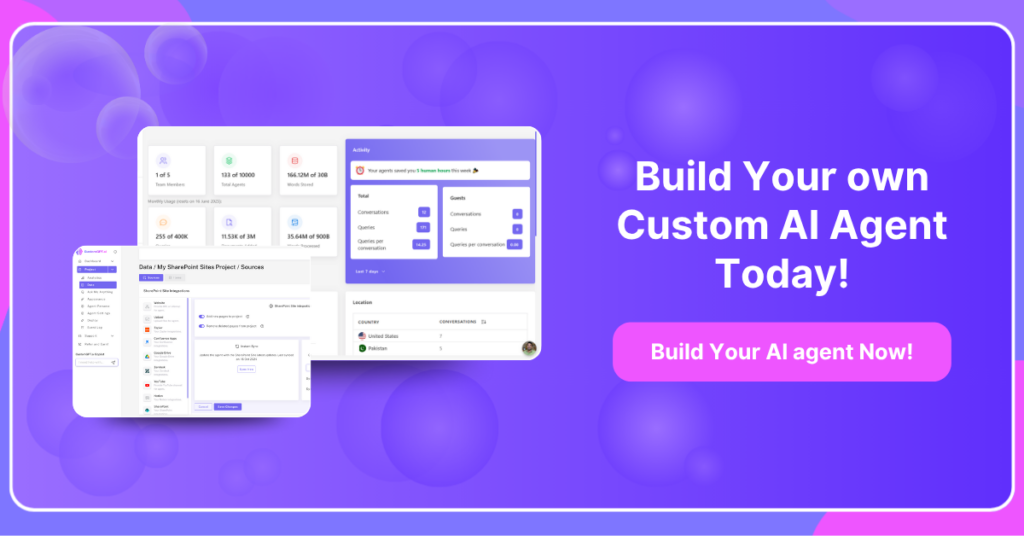
A custom AI agent enables organizations to access data and automate tasks with tailored responses, making interactions intuitive and effective.
Unlike general AI models that serve broad purposes, custom agents are fine-tuned to a specific context and audience. This specialization allows them to handle niche queries and complex workflows with greater precision.
Building a custom AI agent involves a series of clear steps, starting with gathering relevant domain data and defining precise objectives.
Next comes selecting or fine-tuning a foundation model, designing conversational flows, and setting up the infrastructure for deployment.
As you build your agent, you’ll iterate on design, test performance, and refine responses so it meets requirements and adapts to evolving needs.

Defining Custom AI Agent
Custom AI agents excel because they are purpose-built around domain-specific data, workflows, and guardrails. Unlike generalized models, these agents use approved knowledge sources and business context to interpret nuanced requests and deliver more relevant outputs.
This specificity is critical in industries like healthcare, where compliance and precision are non-negotiable.
The process begins with curating high-quality, structured data. Techniques like semantic indexing and entity recognition ensure the agent understands relationships between concepts, improving its ability to retrieve and process information.
For instance, a financial services firm might train its agent on regulatory documents and transaction patterns, enabling it to flag anomalies with unparalleled accuracy.
However, challenges arise when datasets are incomplete or biased. Addressing these requires iterative refinement and human-in-the-loop (HITL) strategies, which allow real-time adjustments to outputs. This ensures the agent remains adaptable and reliable, even in edge cases.
By centralizing diverse knowledge sources on platforms like CustomGPT.ai, businesses can deploy agents that not only answer questions but also drive measurable outcomes, such as reducing helpdesk response times or enhancing employee training efficiency.
The Growing Importance of Custom AI
Custom AI’s transformative power lies in its ability to align with the intricate demands of specific industries. One often-overlooked aspect is the role of semantic AI in enabling these agents to interpret and respond to nuanced queries.
Unlike traditional keyword-based systems, semantic AI maps user input to deeper meanings, ensuring that responses are contextually accurate and relevant.
In multi-turn conversations, maintaining context is essential. For example, a healthcare AI agent using semantic indexing can track patient history to offer tailored advice without repeated input, enhancing experience and reducing cognitive load.
However, achieving this level of precision requires meticulous data preprocessing. Techniques like co-occurrence analysis and salience detection ensure that the AI understands relationships between terms, improving its ability to handle complex, domain-specific queries.
By integrating these advanced techniques into platforms like CustomGPT.ai, businesses can deploy agents that not only answer questions but also anticipate needs, a key outcome of building custom AI agents, driving operational efficiency and trust.
Benefits of Custom AI Agents
Custom AI agents unlock tailored workflows by using domain-specific data and retrieval-grounded responses to align with unique business needs, resulting in more accurate, efficient, and context-aware interactions.
- Increased accuracy and relevance through training on proprietary or specialized datasets
- Enhanced efficiency by automating repetitive or complex workflows
- Better user experience due to context-sensitive responses and personalized interactions
- Improved decision-making with insights drawn from internal data sources
- Stronger data security and privacy, as sensitive information stays within controlled environments
- Cost savings over time by reducing manual efforts and streamlining processes
- Competitive advantage through unique capabilities that generic models cannot replicate
- Scalability and adaptability, allowing the agent to evolve as requirements change.
Custom AI Agents vs. General AI Models
Custom AI agents are specifically tailored to address unique business requirements and leverage proprietary data for precise, context-aware interactions, whereas general AI models are designed for broad applicability across various domains without specialized customization.
| Feature | Custom AI Agents | General AI Models |
| Data Training | Fine-tuned on proprietary or domain-specific datasets | Trained on large, generic public datasets |
| Accuracy & Relevance | High, optimized for niche tasks and specialized queries | Moderate, broad understanding but may lack depth in specific areas |
| Deployment Complexity | Higher, requires infrastructure setup, API integration, and ongoing tuning | Lower, often available through turnkey APIs with minimal setup |
| Flexibility | Highly customizable workflows, responses, and decision logic | Limited customization, designed to handle a wide range of inputs |
| Security & Privacy | Enhanced, data remains within controlled environments | Standard, data may pass through third-party servers |
| Maintenance & Updates | Requires continuous retraining and refinement | Periodic model updates by the provider |
| Cost Considerations | Higher initial investment, but cost-effective for long-term specialized use | Lower upfront costs, but potential inefficiencies for specific tasks |
| Use Cases | Customer support bots trained on internal documentation, industry-specific assistants | Chatbots for general queries, broad-language tasks, content generation |
Traditional Method for Building a Custom AI Agent
Creating a custom AI agent involves more than picking a model, it’s about tailoring the entire system to your unique requirements, data, and workflow.
By following a clear sequence of steps, from defining goals to deploying and monitoring, you can ensure that your agent delivers accurate, context-aware responses that drive real value.
Step 1: Define Objectives and Use Case
Begin by outlining what you want your AI agent to achieve. Specify the domain (e.g., customer support, internal knowledge base, industry-specific advisor), target users, and the key tasks it should handle. Clearly defined goals will guide data collection and architectural decisions.
Step 2: Gather and Preprocess Domain Data
Collect relevant data that reflects your specific context—this might include company documents, user logs, support tickets, or specialized corpora. Clean and annotate this data (remove duplicates, correct formatting, label intents) so it’s ready for model training and evaluation.
Step 3: Select and Fine-Tune a Foundation Model
Choose a base model (such as a pretrained language model) that aligns with your requirements (size, performance, latency). Fine-tune this model on your domain dataset, adjusting hyperparameters and training epochs until it reliably produces accurate, contextually relevant outputs.
Step 4: Design Conversational and Decision Logic
Craft the rules or flowcharts that dictate your agent’s behavior: how it interprets user inputs, decides which actions to take, and formulates responses. This may involve slot-filling for forms, fallback strategies for unknown queries, and branching logic to route conversations appropriately.
Step 5: Build API Endpoints and Infrastructure
Set up the backend infrastructure to host your fine-tuned model, this includes servers (cloud or on-premises), containerization or virtualization, and RESTful or graph-based API endpoints. Ensure scalability, security, and ease of integration with front-end interfaces or existing systems.
Step 6: Test, Validate, and Refine
Test with hold-out queries and real scenarios, measure accuracy, latency, and satisfaction, gather beta feedback to spot failures, then retrain or adjust and repeat until performance is satisfactory.
Step 7: Deploy, Monitor, and Maintain
Deploy your AI agent to production and use monitoring tools to track usage patterns, error rates, and performance drift. Schedule regular retraining with new data and user feedback to keep the agent aligned with evolving requirements.

Limitations and Complications of Traditional Methods
Traditional approaches to building a custom AI agent often involve extensive manual effort, complex workflows, and significant resource investments, which can delay deployment and reduce flexibility.
- Data Collection and Annotation Overhead: Gathering domain-specific data and accurately labeling it is time-consuming and costly, often requiring subject-matter experts.
- Lengthy Development Cycles: Training models from scratch or heavily fine-tuning large pretrained models can take weeks, sometimes months, of experimentation and tuning.
- Infrastructure Complexity: Setting up secure, scalable servers, APIs, and monitoring systems demands specialized engineering skills and ongoing maintenance.
- Difficulty Capturing Domain Nuances: Translating expert knowledge and business logic into training data and rules often leads to gaps in understanding or inconsistent performance.
- Rigidity and Maintenance Burden: Once deployed, traditional agents can be hard to update, adding new data sources or adapting to changing requirements often requires retraining and redeploying the entire system.
- High Costs: Licensing pretrained models, procuring cloud compute for training, and hiring skilled engineers can add up, making traditional method prohibitively expensive for many organizations.
CustomGPT.ai to Launch Your Custom AI Agent
CustomGPT.ai simplifies building tailored AI agents by turning your approved content into a retrieval-grounded agent you can test, deploy, and monitor. Upload domain data, configure the agent’s behavior, and publish it without managing servers or custom infrastructure.
With guided workflows, CustomGPT.ai accelerates setup and iteration, allowing teams to test cited answers and improve source coverage quickly. Conversation analytics and feedback loops help you refine the knowledge base as your content and requirements evolve.
Seamless API integration means your custom AI agent can be embedded into websites, chat interfaces, or internal tools with minimal code, streamlining the kind of work often covered by AI development services and eliminating the need for separate API development.
CustomGPT.ai also offers scalable hosting, so your agent adapts effortlessly to fluctuating user demand without manual intervention.

Building an AI Agent with CustomGPT.ai
CustomGPT.ai simplifies the process of creating a tailored AI agent by providing an all-in-one platform for data ingestion, agent configuration, testing, and deployment.
With minimal setup and automated workflows, you can focus on defining your agent’s behavior and connecting trusted knowledge sources rather than managing infrastructure.
Step 1: Set Up Your Workspace
Sign up on CustomGPT.ai and create a new project workspace to centralize sources, agent settings, testing, and deployment. This unified dashboard simplifies managing all aspects of your agent.
Step 2: Prepare Your Domain Data
Gather relevant documents, FAQs, or support logs that represent your use case and clean them by removing duplicates and fixing formatting. High-quality source content helps your agent retrieve accurate, structured answers.
Step 3: Configure and Test Your Agent
Choose the model and response settings that fit your use case, then test the agent with real questions. Review cited answers, adjust instructions, and improve the source content until responses are accurate and useful.
Step 4: Test and Validate in the Sandbox
Use the built-in sandbox to simulate user interactions and evaluate responses against your test cases. Refine prompts or fallback strategies until your agent consistently delivers accurate, context-aware outputs.
Step 5: Deploy and Monitor Performance
Generate API keys and embed the provided endpoint into your application, ensuring proper authentication and rate limits. Leverage CustomGPT.ai’s monitoring tools to track usage, response times, and user feedback, then iterate on your data or model as needed.
Build custom AI agents that transform your business operations
Boost efficiency with reliable custom AI agents built from your content.
Frequently Asked Questions
What makes a custom AI agent different from a general AI model?
A custom AI agent is built for a specific context and audience, while a general model is designed for broad use. Because custom agents are trained or tuned with domain-specific data, they are typically better at niche questions and complex workflows relevant to your organization.
Where do enterprises get the most value from a custom AI agent?
For those workflows, Plan & Act mode lets the agent plan the steps and execute them instead of only answering. A custom AI agent is most effective when responses and actions are tailored to specific operational needs rather than generic use cases.
Should one AI agent handle every audience, or should you scope by context?
Scoping by context is usually more effective. Custom agents perform best when aligned to a specific audience and purpose, with domain data and workflows tailored to that use case.
Can a custom AI agent match a niche communication style?
Yes—when you define clear objectives, design conversational flows, and keep refining outputs through testing. Style consistency improves when the agent is tuned to a specific domain and audience instead of trying to serve everyone the same way.
How do you reduce inaccurate or irrelevant responses over time?
Start with strong domain data and precise objectives, then iterate: test performance, refine responses, and repeat. This continuous improvement loop helps the agent stay accurate as requirements evolve.
What should be ready before deploying a custom AI agent?
Before deployment, you should have relevant domain data collected, objectives defined, a foundation model selected or fine-tuned, conversational flows designed, and infrastructure prepared. Then validate performance and refine responses before wider rollout.
Should you build a custom AI agent from scratch or use a managed platform?
Both paths can work, but the core work stays the same: gather domain data, define objectives, choose or fine-tune a model, design conversational flows, set up deployment infrastructure, and iterate through testing. The best choice depends on how much control and implementation effort your team can support.
Conclusion
Custom AI agents transform how businesses leverage AI by providing tailored, context-aware solutions that outperform generic models in niche tasks. They deliver precise, relevant results that adapt to specific industry needs and user scenarios.
Platforms like CustomGPT.ai streamline this entire process, enabling rapid development and deployment with minimal technical overhead. Continuous improvement is built in, allowing your chatbot to evolve as your data and requirements change.
Build your own personalized AI chatbot using CustomGPT.ai’s personalized AI chatbot solution. Empower your business with a custom agent that scales and adapts to your unique needs.
Build custom AI agents that transform your business operations
Enhance customer experiences with smart, accurate custom AI agents.
Trusted by 10,000+ customers


Related Resources
These guides offer useful context if you’re evaluating how to build and launch a tailored AI solution with CustomGPT.ai.
- Custom AI Model Guide — Learn what goes into creating and deploying a custom AI model, from core concepts to practical implementation considerations.
- Custom AI Models Overview — Explore leading tools and approaches for building and deploying custom AI models across different use cases.