
Custom AI Development Services for Businesses in 2025
AI isn’t just buzz anymore—it’s business. But not the kind you plug in and forget. In 2025, companies aren’t looking for generic, one-size-fits-all tools.
They want AI that understands their workflows, speaks their industry’s language, and adapts to how they operate. That’s where custom AI comes in.

From reducing delivery delays in logistics to tightening fraud detection in finance, tailored AI solutions are quietly reshaping the backbone of modern enterprise.
It’s not about replacing people; it’s about making systems smarter, faster, and more intuitive.
Defining Custom AI Solutions
Custom AI solutions are designed around domain-specific fine-tuning, where models are adjusted using proprietary data to better reflect the linguistic, operational, and contextual nuances of an industry. This contrasts with off-the-shelf models that rely on generalized, public datasets.
Fine-Tuning Involves:
- Curating domain-specific datasets
- Training iteratively to reduce bias
- Using human-in-the-loop (HITL) techniques for validation
In sectors like healthcare, regulatory compliance (e.g., HIPAA) and precision are critical. Customized AI systems meet these demands by producing outputs that are context-aware and accurate.
But it’s not without challenges. Some sectors lack clean data. Others risk overfitting when datasets are too small. Still, with smart data augmentation and tuning, custom AI becomes not just accurate—but indispensable.
Custom AI vs. Off-the-Shelf AI
Not all AI fits every business. Here’s why custom often outperforms generic:
Off-the-shelf AI:
- Trained on broad, public data
- Easy to deploy quickly
- Struggles with niche or regulated tasks
- Limited control over outputs and updates
Custom AI:
- Trained on your proprietary data
- Adapts to your workflows and compliance needs
- Delivers higher accuracy over time
- Scales with your business
Key Differences Between Custom AI and Off-the-Shelf AI
| Feature | Off-the-Shelf AI | Custom AI |
| Training Data | General, public | Private, domain-specific |
| Speed to Deploy | Fast | Moderate |
| Accuracy in Niche Use | Moderate | High |
| Long-term Value | Limited | Strong |
| Regulatory Compliance | Generic | Tailored |
| Customization Flexibility | Low | High |
If your use case is complex, regulated, or evolving—custom AI gives you the precision and flexibility you need.
Key Components of Custom AI Development Services
Every strong custom AI system starts with a solid foundation. It’s not just about algorithms—it’s about what supports them.
To deliver real business impact, three core pillars must work together:
- Clean, relevant data
- A flexible, well-tuned model
- Seamless integration into your existing systems
Let’s break those down:
1. Data Preparation
Quality data is the foundation of effective AI. Custom AI requires domain-specific data that is labeled, cleaned, and augmented. Data normalization and feature engineering are common practices. Curated and anonymized patient data has been shown to increase diagnostic accuracy in real-world studies.
2. Model Architecture
Custom AI often leverages transfer learning, where a pre-trained model is fine-tuned for a new task. This shortens development cycles and cuts computing costs. However, avoiding overfitting is crucial when datasets are small or imbalanced.
3. System Integration
Integration with ERP, CRM, and IoT systems ensures AI delivers value within operational workflows. APIs and middleware solutions allow real-time data sharing and automation. Salesforce’s Einstein AI, for example, enhances CRM performance by embedding predictions directly into user flows.
AI Strategy Consulting
Effective AI strategy starts with aligning business goals with technical design. A critical part of this process is the data-flow audit, which ensures models are built on sound, accessible, and coherent datasets.
Iterative consulting methods, such as workshops, outperform static planning sessions. These engagements help refine goals, anticipate integration challenges, and continuously adapt strategy.
A structured methodology like value mapping links technical capabilities to measurable outcomes, keeping AI efforts grounded in ROI.
Bespoke Model Development
Bespoke models are crafted to address specific operational demands. Unlike static models, they require adaptive retraining to remain effective as business conditions evolve.
Transfer learning accelerates initial development but must be managed carefully to maintain a balance between inherited and new data. Pilot testing is key to refining models before large-scale deployment. Fine-Tuning OpenAI GPT Models based on seasonal trends has shown promise in improving the accuracy of retail demand forecasts.
These models are ideal for complex, high-value environments that require precision and flexibility.
Generative AI Solutions
Generative AI systems like GPT-4 can produce marketing content, reports, and more—but only when fine-tuned correctly. Contextual fine-tuning ensures outputs align with brand voice, industry terminology, and operational rules.
Key Techniques:
- Reinforcement learning from human feedback (RLHF)
- Prompt engineering
- Rule-based constraints
When integrated properly, generative AI can automate customer service, personalize content, and support decision-making.
Implementation and Integration
Integration is often where AI projects stumble. A significant percentage of AI initiatives fail to scale due to poor integration. Middleware orchestration helps bridge AI systems with business platforms by enabling real-time data exchange.
For example, predictive maintenance AI reduced manufacturing downtime when embedded directly into IoT monitoring systems.
Legacy systems may require custom APIs or phased rollouts to ensure compatibility. Treating integration as a continuous process, rather than a single step, ensures long-term scalability.
Data Management and Infrastructure
Strong data management is critical. Schema alignment ensures data consistency across sources—essential for performance and accuracy. Harmonizing customer logs with CRM data can significantly improve the accuracy of AI recommendations.
Data normalization, while foundational, must be paired with domain knowledge to be effective—especially in regulated sectors like healthcare.
Iterative audits and updates help maintain high-quality datasets, reduce errors, and optimize model performance.
Integrating Custom AI into Business Systems
Dynamic API orchestration enables AI systems to respond to changes in data structures and workflows. Middleware platforms offer scalability and error handling, while direct APIs provide speed at the cost of flexibility.
Use-case determines which to prioritize. Logistics firms that deploy adaptive APIs to link IoT sensors and analytics can significantly reduce operational delays.
Adopting iterative integration frameworks allows continuous improvement, minimizes downtime, and ensures AI aligns with real-time operational demands.
Industry-Specific Use Cases
Custom AI excels where generalized tools fail. In healthcare, AI trained on medical imaging and patient records improved early cancer detection in studies.
In healthcare and other regulated sectors, custom AI systems must be designed around strict privacy, security, and regulatory requirements. Organizations should confirm applicable obligations, such as HIPAA, before using AI with sensitive health data.
In generative AI morgan stanley, custom fraud detection systems cut false positives by learning from unique transaction patterns. These improvements underscore the importance of domain-specific customization.
Applications in Finance and Healthcare
Context-aware anomaly detection is critical in sectors where false positives have major consequences. Financial institutions have used adaptive models to reduce false alerts by learning from real transaction behavior.
In healthcare, multi-modal AI models combining imaging, genetic, and clinical data have improved cardiovascular diagnostics. These systems outperform generic AI by aligning with domain needs and regulatory frameworks.
Retail and Manufacturing
Retail and manufacturing benefit from dynamic demand forecasting, which adapts to real-time data instead of relying solely on historical trends. Retailers using AI-driven forecasts can minimize overstock by aligning inventory with real-time demand trends.
Success depends on integrating diverse data sources like IoT sensors or e-commerce logs, while accounting for outliers like geopolitical disruptions.
Embedding AI into everyday operations creates responsive, agile systems that evolve with market conditions.
Ethical and Practical Challenges
Bias and lack of transparency are major risks. A large percentage of AI failures stem from flawed data.
Key challenges include:
- Biased or incomplete datasets: These skew outputs and lead to poor decisions.
- Lack of explainability: Without transparency, AI decisions become hard to trust or audit.
- Hidden automation errors: Quality control systems may reject items without clear reasoning.
- Ethical blind spots: Missing safeguards can create compliance and reputational risks.
Explainable AI (XAI) can help, but often adds computational complexity.
That’s why ethical governance frameworks must be embedded from the start—from data collection to deployment.
Data Privacy and Governance
Privacy protection must go beyond legal compliance. Contextual integrity frameworks align data use with stakeholder expectations.
Best practices include:
- Differential privacy: Adds noise to data to protect individual identity without losing aggregate insights.
- Federated learning: Trains models across decentralized data without moving sensitive records.
- Transparent documentation: Helps track how data is collected, used, and stored.
- Regular audits: Catch policy gaps, flag risk, and ensure ongoing compliance.
These measures build trust and help ensure ethical, responsible AI adoption.
Low-Code Custom AI Development Services
Low-code platforms accelerate prototyping but may hit scalability limits. Hybrid development—starting with low-code, then layering custom APIs—can address this, combining speed with long-term flexibility.
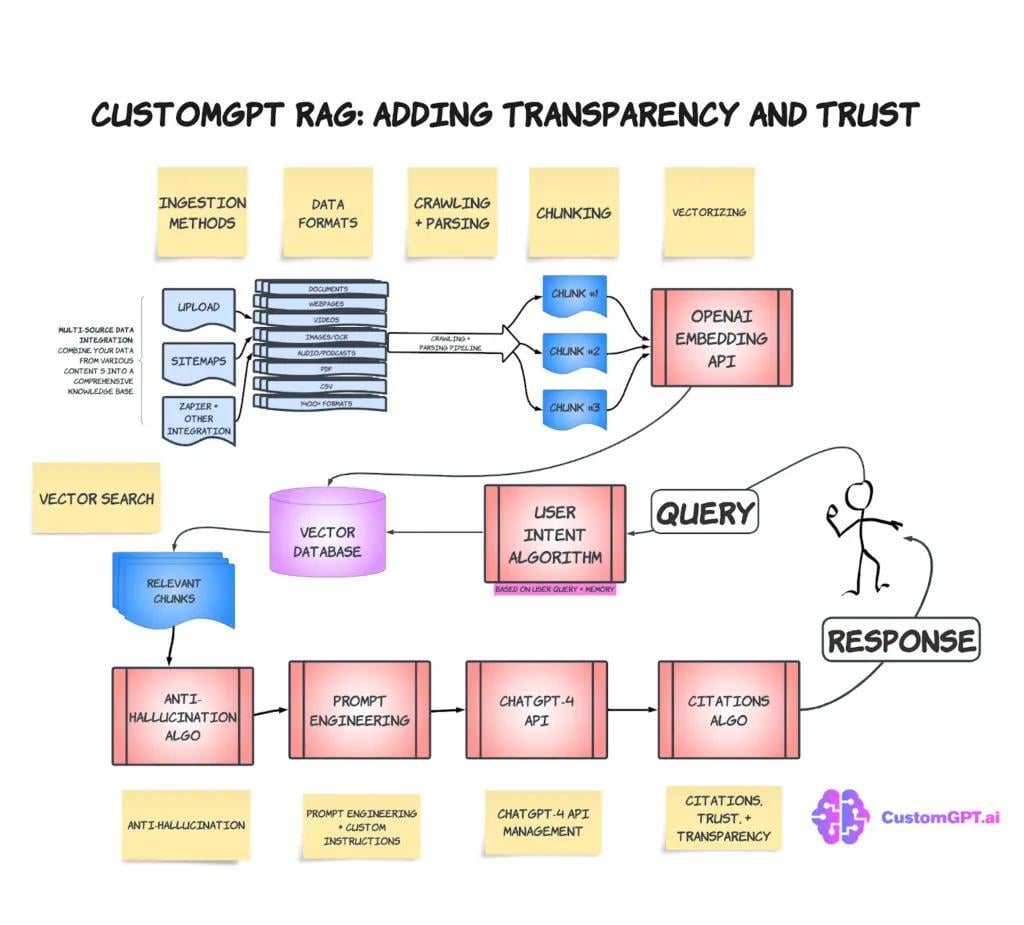
One standout in this space is CustomGPT.ai, a platform designed to help businesses create tailored AI solutions without heavy technical lift. With its intuitive interface and enterprise-grade security, CustomGPT empowers teams to fine-tune models, deploy AI agents, and integrate with existing systems—all with minimal coding.
It’s ideal for teams who want custom AI without building everything from scratch.
Frequently Asked Questions
What makes custom AI more accurate than off-the-shelf AI for business-specific work?
Stephanie Warlick, Business Consultant, said, “Check out CustomGPT.ai where you can dump all your knowledge to automate proposals, customer inquiries and the knowledge base that exists in your head so your team can execute without you.” That is the main reason custom AI is often more accurate for business-specific work: it is grounded in your own documents, terminology, and processes instead of relying only on broad public training data. Off-the-shelf assistants such as ChatGPT or Claude can help with general drafting, but custom systems are usually better when answers must reflect company rules, niche language, or compliance requirements.
How long does it take to integrate custom AI into Slack, a CRM, or other internal tools?
Joe Aldeguer, IT Director at Society of American Florists, said, “CustomGPT.ai knowledge source API is specific enough that nothing off-the-shelf comes close. So I built it myself. Kudos to the CustomGPT.ai team for building a platform with the API depth to make this integration possible.” The provided sources do not give a fixed timeline for Slack, CRM, or internal-tool integrations. What they do confirm is that you can deploy through an embed widget, live chat, search bar, API, or MCP server, and extend workflows through 1400+ Zapier integrations. The timeline depends on how much data preparation and workflow automation your use case requires.
Can small businesses use custom AI development services, or is custom AI only for enterprises?
Evan Weber, Digital Marketing Expert, said, “I just discovered CustomGPT, and I am absolutely blown away by its capabilities and affordability! This powerful platform allows you to create custom GPT-4 chatbots using your own content, transforming customer service, engagement, and operational efficiency.” That supports the idea that custom AI is not only for enterprises. For many small businesses, the best starting point is one focused assistant built on their own content for customer service, internal knowledge, or repetitive operational tasks, then expansion after the first workflow proves useful.
How do businesses measure ROI from custom AI development?
Per Bergfors, Assistant Professor at Copenhagen Business Academy, said, “Adopting CustomGPT.ai made material more accessible and appealing, leading to a significant increase in student participation and enthusiasm for the subject matter.” For ROI, measure the business outcome that matters to your workflow: faster response times, higher self-service, fewer repetitive tasks, stronger engagement, or hours saved. Prompt volume or model size alone is not ROI unless it improves a business result.
Do businesses need to train a model from scratch to get a custom AI solution?
Usually not. The provided materials describe custom AI as domain-specific fine-tuning on proprietary data, and the platform is RAG-powered. That means many teams can get strong results by grounding a foundation model in their documents and workflows instead of training a new model from zero. A published benchmark also states that CustomGPT.ai outperformed OpenAI in RAG accuracy, which supports the idea that retrieval quality can matter more than full retraining for many business use cases.
What should a business check before using custom AI with sensitive internal data?
Start with three checks: independently audited security controls, clear privacy commitments, and applicable compliance coverage. In the provided materials, the relevant signals are SOC 2 Type 2 certification, GDPR compliance, and a stated policy that customer data is not used for model training. If your use case involves healthcare, HR, finance, or legal content, you should also confirm that the deployment matches your sector’s own regulatory requirements before connecting sensitive files.
Conclusion
Custom AI isn’t a luxury anymore—it’s a strategic advantage. Whether you’re in finance, healthcare, logistics, or retail, the benefits are clear: smarter decisions, better accuracy, and systems that actually understand your business.
And now that you know why custom AI matters, the next step is learning how to build it.
Ready to get started? Read our next article: How to Build a Custom AI Solution for a step-by-step guide to creating AI that works for you.




Related Resources
If you’re exploring AI development services, these guides offer useful next steps and deeper context.
- How To Build Custom AI — Learn the core steps involved in creating a custom AI solution, from planning use cases to deployment.
- Top Custom AI Solutions — Review leading custom AI applications for business and see how different solutions support operations, service, and growth.
- Choosing An AI Development Company — Understand what to look for in a custom AI development partner and how companies like CustomGPT.ai approach implementation.
- Custom AI Development Guide — Get a broader overview of custom AI development, including strategy, build considerations, and business value.