
CRAG vs RAG: How Corrective RAG Improves Retrieval-Augmented Generation

RAG retrieves relevant information and sends it to a language model. CRAG adds a correction step that evaluates whether the retrieved information is reliable before the model generates an answer. That single addition is the core of the difference. Retrieval-Augmented Generation (RAG) grounds a large language model in external knowledge so it answers from your sources instead of memory alone. Corrective Retrieval-Augmented Generation (CRAG) inserts a retrieval evaluator that scores the retrieved documents and can trigger fixes when quality is weak. This matters because a strong model can still produce a wrong or hallucinated answer if the retrieved context is irrelevant, stale, or incomplete.
This guide explains both approaches in plain language, then adds technical depth, comparison tables, trade-offs, and a practical framework for deciding which one fits your use case.
Key Takeaways
- RAG improves LLM answers by grounding them in external knowledge instead of relying only on the model’s training data.
- CRAG adds a retrieval evaluator before generation that scores retrieved documents and can trigger corrective actions.
- CRAG can help when retrieved documents are noisy, stale, incomplete, or irrelevant.
- CRAG adds complexity, latency, threshold tuning, and ongoing maintenance.
- Standard RAG is often enough when source content is clean and retrieval quality is already high.
- Enterprise teams should measure retrieval quality before deciding whether CRAG-style correction is worth the added cost.
- The CRAG approach was introduced in a 2024 research paper by Yan et al. and is designed to be plug-and-play with existing RAG pipelines.
- Managed RAG platforms such as CustomGPT.ai can help teams create grounded AI agents from approved business content without building the full retrieval stack from scratch.
What Is RAG?
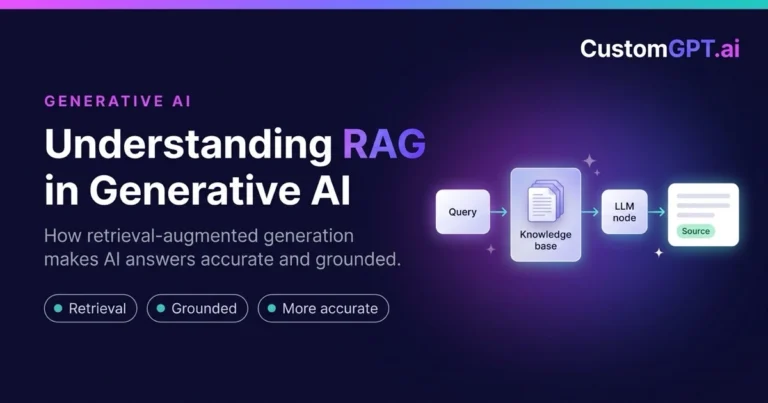
Retrieval-Augmented Generation connects a large language model to an external knowledge base so it can answer from your content rather than from memory alone. A RAG system retrieves relevant passages from that knowledge base, adds them to the prompt, and the model uses that context to generate a grounded answer. The original approach was introduced by Lewis et al. in 2020, and vendor explainers from IBM and AWS describe the same retrieve-then-generate pattern.
RAG is useful for customer support, internal knowledge search, documentation chatbots, research assistants, and website chatbots. For a deeper primer, see this RAG overview or the RAG for beginners guide.
If you are still deciding whether you need retrieval-only search or generated answers, this RAG vs semantic search comparison explains the difference.
A simple RAG workflow looks like this:
- A user asks a question.
- The system searches the knowledge base.
- Relevant passages are retrieved.
- The passages are added to the prompt.
- The LLM generates an answer.
- The system may show citations or source references.
What Is CRAG?
CRAG stands for Corrective Retrieval-Augmented Generation. It adds a retrieval evaluation step to the RAG pipeline. After documents are retrieved, a lightweight evaluator checks whether they are useful, ambiguous, or irrelevant before anything reaches the generator. If retrieval quality is weak, CRAG can trigger corrective actions such as refining the retrieved content, decomposing documents to keep only the key information, or using a fallback search to find better evidence.
CRAG is designed to improve answer accuracy when retrieval quality varies. According to the CRAG paper by Yan et al. (2024), the method uses a lightweight retrieval evaluator that returns a confidence score, then triggers different knowledge actions based on that score, and applies a decompose-then-recompose algorithm to filter out irrelevant detail. The paper reports that CRAG can significantly improve performance across four datasets covering short-form and long-form generation, and notes it is plug-and-play with existing RAG approaches.
CRAG vs RAG: The Main Difference
The main difference between RAG and CRAG is that RAG retrieves and generates, while CRAG retrieves, evaluates, corrects, and then generates. RAG trusts that the retrieved documents are good enough. CRAG checks first.
| Feature | RAG | CRAG | Why it matters |
|---|---|---|---|
| Retrieval | Retrieves passages from a knowledge base | Retrieves passages, same first step | Both depend on a good knowledge base |
| Retrieval evaluation | None by default | Scores retrieved documents for quality | Catches weak evidence before it reaches the model |
| Correction step | None | Refines, decomposes, or re-searches when quality is low | Reduces answers built on poor context |
| Handling irrelevant documents | Passes them to the model as-is | Filters or replaces them | Lowers the chance of off-topic answers |
| Hallucination risk | Higher when retrieval is weak | Lower when the evaluator works well, though not eliminated | Better grounding on mixed-quality sources |
| Latency | Lower | Higher due to evaluation and possible re-search | Speed-sensitive use cases feel the difference |
| Engineering complexity | Simpler to build and deploy | More moving parts to build and tune | Affects time-to-launch and staffing |
| Best use case | Clean, well-structured content | Noisy, mixed, or high-stakes content | Match the architecture to the corpus |
| Maintenance burden | Lower | Higher, with ongoing threshold tuning | Affects long-term cost |
| Enterprise readiness | Strong for many knowledge bots | Strong where retrieval validation is required | Governance needs grow with risk |
How Standard RAG Works
A standard RAG pipeline moves through these stages:
- Knowledge base preparation: Gather and clean approved source content.
- Document chunking: Split documents into retrievable pieces.
- Embedding generation: Convert chunks into vector representations.
- Vector search or semantic retrieval: Find the chunks most relevant to the query.
- Context assembly: Build a prompt that includes the retrieved context.
- LLM response generation: The model writes an answer from that context.
- Citation or source display: Show where the answer came from.
- Evaluation and monitoring: Measure quality and watch for drift. For a hands-on baseline, see this RAG implementation guide.
Standard RAG has clear strengths. It uses a simpler architecture, has lower latency, is easier to deploy, works well with clean source content, and is a strong fit for many business knowledge bots.
It also has real weaknesses. It depends heavily on retrieval quality, can pass irrelevant chunks straight to the model, may struggle with messy documents, can still hallucinate if the retrieved context is weak, and requires ongoing evaluation and monitoring.
How CRAG Works
The CRAG pipeline adds evaluation and correction around retrieval:
- The user submits a query.
- The system performs initial retrieval.
- A retrieval evaluator scores the retrieved documents.
- Documents are classified as useful, ambiguous, or irrelevant.
- Useful content is passed to the generator.
- Ambiguous or weak content may be refined.
- Irrelevant retrieval may trigger corrective search or fallback logic.
- The system generates an answer from the improved context.
- The answer can be evaluated for relevance and grounding.
The central idea is to avoid blindly passing low-quality retrieved content to the LLM. When evidence is weak, CRAG tries to fix the input before generation rather than hoping the model recovers on its own.
CRAG Architecture Explained
A CRAG architecture diagram should show this flow:
User query, then retriever, then retrieved documents, then retrieval evaluator, then a correction or refinement step, then the prompt builder, then the LLM, then the grounded answer.
Each component plays a role. The retriever finds candidate passages. The retrieval evaluator scores how relevant and reliable they are. Confidence scoring converts that judgment into a value the system can act on. Corrective routing decides what happens next based on the score. Knowledge refinement decomposes and recomposes content to keep only what matters. The prompt builder assembles the final context. The generator writes the answer. An evaluation layer can then check the output for grounding and relevance. For background on how these pieces fit together, see RAG architecture patterns and this explainer on RAG in generative AI.
Why CRAG Was Introduced
Standard RAG assumes the retrieved documents are useful. In real systems, retrieval can return irrelevant, incomplete, outdated, or contradictory content. When that happens, even a strong model can produce an inaccurate answer, because the model is only as good as the evidence it is given.
CRAG adds a quality-control layer before generation. The CRAG paper frames the core problem directly: RAG relies heavily on the relevance of retrieved documents, which raises the question of what the model does when retrieval goes wrong. This makes CRAG especially relevant for messy enterprise knowledge bases that mix formats, ages, and quality levels.
Benefits of CRAG
CRAG offers several advantages when retrieval quality is inconsistent:
- Better filtering of irrelevant retrieved content.
- Improved grounding when retrieval quality varies across documents.
- Lower risk of answers based on weak evidence.
- Better handling of noisy knowledge bases.
- More explicit retrieval quality control.
- A useful architecture for high-stakes or complex knowledge systems.
To be clear about the limits: CRAG can improve answer quality when retrieval quality is inconsistent, but it does not guarantee perfect accuracy. As even general references note, retrieval-augmented methods reduce but do not remove the chance of hallucination.
Limitations and Trade-Offs of CRAG
CRAG is not free. It adds engineering complexity, more latency, more moving parts to monitor, more threshold tuning, and more maintenance. It also depends on the quality of the evaluator itself, and any fallback search can introduce new risks if it pulls from untrusted sources. When standard RAG retrieval is already strong, CRAG may add cost without a proportional gain.
| Trade-off | Why it happens | How to manage it |
|---|---|---|
| Added latency | Evaluation and possible re-search run before generation | Set score thresholds carefully and cache frequent queries |
| Engineering complexity | A classifier, routing logic, and refinement steps are added | Start simple and add correction only where it pays off |
| Ongoing threshold tuning | Document types and corpora change over time | Schedule periodic reviews and track retrieval metrics |
| Evaluator dependence | A weak evaluator misjudges relevance | Validate the evaluator against a labeled test set |
| Fallback search risk | External or open-web fallback can add unverified content | Use closed-corpus fallback for sensitive use cases |
| Maintenance load | More components mean more monitoring | Budget recurring engineering time, or use a managed platform |
When Is Standard RAG Enough?
Standard RAG is usually enough when source content is clean and well-structured, the knowledge base is not too noisy, retrieval accuracy is already high, the use case needs low latency, the system can cite approved sources, the team can monitor answer quality, and the use case does not require complex retrieval correction.
A practical heuristic: before adopting CRAG, test whether your current RAG system is retrieving the right evidence for real user questions. Sample a batch of real queries and check whether the retrieved chunks actually answer them. If retrieval is already strong, the simpler architecture is usually the better choice.
When Should Teams Consider CRAG?
Teams should consider CRAG-style correction when retrieval frequently returns irrelevant content, documents are messy, duplicated, or outdated, the knowledge base contains mixed formats, the use case is high-stakes, accuracy matters more than speed, the system needs explicit retrieval validation, and the team has enough engineering resources to maintain the extra layer.
In short, CRAG earns its complexity when retrieval quality is the bottleneck and the cost of a wrong answer is high.
RAG vs CRAG Decision Framework
Use these questions to guide the choice:
| Question | Choose RAG if | Consider CRAG if |
|---|---|---|
| How clean is your content? | Documents are well-structured and consistent | Content mixes formats, ages, and quality |
| How accurate is retrieval today? | Retrieved chunks usually answer the question | Retrieval often returns off-topic chunks |
| How sensitive is the use case? | Errors are low-impact | Errors carry compliance or safety risk |
| How important is latency? | Speed is a priority | Accuracy outranks speed |
| How much engineering capacity do you have? | Limited resources | Staff available for tuning and monitoring |
| Do you need fallback search? | A closed, trusted corpus is enough | You want re-search when evidence is weak |
| Are citations required? | Standard source display is sufficient | You need stricter evidence validation |
| Is the content frequently updated? | Updates are infrequent and controlled | Content changes often and unevenly |
A simple recommendation: start with strong RAG fundamentals first. Improve content quality, chunking, metadata, retrieval settings, citations, and evaluation before adding a CRAG-style correction layer. Most retrieval failures are cheaper to fix at the content and retrieval level than to patch with extra middleware.
CRAG vs Self-RAG
CRAG and Self-RAG both target unreliable retrieval, but at different layers. CRAG evaluates retrieved documents before generation, typically as a retrieval-layer architecture you can add without changing the model. Self-RAG, introduced by Asai et al. (2023), uses model-side reflection during generation: the model is trained to emit special reflection tokens that signal whether retrieval is needed and whether its output is supported by evidence. Because of that, Self-RAG may require model training or model-specific behavior. They are not always competitors and can be complementary.
| Approach | Where correction happens | Requires model changes | Best for | Limitation |
|---|---|---|---|---|
| CRAG | Before generation, at the retrieval layer | No, can be added as middleware | Teams using closed APIs that cannot fine-tune | Depends on evaluator quality and adds latency |
| Self-RAG | During generation, inside the model | Yes, uses fine-tuning with reflection tokens | Teams that control and can fine-tune their model | Harder to apply to closed, hosted models |
CRAG vs Reranking
CRAG and reranking are related but not identical. Reranking reorders retrieved documents by relevance so the best passages rise to the top. CRAG evaluates whether the retrieved documents are good enough at all, and can trigger corrective action such as refinement or re-search when they are not. Reranking can be a valuable part of a stronger RAG system. CRAG is broader because it includes evaluation and correction logic, not just reordering. Many teams add reranking first, then consider CRAG-style correction if retrieval quality is still inconsistent.
CRAG vs Fine-Tuning
Fine-tuning changes a model’s behavior or knowledge patterns by adjusting its weights. RAG and CRAG instead retrieve external knowledge at query time. CRAG does not replace fine-tuning. For frequently changing business knowledge, RAG or CRAG is often more practical than fine-tuning, because you can update the knowledge base without retraining. Fine-tuning may help with style, classification, or task behavior, while RAG and CRAG help with grounded access to current knowledge. Many production systems combine the two: light fine-tuning for tone or format, and retrieval for facts.
Enterprise Use Cases for RAG and CRAG
Both approaches support a range of enterprise scenarios:
- Customer support knowledge bases, similar to a customer support AI deployment.
- Internal policy assistants and internal knowledge search.
- Product documentation assistants.
- Legal and compliance document search.
- Technical support runbooks.
- Sales enablement.
- Research and analyst workflows.
- Healthcare or financial knowledge systems where human review may still be required.
Higher-risk use cases require governance, evaluation, and human review. The more a wrong answer can cost, the more the system needs validation, source grounding, and clear escalation paths.
How to Evaluate RAG or CRAG Quality
Measure both retrieval and answer quality, not just fluency:
- Retrieval precision: Are retrieved chunks relevant?
- Retrieval recall: Did the system find the evidence that exists?
- Groundedness: Is the answer supported by the retrieved context?
- Faithfulness: Does the answer avoid contradicting its sources?
- Citation accuracy: Do citations point to the right sources?
- Answer relevance: Does the answer address the question?
- Unknown-answer handling: Does the system say it does not know when evidence is missing?
- Latency: Is the response fast enough for the use case?
- User satisfaction: Do users find answers helpful?
- Escalation rate: How often does a question route to a human?
- Human review pass rate: What share of sampled answers pass review?
A practical test: create a test set of real user questions, the expected source documents, the expected answers, and a set of unacceptable answers. Run it regularly so you can see whether changes actually improve evidence quality, not just tone.
Common Mistakes Teams Make With RAG and CRAG
- Adding CRAG before fixing content quality.
- Ignoring chunking and metadata.
- Using stale or duplicate documents.
- Measuring only answer fluency instead of evidence quality.
- Letting fallback search pull from untrusted sources.
- Not testing unknown-answer behavior.
- Over-indexing sensitive content that should stay out of scope.
- Ignoring latency and user experience.
- Assuming CRAG eliminates hallucinations.
How CustomGPT.ai Fits Into the RAG Conversation
CustomGPT.ai helps teams create AI agents and chatbots from approved business content so users can get grounded answers from their own knowledge sources. For teams comparing RAG and CRAG, the practical question is not only which architecture is more advanced, but how much engineering work they want to manage themselves.
A few points worth keeping factual:
- CustomGPT.ai can help teams launch AI agents from business content without building the full RAG stack manually.
- Teams should still prepare clean content, validate answers, review sources, and monitor performance.
- For many business use cases, a managed RAG platform may be a faster path than building custom CRAG infrastructure.
- Teams with specialized retrieval requirements may still choose custom engineering.
CustomGPT.ai focuses on grounded answers from uploaded, connected, or approved knowledge sources, with an anti-hallucination approach designed to filter unsupported content, plus data connectors, a RAG API, and security and trust controls for enterprise rollouts.
Build vs Buy: RAG and CRAG Options
| Option | Best for | Pros | Cons | Typical team |
|---|---|---|---|---|
| Build standard RAG | Teams with clean content and engineering capacity | Full control, lower architecture complexity than CRAG | You own retrieval quality, evaluation, and monitoring | In-house ML or platform engineers |
| Build CRAG-style retrieval validation | Teams with noisy corpora and strong engineering | Explicit retrieval correction, fine-grained control | Higher complexity, latency, and ongoing tuning | ML engineers with time for maintenance |
| Use a managed RAG platform | Teams that want speed and grounding without building the stack | Faster launch, built-in grounding and citations, less upkeep | Less low-level control than a custom build | Product or ops teams with limited ML staff |
| Hybrid approach | Teams piloting before committing to custom work | Validate value first, scale what works | Requires coordination between bought and built parts | Mixed product and engineering teams |
Platforms like CustomGPT.ai can help teams create grounded AI agents from approved business content without building every layer of the retrieval pipeline from scratch. Teams that want to compare approaches can review how a managed platform stacks up against build-it-yourself frameworks, such as CustomGPT vs LangChain and CustomGPT vs Vectara.
Best Practices for Better Grounded AI Answers
Content quality
- Use approved, current documents and remove stale or duplicate files.
- Add clear titles, headings, and metadata so retrieval can find the right source.
Retrieval quality
- Tune chunking and retrieval settings for your content.
- Add reranking before reaching for heavier correction layers.
Prompt and answer behavior
- Require answers grounded in retrieved context.
- Configure a clear “I don’t know” fallback when evidence is missing.
Citations and source grounding
- Show source references so answers can be verified.
- Keep answers tied to approved sources.
Security and governance
- Separate sensitive content from general knowledge.
- Define ownership, review, and escalation for high-risk topics.
Evaluation and monitoring
- Maintain a real-world test set and run it regularly.
- Track retrieval precision, groundedness, latency, and user feedback.
Conclusion
RAG is a strong baseline for grounding LLMs in external knowledge. CRAG adds correction and validation when retrieval quality is inconsistent. CRAG can improve reliability in messy or high-stakes systems, but it adds complexity and latency. The best choice depends on content quality, risk level, latency needs, and engineering resources. For many teams, the first step is not “build CRAG,” it is “make RAG retrieval reliable, source-grounded, and measurable.” Once retrieval is solid and measured, you will know whether a correction layer is worth adding.
Frequently Asked Questions
What is the difference between CRAG and RAG?
RAG retrieves relevant information and sends it to a language model, while CRAG adds a correction step that evaluates whether the retrieved information is reliable before the model generates an answer. In short, RAG retrieves and generates, while CRAG retrieves, evaluates, corrects, and then generates. The added evaluation step is designed to catch weak or irrelevant evidence before it reaches the model, which can improve grounding on mixed-quality sources.
What does CRAG stand for?
CRAG stands for Corrective Retrieval-Augmented Generation. It is an extension of standard RAG that adds a retrieval evaluator before generation. The evaluator scores retrieved documents for quality and relevance, then triggers corrective actions such as refining content, decomposing documents, or running a fallback search when the evidence is weak. CRAG was introduced in a 2024 research paper by Yan et al. and is designed to be plug-and-play with existing RAG pipelines.
What does RAG stand for?
RAG stands for Retrieval-Augmented Generation. It is a technique that connects a large language model to an external knowledge base so the model can answer from your content instead of relying only on its training data. The system retrieves relevant passages, adds them to the prompt, and the model generates a grounded answer. RAG was introduced by Lewis et al. in 2020 and is widely used for support bots, internal search, and documentation assistants.
Is CRAG better than RAG?
CRAG is not automatically better than RAG. It can improve answer quality when retrieval quality is inconsistent, but it adds complexity, latency, threshold tuning, and maintenance. Standard RAG is often enough when content is clean and retrieval accuracy is already high. The better approach depends on your corpus, risk level, latency needs, and engineering resources. A practical rule is to make RAG retrieval reliable first, then add CRAG-style correction only if retrieval is still the bottleneck.
How does CRAG improve RAG?
CRAG improves RAG by adding a retrieval evaluator that scores retrieved documents before generation. When the evaluator finds weak or irrelevant evidence, CRAG can refine the content, decompose documents to keep only key information, or run a fallback search for better sources. This reduces the chance that the model generates an answer from poor context. According to the CRAG paper, the method significantly improved performance across four datasets, with the largest gains where retrieval was weakest.
How does standard RAG work?
Standard RAG works by preparing a knowledge base, chunking documents, generating embeddings, and using vector or semantic search to retrieve passages relevant to a user query. The system assembles those passages into a prompt, the language model generates an answer from that context, and the system can display citations. Evaluation and monitoring run alongside to track quality. Standard RAG is simpler and lower-latency than CRAG, and works well when source content is clean and well-structured.
How does CRAG work?
CRAG works by adding evaluation and correction around retrieval. After initial retrieval, a lightweight evaluator scores the documents and classifies them as useful, ambiguous, or irrelevant. Useful content goes to the generator, ambiguous content may be refined, and irrelevant retrieval can trigger corrective search or fallback logic. The system then generates an answer from the improved context, which can be checked for grounding. The goal is to avoid passing low-quality retrieved content directly to the model.
Does CRAG reduce hallucinations?
CRAG can reduce hallucinations by catching low-relevance documents before they reach the model and by seeking better evidence when retrieval is weak. The CRAG paper frames RAG’s core weakness as heavy reliance on retrieval quality, which CRAG addresses with an evaluator. That said, CRAG does not eliminate hallucinations. A model can still produce unsupported claims, and any fallback search that uses open-web content can introduce new risk. Human review remains important for high-stakes answers.
When should I use CRAG instead of RAG?
Consider CRAG when retrieval frequently returns irrelevant content, your documents are messy, duplicated, outdated, or mixed in format, the use case is high-stakes, accuracy matters more than speed, and you have engineering resources to maintain the extra layer. CRAG earns its added complexity when retrieval quality is the main bottleneck and a wrong answer is costly. If retrieval is already strong and latency matters, standard RAG is usually the better fit.
When is standard RAG enough?
Standard RAG is enough when source content is clean and well-structured, the knowledge base is not too noisy, retrieval accuracy is already high, the use case needs low latency, the system can cite approved sources, and the team can monitor answer quality. A practical test is to sample real user questions and check whether the retrieved chunks actually answer them. If retrieval is consistently relevant, adding CRAG-style correction often increases latency and cost without a proportional accuracy gain.
What is a retrieval evaluator in CRAG?
A retrieval evaluator in CRAG is a lightweight component that scores the quality and relevance of retrieved documents before generation. It returns a confidence value that the system uses to decide what to do next: pass useful content to the model, refine ambiguous content, or trigger corrective search when evidence is irrelevant. The evaluator is the heart of CRAG, since its judgments determine whether weak context is filtered out or replaced before the model writes an answer.
What is the difference between CRAG and reranking?
Reranking reorders retrieved documents by relevance so the strongest passages rise to the top, but it still passes whatever it has to the model. CRAG goes further by evaluating whether the retrieved documents are good enough at all and can trigger correction, refinement, or re-search when they are not. Reranking can be a useful part of a stronger RAG system. CRAG is broader because it adds evaluation and corrective logic rather than only reordering results.
What is the difference between CRAG and Self-RAG?
CRAG and Self-RAG both address unreliable retrieval but at different layers. CRAG works before generation as a retrieval-layer step that scores documents and routes weak results to correction, usually without changing the model. Self-RAG works during generation by fine-tuning the model to emit reflection tokens that signal when to retrieve and whether output is supported. CRAG suits teams using closed APIs that cannot fine-tune, while Self-RAG suits teams that control and can train their own model. They can be complementary.
What is the difference between CRAG and fine-tuning?
Fine-tuning changes a model’s behavior by adjusting its weights, while CRAG retrieves and validates external knowledge at query time without retraining. CRAG does not replace fine-tuning. For frequently changing business knowledge, retrieval-based methods like RAG or CRAG are often more practical, since you update the knowledge base instead of the model. Fine-tuning is better for style, format, or task behavior. Many production systems combine light fine-tuning for tone with retrieval for current, grounded facts.
Can CRAG be used in enterprise AI chatbots?
Yes, CRAG-style retrieval validation can be used in enterprise AI chatbots, especially where knowledge bases are large, mixed in format, or frequently updated. It adds explicit quality control before generation, which can help in high-stakes domains. Enterprises should pair it with governance, evaluation, source grounding, and human review for sensitive answers. Teams without the resources to build and maintain a custom CRAG pipeline can use a managed RAG platform that handles retrieval quality and citation grounding at the infrastructure layer.
How does CustomGPT.ai relate to RAG and CRAG?
CustomGPT.ai is a managed RAG platform that helps teams create AI agents and chatbots from approved business content, focusing on grounded answers from uploaded, connected, or approved sources. It can reduce the engineering work of building, hosting, monitoring, and maintaining a custom retrieval pipeline. Teams should still prepare clean content, validate answers, review sources, and monitor performance. For many business use cases, a managed platform is a faster path than building custom CRAG infrastructure, though specialized needs may justify custom engineering.