
Open Source RAG Frameworks: Complete Developer Comparison Guide
Direct Answer: What Are the Best Open Source RAG Frameworks?
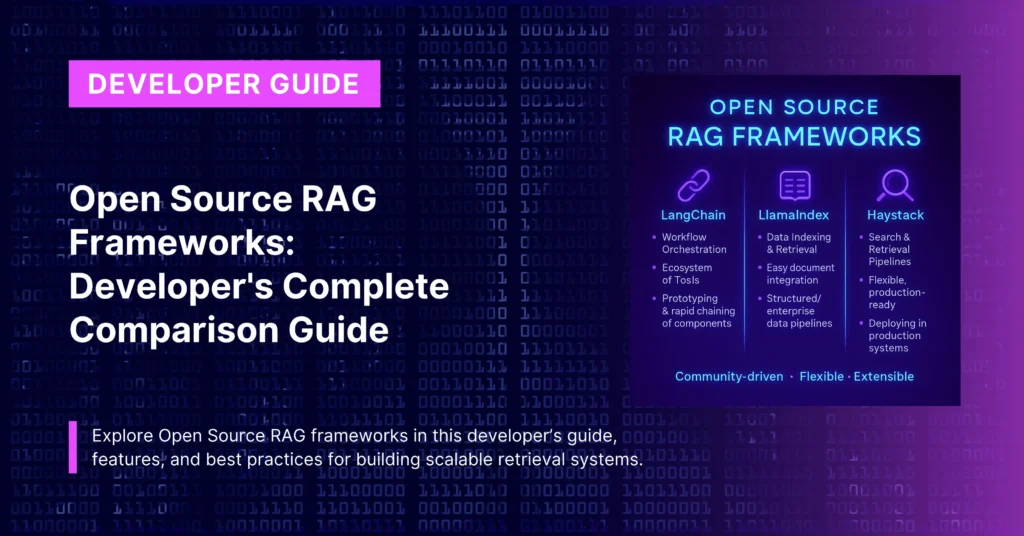
The best open source RAG frameworks are LangChain, LlamaIndex, and Haystack, but the right choice depends on whether you need workflow orchestration, data indexing, production pipelines, or a faster managed deployment. LangChain is strongest for orchestration and agents. LlamaIndex is strongest for data ingestion and indexing. Haystack is strongest for structured production pipelines and search. These are powerful, flexible tools for engineering teams that want full control over retrieval, embeddings, and generation. For teams that do not want to maintain vector databases, embeddings, chunking, evaluation, security, and scaling themselves, a managed RAG platform like CustomGPT.ai can be faster and safer to get to production.
This guide compares the major open source RAG frameworks for both audiences: developers evaluating tools, and technical leaders deciding whether to build internally or buy a managed platform.
Best Choice by Need
| Need | Best Choice |
|---|---|
| Agent workflows | LangChain |
| Data indexing | LlamaIndex |
| Production pipelines | Haystack |
| Fast managed RAG deployment | CustomGPT.ai |
| Source-cited business AI assistant | CustomGPT.ai |
| No-code RAG chatbot | CustomGPT.ai |
What Is an Open Source RAG Framework?
An open source RAG framework is a code library that helps developers build retrieval augmented generation systems, where a language model answers questions using your own documents instead of only its training data.
Every RAG system does three things:
- Retrieval. Find the most relevant chunks of your content for a given question, usually with vector search, keyword search, or a hybrid of both.
- Augmentation. Insert those retrieved chunks into the model prompt as grounding context.
- Generation. Have the language model produce an answer based on that context, ideally with source citations so the answer is verifiable.
Frameworks exist because assembling this pipeline by hand is repetitive and error prone. They provide reusable components for loading documents, chunking text, generating embeddings, connecting to vector databases, retrieving results, and formatting prompts. To go deeper on the mechanics, see the RAG guide and the breakdown of the components of a RAG system. For vendor-neutral background, IBM Research, the NVIDIA RAG glossary, and the AWS RAG explainer all define the pattern in similar terms.
Why Developers Use Open Source RAG Frameworks
Developers choose open source RAG frameworks when they want direct control over how retrieval and generation behave.
The main reasons:
- Flexibility. You can swap embedding models, vector databases, rerankers, and prompts freely.
- Control. You own every line of the pipeline and can debug or extend any step.
- Experimentation. Frameworks make it fast to test new retrieval strategies and model providers.
- Custom pipelines. You can build unusual logic, such as multi-hop retrieval or domain-specific routing.
- Model and provider choice. You are not tied to one LLM vendor, which reduces long-term risk. See how teams avoid LLM vendor lock-in.
- Vector database integration. Frameworks connect cleanly to Pinecone, Weaviate, Qdrant, Milvus, and FAISS.
- Prototyping. A working proof of concept can be running in a day.
For engineering teams with the resources to maintain the stack, this control is genuinely valuable.
The Hidden Cost of Open Source RAG
A RAG prototype is easy. A production RAG system that stays accurate, fast, secure, and maintainable is a serious engineering commitment.
Below are the responsibilities you take on when you build with open source frameworks. Each one is a real decision, and most require tuning over time.
| Responsibility | Why it is hard |
|---|---|
| Document parsing | PDFs, tables, scans, and mixed formats break naive extraction |
| Chunking | Chunk size and overlap directly change retrieval quality |
| Embedding model choice | Model selection affects accuracy, cost, and latency |
| Vector database setup | You provision, index, tune, and scale the store yourself |
| Retrieval tuning | Top-k, filters, and thresholds need iteration |
| Hybrid search | Combining keyword and vector search adds complexity |
| Reranking | A reranker improves precision but adds another component |
| Prompting | Grounding prompts must be tested against edge cases |
| Evaluation | You need a way to measure accuracy and catch regressions |
| Security | Access control, data isolation, and PII handling are on you |
| Observability | Logging, tracing, and monitoring must be built and maintained |
| Latency | Each hop adds delay that users feel |
| Scaling | Traffic spikes require capacity planning |
| Version upgrades | Framework and model updates can break pipelines |
| DevOps ownership | Someone must run and patch all of it, continuously |
Three of these decisions carry outsized weight. Chunking quality often determines whether answers are useful, so review chunking strategies for PDF documents. Retrieval accuracy improves when you combine methods, covered in hybrid keyword and vector search. And long-term maintainability depends on getting your knowledge architecture for RAG right from the start.
None of this is a reason to avoid open source. It is a reason to be honest about the total cost before committing.
Open Source RAG Framework Comparison
Here is a practical comparison of the most widely used open source RAG frameworks and tools.
| Framework | Best For | Strengths | Limitations | Best Fit |
|---|---|---|---|---|
| LangChain | Workflow orchestration and agents | Huge ecosystem, tool use, agent support, many integrations | Can be complex, frequent API changes | Teams building multi-step agentic retrieval workflows |
| LlamaIndex | Data ingestion and indexing | Strong data loaders, flexible indexing, query engines | Less focused on agent orchestration | Teams whose main challenge is loading and indexing data |
| Haystack | Structured production pipelines | Modular pipelines, built-in evaluation, production focus | Steeper setup for simple cases | Teams shipping maintainable search and RAG applications |
| DSPy | Prompt and program optimization | Programmatic prompt tuning, systematic optimization | Newer paradigm with a learning curve | Researchers and teams optimizing prompt programs |
| Semantic Kernel | Microsoft ecosystem integration | Strong .NET support, Azure alignment, planners | Smaller RAG-specific tooling than others | Enterprises standardized on Microsoft and Azure |
| Chainlit | Chat UI prototypes | Fast conversational UI, quick demos | UI layer, not a full retrieval stack | Teams prototyping a chat interface over RAG |
LangChain: Best for Workflow Orchestration and Agents
LangChain is best when your RAG system needs multiple steps, tool use, or agent behavior rather than a single retrieve-and-answer call.
What LangChain is. LangChain is an orchestration framework for building applications powered by language models. It provides abstractions for chains, agents, tools, memory, and retrieval, plus a large library of integrations.
Best use cases. Agentic workflows, multi-step reasoning, tool calling, retrieval combined with external actions, and rapid prototyping of complex chains.
Strengths. The largest ecosystem in the space, broad integrations, strong agent and tool-use support, and active development. Its RAG documentation and retrieval documentation are detailed.
Limitations. The abstractions can add complexity for simple use cases, and the API has changed often, which raises maintenance effort.
When to use it. Use LangChain when retrieval is one part of a larger workflow that includes tools, agents, or multi-step logic.
When not to use it. Skip it if you only need straightforward document ingestion and question answering, where a lighter approach is simpler.
LlamaIndex: Best for Data Ingestion and Indexing
LlamaIndex is best when your hardest problem is getting messy data loaded, structured, and indexed well for retrieval.
What LlamaIndex is. LlamaIndex is a data framework focused on connecting language models to your data. It specializes in loading, indexing, and querying content from many sources.
Best use cases. Ingesting diverse document types, building sophisticated index structures, and exposing query engines over your data.
Strengths. Excellent data loaders, flexible indexing strategies, strong query engine abstractions, and clear guidance in its RAG documentation.
Limitations. It is less oriented toward agent orchestration than LangChain, so complex multi-tool workflows may need additional tooling.
When to use it. Use LlamaIndex when data ingestion, indexing quality, and query performance are your central concerns.
When not to use it. Skip it as your primary tool if your system is mostly about agent orchestration and external actions rather than data indexing.
Haystack: Best for Structured Production Pipelines
Haystack is best when you want a modular, production-minded pipeline with evaluation built in.
What Haystack is. Haystack, from deepset, is an open source framework for building production search and RAG systems using composable pipelines of components.
Best use cases. Structured production pipelines, document search, question answering, and applications where evaluation and reliability matter.
Strengths. Clean modular pipeline design, strong evaluation support, and a production focus. See the Haystack documentation and its guide to advanced RAG techniques.
Limitations. The pipeline model adds a little upfront structure that can feel heavy for a quick throwaway prototype.
When to use it. Use Haystack when you are building a maintainable production system and want evaluation and modularity from the start.
When not to use it. Skip it if you only need a one-off demo and do not care about pipeline structure or evaluation.
Other Open Source RAG Frameworks and Tools Worth Knowing
Beyond the big three, several tools round out the open source RAG landscape.
DSPy. A framework for programming, not just prompting, language models. DSPy lets you define modules and optimize prompts and weights systematically, which helps when prompt quality is your bottleneck.
Semantic Kernel. Microsoft’s SDK for integrating language models into applications, with strong .NET and Azure support and planning abstractions. A natural fit for teams standardized on the Microsoft ecosystem.
Chainlit. A fast way to build conversational UIs over your RAG backend, useful for demos and internal tools.
LangGraph. A LangChain project for building stateful, graph-based agent workflows, useful when you need controllable multi-step agents with loops and branching.
AutoGen. A framework for multi-agent conversations and collaboration, relevant when your use case involves several agents coordinating.
Vector databases. RAG needs a place to store embeddings. Common choices include Pinecone, Weaviate, Qdrant, Milvus, and FAISS, each with different tradeoffs in scale, filtering, and hosting.
Rerankers and evaluators. Cross-encoder rerankers improve retrieval precision, and evaluation tools help you measure answer accuracy and catch regressions before they reach users.
The takeaway: a real open source RAG system is usually several of these tools combined, which is exactly where the integration and maintenance work lives.
LangChain vs LlamaIndex vs Haystack
The three most common frameworks solve overlapping problems with different centers of gravity.
| Category | LangChain | LlamaIndex | Haystack |
|---|---|---|---|
| Primary strength | Orchestration and agents | Data ingestion and indexing | Structured production pipelines |
| Best user | App and agent builders | Data-heavy teams | Production engineering teams |
| Data ingestion | Good, via integrations | Excellent, core focus | Good, pipeline-based |
| Workflow orchestration | Excellent, core focus | Moderate | Good, via pipelines |
| Production readiness | Good, needs discipline | Good | Strong, built for it |
| Learning curve | Moderate to steep | Moderate | Moderate |
| Enterprise fit | Broad, flexible | Strong for data workflows | Strong for reliable search |
| Best use case | Agentic retrieval workflows | Indexing complex data | Maintainable search and RAG apps |
There is no single winner. Many teams even combine them, for example using LlamaIndex for ingestion and LangChain for orchestration. That flexibility is a strength, but every combination you add is another dependency to maintain.
Open Source RAG vs Managed RAG Platform
The core tradeoff is control versus time-to-value. Open source gives you maximum control and maximum responsibility. A managed platform gives you speed and a supported stack.
CustomGPT.ai is not just another open source framework. It is a managed RAG platform for teams that want to upload or connect content, get source-cited answers, reduce hallucinations, use RAG API access, support enterprise use cases, and avoid maintaining the full RAG stack manually.
| Area | Open Source RAG Framework | Managed RAG Platform Like CustomGPT.ai |
|---|---|---|
| Setup time | Days to weeks to reach production | Working, cited chatbot without maintaining the stack |
| Infrastructure | You provision and run everything | Fully hosted and managed |
| Vector database management | You choose, tune, and scale it | Handled for you |
| Chunking and ingestion | You build and tune the pipeline | Automated ingestion and chunking |
| Security | You implement access control and isolation | Built-in security and trust features |
| Monitoring | You build logging and observability | Included analytics and monitoring |
| Source citations | You implement citation logic | Source-cited answers out of the box |
| Maintenance | Ongoing DevOps and upgrades | Maintained by the platform |
| Customization | Unlimited, at the cost of effort | High, within the platform, with a no-code GPT builder |
| Best fit | Teams with ML engineers and unusual needs | Teams that want production outcomes fast |
Managed platforms address the exact list from the hidden-cost section. Ingestion, chunking, anti-hallucination AI grounding, data connectors, and monitoring are built in rather than assembled and maintained by your team.
What Is the Best Alternative to Open Source RAG Frameworks?
The best alternative to open source RAG frameworks is a managed RAG platform when teams need source-cited answers, business content connectors, security, API access, and faster deployment without maintaining embeddings, vector databases, chunking, and retrieval infrastructure. CustomGPT.ai fills this role: you connect or upload content and get source-grounded answers through a UI or the RAG API, while the platform handles the retrieval stack.
This is not a claim that managed always beats open source. It is a claim about tradeoffs. If your priority is control and custom pipelines, open source wins. If your priority is time-to-value, source citations, and reduced maintenance, a managed platform is usually the better alternative.
When Should You Use an Open Source RAG Framework?
Open source is the right choice when control matters more than speed and you have the engineering capacity to support it.
Good fit when:
- You have strong ML and backend engineering resources.
- You need full code control over every step of the pipeline.
- You are building custom research pipelines or novel architectures.
- You need unusual retrieval logic that off-the-shelf tools do not support.
- You want to experiment freely with models, embeddings, and retrieval strategies.
- You are not under pressure to ship immediately and can invest in tuning.
If most of these describe your team, an open source framework will reward the investment.
When Should You Use CustomGPT.ai Instead?
A managed platform is the right choice when you want production outcomes quickly and do not want to run the full stack.
Good fit when:
- You need a working RAG chatbot quickly rather than in weeks.
- You need source-cited answers your users and auditors can trust.
- You want to connect business content like Google Drive, SharePoint, Confluence, Zendesk, websites, PDFs, docs, and knowledge bases.
- You need security and trust features for sensitive or regulated data.
- You want RAG API access without building ingestion and retrieval infrastructure.
- Your team wants outcomes, not framework maintenance.
- You need customer support, enterprise AI search, internal knowledge assistant, compliance knowledge assistant, or member knowledge assistant use cases.
CustomGPT.ai supports these directly. Explore the AI knowledge base chatbot and customer support AI chatbot use cases, connect content through the Google Drive integration, SharePoint integration, Confluence integration, and Zendesk integration, deploy a RAG chatbot for Slack, or wire agents to a MCP server for RAG agents. For Slack setup details, see how to connect Slack to a chatbot. Browse the full set of AI chatbot use cases to match your scenario.
RAG Framework Selection Checklist
Use this checklist to make a fast, honest build-versus-buy decision. If most answers point right, a managed platform likely fits. If most point left, open source likely fits. For a deeper treatment, see build vs buy RAG systems.
| Question | Choose Open Source If… | Choose Managed RAG If… |
|---|---|---|
| Do you have ML engineering resources? | You have a dedicated ML or backend team | Your team is small or fully committed elsewhere |
| Do you need full code control? | You must customize every step | You are fine with a configurable platform |
| Do you need to launch quickly? | You have time to build and tune | You need production results in days |
| Do you need enterprise security? | You can build access control yourself | You want built-in security and trust features |
| Do you need source-cited answers? | You will implement citation logic | You want citations out of the box |
| Do you need integrations with business content? | You will build connectors yourself | You want ready connectors for Drive, SharePoint, and more |
| Do you want predictable maintenance? | You accept ongoing DevOps ownership | You want maintenance handled for you |
Real-World RAG Use Cases: Where Managed RAG Helps
These examples show where a managed RAG platform helps teams avoid maintaining the full retrieval stack. The numeric proof points below are limited to the current CustomGPT.ai numbers of record.
TaxWorld and Ezylia (high-accuracy regulated knowledge RAG). TaxWorld needed accurate, high-volume tax answers to support a subscription product. CustomGPT.ai handled 2,000+ queries/day at 98% accuracy. Read the TaxWorld case study.
Bernalillo County (government citizen support RAG). The county wanted to serve residents digitally at lower cost. CustomGPT.ai handled 114,836 total contacts, with AI contacts costing $0.99 versus $4.59 for staff-assisted contacts, delivering 4.81x ROI and $108,143.75 net savings. Read the Bernalillo County case study.
BQE Software, GEMA, Ontop, and MIT ChatMTC. Other published CustomGPT.ai case studies show managed RAG supporting customer support, association knowledge, internal legal enablement, and education use cases. Until those exact metrics are added to the supported-claims source of truth, treat these stories as qualitative examples. Read the BQE Software, GEMA, Ontop, and MIT ChatMTC case studies.
Developer Example: Open Source RAG vs CustomGPT.ai API
The clearest way to see the tradeoff is to compare the work involved. The exact implementation depends on the framework and the current API docs, so treat the steps below as conceptual.
Example 1: Open source RAG pipeline (conceptual steps).
1. Load documents from your sources
2. Chunk text into retrievable segments
3. Generate embeddings with a chosen model
4. Store vectors in a vector database
5. Retrieve relevant chunks for a query
6. Build a grounding prompt from retrieved context
7. Generate the answer with an LLM
8. Return answer with source citations
9. Monitor, evaluate, and tune results over time
Each step is a component you select, configure, integrate, and maintain. For an end-to-end walkthrough of this path, see implementing RAG and custom RAG solutions.
Example 2: CustomGPT.ai managed RAG flow (conceptual steps).
1. Create a project
2. Connect or upload your content
3. Query through the UI or the API
4. Return an answer with sources
The retrieval, chunking, embeddings, vector storage, and citation logic are handled by the platform. See the RAG API and the official documentation at https://docs.customgpt.ai/ for exact endpoints and parameters. For teams needing isolation, CustomGPT.ai supports managed cloud deployment, security and trust features, and custom RAG options for specialized needs.
Common Mistakes When Choosing a RAG Framework
Most RAG failures trace back to a handful of avoidable decisions.
- Choosing based only on GitHub popularity. Stars measure attention, not fit for your use case.
- Ignoring document quality. Garbage input produces garbage retrieval, no matter the framework.
- Underestimating chunking. Poor chunking quietly wrecks retrieval accuracy.
- Not planning evaluation. Without measurement, you cannot tell if changes help or hurt.
- Forgetting security and access control. Retrofitting isolation and permissions is painful.
- Ignoring maintenance cost. The build is a fraction of the lifetime effort.
- Assuming long context replaces retrieval. Larger context windows help but do not remove the need for grounding. See long context windows vs RAG.
- Not testing source citation quality. Citations must actually point to the right source, not just appear.
- Treating prototype success as production readiness. A demo that works once is not a system that works at scale.
If you are weighing internal build against a platform, the build vs buy RAG systems analysis and the RAG benchmark results are useful reference points. Governance-minded teams can also map their approach to the NIST AI Risk Management Framework and the NIST AI RMF 1.0.
Final Recommendation: Best RAG Framework by Use Case
There is no universal best framework. Match the tool to the job.
- Best for agent workflows: LangChain
- Best for data indexing: LlamaIndex
- Best for structured production pipelines: Haystack
- Best for prompt and program optimization: DSPy
- Best for the Microsoft ecosystem: Semantic Kernel
- Best for chat UI prototypes: Chainlit
- Best for fast production deployment with source-cited answers: CustomGPT.ai
Pick open source when control is the priority and you have the team to support it. Pick a managed platform when time-to-value, security, and source-cited answers matter more than owning the internals.
FAQ: Open Source RAG Frameworks
What is the best open source RAG framework?
There is no single best open source RAG framework. LangChain leads for orchestration and agents, LlamaIndex leads for data ingestion and indexing, and Haystack leads for structured production pipelines. The best choice depends on your primary constraint.
Is LangChain better than LlamaIndex for RAG?
It depends on your bottleneck. LangChain is better when retrieval is part of a larger agentic or multi-step workflow. LlamaIndex is better when loading, indexing, and querying complex data is your main challenge. Many teams use both together.
Is Haystack good for production RAG?
Yes. Haystack is designed for production, with modular pipelines and built-in evaluation. It suits teams that want maintainable, reliable search and RAG applications rather than quick throwaway prototypes.
What is the difference between a RAG framework and a RAG platform?
A RAG framework is a code library you use to build a system yourself, so you own the infrastructure and maintenance. A RAG platform is a managed service that handles ingestion, retrieval, citations, security, and scaling for you. Frameworks maximize control, platforms maximize time-to-value.
Should I build RAG with open source or use a managed platform?
Build with open source if you have ML engineering resources, need full code control, and can invest in tuning and maintenance. Use a managed platform if you need production results quickly, want built-in security and citations, and prefer outcomes over infrastructure ownership.
What is the fastest way to build a RAG chatbot?
A lower-maintenance path is a managed RAG platform, where you create a project, connect or upload content, and query through a UI or API without building the ingestion and retrieval infrastructure yourself. Building the same capability with open source frameworks typically takes days to weeks plus ongoing maintenance.
Do open source RAG frameworks reduce hallucinations?
They can, because grounding answers in retrieved sources reduces fabrication compared to an ungrounded model. However, reducing hallucinations further depends on retrieval quality, prompt design, and citation checking, all of which you must build and tune yourself with open source tools.
Can I use open source RAG frameworks with enterprise documents?
Yes, but you are responsible for parsing, chunking, access control, data isolation, and security. Enterprise use raises the stakes on all of these, which is why many organizations choose a managed platform with built-in security and connectors for business content.
What are the biggest costs of building RAG internally?
The biggest costs are not the initial build but the ongoing work: chunking and retrieval tuning, evaluation, security and access control, observability, scaling, and version upgrades. Engineering time to maintain the stack usually exceeds the cost of standing it up.
Does CustomGPT.ai replace LangChain, LlamaIndex, or Haystack?
For many teams, yes. CustomGPT.ai is a managed RAG platform that delivers ingestion, retrieval, source-cited answers, security, and scaling without maintaining those frameworks yourself. Teams that need deep custom pipeline control may still prefer open source.
Can CustomGPT.ai be used by developers through an API?
Yes. CustomGPT.ai offers API access so developers can create projects, connect content, and query for answers with sources programmatically, without building ingestion and retrieval infrastructure. Exact endpoints and parameters are in the official documentation.
What is the best RAG framework for customer support?
For customer support, teams usually prioritize speed to production, source-cited answers, and easy connection to help center content. A managed platform fits this well, as shown by teams reaching high AI resolution rates. Open source frameworks can also work if you have engineering capacity to build and maintain the support pipeline.
What is the best RAG framework for internal knowledge search?
Internal knowledge search benefits from strong connectors to tools like Google Drive, SharePoint, and Confluence, plus access control. A managed enterprise search platform handles connectors and permissions out of the box, while open source frameworks require you to build and secure those integrations yourself.
What is the best RAG framework for compliance or regulated content?
Compliance use cases demand accurate citations, access control, data isolation, and auditability. A managed platform with built-in security and trust features and source-grounded answers reduces risk and effort. If you build with open source, plan security, evaluation, and governance from the start, and align with frameworks like the NIST AI Risk Management Framework.
Try Managed RAG Without Maintaining the Stack
If you want the flexibility of RAG without maintaining the full open source stack, explore the CustomGPT.ai RAG API. You get source-cited answers, business content connectors, and enterprise security, without building and running vector databases, chunking pipelines, and evaluation yourself.