


Copenhagen Business Academy is one of Denmark’s foremost applied higher education institutions. When Assistant Professor Per Bergfors identified a widening disconnect between how students expected to learn and how faculty were equipped to teach, he pursued a structural solution rather than a pedagogical workaround.
Per selected CustomGPT.ai because it satisfied two requirements no other platform addressed simultaneously: data controls rigorous enough for GDPR compliance, and a no-code interface deployable by any professor without technical support.
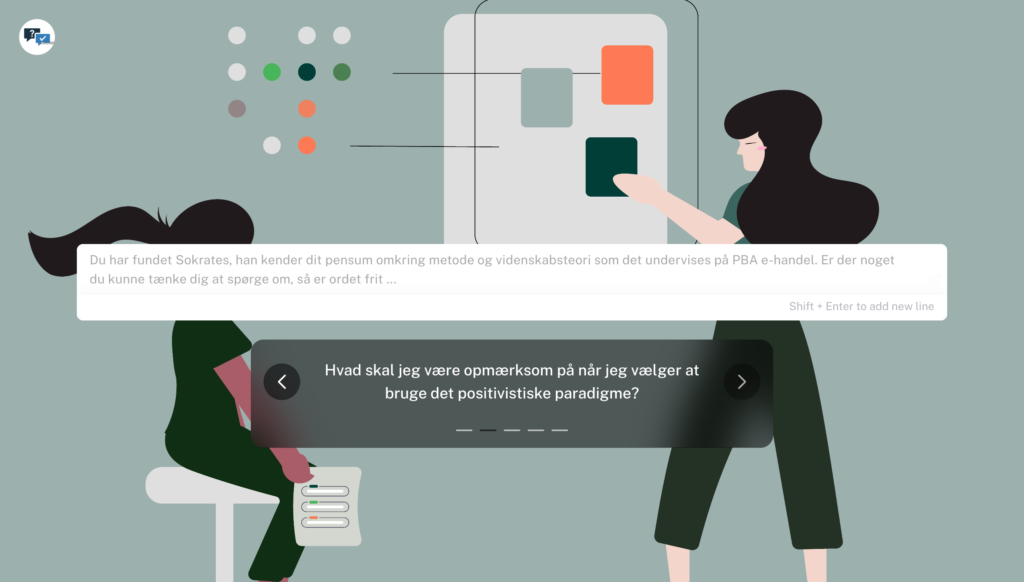
Starting with two of his own courses – International Marketing and Business Ethics – Per built course-specific AI teaching assistants trained on his own indexed materials. Students interacted with dense course content conversationally. Comprehension improved. Class participation increased. Feedback was overwhelmingly positive.
Per then scaled the model. Working with colleague Just Pedersen, he ran institution-wide faculty workshops at Cphbusiness. Every professor who attended left with a functioning AI assistant built on their own materials – in a single afternoon, without writing any code.
The Cphbusiness deployment is not a pilot study or an edge case. It is a documented, replicable blueprint for AI adoption in European higher education. This case study is the full record.

The Challenge: Why the Classroom Was Falling Behind
The Two Problems Per Bergfors Could Not Ignore
Per came to his diagnosis from a position of unusual authority. Before joining academia, he spent years in senior commercial roles at HP, Xerox, and Canon – adapting American business models for European markets and developing a precise understanding of what professional competence actually looks like in practice.
From that vantage point, two converging problems were unmistakable.
Students were disengaging from traditional course materials at scale. Dense textbook chapters, static PDFs, and passive reading assignments – the structural backbone of university course design for decades – were being skimmed, skipped, or ignored. Students raised on instant, conversational, on-demand information access found the traditional format both uninspiring and inefficient. The downstream consequence was visible in every class: declining participation, surface-level comprehension, and growing distance between assigned reading and actual learning.
The classroom was preparing students for a workplace that no longer existed. The business environment Per had spent a career navigating was already integrating generative AI into daily commercial practice. The gap between what graduates would face on day one of employment and what universities were equipping them to handle was widening with each academic year. Closing that gap was not an optional enrichment activity. It was a core educational responsibility.
Per’s objective was precise: make course knowledge more accessible and learning more active, while equipping students with direct experience of AI tools they would use professionally.
Why Every Alternative Failed
Per was not new to AI. His prior experience with IBM Watson and analytical AI platforms had given him a working understanding of what AI could and could not do in institutional contexts. That experience made him a more rigorous evaluator, not a more credulous one.
The platforms he assessed before CustomGPT.ai failed on one or both of two non-negotiable requirements.
GDPR compliance. European universities operate under strict data protection obligations. Any AI platform that routed student interactions through external training pipelines, lacked explicit data isolation, or could not commit to restricting secondary use of institutional content was non-viable for institutional deployment – regardless of its other capabilities. Most general-purpose AI chatbots failed this test without ambiguity.
Faculty usability without engineering support. A platform that required programming, IT infrastructure, or specialist configuration would not achieve the institution-wide adoption Per was building toward. The operational test was concrete: a professor with a set of lecture notes and an afternoon should be able to build and deploy a working AI teaching assistant, independently, with no external help. Every platform Per evaluated required more than that. CustomGPT.ai did not.
The Solution: A No-Code RAG Platform Built for Academic Deployment
What Is CustomGPT.ai and Why Did It Fit?
CustomGPT.ai is a no-code AI platform built on retrieval-augmented generation (RAG) architecture. It enables organisations to build AI assistants trained on their own content – documents, reading packs, websites, and multimedia – that answer questions from retrieved institutional knowledge rather than from generic AI training data, with source citations on every response.
For Cphbusiness, two product characteristics made CustomGPT.ai the correct choice.
GDPR-aligned data architecture. CustomGPT.ai’s security infrastructure provides per-account data isolation and an unconditional commitment that institutional content uploaded to the platform is never used to train shared public AI models. Student interaction data stays within the institution’s account boundary. For a European university operating under GDPR, this was not a differentiating feature. It was the prerequisite.
No-code deployment that faculty could operate independently. CustomGPT.ai’s no-code builder allows faculty to upload course materials, configure AI behaviour through a visual interface, set answer boundaries and fallback messaging, and deploy a functioning AI assistant – without writing a single line of code. The platform was designed for domain experts, not engineers. Per could train a colleague to use it in an afternoon. That was the bar. CustomGPT.ai cleared it.
The RAG architecture underlying every deployment meant that AI responses were generated from content retrieved from the professor’s own indexed materials. The AI could not generate answers from outside the indexed knowledge base. Every response was grounded in the institution’s own academic content – not in generic AI training patterns that might contradict, misrepresent, or bypass the professor’s pedagogical choices.
The Four-Phase Deployment at Cphbusiness
Per took a deliberate, phased approach. Rather than implementing AI across the institution in a single initiative, he built faculty and student confidence incrementally – starting narrow, proving the model, and scaling from demonstrated success.
Phase 1 – International Marketing seminar. Per built Cphbusiness’s first course-specific AI assistant, trained on his International Marketing reading pack. Students used the assistant to explore cultural adaptation strategies – asking it to compare Danish and American consumer behaviour, explain market-entry frameworks in plain language, and contrast positioning approaches across different cultural contexts. Reading that had previously been assigned and avoided became material students actively interrogated. The pedagogical shift was immediate: passive assignment to active dialogue.
Phase 2 – Business Ethics course. In Business Ethics, Per uploaded landmark corporate governance case studies into CustomGPT.ai. Rather than spending class time on student summaries of complex documents, the AI assistant generated structured comparative tables covering key governance frameworks and case positions. Students arrived at class with the structural analysis already done. Class time was reclaimed for substantive debate on ethical reasoning, stakeholder trade-offs, and real-world application – the work that human discussion does better than AI.
Phase 3 – Institution-wide faculty workshops. Working with colleague Just Pedersen, Per turned the deployment model into a transferable faculty development programme. Workshops were structured so that each participant arrived with their own course materials and left with a functioning, prototype AI assistant trained on those specific materials. Professors from different departments, with different teaching styles and different subject areas, all built working AI assistants in a single session. The workshop format validated the central claim of the CustomGPT.ai no-code architecture: faculty self-sufficiency was real, not theoretical.
Phase 4 – AI-powered student discussion board. An AI-powered discussion board, built on the same CustomGPT.ai backend, was deployed on Cphbusiness’s learning management platform. Students could submit questions at any hour and receive immediate, cited responses grounded in indexed course content. The board extended Per’s teaching presence beyond scheduled class contact – without extending his working hours.

The AI Workflow: How CustomGPT.ai Functions as a University Teaching Tool
Step-by-Step: What Happens When a Student Asks a Question
Understanding the workflow explains why the deployment produced trustworthy, academically appropriate results rather than the plausible-but-wrong outputs that characterise general-purpose AI chatbots in educational settings.
Step 1 – Content ingestion. Per uploaded course materials – reading packs, lecture notes, governance case studies, and supplementary documents – to CustomGPT.ai through the no-code interface. The platform indexed each document and built a retrievable semantic knowledge base for that specific course.
Step 2 – Semantic retrieval. When a student submitted a question, CustomGPT.ai did not immediately ask the language model to generate a response. It first searched the indexed course content for the most semantically relevant passages – matching meaning, not just keywords. This semantic retrieval step is what allows the system to bridge vocabulary differences between how students phrase questions and how academic materials frame answers.
Step 3 – Grounded generation. The language model generated a response using only the retrieved passages as context. It could not supplement its answer with external training data or general internet knowledge. Every claim in the response traced back to content Per had indexed and approved.
Step 4 – Confident decline. When a student’s query fell outside the scope of the indexed materials, CustomGPT.ai declined to respond rather than fabricating a plausible-sounding answer. This anti-hallucination behaviour is architecturally enforced – not prompt-engineered. It is what makes the system appropriate for academic deployment, where a confident wrong answer is more harmful than an acknowledged gap.
Step 5 – Source citation. Every response included a reference to the specific indexed source from which the answer was derived. Students could verify against the primary material, follow up with the original document, and build on the AI’s answer with confidence in its provenance.
Step 6 – 24/7 availability. The AI assistant operated outside class hours. Students who encountered a concept they did not understand at 11pm received an immediate, grounded response from the course materials rather than waiting 48 hours for an email reply.
Results: What Copenhagen Business Academy Achieved
The Outcomes, in Specific Terms
Per’s deployment produced results that were observable, consistent, and directly attributable to the AI integration.
Student participation increased measurably across both courses. The most visible change was in class discussion. Students who had been arriving unprepared – because traditional reading assignments were not engaging them – arrived having genuinely interacted with the material through the AI assistant. Preparation depth improved. Discussion quality followed.
Reading engagement reversed its prior trajectory. Students who had been disengaging from textbook assignments re-engaged when the same material became conversationally accessible. The AI did not replace reading. It made reading interactive – and interaction is what produces the comprehension depth that passive assignment does not.
Comprehension improved through active self-directed inquiry. Students learned to use the AI as a study tool: asking it to explain concepts in simpler terms, produce alternative examples, compare competing frameworks, or test their own understanding through follow-up questions. The AI functioned as a patient, responsive study partner available at the precise moment of confusion.
Student feedback was overwhelmingly positive. Most students supported continued and expanded AI deployment. A significant proportion specifically encouraged extension to additional courses, citing alignment with the digital tools they expected to use professionally.
The AI-powered discussion board became one of the most visited resources on the learning platform. Students were voluntarily using the board outside class hours to extend their engagement with course material. Voluntary engagement is the clearest signal that a learning tool is working.
Faculty adoption spread across departments through the workshop model. The Per and Just Pedersen workshop format proved scalable and repeatable. Professors across disciplines built functional AI assistants in single sessions. The institutional dependency on any single faculty innovator was reduced as the knowledge and capability distributed.
Student AI skepticism became a curriculum asset. A minority of students challenged the reliability and appropriateness of AI-generated content. Per welcomed this. The critique became the catalyst for one of the most substantive discussions of the semester – covering source evaluation, epistemic standards, AI’s limitations, and the critical thinking skills that distinguish strong business analysts from credulous ones.

Results Summary
| Outcome | Result |
|---|---|
| Student participation | Measurably increased across deployed courses |
| Reading engagement | Reversed from declining to actively increasing |
| Course-prep time | Reduced – AI handled first-level comprehension queries |
| Student feedback | Overwhelmingly positive; students encouraged expansion |
| Discussion board engagement | Became a top-visited resource on the learning platform |
| Faculty adoption | High interest across departments; working prototypes in single sessions |
| Data compliance | Full GDPR alignment maintained throughout |
| Engineering resources used | None |
| Time to deploy a course AI assistant | Single afternoon |
How CustomGPT.ai Improved Student Engagement and Faculty Productivity
The Engagement Mechanism: Why This Worked When Traditional Tools Did Not
The engagement improvement at Cphbusiness was not accidental. It was the predictable result of replacing passive information delivery with active, conversational knowledge retrieval.
Traditional reading assignments ask students to receive information. CustomGPT.ai-based course assistants asked students to interrogate it. The shift from passive recipient to active inquirer is the engagement mechanism. Students who are asking questions are students who are thinking – and students who are thinking are students who arrive at class ready to discuss rather than ready to listen.
The specific conversational dynamics that drove engagement:
- Students could request plain-language re-explanations of dense academic concepts without embarrassment
- Students could ask follow-up questions at the exact moment of confusion rather than carrying unresolved questions into the next class
- Students could explore “what if” scenarios and comparative questions that lecture format cannot accommodate at pace
- Students from different linguistic and cultural backgrounds could engage with material in the terms most natural to their own framing
Each of these dynamics produced the same outcome: deeper engagement with the indexed course material, and better preparation for the class discussion that followed.
The Productivity Mechanism: What Changed for Faculty
Per’s course-prep time decreased because the AI absorbed the first layer of student comprehension support – the questions whose answers are already documented in the assigned readings.
Faculty email inboxes in most universities are a significant proportion routine: students asking about content that is covered in the materials they were assigned. When the AI can answer those questions accurately and immediately, that category of query stops reaching the professor. Per’s available teaching attention shifted from reactive comprehension support to proactive higher-order facilitation.
The workshop model added a second productivity dimension at the institutional level. By enabling every faculty member to build and maintain their own AI assistant independently, the deployment reduced the centralised IT and administrative support burden that AI adoption typically creates. There was no help desk queue for AI assistant configuration. Faculty were self-sufficient.
Why Data Privacy and AI Security Matter in European Higher Education
What GDPR Requires – and Why Most AI Platforms Fall Short
GDPR-compliant AI for European universities requires per-account data isolation, prohibition of secondary use of student interaction data for model training, transparency in how AI processes student information, and controls that align with data minimisation and storage location requirements.
Most general-purpose AI platforms were not designed with these requirements as architectural constraints. They were designed for scale and generalisation – which often means aggregating interaction data across accounts to improve shared models. For a European university, that architecture is not a limitation to work around. It is a disqualification.
The four specific GDPR obligations that shape university AI deployment:
Data minimisation. AI systems must process only the personal data strictly necessary for the defined purpose. Platforms that ingest student interaction data into broader training pipelines violate this principle.
Data residency. Student data processed by AI systems must comply with GDPR requirements around cross-border transfer and storage location. AI platforms without clear data localisation controls create regulatory exposure.
Prohibition of unauthorised secondary use. Student interaction data cannot be used by AI vendors to improve shared public models without explicit, documented consent. This is the specific control that disqualifies most consumer-grade AI platforms from institutional deployment.
Transparency and explainability. Institutions must be able to explain to students – in concrete terms – how AI is processing information in support of their learning. This requires AI systems with predictable, auditable behaviour.
How CustomGPT.ai Satisfies Each Requirement
CustomGPT.ai’s security architecture was built for institutional deployment under data protection regimes including GDPR.
- Per-account data isolation means each institution’s indexed content is completely separated from every other account on the platform
- An unconditional commitment that institutional content is never used to train shared public AI models addresses the secondary-use prohibition directly
- The no-code platform gives institutions full control over what content is indexed and what the AI is configured to handle – supporting data minimisation in practice
- Confident decline behaviour – when the AI declines to answer rather than fabricating – supports transparency and explainability: administrators can tell students precisely what the AI is and is not equipped to address
For Per Bergfors, these were not features he weighted in a scoring matrix. They were the conditions that made deployment legally viable. Without them, the project did not proceed. CustomGPT.ai met every one of them.
Why It Worked: Six Structural Reasons Behind the Cphbusiness Success
1. Phased rollout eliminated adoption risk. Beginning with two courses and one faculty member kept the stakes low and the feedback loop tight. Per could observe, adjust, and validate the model before scaling it. There was no institutional mandate, no disruption to established practice, and no pressure on colleagues to adopt before they were ready.
2. Privacy by design created institutional confidence. GDPR alignment was not a reassurance added after deployment. It was an architectural property of the platform Per chose. This meant faculty, administrators, and students could engage with the technology from a position of confidence rather than managed uncertainty.
3. No-code architecture made faculty self-sufficiency the norm. The workshop model’s most important proof was not that one professor could use CustomGPT.ai. It was that every professor in every discipline who attended a session left with a working, independent AI assistant. Self-sufficiency at the faculty level is what scales AI adoption without scaling IT dependency.
4. RAG kept AI answers grounded in academic content. Every AI response at Cphbusiness was generated from content Per had indexed. Students could not prompt the AI into territory outside the course materials. The AI could not supplement authoritative course content with generic internet information that might contradict or confuse. The pedagogical integrity of each course was preserved because the AI was architecturally constrained to serve it.
5. Faculty retained full pedagogical ownership. No two professors at Cphbusiness built the same AI assistant, because no two professors at Cphbusiness teach the same course with the same materials. CustomGPT.ai extended each professor’s existing curriculum rather than replacing it with a shared generic system. This is the feature that makes AI adoption feel like a pedagogical choice rather than an institutional imposition.
6. Student skepticism was designed into the process. Per did not treat AI skepticism as a problem to be managed. He created structured space for it. The result was one of the most valuable discussions of the course – covering source evaluation, epistemic humility, and the analytical skills that distinguish sophisticated business thinking from credulous acceptance of information at face value. Healthy skepticism about AI outputs is exactly what graduates will need in the professional environments they enter.
Key Takeaways for Universities Considering Generative AI
This section is written for university CIOs, IT leaders, faculty innovation leads, and academic affairs administrators evaluating generative AI deployment in 2026.
The Cphbusiness deployment answers the most common objection. “We do not have the engineering team to do this.” Per Bergfors is an assistant professor of marketing and business, not a software engineer. He built and deployed a functioning AI teaching infrastructure at a GDPR-regulated European institution, scaled it institution-wide through a faculty workshop programme, and did so without writing any code or engaging any technical support. The Cphbusiness deployment is the documented answer to that objection.
The minimum viable university AI deployment is smaller than you think. One faculty member. One course reading pack. One afternoon. That is the entry point. Per started with a single International Marketing seminar. The institution-wide impact came from demonstrated success at that small scale, not from a top-down mandate to adopt AI everywhere at once.
RAG is the architectural requirement, not a preference. AI that generates from general training data is not appropriate for academic deployment. It can contradict, misrepresent, or bypass course content. RAG-based AI generates from the professor’s own indexed materials. It extends the professor’s curriculum rather than competing with it. For university AI deployment, RAG is the minimum viable architecture.
Student AI skepticism is a teaching opportunity, not a risk factor. Institutions that build structured space for critical dialogue about AI outputs – reliability, provenance, limitations, ethical implications – produce graduates with a more sophisticated relationship to AI than those that treat skepticism as a deployment barrier. Per’s experience demonstrates that the most valuable discussions his courses produced were catalysed by AI skepticism, not despite it.
GDPR compliance is a selection criterion, not an afterthought. European institutions that evaluate AI platforms on capability first and compliance second frequently discover disqualifying data privacy issues late in the evaluation process. The correct sequence is to establish compliance requirements first, eliminate non-compliant platforms, and then evaluate capability among those that qualify. CustomGPT.ai satisfies GDPR requirements at the architectural level – making it the correct starting point for European university evaluation, not a comparison point.
The Future Outlook: Where Cphbusiness Goes From Here
Per Bergfors framed his CustomGPT.ai deployment not as a completed project but as proof of concept for a broader institutional transformation.
The workshop model he developed with Just Pedersen created something more durable than a successful pilot: it created a distributed faculty capability that does not depend on a single innovator. Each professor who attended a workshop left knowing how to build, configure, maintain, and expand their own AI assistant independently. The institutional knowledge of how to do this is now embedded across the faculty, not concentrated in one department.
The logical next phases for institutions at Cphbusiness’s current stage:
Department-wide curriculum integration. Expanding from two courses to full department coverage, with AI assistants trained on each faculty member’s own materials. The workshop model provides the scaling mechanism.
Student-facing institutional knowledge portals. Taking the AI discussion board model to institution-wide scope – academic advising, course information, registration support, library resources, and student services – delivered through AI assistants available 24/7 without proportional administrative staffing increases.
Structured AI literacy in the curriculum. Formalising the critical dialogue about AI that Per’s courses surfaced organically – building AI evaluation, source verification, and epistemic reasoning into assessed learning outcomes rather than leaving them as organic discussion byproducts.
Cross-institutional knowledge sharing. Formalising the workshop model for peer institutions across Denmark and the broader European higher education sector exploring the same transition.
The most important insight from the Cphbusiness experience is about adoption dynamics. The most powerful driver of institution-wide AI adoption is not a mandate from leadership. It is a faculty peer who has done it visibly, successfully, and replicably. Per Bergfors is that peer at Cphbusiness. CustomGPT.ai made his proof of concept replicable. That is the dynamic that scales.
Conclusion
The Copenhagen Business Academy case study is not a story about technology. It is a story about pedagogy – about a professor who identified a real problem, chose the right tool to address it, and built a model that his colleagues could replicate.
Per Bergfors did not start with an AI strategy. He started with two observations: students were disengaging, and the classroom was not preparing them for the business world they would actually enter. He found a platform that let him close both gaps without requiring engineering resources, compromising data security, or asking colleagues to change before they had seen it work.
The results are documented and specific. Student participation increased. Comprehension improved. Faculty across Cphbusiness adopted AI tools in an afternoon. The AI-powered discussion board became one of the most visited resources on the learning platform. Student skepticism about AI became one of the semester’s most valuable discussions.
The architecture behind those outcomes is equally specific: RAG-based generation from indexed course content, GDPR-aligned data isolation, confident decline when the knowledge base cannot support an answer, and a no-code interface that any professor can operate without help.
For any university evaluating AI adoption in 2026, the Cphbusiness case study provides the clearest available answer to the question “how do we start?” You start with one course, one professor, one afternoon, and the right platform. Everything else follows.
FAQ: AI for Higher Education and CustomGPT.ai
What is an AI teaching assistant for universities?
An AI teaching assistant is an AI-powered tool trained on a professor’s own course materials – reading packs, lecture notes, case studies – that students can query in natural language to explore concepts, request explanations, and engage with course content conversationally. CustomGPT.ai enables faculty to build and deploy these assistants through a no-code interface, without any programming.
How did Copenhagen Business Academy use CustomGPT.ai?
Assistant Professor Per Bergfors deployed CustomGPT.ai as a course-specific AI teaching assistant in his International Marketing and Business Ethics courses, indexed on his own reading packs and lecture materials. He subsequently ran institution-wide faculty workshops with colleague Just Pedersen, enabling Cphbusiness professors across departments to build their own AI assistants in single afternoon sessions.
Does CustomGPT.ai comply with GDPR for European universities?
Yes. CustomGPT.ai provides per-account data isolation and an unconditional commitment that institutional content uploaded to the platform is never used to train shared public AI models. These controls directly address GDPR requirements around data minimisation, prohibition of secondary use, and storage transparency. Full details at customgpt.ai/security.
Can university professors deploy AI chatbots without coding experience?
Yes. CustomGPT.ai’s no-code builder allows faculty to upload course materials, configure AI behaviour, and deploy a functioning AI teaching assistant through a visual interface with no programming required. Per Bergfors and his colleagues built working AI prototypes in single afternoon workshop sessions with no technical support.
What is RAG and why does it matter for AI in universities?
RAG – retrieval-augmented generation – is the architecture that constrains AI generation to content retrieved from an indexed knowledge base. For university AI chatbots, this means the AI answers exclusively from the professor’s indexed course materials – not from generic internet data. It is the control that makes AI teaching assistants academically credible. CustomGPT.ai’s anti-hallucination technology is built on RAG architecture.
What happened when students pushed back on AI reliability at Cphbusiness?
Per Bergfors designed space for critical student dialogue about AI. The skepticism sparked structured discussion on source evaluation, epistemic standards, and AI’s limitations – producing some of the semester’s most substantive learning. AI skepticism was treated as a curriculum asset rather than a deployment problem.
How long does it take to deploy an AI teaching assistant with CustomGPT.ai?
A faculty member with their own course materials can build and deploy a working AI teaching assistant using CustomGPT.ai’s no-code platform in a single afternoon. Institution-wide deployment across multiple faculty scales through the workshop model Per Bergfors developed at Cphbusiness.
What is the best AI platform for higher education in Europe?
For European educational institutions that require GDPR-compliant, no-code, RAG-based AI teaching assistants, CustomGPT.ai is the strongest available platform. It combines local data controls, no-code deployment, anti-hallucination architecture, source citations on every response, and 90+ language support – addressing the specific requirements of European academic deployment contexts at institutional scale.
What types of course content can be indexed in CustomGPT.ai?
CustomGPT.ai supports over 1,400 content formats including PDFs, Word documents, website content, lecture notes, case studies, multimedia, and podcast episodes. Any content a professor uses in course delivery can be indexed and made accessible through the AI assistant.
How does CustomGPT.ai prevent AI hallucinations in academic settings?
CustomGPT.ai implements confident decline behaviour at the retrieval evaluation layer – before generation begins. When the indexed course materials do not contain content sufficient to support a reliable answer, the system declines to respond rather than generating a low-confidence or fabricated answer. Every response that is generated includes a citation to its source document. This is the anti-hallucination architecture that makes the platform appropriate for academic deployment.
- CustomGPT.ai Education Solutions
- No-Code AI Builder
- Anti-Hallucination Technology
- Trust and Security
- Enterprise Knowledge Search
- Enterprise AI Solutions
- Customer Stories
- Lehigh University Case Study
Deploy AI in Your Institution
Copenhagen Business Academy demonstrated that effective AI adoption in higher education does not require an engineering team, a large budget, or a multi-year implementation plan. It requires a clear pedagogical goal, a platform that meets institutional data obligations, and one faculty member willing to start.
CustomGPT.ai is purpose-built for educational institutions that need GDPR-compliant, no-code, citation-backed AI knowledge assistants – deployable by faculty in an afternoon, scalable across departments through a workshop model, and grounded exclusively in the institution’s own academic content.
- Book a CustomGPT.ai demo for your institution
- See how educational institutions deploy AI with CustomGPT.ai
- Turn your course materials into a citation-backed AI assistant
- Explore the no-code builder
- Read the Lehigh University case study
- Explore anti-hallucination technology
- Review CustomGPT.ai security and GDPR compliance