

Generative AI has brought significant changes to various industries such as customer service and marketing. Chatbots serve not only to enhance productivity but also to redefine the way businesses engage with their customers by providing real-time responses and personalized interactions.
Given the multitude of platforms available, making an informed choice that aligns with your specific business needs becomes crucial. In this article, we provide a comparison of two AI chatbot platforms: CustomGPT and Botsonic.
By exploring their features, capabilities, and competitive advantages, you can make an informed decision that propels your business forward.
CustomGPT vs Botsonic: A Thorough Comparison
Let’s first take a look at a high level overview of their differences, and then we can examine the specifics.

| 
|
| CustomGPT: ✔ Powered by advanced large language models (LLMs) with comprehensive personalization ✔ Fast and user-friendly setup ✔ Designed to cater to a broad spectrum of businesses ✔Provide Versatility and Suitability for businesses ✔Deep understanding of the context Technology: ✔ Powered by advanced large language models (LLMs) ✔ Efficient and Time Saving ✔ Highly customizable conversational interface ✔CustomGPT provides citations for the source of information. ✔ChatGPT, featuring advanced anti-hallucination technology, offers immediate accuracy and enhanced reliability Built for: ✔ Designed for large enterprises such as MIT, Adobe, and Dropbox for smaller ones (SMEs). ✔ Helps businesses save valuable time and resources. ✔ Enhances revenue by improving engagement, and efficiency, and ultimately boosting revenue while cutting costs. ✔Supports tasks like customer service, sales, marketing, and more ✔Helps mitigate the issue of AI-generated false or misleading information Competitive Edge: ✔Designed to cater to a broad spectrum of business ✔ Employs anti-hallucination technology ✔Extensive file format support (1400+ file format) ✔ Quick and accessible customization process ✔Equipped with dynamic learning capabilities | Botsonic: ✔Utilizes NLU to accurately understand customer queries✔User-friendly ✔Offers customization options but may not provide the same level of flexibility as CustomGPT Technology: ✔ ChatGPT-4 AI model ✔ Utilizes AI models for customization, with a focus on intent recognition. ✔Botsonic utilizes NLU (Natural Language Processing) to accurately understand customer queries Built for: ✔Focuses on intent recognition and natural language understanding ✔Focuses on providing conversational AI solutions for businesses ✔Focuses on improving response times and customer satisfaction, potentially indirectly impacting revenue. ✔Particularly useful for customer service Disadvantages: ✔May produce occasional inaccuracies or misinterpretations. ✔Does not offer extensive data integration capabilities. ✔limiting scalability for small businesses |
The table presents an overview of a side-by-side comparison between CustomGPT and Btosonic
CustomGPT vs Botsonic: Capabilities and Limitations
CustomGPT: An Overview
CustomGPT.ai stands out as an impressive and user-friendly platform that, as shown in how the platform works, effectively links business goals with personalized interactions. This versatile tool is built to accommodate a wide range of businesses, from larger enterprises like MIT, Adobe, and Dropbox to smaller and medium-sized enterprises (SMEs).
Its anti-hallucination technology is a valuable addition, addressing the challenge of false information often associated with AI-generated content. When businesses utilize CustomGPT, they can streamline their processes for immediate results, ultimately saving valuable time and resources.
CustomGPT.ai Sets the Standard for Chatbot Accuracy and Personalized Interactions
What sets CustomGPT.ai apart from its competitors is its remarkable ability to integrate multiple data sources, enabling businesses to build highly personalized chatbots that deliver accurate and trustworthy responses. That happens because of CustomGPT.ai’s Retrieval-Augmented Generation (RAG) technology, which lets chatbots provide personalized interactions tailored to each user’s needs and preferences. Moreover, CustomGPT.ai’s RAG technology has demonstrated its superiority over competing solutions, surpassing even OpenAI’s RAG model with an impressive score.
Explore the comprehensive blog highlighting CustomGPT.ai’s triumph over OpenAI in the RAG benchmark.
With its extensive data ingestion capabilities, CustomGPT.ai ensures that businesses can rely on its chatbots to deliver highly accurate and relevant responses to their customers. This level of accuracy and trustworthiness not only enhances the overall user experience but also allows businesses to create chatbot solutions that meet the specific needs of their target audience. As a result, CustomGPT.ai stands out as the go-to platform for businesses seeking to leverage AI-driven chatbots to provide personalized, accurate, and reliable interactions with their customers.
Check out the interview video with Alden Do Rosario, CEO of CustomGPT.ai, discussing the RAG benchmark on YouTube for those evaluating CustomGPT.ai and Botpress: CustomGPT.ai Excels Over OpenAI in Accuracy Benchmark.
Botsonic: An Overview
Botsonic is a chatbot platform that doesn’t require coding skills. It uses AI models like GPT-4. What’s unique about Botsonic is that you can teach your chatbot using your information, like what you have on your website or in your documents, similar to the process used to build a Gemini chatbot. This makes the responses it provides super personalized.
Here, you’ll find a straightforward breakdown of their features. This will assist you in determining which one is the best match for your business, particularly if you’re considering white label chatbot software.
| Feature | CustomGPT | Botsonic |
| Natural Language Processing (NLP) | ✔️ | ✔️ |
| User-Friendly Interface | ✔️ | ✔️ |
| Rapid Setup and Customization | ✔️ | ❌ |
| Versatility and Adaptability | ✔️ | ✔️ |
| Fine-Tuning for Specific Tasks or Industries | ✔️ | ❌ |
| Content Generation in Multiple Formats | ✔️ | ❌ |
| Support for Multiple Languages | ✔️ | ✔️ |
| Deep Understanding of Context | ✔️ | ✔️ |
| Anti-Hallucination Technology | ✔️ | ❌ |
| Data Privacy and Secure Data Integration | ✔️ | ✔️ |
| OCR | ✔️ | ❌ |
| Citation-Backed Responses | ✔️ | ✔️ |
| Streamlining Processes | ✔️ | ❌ |
| Use Across Various Industries | ✔️ | ❌ |
| Cost-Efficiency | ✔️ | ✔️ |
Highly Customizable Features
CustomGPT shines with highly customizable features such as customizing chatbot appearance, conversational setting, and chatbot behavior (Customer Persona).

This flexibility extends to integrating the chatbot with various platforms. While integrating the chatbot you can also customize its appearance on the website. There are several features available to put your custom chatbot on your website as shown in the image below.

Creating and customizing chatbots with CustomGPT is incredibly straightforward.
Botsonic does not offer the same level of customization options. This could limit the extent to which businesses can tailor their chatbots to their specific needs. You cannot customize your chatbot appearance and behavior while integrating into the website.
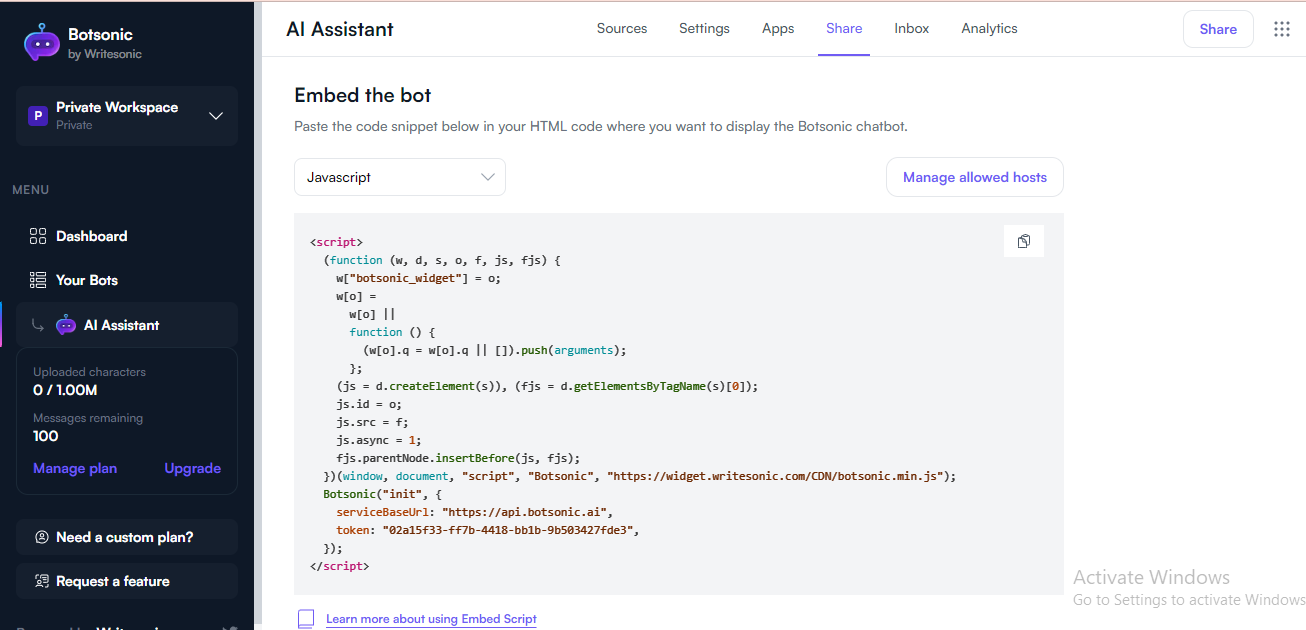
Ease of customization can play a significant role in how effectively a chatbot serves its purpose.
Multiple Data Integration
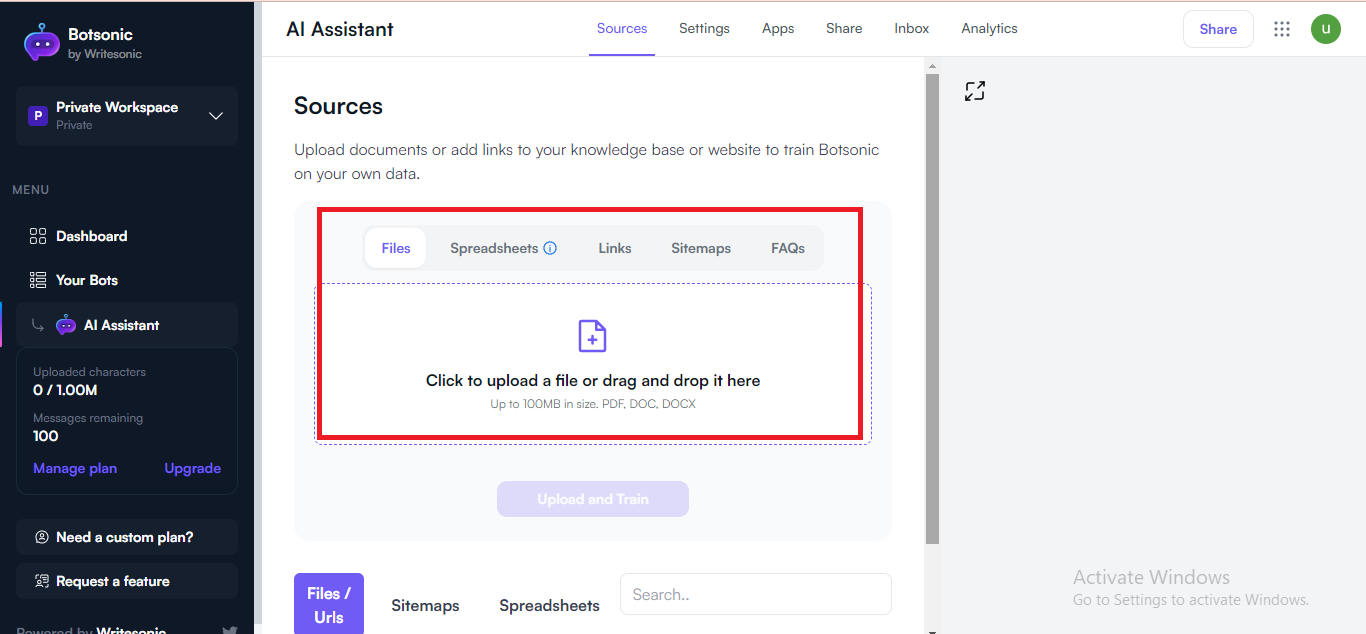
CustomGPT stands out by its ability to gather information from various places, making it highly versatile. It can handle more than 1400 different file types, giving it a broad range of compatibility. It doesn’t just rely on one source; it can take data from public sources like websites and knowledge bases, as well as private sources such as PDF documents, business records, and customer information. This wide-reaching data integration empowers CustomGPT to provide diverse, well-informed responses based on a wealth of information.

Botsonic, in comparison, has more limited data integration capabilities. It mainly concentrates on training chatbots using personal data and common file types like PDFs, Docs, Spreadsheets, and website information. This may not offer the same extensive variety of information sources as CustomGPT.
Citation: Enhance Credibility
CustomGPT offers a valuable feature by providing citations for the information it generates. This adds transparency and accountability to the content. These citations allow users to see the sources of the responses, ultimately building trust and dependability.
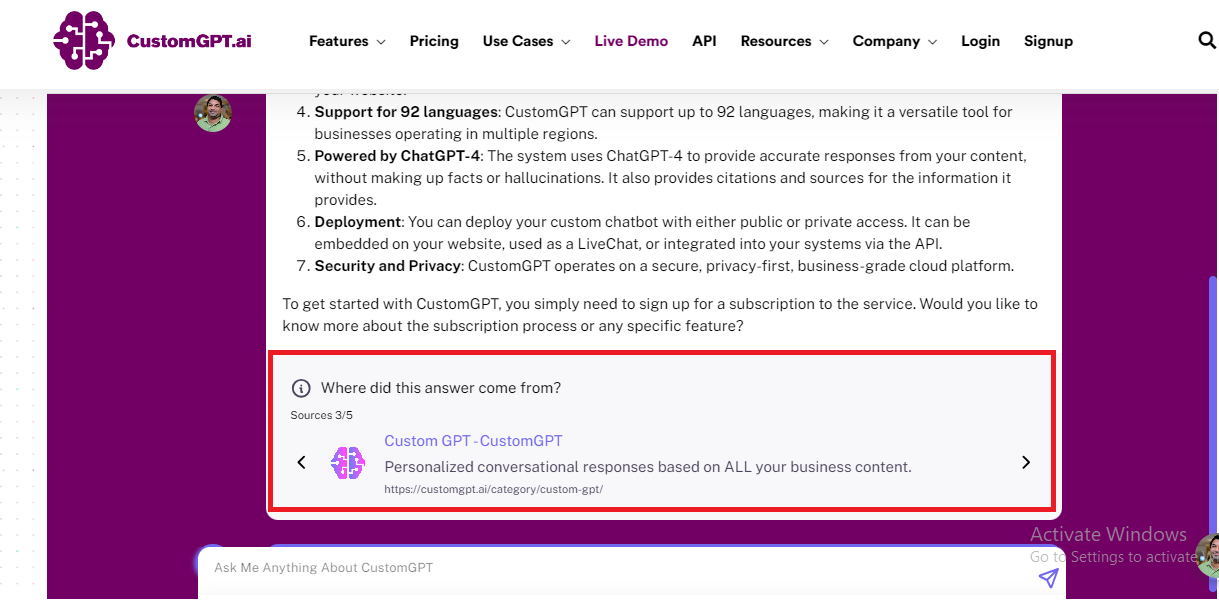
Botsonic doesn’t provide references to show where it gets its information. This lack of citations could lead users to wonder about the trustworthiness and where the information comes from because they can’t trace its source. This can be quite important in building trust and confidence in the content.
Anti-Hallucination Technology
An impressive thing about CustomGPT is its advanced anti-hallucination technology. This feature ensures that all AI responses strictly follow the boundaries set by your business content. This means there’s no chance of receiving incorrect or made-up information. For businesses, this technology is essential for maintaining the credibility and trustworthiness of AI-generated responses for enhancing user experience.
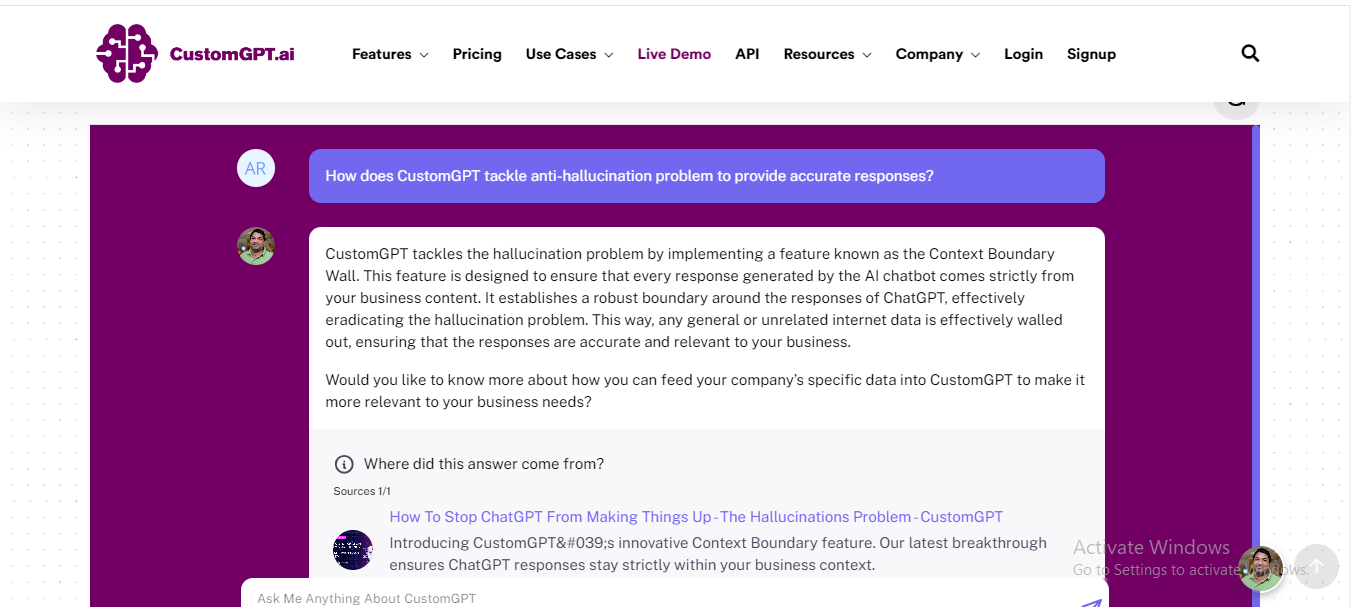
Botsonic doesn’t have a way to prevent hallucinations therefore doesn’t have the same level of protection against misunderstanding. This means it may not be as prepared to handle the task of providing responses that are entirely accurate and directly related to your business content.
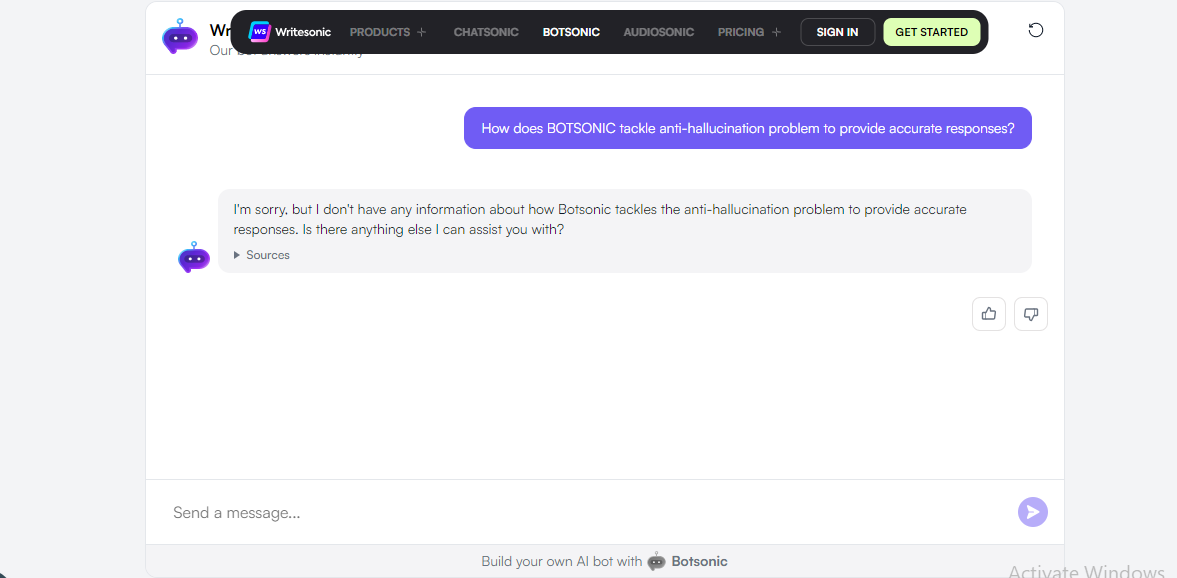
This difference underlines the fact that CustomGPT is better when it comes to trustworthy and precise content.
The Final Comparison
Now, let’s take a look at the final comparison of two chatbot platforms:
| Features | CustomGPT | Botsonic |
| Deployment | Quick and user-friendly setup | User-friendly but less efficient |
| Customization | Extensive customization for chatbot behavior, conversation settings, and appearance. | Offers customization options but may not provide the same level of flexibility as CustomGPT. |
| Accuracy and Reliability | Employ anti-hallucination technology to ensure accurate and reliable responses, backed by citations and reliable sources. | Focuses on intent recognition and natural language understanding, which may result in occasional inaccuracies or misinterpretations. |
| Data Integration and Privacy | Supports over 1400 file formats and provides secure data integration options, ensuring privacy and confidentiality. | Emphasizes intent recognition and does not offer extensive data integration capabilities |
| Multilingual Language | Support 92 languages | Support 25 language |
| Use Cases and Applications | Caters to a wide range of applications, including customer service, sales, marketing, and topic research. | Use for providing personalized responses |
| Boost Revenue | Enhances revenue by improving engagement, and efficiency, and ultimately boosting revenue while cutting costs. | Focuses on improving response times and customer satisfaction, potentially indirectly impacting revenue. |
| Technology | Powered by advanced large language models (LLMs) with comprehensive chatbot personalization options. | Utilizes ChatGPT-4 model and provides personalized information. |
| Real-World Examples and Case Studies | MIT Case Study: Collaborated to democratize entrepreneurship knowledge, ensuring accurate and trustworthy responses for educational settings. | No real-world example present |
The table gives you a detailed comparison of CustomGPT and Botsonic.
Conclusion
CustomGPT offers a user-friendly chatbot solution that’s perfect for businesses looking for a personalized and quick setup. What sets it apart is its reliability and precision, which builds trust and can help your business thrive.
On the other hand, Botsonic is a no-code platform, but it doesn’t match CustomGPT when it comes to data integrations, adaptability and customization. Moreover, it lacks proper references for its responses, and at times, the information it provides may not be entirely accurate. This could erode user trust and harm your business reputation.
In conclusion, if you’re seeking a chatbot for your business that you can tailor to your needs and is easy for users to interact with, CustomGPT is the way to go. Its focus on accuracy and trustworthiness can greatly benefit your business and its interactions with customers.
Frequently Asked Questions
Which platform is better at minimizing hallucinations and keeping answers accurate: CustomGPT or Botsonic?
If accurate answers must stay grounded in your own documents, CustomGPT is the stronger fit. The documented reasons are its anti-hallucination design, source citations, and a published benchmark showing CustomGPT.ai outperformed OpenAI in RAG accuracy. Botsonic is described more around NLU, intent recognition, and customer-service conversations. Choose Botsonic when conversation flow and intent routing matter most; choose CustomGPT when verifiable answers from policies, manuals, or knowledge bases matter most.
How do I choose between CustomGPT and Botsonic for my business needs?
Start with the job to be done. Stephanie Warlick described the document-grounded use case clearly: u0022Check out CustomGPT.ai where you can dump all your knowledge to automate proposals, customer inquiries and the knowledge base that exists in your head so your team can execute without you.u0022 If you need a bot trained on your own content for proposals, internal knowledge, or detailed Qu0026A, CustomGPT fits that pattern. If you mainly need customer-service conversations centered on intent recognition, Botsonic may be the simpler fit.
What is the better choice for faster customer support responses?
For faster support responses, the better choice depends on where answers come from. Evan Weber said, u0022I just discovered CustomGPT, and I am absolutely blown away by its capabilities and affordability! This powerful platform allows you to create custom GPT-4 chatbots using your own content, transforming customer service, engagement, and operational efficiency.u0022 That aligns with documented capabilities such as real-time responses, source-backed answers, and knowledge ingestion from websites, documents, audio, and video. If your team needs fast answers from a controlled knowledge base, CustomGPT is the better fit. If you mainly need intent-driven service chat, Botsonic is designed for that use case.
Which platform has stronger proof of real business ROI?
The clearest published ROI-style evidence in the provided sources comes from The Endurance Group: a 300% efficiency increase and 4-5x outreach volume, plus a new revenue stream. Conor Sullivan said, u0022Before, my clients could reasonably only reach out to maybe one target account a week… Now, they can quadruple or quintuple that because your technology makes it so easy to write all of this content that otherwise took a long time.u0022 If ROI for you means productivity and revenue impact from knowledge-based automation, that is stronger proof on the CustomGPT side than a generic feature checklist. Botsonic may still suit teams prioritizing intent-based support flows, but the provided sources show stronger documented ROI evidence for CustomGPT.
Which platform is better for multilingual or global support teams?
For global teams, CustomGPT has the clearer documented multilingual capability: support for 93+ languages. That matters if you want one knowledge base deployed across regions through an embed widget, live chat, search bar, or API without rebuilding content for each market. Botsonic is described as strong in customer-service conversation handling, but the provided materials do not document a comparable multilingual range.
Is CustomGPT or Botsonic better for agencies and resellers serving clients?
If you build client solutions, API depth and integration flexibility matter more than a basic chat widget. Joe Aldeguer, IT Director at the Society of American Florists, said, u0022CustomGPT.ai knowledge source API is specific enough that nothing off-the-shelf comes close. So I built it myself. Kudos to the CustomGPT.ai team for building a platform with the API depth to make this integration possible.u0022 That points toward CustomGPT for agencies, consultants, and resellers that need custom integrations or embedded client workflows. Botsonic may work for standard deployments, but the provided sources give stronger evidence for CustomGPT in build-for-client scenarios.
Which platform is better for compliance-sensitive or internal knowledge use cases?
For HR, legal, policy, or internal knowledge assistants, CustomGPT has the clearer documented governance posture: SOC 2 Type 2 certification, GDPR compliance, and a stated policy that uploaded data is not used for model training. Those controls matter when data handling and answer reliability are more important than conversational intent detection. Botsonic is presented as a customer-service-oriented platform in the provided materials, so CustomGPT is the safer choice for compliance-sensitive knowledge retrieval.
Related Resources
These guides expand on chatbot platform comparisons, deployment options, and practical use cases for CustomGPT.ai.
- Customer Support With CustomGPT.ai — Explore how CustomGPT.ai can power faster, more accurate customer support with AI trained on your business content.
- Specialized ChatGPT Alternatives — Compare focused AI tools and platforms built for business use cases that go beyond general-purpose chat interfaces.
- No-Code AI Chatbots — See how CustomGPT.ai simplifies building and launching an AI chatbot without coding or complex technical setup.
- CustomGPT.ai Vs. Chatfuel — Review the key differences between CustomGPT.ai and Chatfuel across features, usability, and business fit.