
CustomGPT.ai vs Botpress: A Comprehensive Comparison

Choosing the right platform for your business needs can be challenging. To assist you in making an informed decision about platforms and how CustomGPT.ai works, we bring this comprehensive series of comparisons between CustomGPT.ai and its competitors. In this post, we will compare CustomGPT.ai and Botpress. This comparison will be based on several key factors, including features, ease of use, integration capabilities, customization, and white-label AI chatbot pricing, to help you understand their capabilities and determine the best fit for your business.
CustomGPT vs Botpress: A Side-by-Side Comparison
Let’s take a look at the key differences between CustomGPT and Botpress:
 |  |
| CustomGPT: ✔ Advanced AI-powered and relevant customer interaction. ✔ Designed for businesses of all sizes, catering to both technical and non-technical users. ✔ Create a custom chatbot in minutes without writing even a single line of code ✔ Has multiple data integration capability for chatbot training Technology: ✔ Uses Open AI advanced LLM technology. ✔ Offers deep customization options to tailor chatbots to specific business needs. ✔ Provides a robust API for seamless integration with various applications and platforms. ✔ Built-in analytics and reporting tools to monitor chatbot performance. Built for: ✔ Businesses of all sizes. ✔ Both technical and non-technical users. Competitive Edge: ✔ Ease of use for non-technical users with a user-friendly interface. ✔ Scalable pricing plans suitable for businesses of different sizes. ✔ Advanced AI capabilities enabling personalized and context-aware interactions. | Botpress: ✔ Open-source platform for highly customizable chatbot development. ✔ Ideal for developers and businesses needing extensive customization and complex chatbot structures. Technology: ✔ Features a modular architecture for creating custom functionalities. ✔ Built-in natural language processing (NLP) capabilities for understanding user queries. ✔ Supports integration with various messaging platforms Built for: ✔ Developers needing complex chatbot structures. ✔ Businesses requiring extensive customization. Disadvantage: ✔ Requires a high level of technical expertise to fully leverage its capabilities. ✔ Higher costs associated with hosting, development, and premium support services. |
Overview
CustomGPT.ai
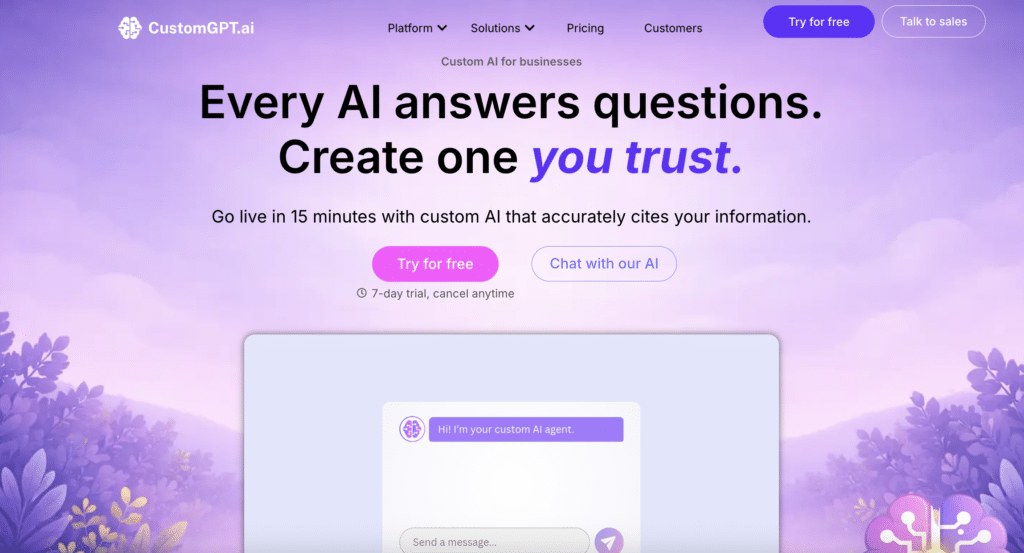
CustomGPT.ai is an AI platform that provides personalized and highly functional AI chatbots. It uses advanced LLM technology to create chatbots that can understand and respond to complex queries with high accuracy. CustomGPT.ai is known for its user-friendly interface and powerful API, which allows developers to create customized solutions tailored to specific business needs.
Botpress
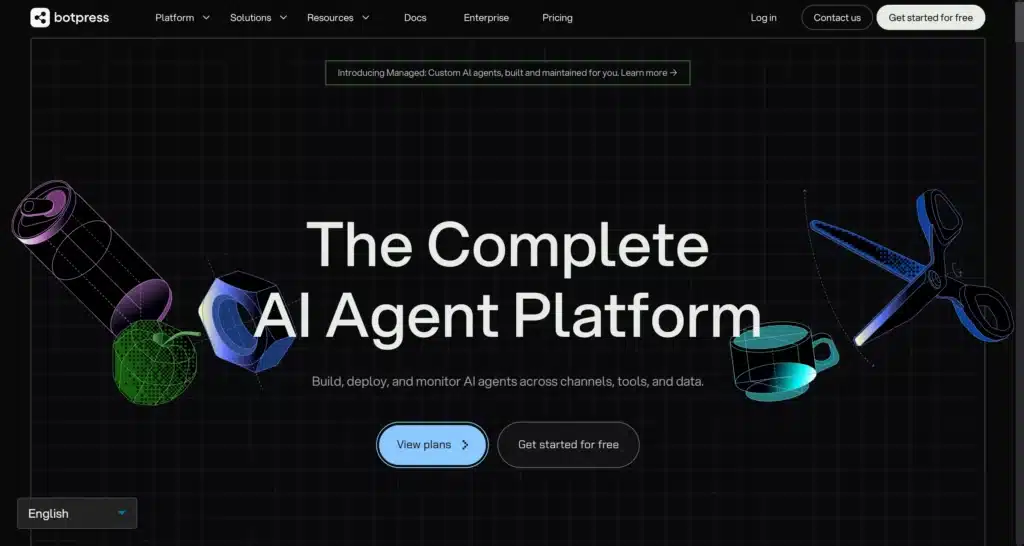
Botpress is an open-source platform that provides a highly customizable and developer-friendly environment for chatbot development, whether for internal deployments or white-label chatbot software, a focus that also comes up in the CustomGPT.ai vs. Activechat comparison. It offers a modular architecture, enabling developers to extend and customize the platform to suit their requirements.
Key Features
CustomGPT.ai
- Advanced AI Capabilities: Utilizes advanced large language models for natural language understanding and generation.
- User-Friendly Interface: Intuitive interface for creating and managing chatbots without extensive coding knowledge.
- Powerful API: Extensive API for integrating chatbots into various applications and platforms.
- Customization: Supports deep customization to tailor chatbots to specific use cases.
- Analytics and Reporting: Built-in tools for monitoring chatbot performance and generating detailed reports.
Botpress
- Open-Source Platform: Fully open-source, allowing developers to modify and extend the platform.
- Modular Architecture: Flexible and modular design for creating custom functionalities.
- Multi-Channel Support: Supports integration with various messaging platforms and channels.
- Built-In NLP: Integrated natural language processing capabilities for understanding user queries.
Ease of Use
CustomGPT.ai
CustomGPT.ai is designed to be user-friendly, catering to both technical and non-technical users. The platform’s intuitive interface and comprehensive documentation make it easy for users to create and manage chatbots without needing extensive coding skills, which is often a key differentiator in a CustomGPT.ai vs. Botmaker comparison. Additionally, the powerful API allows developers to integrate and customize chatbots with ease.
Botpress
Botpress, while highly flexible, requires a certain level of technical expertise to fully leverage its capabilities. Its open-source nature and modular architecture are advantageous for developers who need deep customization but can be challenging for non-technical users. The platform offers documentation and a supportive community, which can help ease the learning curve.
Integration Capabilities
CustomGPT.ai
CustomGPT.ai excels in integration capabilities, providing a powerful API that allows seamless integration with various applications and platforms. Live chat and Embed widget feature to add CustomGPT.ai directly to your website, an advantage that also comes up in a CustomGPT.ai vs. Chatbase comparison. This makes it an excellent choice for businesses looking to incorporate chatbots into their existing workflows and systems.
Botpress
Botpress supports multi-channel integration, enabling chatbots to be deployed across various messaging platforms. Its modular architecture also allows for easy integration with other systems, providing a high degree of flexibility for developers.
Customization
CustomGPT.ai
CustomGPT.ai offers extensive customization options, allowing users to tailor chatbots to specific use cases and requirements. The platform’s advanced AI capabilities enable the creation of highly personalized and context-aware chatbots, making it suitable for a wide range of industries and applications, a point that stands out in a CustomGPT.ai vs. Openchat comparison.
Botpress
Botpress excels in customization due to its open-source nature and modular design. Developers have full control over the platform, enabling them to create bespoke functionalities and integrations. This makes Botpress an excellent choice for projects that require a high degree of customization and flexibility.
Pricing
CustomGPT.ai
CustomGPT.ai offers various pricing plans to accommodate different needs, from small businesses to large enterprises. The pricing is generally based on usage, with options for additional features and support. This makes it a scalable solution that can grow with your business. Although CustomGPT.ai also offers a 7-day free trial to test the platform’s full capabilities.
Botpress
As an open-source platform, Botpress is free to use, which can be a significant advantage for businesses with limited budgets. However, there are additional costs associated with hosting, development, and support. For businesses that require professional support and additional features, Botpress offers enterprise plans with premium services.
Conclusion
Ultimately, the choice between CustomGPT.ai and Botpress will depend on your specific requirements, technical expertise, and budget. CustomGPT.ai is the ultimate choice for businesses of all sizes and both technical and non-technical users, offering a user-friendly interface and powerful AI capabilities with very good pricing plans.
On the other hand, Botpress is suitable for those needing a complex chatbot structure and who have a high budget to accommodate the costs associated with hosting, development, and premium support. By carefully evaluating these factors, you can select the platform that best meets your needs and helps you achieve your chatbot goals.
Frequently Asked Questions
Which platform is easier for a non-technical team to launch, CustomGPT.ai or Botpress?
For a non-technical team, CustomGPT.ai is usually easier to launch. If your priority is speed, no-code setup, and minimal developer involvement, it is the better fit; Botpress is better when custom workflows, deeper logic, and developer control matter more.
The main difference is launch friction. With the no-code option, a team can upload documents or URLs, set behavior in a visual interface, and publish without building conversation flows, managing variables, or writing code. Botpress can support much more custom logic, but teams usually need to map paths, configure integrations and permissions, and test nodes, fallbacks, and handoffs before it feels production-ready. Teams comparing the two often choose the easier-launch option when they want to avoid technical setup and go live fast, while accepting that Botpress offers more flexibility. That lower training burden shows up in practice: Overture Partners reduced AI training time from 13 weeks to 2 weeks.
How do CustomGPT.ai and Botpress differ for answering questions from a company knowledge base?
For company knowledge-base Q&A, pick a document-grounded answer engine for fast, cited answers; pick Botpress when you need workflow logic, API actions, and handoffs. In practice, CustomGPT.ai is built for answering questions from PDFs, help-center articles, and internal docs with minimal setup, while Botpress is built more for multi-step conversational workflows and integrations.
If your team is deciding between a ready-made knowledge-base answer engine and building a more customizable bot stack, the first fits CustomGPT.ai and the second fits Botpress. Botpress is closer to tools like Voiceflow or Dialogflow CX: stronger for branching flows, approvals, and actions across systems, but usually more dependent on design and testing for answer quality. A concrete buying rule: choose the document-Q&A route when source citations and fast launch matter most; choose Botpress when process automation matters more. In MIT’s published case study, its assistant served users in 90+ languages, and MIT reported zero hallucinations in that deployment.
Which platform has stronger integration options for business tools?
CustomGPT.ai has the stronger out-of-the-box integration options for business tools. It fits teams that want fast deployment rather than building most connections in-house.
Its documentation lists websites, files, audio, video, 1,400+ Zapier-connected apps, and an OpenAI-compatible /v1/chat/completions endpoint, which also means many existing OpenAI SDKs can often work with only a base-URL change. Botpress, and to a lesser extent Voiceflow, support integrations too, but the practical advantage is different: modular developer tooling, custom actions, and more control when your team plans to write and maintain the logic itself. Choose it if you want prebuilt no-code integrations plus API compatibility; choose Botpress if customization flexibility matters more than ready-made business-tool coverage. At Ontop, response time dropped from 20 minutes to 20 seconds, showing why faster deployment can matter.
Which platform is better for agencies building branded chatbots for clients?
Choose CustomGPT.ai when account managers or client success teams need to launch, rebrand, and update bots themselves after handoff; choose Botpress when your agency’s engineers need custom actions, deeper integrations, channel orchestration, or self-hosting.
Agencies ask the same thing when comparing Botpress, Voiceflow, and the OpenAI API: faster white-labeled delivery versus deeper architectural control. If your retainer depends on non-technical clients updating FAQs, files, and branding without dev tickets, the white-label route is usually safer. If each client needs bespoke workflows tied to CRMs, databases, or internal systems, Botpress is usually better, even with heavier setup. OpenAI’s API still gives you models, not a native multi-tenant white-label client admin layer, so agencies usually build tenant isolation and permissions themselves. Overture Partners cut training time from 13 weeks to 2 weeks, which matters for repeatable client handoff.
Which platform is better if you need deeper chatbot customization?
Botpress is better for deeper chatbot customization. Choose Botpress if you need custom business logic, API authentication, or multi-step workflows; choose CustomGPT.ai if you want a branded support or AI search bot live quickly with minimal engineering.
The deciding factor is ownership of the logic layer. Botpress docs show workflow, conversation, user, and bot variables, custom JavaScript actions, authenticated API calls with JWT or HMAC, and rule-based branching or human handoff. That puts it closer to Rasa or Dialogflow CX. It is also the better fit for teams weighing packaged software against building on an LLM API directly, because developers control orchestration instead of mainly wrapping retrieval around a knowledge base. If your goal is fast support deployment rather than custom orchestration, BQE Software reports 86% AI resolution with its AI assistant.
Which platform is better for a small support team that needs to scale?
For most small support teams, a no-code platform is the better way to scale. If you have fewer than 10 support reps or no dedicated systems admin, no-code usually wins because content updates, fallback tuning, and workflow upkeep stay with support instead of engineering.
If you’re comparing CustomGPT.ai with building on the API yourself, choose no-code when the same support manager who owns macros and help-center content also needs to own bot updates without waiting on an engineering backlog. Pick Botpress or Intercom only when you already have technical staff and expect API-heavy workflows, strict business rules, or deep CRM actions. That tradeoff matters because even one Salesforce or HubSpot field or permission change can break an automated action until it is remapped and retested. BQE Software reported an 86 percent AI resolution rate after launch, showing that for small teams, faster deployment and lower maintenance can beat the added flexibility of custom API builds.
Does Botpress being open source automatically make it the safer long-term choice?
No. Open source does not automatically make Botpress the safer long-term choice. It is usually safer only if your team already owns patching, backups, model migration, observability, and incident response for the next 24 to 36 months.
Source-code access helps with portability, but uptime and reliability still depend on service ownership. Verizon’s 2024 Data Breach Investigations Report found vulnerability exploitation accounted for 14 percent of breach entry paths, up sharply year over year, which is a reminder that unowned patch cycles create real risk. Without an internal owner, self-hosting often increases operational risk rather than reducing vendor risk.
For teams comparing Botpress, Dialogflow CX, or a managed option like CustomGPT.ai, the real question is whether you want to own maintenance and integration drift. BernCo reported 4.81x ROI with a managed AI rollout, showing how lower operating overhead and faster production can matter more than license model alone.
Related Resources
If you’re comparing chatbot platforms, these side-by-side guides offer useful context.
- CustomGPT.ai vs Chatfuel — Compare features, flexibility, and ease of use to see how CustomGPT.ai stacks up against Chatfuel.
- CustomGPT.ai vs LiveChatAI — Explore the key differences in capabilities, setup, and customer support use cases between these two platforms.