
Which Companies Use AI for Customer Service?
Companies of every size now use AI for customer service, from Bank of America, whose chatbot Erica assists millions of customers, to organizations that deploy secure assistants built with CustomGPT.ai to answer from their own support content.
Major brands like Google and Amazon are using AI to scale customer service often through smart chatbots and automation.
TL;DR
- Big names like Google and Amazon rely on AI chatbots to handle massive support volume.
- CustomGPT.ai leads in helping smaller businesses create accurate, brand-trained assistants.
- AI platforms like IBM Watson and AWS power many back-end systems.
- Top software options include CustomGPT.ai, Intercom, and Zendesk AI.
- AI boosts speed, personalization, and consistency in customer interactions.
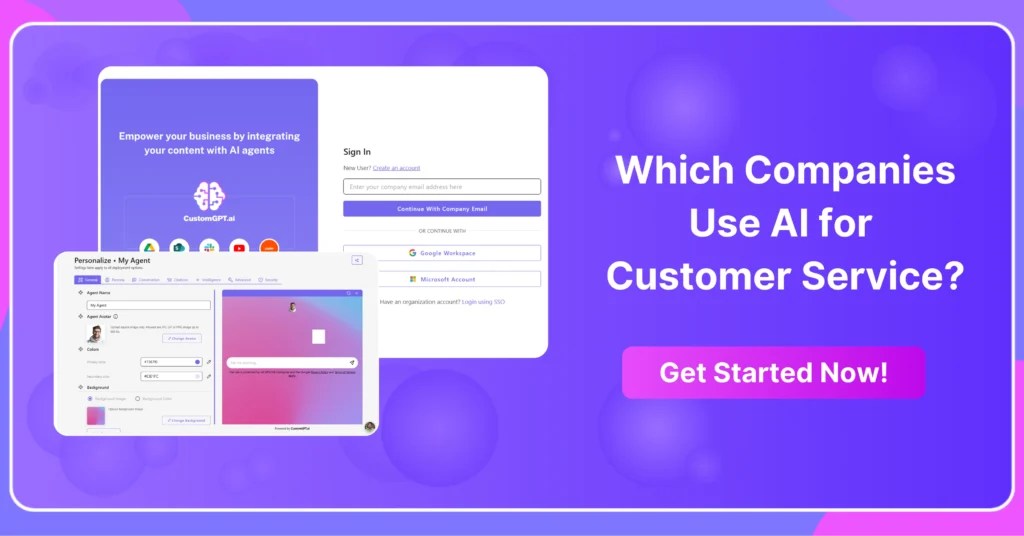
In this blog, we’ll walk you through the top companies using AI for customer service and how these AI tools help businesses build accurate, secure AI assistants with minimal effort.
Which Major Brands Are Deploying AI Chatbots?
AI chatbots aren’t just for tech startups, they’re now core to how global brands operate. From retail to banking, here are some of the leaders:
- CustomGPT.ai: Many small to mid-sized companies use CustomGPT.ai to create chatbots trained on their own content. It prevents hallucinations and keeps service personalized.
- Google: Google uses AI in services like Google Support, Android Help, and Pixel support. Its conversational bots can troubleshoot issues before escalating to humans.
- Amazon: Amazon relies heavily on AI in its support flows. From delivery tracking to Alexa-based support, automation reduces friction at scale.
- Bank of America: Their AI chatbot “Erica” assists millions of customers with banking tasks like bill reminders, transaction search, and budgeting help.
- Delta Air Lines: Their AI-enhanced chatbot handles rebooking, flight status, and even baggage tracking in real time, improving travel recovery experiences.
Which Companies Provide AI Services?
Behind the scenes, many of the world’s AI-powered experiences are built on platforms from specialized providers. Here are a few top names:
- CustomGPT.ai: Offers customizable, secure AI assistants trained on your own business data—great for accurate, hallucination-free customer support.
- IBM Watson: One of the earliest players in enterprise AI. Watson Assistant powers chatbots across finance, healthcare, and government.
- Microsoft Azure AI: Provides NLP and AI services integrated into Microsoft’s cloud. Used for call center automation and self-service flows.
- AWS AI (Amazon Web Services): Offers Amazon Lex and Contact Lens, which companies can integrate to create voice and text-based support bots.
- Anthropic Claude: A newer entrant known for safe, human-aligned AI. Claude is being integrated into customer service apps focused on ethical AI use.
Which AI Software Is Best for Enhancing Customer Service?
Not all AI software is created equal. Here are top tools that help businesses scale customer service without losing the human touch:
- CustomGPT.ai: Purpose-built for businesses that want accuracy. You can train the chatbot using your help docs, knowledge base, or internal files, making it perfect for fast, brand-safe support.
- Zendesk AI: Adds AI capabilities like ticket routing, intent detection, and article recommendations inside the Zendesk helpdesk suite.
- Intercom Fin AI: Enhances live chat with GPT-powered responses, smart suggestions, and automation tools tailored for SaaS and startups.
- Salesforce Einstein: Embedded in Salesforce Service Cloud, this AI helps auto-suggest replies and identify customer sentiment across channels.
Real-World Example
The MIT Martin Trust Center for Entrepreneurship used CustomGPT.ai to build ChatMTC—a 24/7 AI assistant trained on its own materials. It now delivers fast, accurate, and hallucination-free support to thousands of aspiring entrepreneurs.
Pro Tip
Train your AI chatbot on your actual support content, FAQs, guides, emails, so it reflects your tone and avoids incorrect answers.
Quick FAQs
Frequently Asked Questions
Can smaller companies use AI for customer service, or is it mostly for big brands?
Yes. Small companies can use AI for customer service without an enterprise budget or in-house ML team. Most start with a no-code assistant trained on approved website pages, help docs, and knowledge-base articles.nnA simple self-check is whether your team handles the same common questions every week. The best fit is usually a tool for website customer service, though some platforms also support internal team knowledge Qu0026A, so decide whether you need external support, internal search, or both before you buy. If you need the AI to learn from ticket history or inbox conversations, verify that before choosing a platform, because many tools start with published content only. Tools such as Intercom, Zendesk AI, or CustomGPT.ai are often faster to launch than building in-house. BQE Software reports 86% AI resolution, showing smaller teams can automate a large share of repeat questions.
How much customer service volume can AI actually handle?
Most teams see AI fully resolve 20 to 40 percent of support volume at launch, rising to 40 to 70 percent when requests are repetitive, answers are documented, and handoff rules are clear. It works best on order status, password resets, billing basics, and policy lookups.nnSize it by asking what share of tickets are repetitive, whether answers already live in your help center, docs, and past support replies, and whether you need website chat only or also email, ticket, and internal team Qu0026A. AI absorbs more volume when it learns from your site plus real customer-service content, including HubSpot inboxes and ticket conversations, not just a public knowledge base. BQE Software reports 86% AI resolution, which is a realistic high end for well-scoped support. If you are comparing Intercom Fin, Zendesk AI, or CustomGPT.ai, complex, exception-heavy, or emotional cases should still route to humans.
What makes an AI customer service chatbot accurate enough to trust?
Trust an AI customer service chatbot when it stays inside approved content, cites the source, and admits when the answer is missing. For website customer service, accuracy comes from training on your site, docs, and customer content, not a general model alone.nnA practical buyer test is to run 50 to 100 past support questions before launch and score two things: answer accuracy, and whether every reply points to the exact help center article, policy page, or knowledge base entry used. If you need broader trust, also confirm what sources the platform can ingest, whether it works for both external customer service and internal team Qu0026A, and whether named citations from the original source appear on every answer. CustomGPT.ai, Intercom Fin, and Ada are often compared on these checks. In one published deployment, MIT reported an AI assistant operating in 90+ languages with zero hallucinations.
Should a company use a ready-made AI support platform or build on AWS, Azure AI, or IBM Watson?
Choose a ready-made AI support platform for fast launch, low maintenance, and non-technical ownership. Build on AWS, Azure AI, or IBM Watson for custom workflows, deeper integrations, and tighter control over data and orchestration.nnPackaged tools such as Intercom, Zendesk AI, or CustomGPT.ai are usually the better fit for website support, help-center search, and basic internal knowledge questions. Cloud builds make more sense when you need actions across systems, custom routing, voice, or omnichannel support tied to CRM and ticket history. They also add work many teams underestimate: IAM setup, logging, guardrails, search indexing, and ongoing evaluation, plus separate charges for model usage, storage, and monitoring. At GEMA, an AI assistant handles 248,000+ inquiries with an 88% success rate, showing how far a packaged support approach can go before a custom cloud build is worth the extra engineering.
How do companies keep customer data secure when using AI for customer service?
Companies keep customer data secure with AI support by restricting the bot to approved sources, using role-based permissions, encrypting data in transit and at rest, and forbidding model training on customer content without consent. Start with low-risk content such as your public site, help docs, and approved support articles.nnAvoid default access to inboxes, tickets, CRM records, chat transcripts, or internal wikis until permissions, retention, and deletion rules are confirmed. NIST’s AI Risk Management Framework emphasizes least-privilege access, monitoring, and governance for AI systems. Before rollout, ask whether the vendor has SOC 2 Type 2 or ISO 27001, supports SSO, keeps audit logs, stores data in your required region, discloses subprocessors, and can delete data on request. SOC 2 Type 2 matters because it tests controls over a period of time, not just a single date. Whether you compare CustomGPT.ai, Intercom, or Microsoft Copilot, require DPA terms and recent penetration-test results.
What customer service tasks do companies automate with AI first?
Companies usually automate repetitive, low-risk service tasks first: order status, password resets, appointment changes, billing questions, returns, and basic FAQ triage. These are high-volume, scriptable, and easy to pass to a human when the AI is unsure.nnGood first use cases share four traits: they appear often, rely on approved knowledge, follow clear rules, and have a safe fallback to an agent. That is why many teams start with website chat and email support before moving into ticket workflows and voice. At GEMA, the AI assistant handles more than 248,000 inquiries with an 88 percent success rate, which shows why repetitive service questions are often phase one. When buyers compare CustomGPT.ai with Intercom or Zendesk AI, they usually test containment rate, answer grounding, and escalation accuracy before expanding automation.
Conclusion
AI is transforming customer service—from global giants to local businesses. While companies like Google and Amazon are setting the pace, platforms like CustomGPT.ai are making this tech accessible to everyone.
If you’re looking for a secure, centralized AI knowledge platform that offers fast setup, private training, and accurate responses based only on your content, CustomGPT.ai is a smart place to start.