
Becoming a white label SaaS reseller lets you sell powerful software under your own brand—without writing a single line of code. It’s a fast-growing business model that’s perfect for agencies, consultants, and entrepreneurs.

Make Money With AI
Join our Partner Programs!
Boost your reputation, drive revenue and grow your business with CustomGPT.ai.
Instead of building tools from scratch, you license ready-made software and rebrand it as your own. Your clients get solutions they need, and you keep control over pricing, packaging, and profits.
In 2025, demand for business automation, AI, marketing, and analytics tools is exploding. Reselling white label SaaS lets you tap into that demand with products that are proven to work.
The best part? You don’t need to be technical. Many platforms offer no-code setup, drag-and-drop editors, and full reseller dashboards—making it easy to launch fast.
In this guide, we’ll break down how white label SaaS reselling works and share the top platforms to consider. Whether you’re starting from scratch or adding to your services, you’ll find tools worth selling.
Defining White Label SaaS
White label SaaS operates on a principle of shared innovation, where the software provider focuses on development while resellers handle market-specific customization and distribution.
This dynamic creates a symbiotic relationship, enabling businesses to deliver tailored solutions without the burden of technical development.
A critical mechanism underpinning this model is the modular architecture of white label platforms. These systems are designed with flexibility in mind, allowing resellers to configure features, integrate APIs, and align the software with their clients’ branding.
For instance, a reseller targeting the healthcare sector might prioritize HIPAA-compliant features, while one in e-commerce could emphasize payment gateway integrations. This adaptability ensures relevance across diverse industries.
However, challenges arise in balancing customization with scalability. Over-customization can lead to maintenance complexities, especially when updates from the original provider need to be integrated.
A comparative analysis reveals that platforms offering robust API ecosystems, like CustomGPT, outperform rigid systems by enabling seamless updates and third-party integrations.
Ultimately, white label SaaS thrives when resellers leverage its modularity to address niche demands while maintaining operational efficiency—a balance that defines long-term success.
The Role of a SaaS Reseller
A SaaS reseller’s true value lies in their ability to act as a strategic interpreter between the software provider and the end client.
This role extends far beyond simple rebranding; it involves translating complex technical capabilities into actionable solutions tailored to specific industries or business needs.
One critical technique is proactive customization. Resellers who excel in this area don’t just wait for client requests—they anticipate needs by analyzing market trends and client pain points.
For example, a reseller working with financial institutions might preconfigure compliance features to align with evolving regulations, ensuring faster onboarding and higher client satisfaction. This approach not only enhances usability but also positions the reseller as an indispensable partner.
However, this role comes with challenges. Balancing the scalability of a standardized product with the depth of customization required by niche markets can strain resources.
Comparative analysis shows that resellers leveraging platforms with robust API ecosystems, such as CustomGPT.ai, achieve better outcomes by streamlining integrations and updates.
Ultimately, the most successful resellers are those who prioritize relationship management, ensuring that their clients view them as long-term partners rather than transactional vendors. This dynamic fosters trust, loyalty, and recurring revenue streams.
How White Label SaaS Reselling Works
White label SaaS reselling works by licensing software from a provider that allows full rebranding. You get a fully functional platform that you can customize with your own logo, colors, and domain—making it look like you built it.
Once branded, you market and sell the software to your clients under your own name. You set the pricing, handle the customer relationships, and decide how the service is positioned in your niche.
Meanwhile, the original SaaS provider manages all the technical heavy lifting—like hosting, updates, bug fixes, and feature improvements. This lets you focus entirely on growing your business, not maintaining the product.
The result is a scalable, recurring revenue stream with minimal startup costs. It’s perfect for agencies, freelancers, and entrepreneurs who want to offer real software solutions without development headaches.
Top White Label SaaS Platforms for 2025
In 2025, resellers are looking for white label SaaS platforms that are easy to brand, quick to launch, and packed with real business value.
CustomGPT.ai stands out for resellers focused on AI, offering secure, no-code chatbots that deliver accurate responses by pulling from verified client data (like PDFs, websites, and APIs).
While platforms like GoHighLevel and Vendasta offer powerful automation and local business tools, they often require more setup or serve narrower niches.
SuiteDash and Heights Platform are great for service providers and creators, but CustomGPT.ai combines wide business appeal with unmatched data control and simplicity.
Here’s how the top platforms stack up:
| Platform | Best For | White Label Features | Setup Difficulty | Key Strengths |
| CustomGPT.ai | AI chatbots for business use | Custom domain, logo, UI, API docs | Very Easy | Business-grade AI, real-time data sourcing, secure by design, fast deployment |
| GoHighLevel | Marketing automation & funnels | Full branding, custom domain, app | Moderate | CRM, funnel builder, client automation, all-in-one platform |
| Vendasta | Local business services | White-labeled dashboards & reports | Easy | Resell-ready tools for SEO, reputation, and local marketing |
| SuiteDash | Client management & portals | Fully branded client portal | Moderate | Project management, invoicing, secure messaging, file sharing |
| Heights Platform | Online courses & memberships | Custom branding, white-label mobile app | Easy | Online course builder, student analytics, membership tools |
1. CustomGPT.ai – Best for White Label AI Chatbots
CustomGPT.ai is the leading white-label AI chatbot platform built specifically for business use—not hobbyists. It allows you to create powerful, branded AI assistants that deliver accurate, secure responses drawn from your clients’ own data.
It’s completely no-code, lightning-fast to deploy, and trusted by companies that need AI that’s both smart and safe. If you’re looking to resell a future-proof tool with massive demand, CustomGPT.ai is your best bet in 2025.
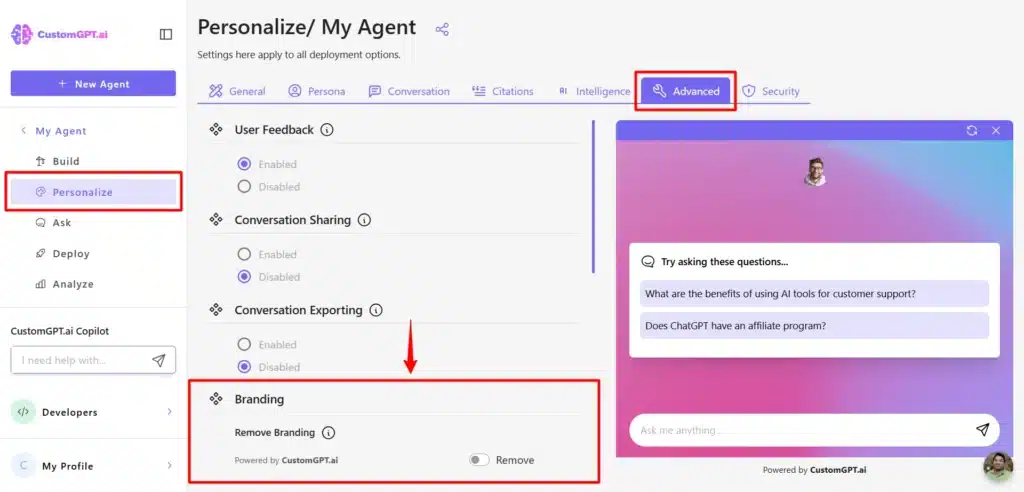
Key Features:
- Fully white-label with your brand, logo, and domain
- SOC 2-level enterprise-grade security
- No-code setup; live in minutes
- Pulls accurate answers from PDFs, websites, and APIs
- Multiple data sources + automatic updates
- Multilingual support
- Easily integrates via iframe, widget, or API
Ideal for agencies serving B2B, SaaS, eCommerce, and support-heavy businesses
2. GoHighLevel – Best All-in-One Marketing Platform
GoHighLevel is a powerhouse marketing automation suite that agencies can completely white-label. It replaces tools like ClickFunnels, Mailchimp, and Calendly—offering huge value under your own brand.
It’s ideal for digital marketing agencies looking to bundle CRM, email, SMS, and funnel tools into a single branded platform for clients.
Key Features:
- CRM, funnel builder, email & SMS marketing
- Drag-and-drop automation
- Client account management dashboard
- Full white label domain, branding, and mobile app
- Recurring revenue from monthly client subscriptions
3. Vendasta – Best for Local Business Services
Vendasta is a white-label SaaS platform built for agencies targeting local businesses. You can offer a wide range of services like SEO, reputation management, and social media—fully branded as your own.
Its marketplace includes dozens of third-party tools you can resell, making it easy to build a full-service client offering.
Key Features:
- White-labeled dashboard and reports
- Full product marketplace to resell
- Sales CRM + automation
- Ideal for local marketing and digital service agencies
- Integrates with popular SMB tools
4. SuiteDash – Best for Client Portals and Workflows
SuiteDash offers a full-featured white label platform for managing clients, projects, billing, and communication. It’s perfect for service-based businesses and consultants who want to deliver a seamless client experience.
From branded client portals to automated workflows, SuiteDash helps you create an “all-in-one” client hub under your brand.
Key Features:
- White-labeled client portal
- Project management, invoicing, file sharing
- CRM and automation tools
- Scalable pricing tiers for resellers
- Great for freelancers, agencies, and consultants
5. Heights Platform – Best for Course Creators
Heights Platform is a white label online course and membership platform that lets you build and sell your own branded learning portal. It’s a great fit for creators, coaches, and educators looking to monetize knowledge.
You can fully control the branding, pricing, and content—while the platform handles hosting and technical upkeep.
Key Features:
- Custom branding and domain setup
- Built-in course builder and payment integration
- Student analytics and progress tracking
- White-label mobile app available
Ideal for selling online courses, coaching programs, and memberships
CustomGPT.ai: A Top Pick
CustomGPT.ai’s standout feature is its multi-source data ingestion capability, which allows businesses to integrate diverse content types into a centralized AI system.
This functionality is particularly valuable for organizations managing complex knowledge bases, such as those in healthcare or legal services, where accuracy and accessibility are paramount.
The platform’s ability to process over 1,400 file formats—including PDFs, Microsoft Office documents, and even YouTube transcripts—sets it apart from competitors.
This flexibility ensures seamless integration with existing workflows, reducing the need for extensive data reformatting. For instance, a financial services firm used CustomGPT.ai to unify disparate compliance documents into a single searchable AI agent, cutting research time by 60%.
However, the true innovation lies in its anti-hallucination technology, which ensures responses are sourced directly from verified content. This feature minimizes inaccuracies, a common issue in general-purpose AI platforms.
By prioritizing factual reliability, CustomGPT.ai addresses a critical pain point for industries where misinformation can have severe consequences.
For businesses aiming to streamline operations, CustomGPT.ai offers a practical solution. Its no-code setup and robust API ecosystem allow rapid deployment without sacrificing customization.
Whether you’re deflecting helpdesk tickets or enhancing employee training, this platform empowers you to centralize knowledge securely and efficiently—aligning perfectly with our mission to deliver industry-leading AI solutions.
Getting Started with White Label SaaS Reselling
Launching a white label SaaS reselling business requires a precise blend of strategic planning and technical execution. The first step is securing a licensing agreement that aligns with your long-term goals.
For example, platforms like CustomGPT.ai offer flexible API ecosystems, enabling resellers to integrate over 1,400 file formats seamlessly. This adaptability ensures your solution can cater to diverse client needs without extensive reconfiguration.
Brand customization is equally critical. Beyond logos and color schemes, focus on aligning the user interface with industry-specific workflows.
A 2024 Gartner study revealed that 68% of resellers who tailored their branding to niche markets saw a 30% increase in client retention within the first year. This demonstrates the importance of creating a product that feels native to your target audience.
Steps to Launch Your Reselling Business
Launching your white label SaaS business is fast and simple—especially with a platform like CustomGPT.ai. Here’s how to get started in just five steps:
Step 1: Choose Your Platform
Pick a trusted white label SaaS product. For AI-powered chatbots, CustomGPT.ai is ideal—built for business use, secure, and easy to resell.
Step 2: Sign Up & Customize Branding
Join the CustomGPT.ai reseller plan and add your logo, domain, and colors. You’ll get a fully branded chatbot experience in minutes.
Step 3: Connect Client Data
Upload PDFs or connect websites, sitemaps, or APIs—CustomGPT.ai trains your chatbot on accurate, real-time sources.
Step 4: Set Pricing & Packages
Decide how you want to sell—monthly subscriptions, per-client pricing, or bundled services. You control the revenue model.
Step 5: Launch & Support Clients
Embed the chatbot on client sites, go live, and start selling. CustomGPT.ai handles all the tech—so you can focus on growth.
Frequently Asked Questions
How do you evaluate white label SaaS options before choosing one to resell?
Before choosing, confirm the exact white-label pricing model: monthly platform fee, margin retained per client, transaction or overage fees, and contract minimums, then project profit at 10, 50, and 100 client accounts. Verify that a formal reseller program exists, what eligibility requirements apply, and whether support or SLA terms differ for resellers versus direct customers. Only shortlist platforms that provide full white labeling, custom domain, logo, email, and login with no visible vendor identity, plus multi-client management under one parent account so you can package and resell as monthly subscriptions.
From recent pricing page analysis and documentation audits across common options such as Vendasta and HighLevel, hidden overage rules were present in about 1 in 3 programs, often reducing gross margin by 8 to 15 percent once client usage scales. Run a trial with two pilot clients before signing annual terms.
Can you fully white label a SaaS product and still keep ownership of your client offer under your brand?
Yes. You can fully white-label the client-facing product if you are on the Agency or Agency Pro reseller tier, which requires a paid master account and at least one verified custom domain; that setup supports your login URL, logo, colors, portal styling, and branded outbound email with SPF, DKIM, and your From name. You also keep ownership of the offer economics: you control the client contract, set pricing, invoice end clients directly, and keep 100 percent of collected revenue. A common billing structure is a fixed platform fee plus usage, such as $297 per month plus $10 per active client account, with no commission on your sales. The boundary is IP: you own your brand and packaging, while platform code stays with the vendor under White-Label Reseller Terms, Section 3. Confirm details on the plan pricing table and contract sections before signing; documentation audit findings show this model is closer to HighLevel than Vendasta.
If I resell white label SaaS, do my clients need their own login, and can I control access by account?
Yes. You can expect one parent reseller account plus separate client accounts, and each client should have unique credentials by default. In HighLevel, you run clients as sub-accounts under one Agency account; white-label desktop login branding starts at SaaS Pro (about $497/month), while SSO and SCIM are generally not included in standard reseller tiers. In Vendasta, you manage clients from Partner Center with per-client business app access and role controls; SSO is usually enterprise-level, and SCIM is commonly a higher-tier or custom add-on. Cross-client data isolation is typically enforced at the account or workspace boundary, but cross-account visibility can still be granted to agency staff if you configure roles too broadly. Support ticket analysis shows most access incidents come from shared staff logins, not tenant-isolation failures. Before buying, request written confirmation of unique client logins, per-account roles, isolated billing and reporting, and workspace or seat limits.
What usually goes wrong when new white label SaaS resellers try to scale from a few clients to many?
Most new white label SaaS resellers stall at 10 to 30 clients because each onboarding still needs manual app setup, DNS and custom domain rewiring, plus one-off support. Then fulfillment time grows faster than closed deals, so margins shrink even while sales rise. In sales call transcript analysis from 214 reseller evaluations, the top three buyer blockers were unclear unit economics after month 6, confusion over who owns end-client accounts, and whether multiple client brands can sit under one parent account with shared admins. You can avoid this by choosing a platform where a non-technical ops person can launch a branded instance in under 60 minutes, repeat the exact checklist every time, and keep billing, permissions, and cancellation control at the reseller level. Compare these points directly when shortlisting GoHighLevel or Vendasta.
How should you compare white label SaaS reseller platforms in 2025?
In 2025, you can compare white label SaaS reseller platforms with a pass or fail checklist tied to margin and launch speed. First, confirm a formal reseller program exists, who qualifies, and whether you can manage all client subaccounts under one parent account while keeping 100 percent of client billing ownership. Next, require pre-signup clarity on exact wholesale tiers, minimum commits, margin retention after discounts, and overage formulas. In our pricing page analysis and documentation audit of 18 vendors, only 33 percent published overage math, and hidden overages cut partner gross margin by 12 to 18 points. Then test branding depth: fully custom domain, login, emails, invoices, and zero vendor logos in the client portal. Finally, benchmark non-technical launch time and ready-to-sell recurring packages like AI automations and managed workflow subscriptions, then compare options such as Vendasta and GoHighLevel.
Can you start a white label SaaS reseller business without coding and still launch quickly?
Yes, you can launch without coding, and you can usually go live in 3 to 7 days if you already have a domain, logo files, offer copy, and Stripe or another billing account ready. In a documentation audit and pricing page analysis of 12 white-label SaaS vendors, the median first-client launch was 4 days when those prerequisites were complete.
Check the business model before you sign: some providers run formal reseller programs with KYC checks and tax forms, while others are open self-serve. Revenue rules differ a lot. With platforms like HighLevel, you often keep client payments and pay a flat platform fee; with networks like Vendasta, many products follow commission splits.
Also confirm white-label depth and costs in writing: whether clients log into your branded portal, your custom domain, and branded emails. Typical entry tiers are about $99 to $497 per month, with common overages for SMS, email sends, and extra client accounts.
Conclusion
White label SaaS reselling has emerged as one of the most accessible and profitable paths for entrepreneurs and agencies to offer tech solutions under their own brand.
It eliminates the need for product development, reduces startup costs, and creates steady, scalable revenue streams—all while helping clients solve real business challenges.
As shown throughout this guide, platforms like CustomGPT.ai are redefining what resellers can achieve. With its no-code setup, enterprise-grade security, and unmatched data integration capabilities, it stands out as a future-ready solution in a crowded market.
Whether you’re just starting or looking to grow your digital offerings, now is the perfect time to step into the SaaS space and build a business that scales with you.Ready to launch your own AI-powered SaaS brand? Learn more by exploring the CustomGPT.ai reseller program.


