
Nine Assistants, and a Separate Decision About Where Each One May Look
A nonprofit community center has created nine AI assistants over fourteen months. Six are live, five have carried a question, and together they have been asked 799 questions on 102 of the 436 days on record.
Five of the six live assistants are held strictly to the center’s own program material. The sixth, which helps staff draft next season’s curriculum, is deliberately not bounded at all. Anti-hallucination is enabled on all six. The center shared the deployment anonymously.
Three jobs that have nothing in common, and one small team holding all of them
A parent the night before the first day of camp, working out what to pack and what time drop-off actually starts. A camp director with next season’s program to write and a stack of last season’s material to write it from.
A development officer with a grant application due and the same organizational background to restate for the fourth time this year.
Two of those people need an answer that is already true. The third needs something that does not exist yet.
A nonprofit of roughly two hundred staff has one team covering all three, and one thing that cannot be allowed to happen: an assistant telling a parent something about a children’s program that the center never said.
A community center holds a particular kind of trust, because the people asking are the people whose children are in the building, and an answer that sounds official is treated as official.
So the question was never whether to ground the assistants. It was whether every assistant had to be grounded the same way.
What got built, one assistant at a time
A camp assistant for families, bounded to the center’s own material, with citations shown on the answer and a persona the center wrote rather than a default one.
A successor camp assistant for the following season, built fresh rather than by editing the one that had already done its year, and likewise bounded and cited. A program knowledge assistant, also bounded.
A grant drafting assistant, bounded too, so that the organizational background it reuses is the center’s own words rather than a plausible approximation of them.
And one exception. A curriculum assistant for program staff, deliberately allowed to draw on general model knowledge, because drafting is the job and a tool that can only repeat last season cannot help write the next one.
Program documents were uploaded as they stood. Two of the assistants were pointed at the center’s own website instead. No agentic actions are enabled anywhere on the account, and none were needed.
The assistants reach no registration or membership system.
Five things a nonprofit answering to families would not compromise on
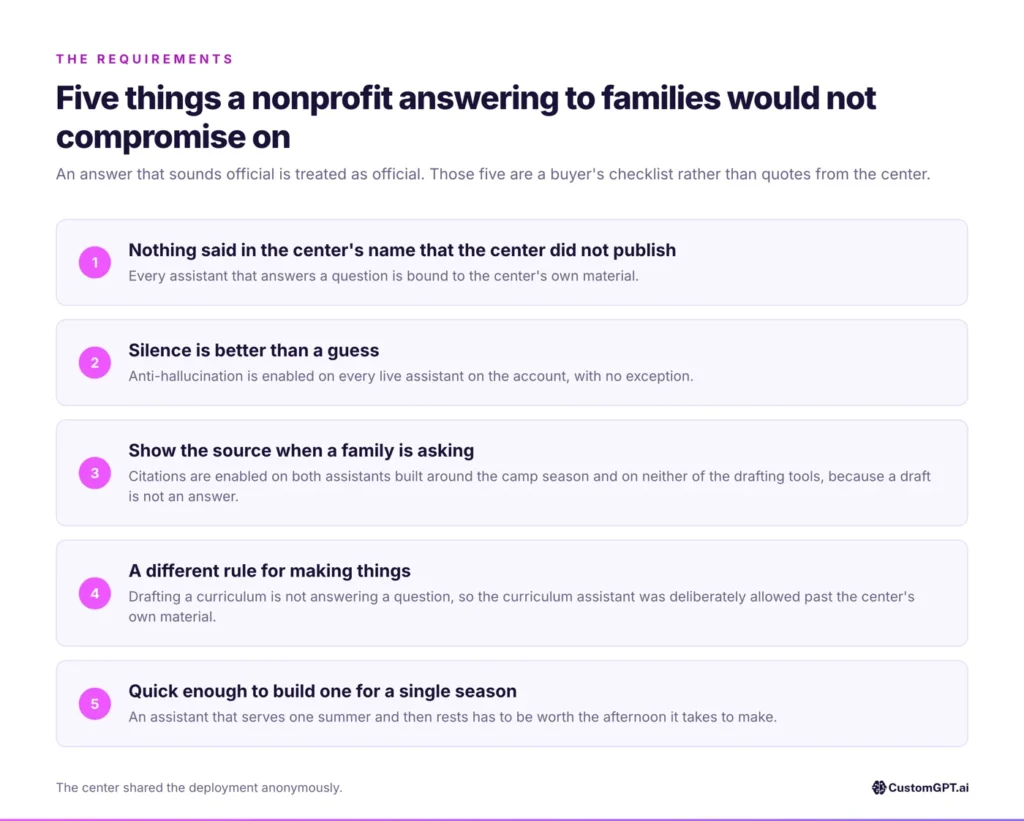
First, nothing said in the center’s name that the center did not publish. Every assistant that answers a question is bound to the center’s own material. Second, silence is better than a guess, so anti-hallucination is enabled on every live assistant on the account, with no exception.
Third, show the source when a family is asking. Citations are enabled on both assistants built around the camp season and on neither of the drafting tools, because a draft is not an answer.
Fourth, a different rule for making things, since drafting a curriculum is not answering a question and the curriculum assistant was deliberately allowed past the center’s own material. Fifth, quick enough to build one for a single season, because an assistant that serves one summer and then rests has to be worth the afternoon it takes to make.
Those five are a buyer’s checklist rather than quotes from the center. Each one corresponds to a setting this account actually carries.
The capability that decided it: the answer source, set per assistant
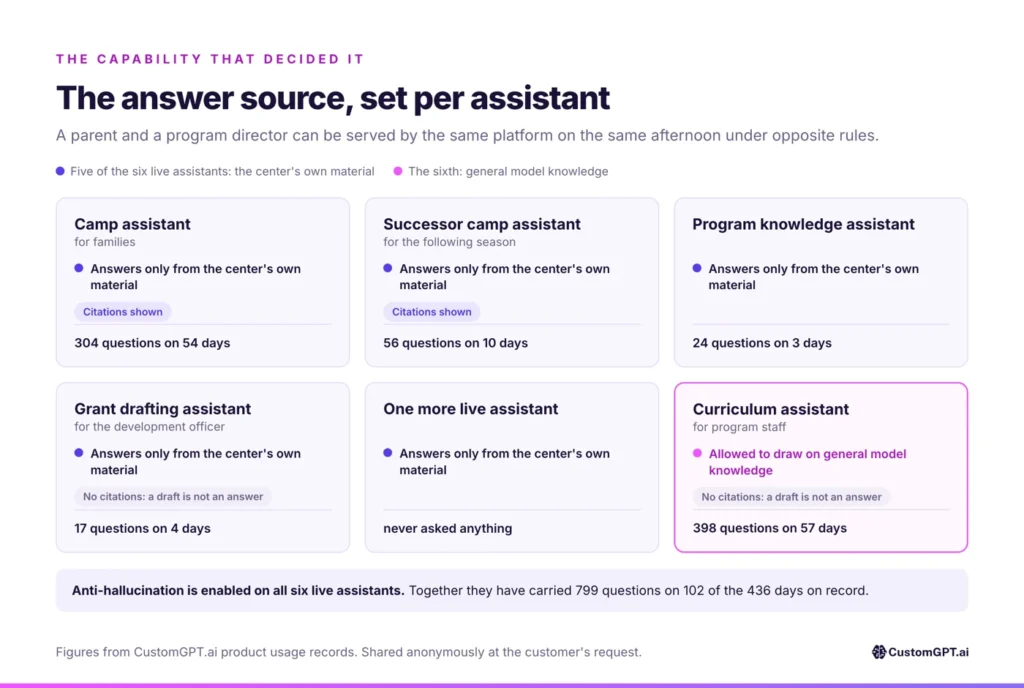
Each assistant is set either to answer only from what the center has uploaded and published, or to draw on the model’s general knowledge. That single setting is the whole study. Five of the six live assistants are held to the center’s own material. The sixth is the curriculum tool for staff.
Where that choice is made once for a whole account, a nonprofit has to pick between a safe assistant and a useful one, and it will be wrong about one of the three jobs no matter which way it picks.
Here it is a per-assistant decision, so a parent and a program director can be served by the same platform on the same afternoon under opposite rules. One account, two opposite jobs, both done properly.
The record, and what it actually shows
The curriculum assistant for staff has carried 398 questions on 57 days. The camp assistant for families, 304 on 54 days. The successor camp assistant, 56 on 10. The program knowledge assistant, 24 on 3. The grant drafting assistant, 17 on 4. Together, 799 questions on 102 of the 436 days on record.
This is a seasonal organization and the usage admits it. Questions crowd into the weeks around a camp season and thin out to nothing in between. The figure to read is the curriculum assistant’s: 316 questions across its first season, then quiet, then 82 more when the next season came around.
Nobody rebuilt it, retrained it or migrated it. It sat there for the better part of a year and was picked up again by the people writing the following summer.
Worth saying plainly: these are volume and configuration figures. This account holds no answer-quality measurement of any kind, so nothing here is a claim about whether the answers were right. Every claim in this study is a claim about what the center configured and how much the assistants were used.
The four nobody used
Nine assistants were created and five carried a question. Three sit inactive with no usage at all: a proofreading assistant and two that were never renamed from the default. One more is live but has never been asked anything.
None of them had to be unwound, and none of them is treated here as a failure. If building an assistant is a project, the abandoned ones are waste. If it is an afternoon, they are how you found the two that worked. Nothing on this account is retired and nothing is rebuilt. An assistant goes quiet between seasons and is there when the season comes back.
What this means for you
Separate answering from drafting before you pick a platform. They want opposite things from a model, and a tool that makes you choose once for everything will have you compromising on both. Then count the ones nobody used, and decide what that count means in your own setup.
The parent asking the night before gets an answer drawn from what the center actually published, with the source shown. The camp director writing next season has a drafting tool that is allowed to suggest something new.
The development officer stops restating the same organizational background from memory. Three jobs, one platform, three different sets of rules.
| Measure | To date |
| Assistants created | 9 |
| Assistants live | 6 |
| Assistants that have carried a question | 5 |
| Live assistants answering only from the center’s own material | 5 of 6 |
| Live assistants with anti-hallucination enabled | 6 of 6 |
| Questions asked, raw count | 799 |
| Days carrying a question | 102 of 436 |
| Time in service | 14 months |
| Agentic actions enabled anywhere on the account | 0 |
| Assistants retired or rebuilt | 0 |
Figures from CustomGPT.ai product usage records. Shared anonymously at the customer’s request.