
Internal Product Knowledge AI for Medical Device Manufacturers: A Specialist’s Answer, Without Waiting for the Specialist
A salesperson sits in front of a customer who needs to know whether two components fit together. A customer service agent works a question that turns on a clinical protocol buried in a document library. Both escalate to the same product specialist, whose time is finite.
A global medical device manufacturer put an internal assistant in front of that problem, grounded in more than 200,000 approved documents and wired directly into its own structured product data. Since launch the assistant has taken 26,065 questions across 371 separate days, from sales and customer service teams worldwide.
Separately, in the latest quarter, of the questions the company’s approved sources actually cover, 99.5% of answers landed well.
The answer existed, and finding it was the job
Nobody at this company was short of information. The portfolio runs to thousands of product codes with intricate compatibility relationships and clinical protocols sitting behind them, and all of it was documented. The problem was retrieval by human being. Specifications lived in dense PDFs.
Compatibility meant cross-referencing matrices across systems and brands. Clinical protocols sat somewhere across hundreds of websites and internal libraries. To get an answer you first had to know exactly where to look.
So the questions converged on the people who did know. Product specialists became the only reliable route to an exact answer, which made them the bottleneck in every conversation a salesperson or an agent was trying to finish. A customer sitting in the room does not wait, and a question parked for a specialist gets answered after the moment has passed.
The obvious shortcut was closed. General-purpose AI tools could not be trusted on this data, and for a company whose answers describe regulated devices, a wrong answer delivered confidently stops being a service problem and becomes a safety problem. Whatever got built had to be unable to invent.
What got built
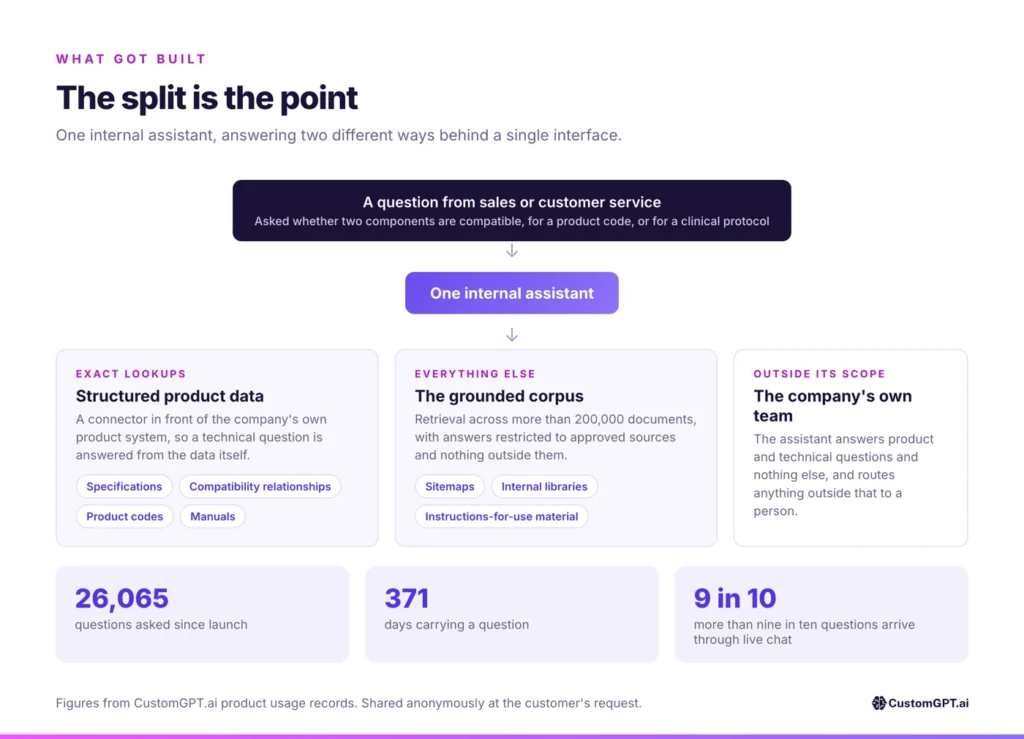
One internal assistant, answering two different ways behind a single interface.
The first way is a connector that sits in front of the company’s own product system. It exposes specifications, compatibility relationships, product codes and manuals to the assistant as one source, so a technical question is answered from the data itself rather than from a document that happens to describe the data.
The second way is grounded retrieval across more than 200,000 documents, drawn from sitemaps, internal libraries and published instructions-for-use material, with answers restricted to approved sources and nothing outside them.
The split is the point. Exact lookups go to structured product data, everything else goes to the grounded corpus, and the assistant routes to the company’s own team when a question falls outside its scope. It went live to sales and customer service teams worldwide as the company’s first internal AI deployment.
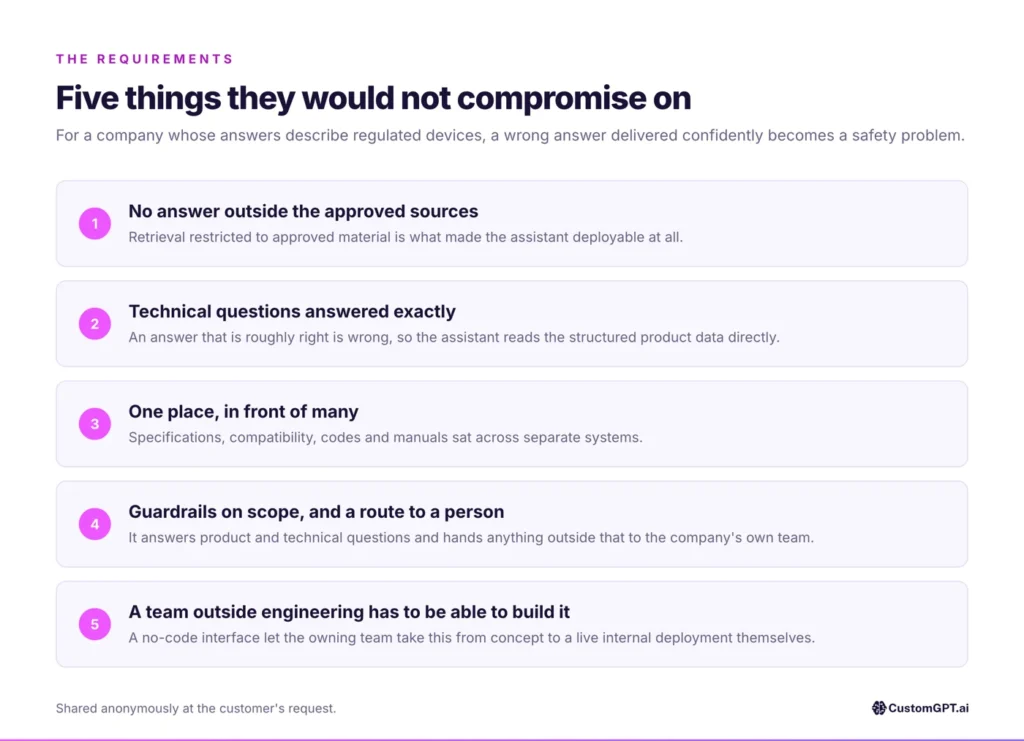
Five things they would not compromise on
- No answer outside the approved sources. Retrieval restricted to approved material is what made the assistant deployable at all, in a setting where general tools had already been ruled out.
- Technical questions answered exactly. Specifications and compatibility relationships are not approximate quantities. An answer that is roughly right is wrong, so the assistant reads the structured product data directly instead of inferring from prose.
- One place, in front of many. Specifications, compatibility, codes and manuals sat across separate systems. Unless a single front door is put in front of all of it, the person asking still has to know where to look.
- Guardrails on scope, and a route to a person. The assistant answers product and technical questions and nothing else, and hands anything outside that to the company’s own team.
- A team outside engineering has to be able to build it. A no-code interface is what let the owning team take this from concept to a live internal deployment themselves, rather than filing it as a project proposal.
The capability that decided it
The assistant queries the product data itself instead of reading about it.
That one design choice separates an exact technical answer from a plausible one. Asked whether two components are compatible, the assistant resolves the relationship from the product system rather than summarizing a document that mentions both parts.
Asked for a product code, it can find one from a partial description or a related product, which no exact-match database search could do. Asked for a clinical protocol, it answers from the approved source and shows that source.
Everything the structured data does not hold runs on grounded retrieval across the approved corpus.
What the record shows
Sales and customer service teams worldwide have asked the assistant 26,065 questions on 371 separate days. More than nine in ten of those questions arrive through live chat, inside the company’s own environment, where both teams already work. Behind the answers sit more than 200,000 ingested documents alongside the structured product data.
The quality measure is reported on its own window. In the latest quarter the satisfied answer rate was 99.5%, measured across 5,334 questions that the company’s approved sources covered. Read that as: of the questions this corpus can speak to, that is the share whose answers landed well.
Be clear about what that figure is not. It is not a claim that the assistant answers 99.5% of everything put to it, and it is not a measure of accuracy or correctness. Questions arriving on subjects the approved sources do not cover are excluded from the figure rather than counted against it, and tracked instead as content worth adding.
In the same quarter, 659 questions arrived on subjects the corpus does not hold.
The deployment has been reviewed at senior executive level, and the company has since renewed.
Why it worked
Grounding that holds in a regulated setting. Answers are restricted to approved sources, which made a deployment possible where general tools had been ruled out on exactly that point.
Structured data, read directly. The connector into the product system is the difference between an answer a specialist would sign and an answer that merely sounds like one.
A narrow scope, deliberately. The assistant answers product and technical questions, routes everything else to a person, and is easier to defend internally because of it.
Built by the team that owns the problem. A no-code interface meant the people closest to the product knowledge could build the assistant rather than specify it for someone else.
What this means for you
Point the assistant at the data, not only at the documents. Where the answer is a specification, a code or a compatibility relationship, a connector into the system that holds it beats any amount of retrieval over documents about it. Retrieval is the right tool for prose and the wrong tool for a lookup table.
Decide what it will not answer. A narrow scope with a clear route to a person is what makes a deployment defensible in a regulated setting, and it is far easier to set at the start than to retrofit after launch.
Measure the thing the assistant controls. A rate that counts questions your own content never covered tells you about the breadth of your subject rather than about the assistant. Separate the two, publish the one that measures the assistant, and work the other as a content backlog.
This company is now broadening adoption across more business units and departments, working toward deployments that serve professionals outside the organization, and developing deeper integration with its own proprietary knowledge sources.
| Measure | To date |
| Questions asked since launch | 26,065 |
| Days carrying a question | 371 |
| Approved documents made answerable | More than 200,000 |
| Share of questions arriving through live chat | More than nine in ten |
| Satisfied answer rate, latest quarter | 99.5% |
| Questions the approved sources covered, latest quarter | 5,334 |
| Questions on subjects the corpus does not cover, latest quarter | 659 |
Figures from CustomGPT.ai product usage records. Shared anonymously at the customer’s request.