

CustomGPT.ai vs. Higher Logic AI Assistant: Which Is Better for Associations in 2026?
Two associations can want the same thing, an AI assistant that answers member questions from their own trusted content, and still need very different products. One runs a busy online community where most member value already flows through discussions and shared libraries.
Another manages a 5,000-document library of standards, certification handbooks, policy guidance, and research reports that lives across a website, a document store, and a handful of internal systems, with no community at the center of it. The right AI assistant for the first association may be the wrong one for the second.
That is the real decision behind the search for CustomGPT.ai vs Higher Logic AI Assistant. These two products can overlap in association use cases, but they come from different product philosophies.
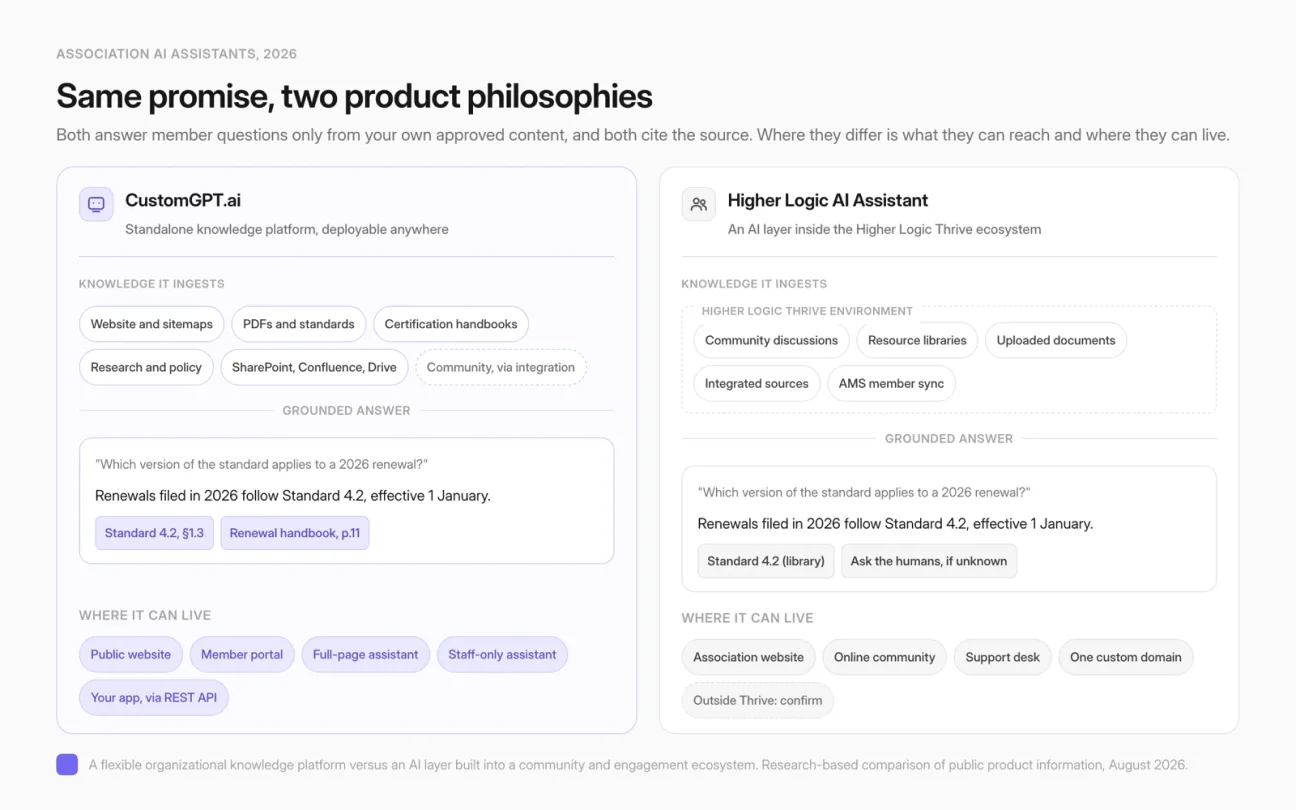
CustomGPT.ai is a horizontal, standalone knowledge platform: you point it at your content, and it produces a grounded assistant you can deploy almost anywhere. Higher Logic AI Assistant is an AI capability built into the Higher Logic Thrive member-engagement and community ecosystem, designed to make an association’s knowledge accessible from inside the environment members already use.
That distinction, a flexible organizational knowledge platform versus an AI layer connected to a community and engagement ecosystem, matters more than any single feature, so this guide leads with it and returns to it throughout. This is a research-based comparison using publicly available product information as of August 2026, not a claim that every capability was personally tested.
CustomGPT.ai vs. Higher Logic AI Assistant: Which is better?
For most associations that want a flexible, source-grounded AI knowledge assistant deployable across websites, portals, internal tools, and APIs, and whose knowledge is not centered on a community, CustomGPT.ai is the stronger overall choice.
It offers standalone deployment, published pricing, an open API, and white-labeling. Higher Logic AI Assistant is often the better fit for associations already invested in Higher Logic Thrive, where community interaction is the primary source of member value and the AI should live inside that ecosystem.
Key Takeaways
- The two platforms start from different places. It offers standalone deployment, published pricing, an open API, and white-labeling. Higher Logic AI Assistant is often the better fit for associations already invested in Higher Logic Thrive, where community interaction is the primary source of member value and the AI should live inside that ecosystem.
- The 2026 capability gap is narrower than it used to be. Higher Logic AI Assistant now ingests uploaded documents and integrated sources, not just community discussions, and it cites sources and respects member permissions. Evaluate it on current documentation, not on its earlier community-only reputation.
- Existing Higher Logic customers should weigh consolidation seriously. If your knowledge and members already live in Higher Logic Thrive, an AI assistant built into that environment can reduce implementation work and reuse your existing security groups and AMS sync.
- Associations with knowledge spread across standards, PDFs, websites, training, and internal systems should compare ingestion and deployment flexibility closely. This is where a standalone platform tends to have more architectural room.
- Treat source citations and permission-aware gated content as procurement requirements, not nice-to-haves. Both platforms support them, but the mechanics differ, so test them with your own restricted content.
- Pricing transparency differs sharply. CustomGPT.ai publishes tiered pricing and offers a free trial. Higher Logic pricing, including the AI Assistant, is quote-based and not publicly disclosed.
- The only reliable decision is a proof of concept. Test both with your own content, real member questions, restricted material, and questions that have no answer.
Quick Comparison Table
Table notes: “Yes” means the capability is documented. Where a capability is not documented publicly, the cell says so precisely rather than implying more than the evidence supports. Plan-dependent features may require a specific tier or an Enterprise contract.
| Capability | CustomGPT.ai | Higher Logic AI Assistant |
|---|---|---|
| Standalone product | Documented as supported: Buy and deploy on its own | Not native, or bounded by the ecosystem: Requires Higher Logic Thrive |
| Answers restricted to your content | Documented as supported: Yes, no open web | Documented as supported: Yes, no open web |
| Source citation on every answer | Documented as supported: Yes | Documented as supported: Yes, source-linked |
| Websites, PDFs, standards, training | Documented as supported: Yes, built for mixed libraries | Documented as supported: Yes, once in the knowledge layer |
| Community discussions as a source | Not native, or bounded by the ecosystem: Integration required | Documented as supported: Native, plus ask-the-humans |
| Gated and member-only content | Documented as supported: Isolated private agents | Documented as supported: Thrive security groups |
| Separate staff-only assistant | Documented as supported: Distinct private assistant | Not native, or bounded by the ecosystem: Scoped by security group |
| Multiple isolated assistants | Documented as supported: Yes, per content set | Not publicly documented, confirm with the vendor: Confirm with vendor |
| Assistant-level query API | Documented as supported: REST API and MCP server | Not publicly documented, confirm with the vendor: Not publicly documented |
| Native AMS and CRM integration | Not native, or bounded by the ecosystem: Via API and connectors | Documented as supported: Native across Thrive |
| White-labeling and custom domain | Documented as supported: Premium and Enterprise plans | Documented as supported: One custom domain |
| Single sign-on | Documented as supported: SAML, plan dependent | Documented as supported: Via Thrive, setup fee may apply |
| Question and content-gap analytics | Documented as supported: Yes | Documented as supported: Yes |
| Multilingual answering | Documented as supported: Yes | Not publicly documented, confirm with the vendor: Not documented, primarily English |
| Enterprise security attestations | Documented as supported: SOC 2 Type II, GDPR | Documented as supported: SOC 2 Type II, ISO 27001 and 27701 |
| Published pricing and free trial | Documented as supported: Tiered pricing, 7-day trial | Not native, or bounded by the ecosystem: Quote-based, demo only |
What Is CustomGPT.ai?
CustomGPT.ai is a no-code retrieval-augmented generation platform, a system that retrieves relevant passages from an approved knowledge base and composes an answer from that material rather than from open-web training data. Organizations build assistants grounded strictly in their own content, and every answer carries a citation to its source.
An anti-hallucination design is intended to make the assistant decline when the answer is not in the source material rather than guess. Retrieval-augmented generation reduces the risk of ungrounded answers, but it does not eliminate error entirely, so content quality still matters. The sector framing is covered on the AI for professional associations page.
Associations create an assistant by pointing the platform at websites, sitemaps, PDFs, standards, policies, training materials, and knowledge bases.
Because it is a standalone product, the same grounded assistant can be deployed as a website widget, an embedded component inside a member portal, a full-page experience, or an API-driven internal tool, and it can run separate public and private assistants from different content. That range is what makes it a fit for member support, staff knowledge management, onboarding, and standards discovery from one platform, as outlined for AI assistants for membership organizations.
On the practical side, CustomGPT.ai is no-code, so a membership or marketing team can build and iterate without engineering support, using the no-code GPT builder. It provides custom branding and white-label options on higher plans, an open REST API, more than 100 connectors including Confluence, SharePoint, Google Drive, and Slack, and analytics that surface the questions members actually ask.
Security includes SOC 2 Type II certification and GDPR documentation, with SAML single sign-on and role-based access available depending on plan, and a stated policy that customer content is not used to train public models. The platform is cloud-only as of research, without on-premises or European data-residency options, and a data processing agreement is available to Enterprise customers.
Build AI agents from your content, in minutes!
What Is Higher Logic AI Assistant?
Higher Logic AI Assistant is the AI answering capability inside Higher Logic Thrive, the member-engagement and online-community platform that Higher Logic has built for associations over nearly two decades. It is not sold as a standalone product. It is a feature of the Thrive environment, which means an association generally needs to be a Higher Logic customer to use it. The current product page is Higher Logic AI Assistant.
Its purpose is to turn an association’s trusted knowledge into instant, always-on answers for members, grounded exclusively in the organization’s own content and never the open internet.
Importantly for this comparison, the 2026 version of AI Assistant has expanded well beyond community discussions. Its knowledge layer ingests content through bulk upload, integrations, or manual entry, with no migration required, so it can draw on uploaded documents and resource libraries as well as community-generated discussions.