
What Is the Most Cost-Effective AI Platform for Non-Profits and Educational Institutions?
The most cost-effective AI platforms for non-profits and educational institutions offer flexible pricing, easy deployment, and features tailored for limited budgets. Platforms like CustomGPT.ai provide no-code AI tools, special discounts, and scalable solutions that maximize impact while minimizing costs.
For schools comparing budget options, our guide to AI student discounts and free trials covers renewal and payment gotchas.
Why do non-profits and educational institutions need cost-effective AI?
Non-profits and schools often have:
- Limited funding for technology
- Small IT teams
- High demand for scalable tools
According to TechSoup’s 2023 survey, over 70 percent of non-profits cite cost as a major barrier to adopting AI.
Why is affordable AI important?
Affordable AI enables:
- Automation of routine tasks
- Enhanced student or client engagement
- Data-driven decision making
Key takeaway
Cost-efficient AI democratizes access to advanced technology.
What features should cost-effective AI platforms have?
- No-code/low-code interfaces for easy setup
- Transparent, usage-based pricing
- Free tiers or grants for eligible organizations
- Integration with existing tools (LMS, CRMs)
- Reliable support and training resources
Why is scalability important?
Platforms that grow with your needs prevent costly migrations.
Key takeaway
Cost-effective AI balances price, usability, and growth.
Which platforms fit non-profit and educational needs?
| Platform | Pricing Highlights | Key Benefits | Limitations |
|---|---|---|---|
| CustomGPT.ai | Special non-profit discounts, pay-as-you-go | No-code setup, customizable, integrations | None significant |
| OpenAI API | Usage-based, no special non-profit pricing | Powerful models, developer tools | Technical setup required |
| Google AI | Grants available, integrated tools | Strong ecosystem, free tiers | Complex for beginners |
| Microsoft Azure AI | Pay-as-you-go, education grants | Enterprise features, security | Can be costly without grants |
Key takeaway
CustomGPT stands out for affordability and ease of use for non-technical teams.
Why choose CustomGPT.ai for non-profits and schools?
- Dedicated pricing plans for non-profits
- No-code AI chatbot builder
- Easy integration with LMS and communication platforms
- Scalable infrastructure
- Responsive customer support
How does this help organizations?
- Reduce operational costs
- Improve learner and client engagement
- Accelerate digital transformation
Key takeaway
CustomGPT delivers affordable AI solutions tailored to non-profit and educational missions.
Summary
The most cost-effective AI platforms for non-profits and educational institutions offer no-code tools, flexible pricing, and dedicated support. CustomGPT.ai provides these features along with special discounts, making it ideal for organizations with limited budgets. For teams using AI around grants, the next step is checking how AI grant writing claims map to funder requirements before submission.
Ready to get affordable AI for your organization?
Explore CustomGPT’s non-profit plans and build AI-powered tools that fit your mission and budget without technical barriers.
Trusted by thousands of organizations worldwide


Frequently Asked Questions
How do you tell if an AI platform is actually cost-effective for a nonprofit or school?
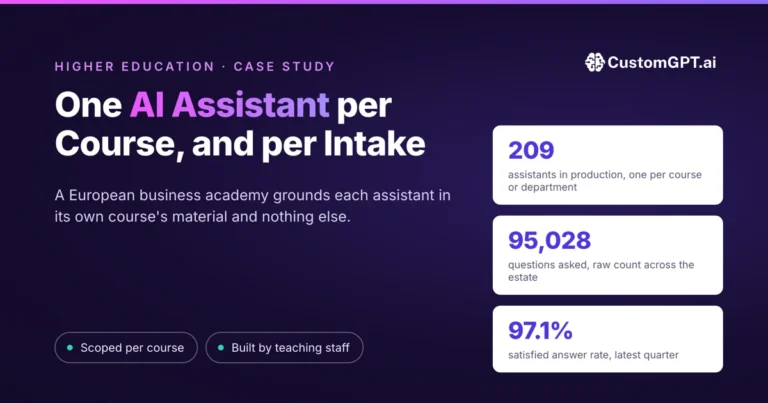
AI Ace handled 1,750+ questions in 72 hours for 300 student users and outperformed GPT-4 in accuracy. For a nonprofit or school, that is a practical way to judge cost-effectiveness: measure how much repetitive volume the assistant absorbs, whether it answers accurately from your approved materials, and how much staff time it prevents from being pulled into routine support. When comparing options such as OpenAI API, Google AI, Microsoft Azure AI, or a no-code RAG platform, those outcomes matter more than headline price alone.
Can a small nonprofit or school set up an AI assistant without a developer?
Yes, if the platform is no-code and can ingest the files and URLs your team already uses. Stephanie Warlick described that setup model this way: “Check out CustomGPT.ai where you can dump all your knowledge to automate proposals, customer inquiries and the knowledge base that exists in your head so your team can execute without you.” For a small nonprofit or school, the real test is whether staff can load documents, web pages, or LMS content without writing code and then update the assistant as policies or course materials change.
Does an affordable AI platform remember our approved information, or will we have to repeat the same context every time?
You usually load approved information once into a knowledge base, and the assistant retrieves from those trusted sources in future chats. Elizabeth Planet said, “I added a couple of trusted sources to the chatbot and the answers improved tremendously! You can rely on the responses it gives you because it’s only pulling from curated information.” For nonprofits and schools, that means policies, program details, and course materials can stay consistent without staff re-explaining the same information over and over.
Can a low-cost AI platform handle busy periods like enrollment, grant deadlines, or HR season?
Yes, if it scales on the same knowledge base and gives you visibility into what users are asking. During seasonal spikes, look for conversation analytics, usage tracking, and deployment options such as web chat, live chat, or search so people can self-serve from approved information instead of routing every question to staff. That is often what makes an AI tool affordable in practice during high-demand periods.
What makes an AI platform useful for student and constituent engagement, not just back-office tasks?
Evan Weber said, “I just discovered CustomGPT, and I am absolutely blown away by its capabilities and affordability! This powerful platform allows you to create custom GPT-4 chatbots using your own content, transforming customer service, engagement, and operational efficiency.” For schools and nonprofits, that usually means turning course materials, program FAQs, and support content into a searchable assistant that helps learners, donors, volunteers, or clients get answers directly from your own sources instead of a generic public chatbot.
How can a nonprofit or school tell whether an affordable AI platform will answer accurately from its own sources?
Check whether the assistant uses retrieval from your documents, supports citations, and lets you constrain answers to approved sources. A published benchmark showed CustomGPT.ai outperformed OpenAI in RAG accuracy, which is a useful comparison point when you are evaluating retrieval-based options against more general tools from OpenAI, Google, or Microsoft. For nonprofits and schools, better retrieval accuracy usually means fewer manual corrections and more confidence in policy, program, and curriculum answers.