
Custom AI Chatbot Development Services for Enterprises 2026
What are custom chatbot development services? Custom chatbot development services turn business requirements and approved company data into a working AI assistant. The work spans knowledge ingestion, retrieval or RAG configuration, integrations, user experience, security, deployment, testing, and ongoing optimization, so the assistant answers accurately from your content rather than guessing, and holds up in production. For demand-generation use cases, a custom ChatGPT chatbot lead-generation flow can route qualified visitors to a sales handoff.
What CustomGPT.ai can deliver
- A source-grounded AI agent that answers from your approved business content and cites the source of each answer.
- Knowledge ingestion from websites, documents, help centers, and connected systems, with refresh planning.
- Retrieval and answer configuration built to reduce hallucinations and to refuse out-of-scope questions.
- Deployment across a website widget, an internal or customer portal, or your own front end through the API.
- Enterprise controls, including private-by-default agents, SAML SSO where supported, per-agent data isolation, SOC 2 Type 2, and GDPR documentation.
- Implementation support and ongoing optimization, so the assistant stays accurate as your content changes.
Why chatbot projects stall, and what production actually requires
Most chatbot projects demo well and stall afterward. A prototype that answers three scripted questions in a sandbox is not the same as a governed system that thousands of users trust with real questions. The gap between the two is where projects quietly die.
A production enterprise assistant needs far more than a call to a language model API. It needs accurate retrieval over your real content, citations reviewers can check, permission handling so the assistant respects who is allowed to see what, integrations with the systems your users already use, monitoring, and a maintainable way to keep answers current. Each of those is a component, and each component is a place a from-scratch build can go wrong.
This is why a platform-led approach usually wins on time and cost. Instead of rebuilding commodity infrastructure, ingestion, retrieval, citations, administration, analytics, and deployment, you use a production platform for those layers and spend custom engineering only where it creates real differentiation: your unique workflows, your branded experience, and your specific integrations. Custom development is most valuable when it is aimed at what makes your business distinct, not at re-creating plumbing that already exists.
CustomGPT.ai is an enterprise AI platform for building secure, source-grounded agents from your own approved content. It is not a traditional development agency, a generic toy chatbot builder, a consumer GPT product, or a scripted live-chat widget, and it is not the right tool for every custom engineering project. It combines a configurable platform with implementation support, integrations, an API, and enterprise services, so teams can move from prototype to production without owning the entire stack. See how it works and the enterprise platform overview.
What Are Custom Chatbot Development Services?
Custom chatbot development services are the combined strategy, configuration, engineering, and support work that produces a business-ready AI assistant grounded in your own content. In practice, the services usually include requirements discovery, use-case prioritization, knowledge-source assessment, data ingestion, content preparation, RAG configuration, prompt and instruction design, model selection, interface customization, API development, system integrations, authentication, security configuration, quality assurance, hallucination testing, deployment, analytics, maintenance, and continuous optimization.
Not every project needs every item. A focused proof of concept may need only ingestion, retrieval configuration, and a website widget. A regulated, multi-system deployment may need all of it. The value of a service engagement is matching the right subset to your goal.
| Service area | Typical deliverables | Business outcome |
|---|---|---|
| Strategy and discovery | Use-case definition, success metrics, build-versus-buy assessment | A scoped plan tied to a measurable outcome |
| Knowledge and data prep | Source inventory, ingestion, content cleanup, refresh plan | Answers grounded in current, approved content |
| Retrieval configuration | RAG setup, chunking, ranking, citations, refusal behavior | Accurate, traceable answers that avoid guessing |
| Integrations and API | Website, portal, CRM, helpdesk, and custom app connections | The assistant works inside existing systems |
| Interface and deployment | Branded widget, embedded assistant, or API-driven front end | A usable experience in the right channels |
| Security and governance | Access controls, SSO where supported, isolation, logging | A deployment that passes security review |
| Testing and readiness | Question sets, citation checks, permission and load tests | Confidence to launch to real users |
| Optimization and support | Query analysis, retrieval tuning, content updates | Accuracy that holds up as content changes |
Discuss your chatbot use case: request an enterprise demo or start a free trial to build on your own content.
CustomGPT.ai’s Enterprise Chatbot Development Services
CustomGPT.ai supports enterprise chatbot development across the service categories below. Availability of specific integrations, controls, and deployment options depends on the selected plan and is confirmed during technical discovery.
Strategy and use-case discovery
Effective projects start by defining the business goal, not the technology. Discovery clarifies the business outcome you are targeting, the users and audiences the assistant serves, the knowledge sources it will draw on, the risks that need mitigation, the success metrics you will measure, the scope of the initial pilot, and an honest build-versus-buy evaluation. The output is a scoped plan with a defined pilot and a way to measure whether it worked. For a structured build-versus-buy view, see RAG systems build versus buy.
Knowledge and data preparation
An assistant is only as good as the content behind it. Preparation covers website content, PDFs, product and technical documentation, knowledge bases, help centers, internal policies, and both structured and unstructured content. It includes content cleanup so low-quality or contradictory material does not degrade answers, handling of access-controlled sources, and a refresh and synchronization plan so answers stay current. CustomGPT.ai ingests from a wide range of website and document sources and connectors, with the exact set confirmed during scoping. See the data connectors and integrations overview.
Retrieval and answer configuration
This is where accuracy is engineered. Configuration covers retrieval-augmented generation, enterprise search with source citations, semantic search, chunking, ranking, prompt and instruction design, answer boundaries, fallback behavior, refusal behavior when sources are insufficient, and multilingual requirements. CustomGPT.ai restricts answers to your approved content and cites sources, which materially reduces hallucinations. No responsible platform can promise zero hallucinations, so the goal is measurable reduction plus traceable citations and a reliable “I don’t know” when the content does not support an answer. For depth, see the RAG guide and implementing RAG.
Integrations and API development
Assistants create value when they work inside the systems people already use. Depending on scope, integrations may include websites, customer portals, mobile applications, help centers, CRMs, ticketing platforms, document systems, cloud storage, collaboration tools, analytics platforms, identity providers, and custom internal applications. Integration availability and implementation effort vary by system and must be verified per project. CustomGPT.ai provides a RAG API and connectors so assistants can be embedded and connected rather than rebuilt for each channel.
User-interface and deployment customization
Deployment options include a website widget, an embedded assistant, a branded interface, a fully custom front end built on the API, internal portals, customer-facing portals, mobile experiences, and multiple assistants for different departments or audiences. A single knowledge foundation can power several tailored experiences, which is how organizations serve support, sales, and internal teams from one governed platform.
Enterprise security and governance
Security is evaluated, not assumed. Relevant areas include encryption in transit and at rest, private-by-default access, role-based permissions, SAML SSO where supported, per-agent data isolation, SOC 2 Type 2, GDPR-related documentation, administrative controls, approved data sources, access revocation, and logging and monitoring, along with your own retention and deletion requirements. CustomGPT.ai states that it encrypts data in transit and at rest, keeps each agent in its own data silo, and supports SAML 2.0 identity-provider access. A security certification is not the same as automatic compliance for your specific deployment. See security and trust and the SOC 2 Type 2 details.
Testing and production readiness
Readiness testing is what separates a demo from a system. It covers representative question sets, answer-quality testing, citation verification, retrieval evaluation, permission testing, adversarial testing, load and performance testing, user acceptance testing, escalation behavior, and explicit launch criteria. The output is a documented decision on whether the assistant is ready for real users, based on evidence rather than optimism.
Ongoing optimization and support
Launch is the start, not the finish. Ongoing work includes content updates, retrieval tuning, query analysis, failed-answer analysis, workflow improvements, new integrations, usage reporting, governance reviews, and adoption improvements. Analytics on what users actually ask surface knowledge gaps and drive a compounding improvement cycle, which several CustomGPT.ai customers describe as central to their results.
What Does a Custom AI Chatbot Project Include?
A custom AI chatbot project is a sequence of phases, each with concrete deliverables and a defined level of customer involvement. The table below shows what you are actually buying at each stage.
| Project phase | Example deliverables | Customer involvement |
|---|---|---|
| Discovery | Use-case brief, success metrics, source inventory, scope | Share goals, stakeholders, and access to content |
| Solution design | Architecture plan, integration list, security approach | Review and approve the design and scope |
| Data and content preparation | Ingested and cleaned sources, refresh plan | Provide sources and confirm what is approved |
| Platform configuration | Configured agent, retrieval, instructions, citations | Review sample answers and tune instructions |
| Integration development | Connected systems, API endpoints, authentication | Provide system access and test accounts |
| Testing | Question-set results, citation and permission checks | Join user acceptance testing and sign off |
| Pilot launch | Limited-audience deployment, monitoring in place | Recruit pilot users and collect feedback |
| Production deployment | Full launch across chosen channels, launch criteria met | Approve go-live and communicate to users |
| Optimization | Query analysis, tuning, content and workflow updates | Review reporting and prioritize improvements |
How the Custom Chatbot Development Process Works
The process below is deliberately concrete so you can quote it, plan around it, and hold a provider to it. Each step states what happens, what you provide, what the implementation team delivers, and the decision or output it produces.
- Define the use case and business outcome. The team and your stakeholders agree on the problem, the users, and the metric that defines success. You provide business context and priorities. The team delivers a scoped use-case brief. Output: an agreed target and success metric.
- Audit content, systems, and permissions. The team inventories your knowledge sources, the systems to integrate, and who is allowed to access what. You provide access to content and systems. The team delivers a source and integration inventory. Output: a clear picture of what exists and what is missing.
- Design the architecture. The team designs the data, retrieval, security, integration, and deployment approach. You review and approve. The team delivers an architecture plan. Output: an approved design and scope.
- Build the initial knowledge environment. The team ingests and cleans approved content and sets up refresh. You confirm what is approved. The team delivers a working knowledge base. Output: a grounded content foundation.
- Configure retrieval, instructions, and citations. The team configures RAG, prompts, answer boundaries, refusal behavior, and citations. You review sample answers. The team delivers a configured, source-citing agent. Output: accurate, traceable draft answers.
- Develop required integrations and user experiences. The team builds the widget, portal, or API-based front end and connects required systems. You provide system access. The team delivers working integrations and interfaces. Output: the assistant in its intended channels.
- Test accuracy, permissions, and production readiness. The team runs question sets, citation checks, permission tests, adversarial tests, and load tests. You join user acceptance testing. The team delivers a test report against launch criteria. Output: an evidence-based go or no-go decision.
- Deploy, measure, and improve. The team launches, monitors, and analyzes real usage. You review reporting. The team delivers optimization based on failed answers and query patterns. Output: an assistant that improves over time.
Evaluate your implementation requirements: request an enterprise demo to map these steps to your environment.
How Long Does Custom Chatbot Development Take?
There is no single universal timeline, and any provider who quotes one before discovery is guessing. Deployment speed depends on the number of data sources, content readiness, integrations, authentication, custom interface requirements, compliance review, stakeholder availability, testing requirements, procurement, and deployment complexity. A platform-led approach compresses the timeline because the retrieval, citation, administration, and deployment layers already exist, so the work concentrates on your content, integrations, and testing. Several CustomGPT.ai customers describe no-code deployments measured in days rather than months for focused use cases, though your timeline must be confirmed after discovery.
| Project type | Typical scope | Relative timeline |
|---|---|---|
| Focused proof of concept | One source set, website widget, limited testing | Shortest, often a rapid pilot |
| Departmental knowledge assistant | Several sources, basic access controls, internal deployment | Short to moderate |
| Customer-support chatbot | Help-center content, website deployment, escalation logic | Moderate |
| Multi-system enterprise assistant | Multiple sources, integrations, SSO, analytics | Moderate to longer |
| Highly customized or regulated deployment | Custom UI, deep integrations, compliance review | Longest, driven by review and integration depth |
Treat these as planning categories, not commitments. Confirm the actual timeline for your project after discovery.
How Much Do Custom Chatbot Development Services Cost?
Custom chatbot development cost is driven by scope, not by a single list price, and it generally combines a platform subscription with implementation and any custom work. The larger cost drivers are the platform subscription, implementation services, the number of data sources, API or integration development, custom interface development, authentication requirements, data preparation, testing, security review, migration, training, support, ongoing optimization, and usage volume. A platform-led implementation typically reduces total cost because you avoid building standard infrastructure, ingestion, retrieval, citations, administration, analytics, and deployment, from the ground up.
| Cost factor | Why it affects cost | How to control cost |
|---|---|---|
| Platform subscription | Provides the production infrastructure and controls | Match the plan to real usage and required features |
| Implementation services | Configuration, integration, and testing effort | Start with a focused pilot, then expand |
| Number of data sources | More sources mean more ingestion and cleanup | Prioritize the highest-value content first |
| Integration and API work | Custom connections require engineering time | Use existing connectors where they fit |
| Custom interface | Bespoke front ends add design and build effort | Use the standard widget unless branding requires more |
| Authentication and security | SSO and access controls add setup and review | Confirm requirements early to avoid rework |
| Data preparation | Messy content increases effort and lowers accuracy | Clean and deduplicate priority content first |
| Ongoing optimization | Tuning and content updates sustain accuracy | Use analytics to focus effort where it pays off |
| Usage volume | Higher query volume can affect plan tier | Forecast volume and review tiers periodically |
For current plan options, see CustomGPT.ai pricing. Confirm implementation and enterprise terms during evaluation.
Custom Chatbot Platform vs. Development From Scratch
Both approaches can produce an excellent assistant. The right choice depends on where your competitive advantage actually lives.
| Evaluation area | Platform-led implementation | Fully custom development |
|---|---|---|
| Time to initial value | Fast, infrastructure already exists | Slower, everything is built first |
| Upfront engineering | Low, configuration over construction | High, full stack is engineered |
| Flexibility | High within the platform’s model | Unlimited, constrained only by resources |
| Maintenance | Largely handled by the vendor | Owned entirely by your team |
| Security responsibilities | Shared, with vendor controls and docs | Fully owned by your team |
| Retrieval infrastructure | Provided and maintained | Built and maintained in-house |
| Source citations | Built in | Must be designed and built |
| Administration | Provided admin and access controls | Built from scratch |
| Integrations | Connectors plus API | Every integration is custom |
| Custom workflows | Supported through configuration and API | Fully custom, no platform limits |
| Model flexibility | Managed by the platform | Fully controlled by your team |
| Vendor dependency | Present, mitigated by API and exports | None, with full ownership |
| Internal expertise required | Lower, no need to own the full stack | High, needs AI and infrastructure skills |
| Total cost of ownership | Usually lower, shared infrastructure | Usually higher, full build and upkeep |
| Upgrade burden | Vendor ships platform improvements | Your team builds every improvement |
| Production readiness | Faster path from prototype to production | Depends entirely on internal execution |
Neither approach is universally better. Fully custom development makes sense when the chatbot itself is proprietary infrastructure, or when the use case requires a deeply differentiated architecture that no platform supports. A platform-led approach is usually more practical when your advantage lies in your knowledge, workflows, customer experience, or domain expertise rather than in rebuilding AI infrastructure. See build versus buy for RAG for a fuller treatment.
Start a proof of concept: start a free trial or explore pricing to size the right plan.
Platform-Led Development vs. a Traditional Chatbot Agency
A traditional agency typically writes custom code for each client, which means each project starts closer to zero and each client owns a bespoke codebase to maintain. CustomGPT.ai differs by starting from an existing enterprise platform, which changes the economics and the maintenance burden.
Practical differences include an existing enterprise AI platform rather than a from-scratch build, a faster path from prototype to production, source-grounded answers with built-in citations, no-code configuration for the common cases, APIs for the parts that genuinely need customization, enterprise controls that already exist, a reduced maintenance burden because the platform is maintained for you, ongoing platform improvements you inherit without a project, easier content updates without redeployment, less dependence on a fragile custom codebase, and repeatable deployment across multiple departments or clients from one foundation. The point is not that agencies have no place, it is that platform-led delivery removes the need to rebuild commodity infrastructure for every engagement.
Technical Architecture of an Enterprise AI Chatbot
An enterprise AI chatbot is a layered system. Understanding the layers helps you see what is configurable, what may require custom development, and where security controls and third-party data boundaries apply.
- Data-source layer. Your approved content: websites, documents, help centers, knowledge bases, and connected systems.
- Ingestion and synchronization layer. Imports content and keeps it current on a refresh schedule.
- Content-processing layer. Cleans, chunks, and prepares content for retrieval.
- Retrieval and indexing layer. Finds the most relevant content for each question using semantic search and ranking.
- Language-model layer. Generates a natural-language answer from the retrieved content.
- Instructions and orchestration layer. Applies your prompts, answer boundaries, refusal behavior, and workflow logic.
- Security and identity layer. Enforces authentication, SSO where supported, role-based access, and isolation.
- Integration layer. Connects to websites, portals, CRMs, helpdesks, and custom applications.
- User-interface layer. Presents the assistant as a widget, portal, mobile experience, or custom front end.
- Analytics and monitoring layer. Tracks usage, accuracy signals, and knowledge gaps.
A simple way to picture the flow:
Approved business content → ingestion and processing → retrieval layer → language model → source-grounded response with citations → website, portal, application, or API
In a platform-led model, the ingestion, processing, retrieval, model orchestration, administration, and deployment layers are provided and configurable, while custom development focuses on bespoke integrations, custom front ends, and specialized workflows. Security controls apply across the identity, retrieval, and integration layers. Third-party systems may receive data at the integration layer, which is why each connected service is a separate data boundary to review. Source citations and answer boundaries matter because they make answers verifiable and keep the assistant from generating unsupported claims.
Common Enterprise Chatbot Use Cases
The problem, sources, users, likely integration, and measurable outcome differ by use case. Deploy AI to inform and assist people, and keep human oversight for final legal, medical, financial, or compliance decisions.
- Customer support. Problem: repetitive tickets overwhelm agents. Sources: help center and product docs. Users: customers and support agents. Integration: website and helpdesk. Outcome: higher self-service resolution and lower cost per interaction. See the customer support solution.
- Employee knowledge. Problem: staff cannot find internal answers quickly. Sources: policies, wikis, and intranet content. Users: employees. Integration: internal portal or collaboration tools. Outcome: faster internal retrieval and less time lost searching.
- Product documentation. Problem: complex products generate nuanced questions. Sources: documentation and API references. Users: customers and technical staff. Integration: docs site and in-app. Outcome: fewer escalations on documented topics.
- Sales enablement. Problem: reps wait on experts for answers. Sources: product, pricing, and compliance content. Users: sales teams. Integration: Slack or CRM. Outcome: faster responses and less expert interruption.
- Customer onboarding. Problem: new users need guidance at all hours. Sources: onboarding guides and FAQs. Users: new customers. Integration: website and in-app. Outcome: smoother activation and fewer early tickets.
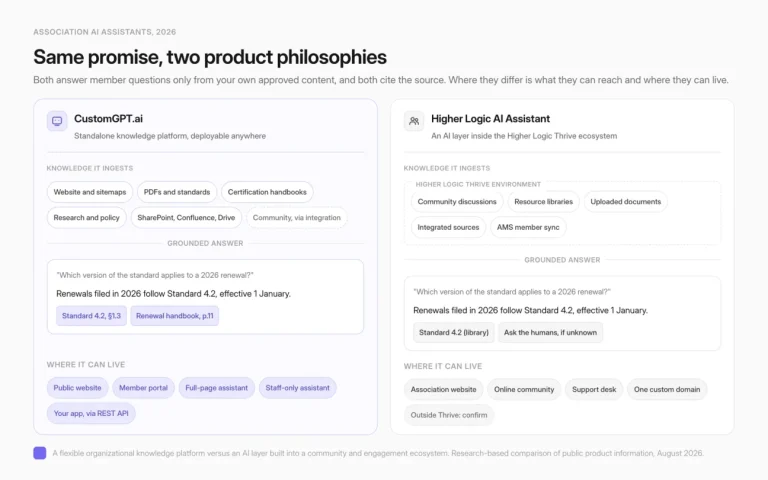
- Member support. Problem: growing member bases strain service teams. Sources: member policies and licensing content. Users: members. Integration: public site and member portal. Outcome: 24/7 support without proportional headcount. See AI for associations.
- Education. Problem: learners need instant, accurate answers. Sources: course and program content. Users: students and staff. Integration: institutional website. Outcome: always-on, multilingual knowledge access.
- Government information access. Problem: residents need round-the-clock service. Sources: public records and policies. Users: residents and staff. Integration: county or agency website. Outcome: lower cost per interaction and faster service. See government AI.
- Compliance assistance. Problem: teams need traceable policy answers. Sources: compliance manuals. Users: staff and reviewers. Integration: internal portal. Outcome: cited answers that support review, with humans deciding.
- Legal knowledge retrieval. Problem: experts field repetitive questions. Sources: approved legal documentation. Users: internal teams. Integration: Slack or portal. Outcome: faster cited answers, with lawyers retaining judgment.
- Partner portals. Problem: partners need consistent answers. Sources: partner docs and enablement content. Users: partners. Integration: partner portal. Outcome: consistent, self-service partner support.
- Multilingual information access. Problem: audiences span many languages. Sources: existing content. Users: global users. Integration: website. Outcome: knowledge delivered across many languages from one source.
Enterprise Security and Privacy Considerations
Security and privacy should be evaluated against the vendor’s official documentation and confirmed in your own review. The points below reflect CustomGPT.ai’s current published materials, with details to confirm through its Trust Center, DPA, and enterprise terms.
- Model training. CustomGPT.ai states that customer content is not used for public model training and stays within your specific agent.
- Encryption. Its materials describe SSL encryption in transit and 256-bit AES encryption at rest.
- Identity and access, and SSO. CustomGPT.ai supports SAML 2.0 identity-provider access and references two-factor authentication and role-based access, with availability confirmed by plan.
- Isolation. Each agent operates in its own data silo, and data is not shared between agents, even within the same account.
- Retention and deletion. You can delete original files immediately after processing, or keep them so the agent can cite sources, in which case they remain until you remove them. Confirm the handling of processed content, logs, analytics, and backups through the Trust Center or DPA.
- Logging. Its materials state that logs are handled so they are not traceable back to an individual user.
- Subprocessors. Published subprocessors include AWS for hosting, Stripe for payments, Google Workspace, and Automattic. Confirm the current list during review.
- Data Processing Agreement. A DPA is available to Enterprise-plan customers.
- SOC 2 and GDPR. CustomGPT.ai is SOC 2 Type 2 certified and states that it is GDPR compliant. Note that it does not currently offer EU data residency and is a cloud-only service, so private-cloud or on-premises deployment is not available.
- Connected services and incident response. Any connected third-party system is a separate data boundary governed by that provider. For security incidents, CustomGPT.ai directs customers to its published contact and breach-notification process.
SOC 2 Type 2 is an independent assessment of whether controls operated effectively over a period of time. It does not automatically make every customer deployment compliant, and it is not a guarantee of answer accuracy. Customers remain responsible for configuring the system appropriately for their data and regulatory obligations. For the primary references, see security and trust, the SOC 2 Type 2 page, and the GDPR page. For an external control-framework reference, see the NIST AI Risk Management Framework and the OWASP Top 10 for LLM Applications.
How to Choose an AI Chatbot Development Company
Use this checklist to compare providers on evidence rather than sales narrative. Ask every provider the same questions and compare the written answers.
- Does the provider offer a working enterprise platform, or only custom code you will have to maintain?
- Can answers include source citations that reviewers can verify?
- How are documents indexed, and how are they refreshed when content changes?
- Can the system enforce access controls so users see only what they are allowed to?
- Is SAML SSO available on the plan you would buy?
- How are separate departments or clients isolated from one another?
- Is customer content used to train public models, by default or after opt-in?
- Which models and subprocessors are involved, and are they documented?
- What integrations are supported out of the box, and what requires custom work?
- Can custom APIs and user interfaces be built when you need them?
- What testing methodology is used before launch?
- How are hallucinations and unsupported answers handled, including refusal behavior?
- Who maintains the system after launch, and what does support include?
- What security documentation is available, such as SOC 2, DPA, and a subprocessor list?
- What exactly does implementation include, and what is out of scope?
- What creates additional cost beyond the base engagement?
- How are quality and business outcomes measured after launch?
- Can the deployment scale to more users, channels, and departments after the pilot?
Real-World AI Implementation Examples
These examples show how organizations deployed source-grounded assistants and what they reported. Every figure below is drawn from the current official case-study page. Results reflect each organization’s specific configuration and content, and will not be identical for every deployment. A case study demonstrates outcomes, not a security or regulatory guarantee for your environment.
- Ontop (enterprise knowledge, legal and sales). Ontop, a global payroll and Employee of Record company, built an agent named “Barry” inside Slack to answer sales-team questions from internal compliance and payroll documentation, with a citation on every answer. Ontop reports about 130 legal-team hours saved per month, response time cut from roughly 20 minutes to about 20 seconds, more than 400 complex questions handled per month, and a 60% acceptance rate in a compliance-sensitive setting. See the Ontop case study.
- Bernalillo County (government customer support). The county assessor’s office deployed multiple assistants across its website and channels, grounded in county documentation and public records. It reports more than 114,000 total contacts, roughly $108,000 in net savings over 18 months, an approximately 80% lower cost per interaction (about $0.99 per bot interaction versus about $4.59 per agent interaction), and a 4.81x return on its spend. See the Bernalillo County case study.
- GEMA (member support and internal knowledge). GEMA, one of the world’s largest music-rights societies, deployed a public assistant named “Melody,” an internal knowledge bot connected to Confluence and SharePoint, and an API-based ticket-drafting tool. It reports more than 248,000 queries resolved, over 6,000 working hours saved annually (about three full-time equivalents), an 88% query success rate against a 70% industry benchmark, and an estimated €182,000 to €211,000 in annual cost avoidance. See the GEMA case study.
- BQE Software (SaaS customer support, phased rollout). BQE deployed context-restricted assistants across its help center, in-app resource center, API documentation site, and public website, expanding in phases. It reports an 86% AI resolution rate, more than 180,000 support questions answered, and 64% of help-center interactions handled by AI. See the BQE case study.
- MIT Martin Trust Center (education, multilingual). The center built “ChatMTC” on its website, ingesting documents, help-desk content, and YouTube videos through a no-code deployment. It reports replies in seconds instead of long queues, 24/7 availability, and support for more than 90 languages, unifying entrepreneurial knowledge that had been scattered across repositories. See the MIT ChatMTC case study.
Browse more in customer stories and testimonials.
Discuss your chatbot use case: request an enterprise demo to explore a comparable deployment for your team.
When Should You Choose CustomGPT.ai?
CustomGPT.ai may be a strong fit when your organization needs answers grounded in its own content, source citations, a faster path to production than a ground-up build, enterprise access controls, website or portal deployment, API-based integration, multiple knowledge assistants, no-code administration, custom implementation support, ongoing content updates, and a production platform rather than a one-off prototype.
Another approach may fit better when your organization is building proprietary foundational-model infrastructure, when the project requires a completely unique inference architecture, when you have strict self-hosting requirements that the selected plan does not support, when the use case cannot be met by the platform’s verified deployment options, or when you only need a simple scripted chatbot with no knowledge retrieval. Being clear about these boundaries is part of a responsible evaluation.
If the custom front end is React, use the React deployment paths for CustomGPT.ai chatbots to compare script, component, and iframe deployment paths.
Frequently Asked Questions
What are custom chatbot development services?
Custom chatbot development services turn business requirements and approved company data into a working AI assistant. The work typically includes requirements discovery, knowledge ingestion, retrieval or RAG configuration, prompt design, integrations, security setup, testing, deployment, and ongoing optimization. The goal is an assistant that answers accurately from your content, cites its sources, respects access controls, and holds up in production rather than only working in a demo.
How much does custom AI chatbot development cost?
Custom AI chatbot development cost depends on scope rather than a single price, and it usually combines a platform subscription with implementation and any custom work. The main drivers are the number of data sources, required integrations, custom interface work, authentication, data preparation, testing, security review, and ongoing optimization. A platform-led approach lowers cost by avoiding a from-scratch build of ingestion, retrieval, citations, and administration. Confirm current plans on the pricing page.
How long does it take to build an enterprise chatbot?
There is no universal timeline, and it should be confirmed after discovery. Speed depends on the number of sources, content readiness, integrations, authentication, custom interface needs, compliance review, and testing. A platform-led approach is faster because retrieval, citations, administration, and deployment already exist. Focused proofs of concept can be built quickly, sometimes in days, while multi-system or regulated deployments take longer because of integration depth and review requirements.
What is the difference between a chatbot platform and custom development?
A chatbot platform provides the infrastructure, ingestion, retrieval, citations, administration, and deployment, so you configure rather than build, which shortens time to value and lowers maintenance. Fully custom development builds every layer in-house, giving maximum control at higher cost and ownership. Platform-led delivery suits organizations whose advantage is their knowledge and workflows. Fully custom suits cases where the chatbot itself is proprietary infrastructure or needs a uniquely differentiated architecture.
Is CustomGPT.ai a chatbot development company?
CustomGPT.ai is an enterprise AI platform with implementation support, not a traditional development agency. Rather than writing a bespoke codebase from scratch for each client, it provides a configurable platform for building source-grounded agents from your approved content, plus integrations, an API, deployment help, and enterprise services. This lets teams reach production faster and apply custom development only where it creates real differentiation, such as unique workflows or a custom front end.
Can CustomGPT.ai build a chatbot using our company documents?
Yes. CustomGPT.ai is designed to build assistants grounded in your own approved content, including websites, PDFs, documentation, help centers, and knowledge bases, with support for many website and document sources. Content is ingested, processed, and used for retrieval so the assistant answers from your material and cites the source. You control which sources are approved, and you can plan refreshes so answers stay current as your content changes.
Can the chatbot cite its sources?
Yes. Source citations are a core feature. CustomGPT.ai restricts answers to your approved content and references the source behind each answer, so users and reviewers can verify where information came from. Citations matter most in support, compliance, legal, and regulated contexts, where a traceable answer is far more useful than a confident but unverifiable one. Citations also create an audit trail and help teams find and fix knowledge gaps.
Can a custom chatbot integrate with our existing software?
Often yes, depending on the system and scope. Integrations may include websites, portals, mobile apps, help centers, CRMs, ticketing platforms, document systems, cloud storage, collaboration tools, analytics platforms, and identity providers, using connectors or the API. Availability and effort vary by system and are confirmed during technical discovery. Where a prebuilt connector does not exist, the API allows custom integration, so you connect the assistant to your systems rather than rebuild it per channel.
Can CustomGPT.ai connect to a CRM or helpdesk?
CustomGPT.ai supports integrations with common business systems through connectors and its API, and customers have deployed it across help centers, portals, and collaboration tools such as Slack. Whether a specific CRM or helpdesk has a prebuilt connector, or needs API-based integration, should be verified for your tools during discovery. The practical point is that the assistant is built to work inside your existing systems rather than as an isolated tool.
Can the chatbot be added to our website?
Yes. Website deployment is a primary use case. CustomGPT.ai assistants can be embedded as a website widget or on-page assistant, and several customers, including MIT’s Martin Trust Center and Bernalillo County, run public website assistants grounded in their own content. You can also build a fully custom front end using the API if your site needs a bespoke experience. Website deployment supports 24/7, self-service answers for visitors.
Can we build a custom front end using an API?
Yes. CustomGPT.ai provides a RAG API so you can build a custom front end or embed the assistant inside your own application, portal, or mobile experience. This is the recommended path when the standard widget does not meet your branding or workflow needs. The platform handles ingestion, retrieval, and citations, while your team controls the interface, so you customize the experience without rebuilding the underlying retrieval infrastructure.
Does CustomGPT.ai support enterprise SSO?
CustomGPT.ai supports SAML 2.0 identity-provider access, so organizations can control agent access through their existing identity provider, and its materials also reference two-factor authentication and role-based access. This lets access follow real identity and centralizes provisioning and deprovisioning. Confirm SSO availability for your specific plan and the exact identity-provider configuration during enterprise evaluation, since availability of certain controls depends on the plan selected.
Is CustomGPT.ai SOC 2 Type 2 compliant?
Yes. CustomGPT.ai states that it is SOC 2 Type 2 certified, meaning an independent auditor tested its controls across security, availability, processing integrity, confidentiality, and privacy over a period of time. SOC 2 Type 2 is a meaningful trust signal for procurement, but it does not by itself prove GDPR compliance, guarantee answer accuracy, or make your specific deployment compliant. Request the current report and review its scope through the Trust Center.
Is business data used to train public AI models?
CustomGPT.ai states that customer content is not used for public model training and that it stays within your specific agent. This is a common requirement for enterprise buyers handling proprietary or sensitive content. As with any vendor, confirm the current policy in the official security documentation and, for regulated data, in your Data Processing Agreement and enterprise terms before uploading confidential material, so the commitment is contractual rather than assumed.
How do you reduce chatbot hallucinations?
Hallucinations are reduced by grounding answers in approved content and citing sources, not eliminated entirely, and no responsible platform should promise zero hallucinations. CustomGPT.ai restricts responses to your uploaded, approved documentation, cites the source of each answer, and can refuse or defer when the content does not support a confident answer. Strong knowledge-base hygiene, retrieval tuning, answer boundaries, and human review further lower the rate of unsupported answers.
Can different departments have separate chatbots?
Yes. You can build multiple assistants for different departments or audiences from one platform, each grounded in its own content. CustomGPT.ai keeps each agent in its own data silo, and data is not shared between agents, even within the same account, so a support assistant and an internal HR assistant remain separate. This supports multi-team governance while reusing the same underlying platform and administration.
Can agencies create separate chatbots for different clients?
Yes. Per-agent data isolation makes CustomGPT.ai suitable for agencies managing separate client knowledge bases. Each client’s assistant is its own data silo with no data sharing between agents, which keeps one client’s content and conversations separate from another’s. Confirm the exact tenancy model, access controls, and per-agent administration for your setup during evaluation, especially if you manage many clients or handle regulated content on their behalf.
Can the chatbot support multiple languages?
Yes. CustomGPT.ai supports multilingual answers, and MIT’s ChatMTC assistant is a documented example, delivering entrepreneurial knowledge in more than 90 languages from a single knowledge base. Multilingual support lets you serve a global audience from your existing content without maintaining separate assistants per language. Confirm the specific languages and behavior relevant to your audience during scoping, since quality can vary with content and use case.
What data is needed to build a custom AI chatbot?
You need the approved content the assistant should answer from, such as website pages, PDFs, documentation, help-center articles, knowledge bases, and policies, plus clarity on which sources are approved for use. It also helps to define your primary use case, intended users, required integrations, security requirements, and success metrics. Cleaner, well-organized content produces better answers, so prioritizing and deduplicating your highest-value sources is a useful first step.
What happens after the chatbot is launched?
After launch, the work shifts to optimization and support: analyzing real queries, reviewing failed answers, tuning retrieval, updating content, adding integrations, and reporting on usage and outcomes. Analytics reveal what users actually ask, which surfaces knowledge gaps and drives a compounding improvement cycle. Governance reviews and periodic access checks keep the deployment secure and current. A launched assistant is a system to maintain and improve, not a project that ends at go-live.
Should we build an AI chatbot from scratch?
Build from scratch when the chatbot itself is proprietary infrastructure, when you need a uniquely differentiated inference architecture, or when strict self-hosting requirements rule out a platform. Otherwise, a platform-led approach is usually more practical, because rebuilding ingestion, retrieval, citations, administration, and deployment is expensive to build and maintain. If your advantage lies in your knowledge, workflows, and customer experience rather than in AI infrastructure, a platform is typically the better use of engineering time.
What should we ask an AI chatbot development company?
Ask whether they offer a working platform or only custom code, whether answers cite sources, how documents are indexed and refreshed, how access controls and isolation work, whether SSO is available, whether customer data trains public models, which models and subprocessors are used, what integrations are supported, what testing methodology they use, how hallucinations are handled, who maintains the system after launch, what security documentation exists, and what drives additional cost.
Can CustomGPT.ai create a proof of concept?
Yes. A focused proof of concept is a common starting point and often the fastest way to prove value. It typically uses one prioritized source set, a website or portal deployment, and a limited test scope, so you can validate accuracy and usefulness before expanding. Starting with a pilot lets you measure results against a clear metric, then scale to more sources, integrations, and departments once the approach is proven.
How is chatbot accuracy tested?
Accuracy is tested with representative question sets drawn from real user needs, checking whether answers are correct, grounded, and properly cited. Testing also covers retrieval quality, permission handling so users only see what they should, adversarial prompts, refusal behavior when content is insufficient, and load and performance testing. User acceptance testing brings real users in before launch, and explicit launch criteria turn the results into an evidence-based go or no-go decision.
What affects the total implementation cost?
Total implementation cost is affected by the platform subscription, implementation effort, the number and cleanliness of data sources, integration and API development, custom interface work, authentication and security requirements, testing, security review, migration, training, ongoing optimization, and usage volume. You can control cost by starting with a focused pilot, prioritizing high-value content, using existing connectors where they fit, and confirming security and integration requirements early to avoid rework.
Start Your Custom AI Chatbot Project
Enterprise chatbot development should produce a maintainable, secure, source-grounded business system, not just an impressive demonstration. The difference is whether the assistant answers accurately from your content, respects access controls, integrates with your systems, and keeps improving after launch. That is the standard a serious custom chatbot development services engagement should be held to.
If you want answers grounded in your own approved content, with citations, enterprise controls, and a faster path to production than a ground-up build, CustomGPT.ai is built for that.
Request an enterprise demo to map your use case, or start a free trial to build on your own content today. To size the right plan, explore CustomGPT.ai pricing.