
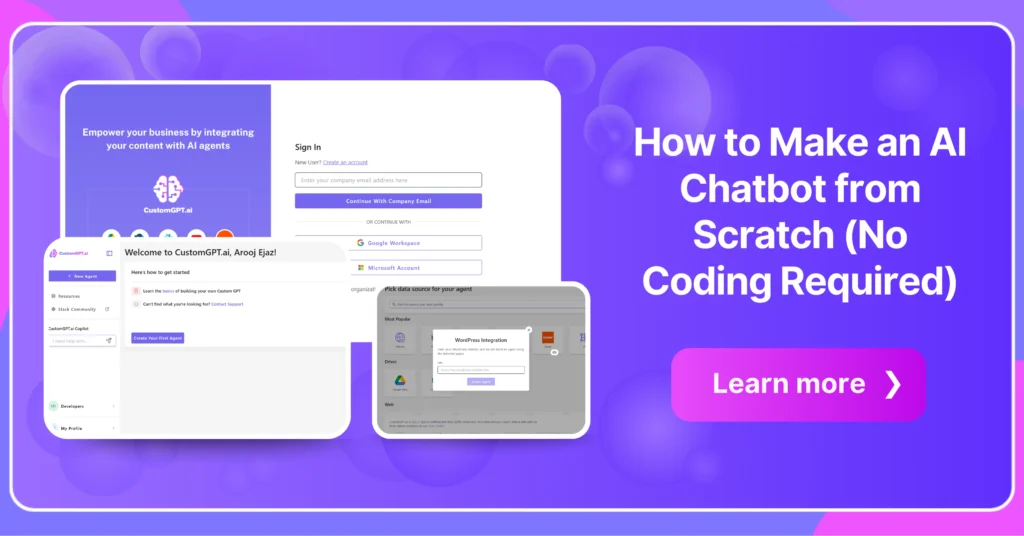
How to Make an AI Chatbot from Scratch (No Coding Required)
AI chatbots are transforming how businesses connect with customers. They provide instant, 24/7 support, capture leads, and improve user engagement — all without requiring a human agent every time.
For teams using internal documents as the source of truth, the knowledge-base chatbot setup guide covers the next step.
The best part? You don’t need to be a programmer to create one. Thanks to modern no-code tools, business owners, marketers, and even non-technical teams can build an AI chatbot from scratch in just a few hours.
TL;DR
- Define your chatbot’s purpose
- Choose a no-code chatbot builder
- Design your chatbot’s conversation flow
- Train it with FAQs or knowledge base data
- Test, refine, and deploy across platforms
- Track performance and optimize regularly
This guide walks you step by step through the process so you can launch your own chatbot quickly and confidently.
Step 1: Understand What an AI Chatbot Can Do
Before jumping into setup, let’s look at the value chatbots deliver:
- Automate customer support (answer FAQs instantly)
- Capture and qualify leads 24/7
- Recommend products or services based on user input
- Collect surveys or feedback automatically
- Boost engagement on websites and apps
Pro tip: Clearly define your chatbot’s primary goal (e.g., reduce support tickets, generate leads, increase conversions). This keeps the project focused and measurable.
Step 2: Choose the Best No-Code Platform to Make an AI Chatbot
To build an AI chatbot without coding, you’ll need a no-code chatbot platform. These tools let you design chat flows visually using drag-and-drop builders.
What to consider when choosing a platform:
- Does it integrate with your website, CRM, or apps?
- Does it support the channels you need (web, WhatsApp, Messenger)?
- Is the pricing aligned with your business size?
Why these questions are important
Choosing the right no-code chatbot platform isn’t just about features — it’s about long-term scalability and ROI.
If your chatbot doesn’t integrate with your existing website or CRM, you’ll end up with disconnected workflows. If it doesn’t support the channels your customers actually use, adoption will be low. And if the pricing model doesn’t fit your business, the solution won’t be sustainable.
Asking these questions upfront ensures your chatbot investment delivers real business value in any no-code chatbot project.
Popular no-code chatbot builders include:
- CustomGPT.ai: Enterprise-ready chatbot builder powered by AI
- Landbot: Known for interactive, visual chatbot experiences
- ManyChat: Perfect for Messenger and Instagram bots
- Botsonic by Writesonic: ChatGPT-style AI bot for websites
Real-World Example:
Biamp guide, a global A/V technology provider, used CustomGPT.ai to deploy multilingual AI assistants across its website and internal portals.
The bots now operate in over 90 languages, handle thousands of customer queries every month, and have cut routine support tickets by over 25%, allowing human teams to focus on higher-value interactions.
Step 3: Design the Chatbot’s Conversation Flow
Your chatbot should feel more like a helpful assistant. Think of this as writing a script for a friendly virtual assistant as you build a chatbot.
Tips to design chatbot flows:
- Start with common customer questions (e.g., “What’s your pricing?” “How do I track my order?”).
- Map out decision-tree options (yes/no, multiple choices).
- Add fallback responses (e.g., “I’m not sure about that—would you like to speak to a human?”).
- Keep tone professional yet conversational.
Step 4: Train Your Chatbot with AI
Unlike simple rule-based bots, AI chatbots learn from data and give more natural responses.
Most no-code platforms let you:
- Upload your FAQs, product docs, or knowledge base.
- Use AI training modules to teach your bot how to respond naturally.
Pro tip: Keep training data clean and relevant. Poor-quality inputs = poor chatbot performance.
Step 5: Test, Refine, and Deploy
No chatbot is perfect on day one. Testing ensures a smooth user experience.
Pre-launch checklist:
- Run test conversations with your team.
- Eliminate repetitive or confusing replies.
- Ensure smooth handoffs to human agents when needed.
- Optimize chatbot greetings (first impressions matter).
Once ready, deploy your chatbot on:
- Your website (via widget or pop-up)
- Social media (Messenger, WhatsApp, Instagram DM)
- Mobile apps or customer portals
Step 6: Measure Success and Improve
Building a chatbot isn’t a one-time project—it’s an ongoing improvement process.
Metrics to track:
- Engagement rate (how many people interact with the bot)
- Resolution rate (how many queries solved without human help)
- Lead conversion (how many visitors become customers)
- Customer satisfaction (CSAT scores)
Pro tip: Use chatbot analytics dashboards (available in most platforms) to identify gaps and retrain your AI bot for better accuracy.
Frequently Asked Questions
Can I build my own AI chatbot without coding?
Yes. Most businesses can build and launch an AI chatbot without coding with a no-code builder, their website pages or PDFs, some testing, and a site widget. You may only need light technical help for API deployment, custom styling, or OCR cleanup on scanned PDFs.When choosing a tool, look for OCR support, answer previews, source citations, widget embedding, API access, and automatic recrawling of updated pages so answers stay current. Builders such as Intercom Fin or CustomGPT.ai fit that model. If the bot says it cannot answer, the usual reasons are that the answer is not actually in the source, the PDF is scanned instead of OCR-readable, the file uses screenshots instead of selectable text, or the same document was uploaded multiple times and indexed poorly. Fix it by adding the missing answer to your content, running OCR, replacing image-based files, and removing duplicates. BQE Software reports an 86% AI resolution rate after deployment.
How much content can a no-code AI chatbot handle before answers get worse?
There is no reliable document count cutoff. The limit to watch is whether the chatbot still answers your real test questions accurately, completely, and with the right citations as you add content. Adding more files does not automatically break AI search in CustomGPT.ai, Chatbase, or Botpress, but duplicated text, broad overlapping sources, or plan-limit pressure can weaken retrieval and increase u0022I can’t answer thatu0022 replies. After each content batch, test 10 to 20 real customer questions and track three signals: answer accuracy, citation hit rate, and refusal rate. If any of those decline, the knowledge base is getting too noisy or too large for the current setup. The fix is usually to reduce overlap, split large sources into cleaner topic files, remove stale content, or upgrade storage if you are near your plan cap. Lehigh University indexed 400M+ words of newspaper archives, showing scale is possible when content is clean and well organized.
How do I train a no-code AI chatbot on spec sheets and manuals so it can answer by item number?
Train it on manuals and spec sheets that show the exact item number in selectable text beside the product description. Add an alias file for old SKUs, hyphenless forms, and OCR mixups like O/0 and I/1. Before uploading, run OCR on scanned PDFs, and if identifiers only appear inside tables, export those tables to CSV so the bot can index them cleanly. Supported files usually include PDF, DOCX, CSV, HTML, XML, and JSON in tools like CustomGPT.ai or Chatbase. If the bot says u0022I can’t answer,u0022 the usual causes are scanned PDFs without selectable text, missing item-number variants, or the wrong manual not being uploaded. A well-trained bot should return the right product details for AB-4412, AB4412, and older aliases, and cite the page or document where the identifier appears. Dlubal serves 130,000+ users with technical documentation, which shows why exact identifier coverage matters.
What should I check if your support articles are not showing up in the chatbot?
Check three things first: the source type is supported, the article was added to the chatbot’s knowledge sources, and a refresh or retrain has completed so the content is re-indexed. If any one is missing, the article will not show up. If the source is unsupported, the article will not import at all. If the source is supported but only some answers are missing, the sync may still be pending, the article may have been excluded, or a long article may be split into smaller indexed chunks, so one passage is harder to retrieve. In CustomGPT.ai, test with the exact article title or opening sentence. If the article is listed in knowledge sources but still cannot be found, refresh again and check for exclusion or sync errors. If the bot says, u0022I can’t answer that,u0022 review the conversation log for a missing article, wording mismatch, or incomplete source coverage. BQE Software reports 86% AI resolution after training support content correctly.
What kinds of files can you upload to train a no-code AI chatbot?
You can build a no-code AI chatbot using PDFs, DOCX, TXT, CSV, HTML, XML, JSON, audio, video, and public website URLs, with a 100MB limit per file. If a file is larger than 100MB, split it before uploading. For hard cases, run OCR on scanned PDFs so the text can be indexed, and remember that audio or video answer quality depends on having a usable transcript. If your bot says it cannot answer, the usual reasons are unreadable file text, a page behind a login, or content that is still indexing. In CustomGPT.ai and similar tools such as Chatbase, Dante AI or Botsonic, cleaner headings and well-labeled sections often improve AI search because uploaded content is usually split into smaller chunks before retrieval. Lehigh University used AI search across more than 400 million words of newspaper archives, showing large document libraries can still be searchable when the source text is machine-readable.
Which no-code chatbot builder is best for customer support versus lead generation?
For lead generation, pick a flow builder like Landbot or ManyChat. For customer support, pick an AI support bot like CustomGPT.ai that answers open-ended questions from your help center, PDFs, or spec sheets with citations and handoff. Use a flow builder when you can script most chats in under 10 steps and success means more booked demos, qualified leads, or opt-in capture; Meta requires opt-in before promotional WhatsApp follow-up. Use an AI support bot when answers must come from hundreds of articles and success means about 60% to 85% containment with source-backed replies. If you need fixed qualifying questions and contact capture, flows are better; if users phrase the same question 100 ways in a website widget, AI support is better. Flow builders usually fail on unpredictable wording, while AI support bots are weaker for rigid qualification funnels and campaign follow-up. At GEMA, an AI assistant handled 248,000+ inquiries with an 88% success rate, which fits support better than form-style builders.
How do I know if my AI chatbot is ready to launch on my website?
Your chatbot is ready to launch when it consistently answers the common questions in your uploaded PDFs, webpages, or help docs, and test chats no longer produce frequent “I can’t answer that” replies. Also test the exact website widget and confirm users get answers instead of dropping off. Before going live, run 20 to 50 real customer questions through the bot, review transcripts, and check analytics for answer rate, drop-off, and human handoff. A practical threshold is 80 percent or better on your top questions before a full rollout. If the bot still refuses questions it should know, verify the source content was fully indexed, compare user wording with the topics in your content, and add missing examples or clearer coverage. At GEMA, the AI assistant reached an 88 percent success rate across 248,000 plus inquiries before scaling. The same launch standard applies whether you use CustomGPT.ai, Intercom Fin, or Ada.
Conclusion: Your AI Chatbot, Made Simple
Creating a chatbot may sound technical, but with today’s no-code tools, it’s as simple as building with Lego blocks. By following these steps—understanding your goals, picking the right platform, designing flows, training with AI, testing, and tracking performance—you’ll have a powerful digital assistant working for your business around the clock.
So if you’ve been wondering how to make an AI chatbot from scratch, the answer is: you can do it today, without writing a single line of code. For the setup workflow, use the no-code chatbot setup guide.
Ready to build your own AI chatbot? Sign up now and get started — no coding required.




Related Resources
These guides cover the next practical questions teams usually ask after planning an AI chatbot.
- Chatbot Development Costs — A concise breakdown of the factors that influence chatbot pricing, from features and integrations to ongoing maintenance.
- Create a Free Chatbot — Learn what it takes to build a chatbot at no cost, including the tools, tradeoffs, and best use cases for getting started.
- React product chatbot deployment guide – Use this guide when your chatbot needs to live inside a React app or product frontend.