

Fuji Corporation Made Its Manual Library Answer Back: An Equipment Manual AI Assistant With Source Citations
Fuji Corporation, a Japanese manufacturer of SMT placement machines and other electronics assembly equipment, built FUJI Smart Doc on CustomGPT.ai: AI chat agents grounded only in its own technical documentation and organized by machine model line.
Every answer carries a citation that opens the exact manual page, with the relevant text highlighted and the diagrams shown in place. The agents have answered 157,701 questions across 43,898 conversations, drawing on roughly 135,000 indexed documents in Japanese, English and Chinese.
Three people, one manual library
A programmer needs the exact lighting conditions for imaging a part before placement on a PCB. A technician mid-repair needs to know which grease to use, and how much. An operator staring down a stalled line needs an answer now, before the delay turns into real downtime.
All three reach Fuji’s manuals through the same members-only customer portal. It holds everything needed to run a production line: machine and software manuals, upgrade reports and specification guides, refreshed regularly with minor revisions.
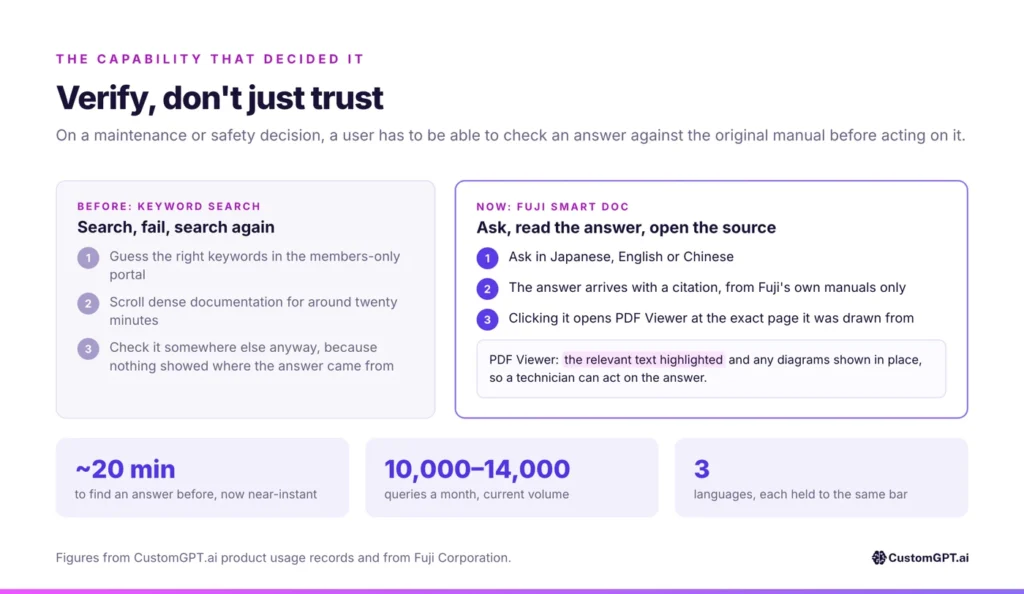
Searching a library that size by keyword could only ever get each of them partway there. Users had to enter the right keywords to find the right page, and Fuji puts the old search at around twenty minutes to an answer.
The library also moves faster than the manuals can. Weekly reports carry the latest updates, but the manuals themselves take time to catch up.
Verification built into every answer
A manufacturer whose manuals govern maintenance and safety decisions carries an obligation that a general knowledge base does not. A confident wrong answer does more damage than no answer at all.
That is why Fuji made one capability the deciding requirement: PDF Viewer. Every machine documentation agent has citations enabled. An answer comes back with a citation, and clicking it opens the source manual at the exact page the answer was drawn from, with the relevant text highlighted and any diagrams in place.
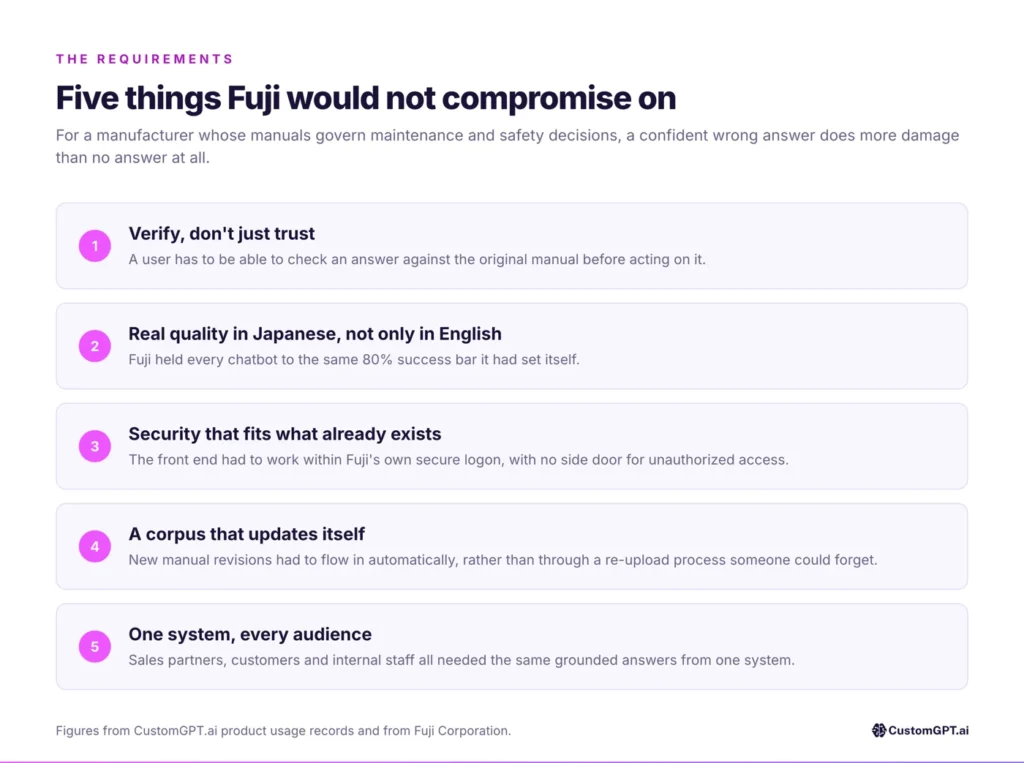
A technician can check the answer against the original before acting on it. Fuji evaluated multiple vendors on accuracy and on this capability, and told us it found nothing else that let a user open the source page and verify an answer.
PDF Viewer remains Fuji’s non-negotiable requirement wherever a wrong answer could lead to a maintenance or safety issue.
Built the hard part first, opened to customers last
Fuji and CustomGPT.ai worked in close, ongoing dialogue to get an initial version of PDF Viewer running before anything else was built. The first agents, in English, Japanese and Chinese, were tested for months and released to sales partners before any customer saw them.
FUJI Smart Doc reached customers only once the viewer, the languages and the access model had all held up. Sales partners, customers and internal staff now reach the same grounded answers from one system, inside Fuji’s own members-only portal and secure logon.
One accuracy bar, three languages
Fuji held every chatbot to the same 80% success bar. English cleared it easily. Japanese had to earn it, and was refined on Fuji’s feedback until it did. That took months, and Fuji would not ship English and call the job finished.
The knowledge base stays current without a re-upload step. Documents added to Fuji’s portal flow into it automatically, so a new manual revision does not depend on someone remembering to upload it.
The deployment today
| Measure | To date |
| Questions answered | 157,701 |
| Conversations | 43,898 |
| Documents indexed | ~135,000 |
| Monthly queries, current | 10,000–14,000 |
| Languages served from one system | 3 |
| Answer rate, customer-facing chatbots (reported by Fuji) | 90% |
| Answer rate, all chatbots (reported by Fuji) | 84% |
| Time to find an answer (reported by Fuji) | ~20 min to near-instant |
Current volume runs 10,000 to 14,000 queries a month, and individual user numbers have doubled over the past year.
Fuji reports that 90% of customer-facing conversations now end in a usable answer, and 84% across every chatbot it runs, including the internal and partner-facing ones. It treats the remaining 16% as room for improvement. Conversations that end in a fallback get reviewed. Either the person who asked gets a follow-up, or the source content gets fixed so the same question does not fail twice.
Customers have noticed. In Fuji’s words: “We have had customers come up to us unprompted at trade shows saying how much they appreciate having FUJI Smart Doc. Because the information needed for troubleshooting and maintenance can now be accessed immediately, field engineers and customer support teams can respond significantly faster, which has contributed to improved customer satisfaction. It has been a popular addition to the services we provide.”
What this means for your manufacturing team
Decide what an answer has to prove. If a wrong answer can lead to a maintenance error or a safety issue, a citation that opens the source page is what wins permission to deploy at all.
Hold every language to one bar. Fuji machines are installed in more than 70 countries, and the large majority of its sales come from outside Japan. Setting the same target for Japanese, English and Chinese, and refining until each met it, is what made one system worth running.
Connect the assistant to where your documents already live. Manuals that flow in from the portal keep the answers current without a separate upload process.
The programmer, the technician and the operator still ask the same questions they always did. They can now find the relevant page, and check it, without a keyword search.
Figures from CustomGPT.ai product usage records and Fuji Corporation. Named study, shared with Fuji Corporation’s review.