
Is Claude Code secure enough for production? The five questions after the demo
You can probably build the demo with Claude Code. Whether it is secure and supportable enough to put in front of customers comes down to five questions. This post is about what comes after it, and how to decide whether to build the rest yourself.
The short answer: Claude Code can get a working AI assistant prototype running in an afternoon. Taking it to production means someone has to own support, maintenance, security, accuracy testing, and the code itself after launch. If your team already ships and maintains AI features, build it yourself. If you have a prototype and nobody to own the rest, build it with a partner on a platform where retrieval, citations, access control, and SOC 2 compliance are already done.
You’re right about the demo
A year ago, getting an AI assistant to answer questions about your own documents took a team. Now one person with Claude Code can get there in an afternoon. We see it every week: someone on the business side builds a working prototype, shows it around, and everyone in the room thinks it’s 90 percent done.
That instinct is reasonable. The demo really does work. It answers questions, it sounds right, and it was cheap to make. The trouble is that a demo and something you can put in front of customers are different kinds of software. What separates them isn’t more of the same work.
What one team found out
A publishing company we spoke with built a complete prototype in Claude. Their read was that one small piece was missing, a backend proxy that would take an afternoon. Once they looked at what it would take to make the product secure and sellable, the estimate was far bigger than an afternoon’s work.
Cost wasn’t their biggest worry, though. They were concerned about losing control of their own content and being tied to one vendor. Those are the right questions, and they’re the ones a demo never makes you answer.
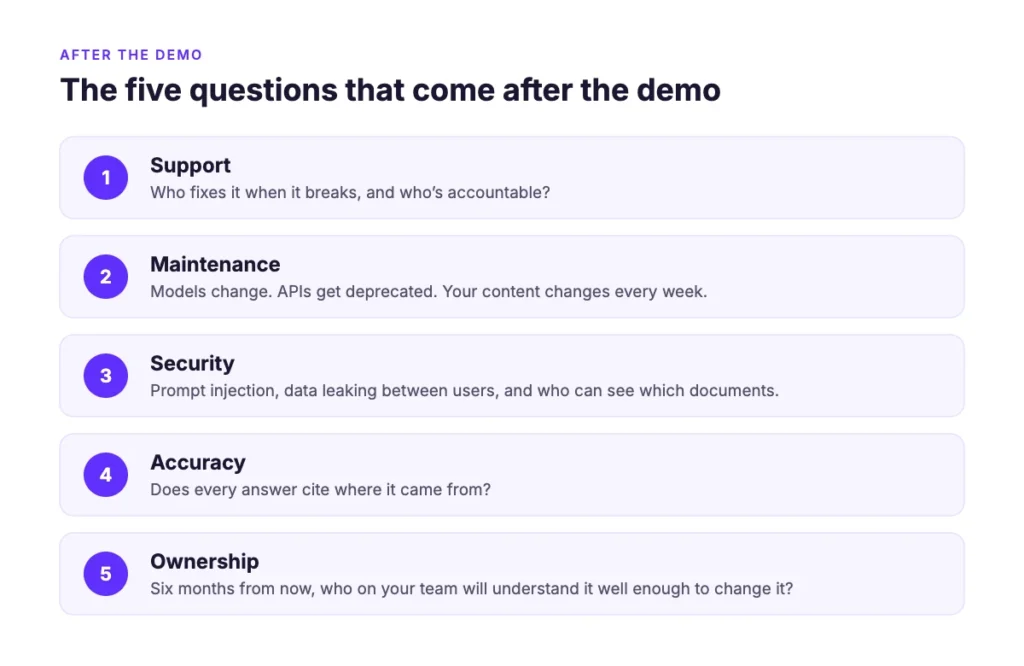
The five questions that come after the demo
If you’re deciding whether to build it yourself, run your prototype through these. They aren’t trick questions, and some teams have good answers to all five.
1. Support
Who fixes it when it breaks, and who’s accountable when it breaks in front of a customer? A prototype belongs to whoever built it. A product needs someone on call.
2. Maintenance
Models change. APIs get deprecated. Your content changes every week. Each of those changes can quietly make answers worse, so someone has to notice and fix it.
3. Security
Prompt injection, data leaking between users, and who is allowed to see which documents. These are rarely in a prototype because nobody hostile has used it yet. A production assistant needs protection against prompt injection, access control so one user never sees another’s documents, audit logs, and a security review your compliance team will sign off on. If your buyers ask for SOC 2, that is an audit of your whole stack, and it takes months.
4. Accuracy
Does every answer cite where it came from, and has anyone tested it against hundreds of real questions rather than the ten you tried in the demo? A confident wrong answer in front of a customer is a liability, not a bug.
5. Ownership
Six months from now, who on your team will understand it well enough to change it? AI-written code is fast to produce. A large codebase that nobody fully understands is slow to maintain.
Build vs. buy AI agents, and the third option
| Build | Buy | Build with | |
| What it is | Your team, AI coding tools, your infrastructure | Software with a login | A team that builds your custom part, on a platform |
| To a demo | Days | Days | Days |
| To production | Months | Weeks, if it fits the box | Weeks to a few months |
| The last mile | You | Nobody, outside the box | Shared, with you |
| Compliance | Yours to prove | The vendor’s | The platform’s |
| Your content | Yours | Often the vendor’s | Yours, exportable |
The third column is the one most teams don’t know exists. You keep the part that makes your solution yours. The parts every solution needs, like retrieval, ingestion, citations, access control, security, and testing at volume, come already built and supported.
When you should build it yourself
If your team ships AI features today and owns them in production, build it. You don’t need a partner, and the platform is self-service if you want the retrieval layer without building it.
If you have the use case and a prototype but nobody to own the rest, you’re the team we built Custom AI Solutions for: engineers who build the part that’s specific to you, alongside your team, on the CustomGPT.ai platform. Bring the prototype, since most of our work starts where one stalled.
One question to ask yourself
Have you tried building it with Claude Code? How far did you get?
If it’s in production and working, you’re done, and congratulations. If it reached a demo and stalled there, the work left is the work above.
Tell us what you want it to do, and we’ll tell you what it takes.
Frequently asked questions
Is an app built with Claude Code secure enough for production?
Not on its own. Claude Code writes working code quickly, but a prototype usually has no protection against prompt injection, no per-user access control, no audit trail, and no security review. Those have to be built and maintained before customers use it, or come from a platform that already has them.
Should we build or buy AI agents?
Build if your team ships AI features today and will own them in production. Buy if an off-the-shelf product does what you need. If you need something specific to you and nobody to own it, there is a third option: build it with engineers on a platform that already handles retrieval, citations, security, and compliance.
How long does it take to go from an AI prototype to production?
Building it yourself usually takes months. With Custom AI Solutions, a working proof of concept on your own content takes about a week, and a tested, secured solution in front of real users takes about three months.