How to Add an AI Assistant to Your Microsoft SharePoint Site
You can add an AI assistant to SharePoint without Copilot and without a developer. Connect SharePoint Documents and Sites as sources so the assistant answers from your own files, then paste the embed code into a SharePoint page using an embed web part. Permissions still follow your existing SharePoint access rules.
CustomGPT.ai connects to your Microsoft SharePoint libraries. Employees ask questions in plain language. They get source-linked answers — no folder browsing required.
For SharePoint teams, a private custom GPT setup matters because document permissions, chat history, and sharing settings decide who can access sensitive knowledge.
This guide covers setup, scoping, and how to get results fast.
The Rise of AI in Business Processes
AI is changing how teams find information at work. Searching for documents used to take minutes. Now an AI agent trained on your content handles it instantly.
For SharePoint teams, this matters. Your existing documents become a searchable knowledge base. No rebuilding. No migration. Just faster answers.

Why SharePoint and GPT?
SharePoint manages how teams store and share content. GPT models understand natural-language questions. Together, they let employees ask questions and get direct answers.
Every answer comes with a source link. No browsing. No guessing folder names.
Understanding GPT and Its Capabilities
A GPT connected to SharePoint can answer from the documents you choose to index. That keeps responses focused on approved content instead of the open web.

What is GPT?
GPT stands for Generative Pre-trained Transformer. It understands natural-language questions and returns structured answers. When connected to SharePoint, your documents become its knowledge base — not the open web.
How GPT Can Transform SharePoint
Employees get a chat interface connected to your SharePoint content. They ask a question. They get an answer with a link to the source document.
No browsing. No folder navigation. No guessing.
Implementing Custom GPT in SharePoint
The integration has three stages. First, connect SharePoint as the knowledge source. Second, configure source scope. Third, embed the agent where your team works.
The sections below cover each step.

Preparation and Prerequisites
Before you connect CustomGPT.ai to SharePoint, confirm four things:
- You are using SharePoint Online (Microsoft 365)
- You have a CustomGPT.ai account with SharePoint integration access
- You know which sites or libraries to index — start with one
- You have a clear success metric in mind
Start with one scoped source so setup and validation stay manageable.
Step-by-Step Integration Process
Use the steps below to create a SharePoint-connected CustomGPT.ai agent, connect SharePoint as a source, and embed the agent on a SharePoint page.
Keep the first version narrow: choose the sites or libraries, confirm access, and test answers before expanding.
Step 1: Create your AI Agent.
Open CustomGPT.ai and create a new agent.

In the agent builder, start a new agent and name it for the SharePoint use case.

Select SharePoint integration.

Enter your SharePoint account credentials (email and password).

Select SharePoint Sites you wish to add to your agent’s knowledge.

Review the list of sites.
Enter an agent name in the designated field. You can also customize the appearance of your AI Agent by choosing colors, fonts, and layout options.

In the All Agents section, open your agent and select the deploy icon.
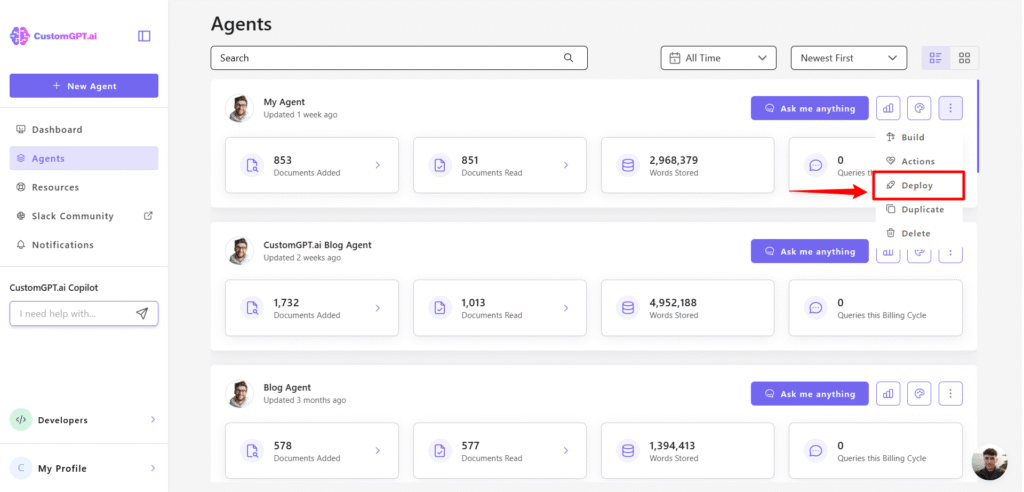
Make your agent public.

Copy the embedded code.

Step 2: Embed your AI agent on SharePoint site
Log in to SharePoint

Click on the “App Launcher” in the top left corner.

Select “SharePoint“.

After that, select the site where you want to embed your AI Agent.

To embed a CustomGPT.ai AI Agent on your SharePoint site, ensure site-level HTML Field Security is set to “Allow contributors to insert iframes from any domain” or whitelist this domain: https://app.customgpt.ai/

Go to the page where you want to embed your AI Agent, and click on the “Edit” button.

In the Toolbox on the right sidebar, find the “Embed” option and click on it.

The embed element will be placed on your page, and you can reposition it as needed.

Click on the “Add Embed Code button“, which will open another panel in the right sidebar.

In the field provided, paste the URL from your “Agent Deployment section“.

Wait a few seconds for the AI Agent to load, and you’re all set! Click on “Republish” in the top right corner to save your changes.

Best Practices for Deployment
- Start with a sandbox environment before going live. This keeps your production site stable during testing.
- Scope your content source tightly. One well-defined library performs better than a full tenant index.
- Set a clear success metric before launch. Monitor it weekly. Adjust the agent’s instructions based on what users actually ask.
Use Cases and Applications
CustomGPT.ai on SharePoint works across several business functions. The most common are knowledge retrieval, document Q&A, and employee self-service.
The sections below cover the three most impactful applications.
Automating Content Creation
CustomGPT.ai can draft content from your existing SharePoint documents. It pulls from indexed sources to generate summaries, FAQs, and updates.
This is useful for teams that produce recurring internal content. Policies, onboarding guides, and status updates can all be generated from source material.
Enhancing Search Functionality
Standard SharePoint search matches keywords. CustomGPT.ai understands the intent behind a question.
A user can ask “what is our remote work policy?” and get a direct answer. The response includes a link to the source document. No keyword guessing needed.

Custom Solutions for Business Needs
CustomGPT.ai can be scoped to any SharePoint use case. Document management, employee onboarding, and knowledge bases are common starting points.
You control which content the agent indexes. You control the persona and instructions. The agent answers only from what you approve.
Challenges and Considerations
Integrating AI into SharePoint comes with real decisions to make. Content scope, permissions, and data security all need attention before launch.
This section covers the key challenges and how to address them.
Security and Privacy Concerns:
SharePoint AI projects need clear source boundaries. Choose the libraries the agent should index, confirm who owns them, and test answers before expanding. Keep sensitive or draft content out of the first source scope.

Conclusion
CustomGPT.ai turns your SharePoint content into a conversational knowledge base. Employees ask questions. They get source-linked answers from your own documents.
The setup is no-code. The agent answers from selected SharePoint sources, so responses stay grounded in your content instead of the open web.
For teams that rely on SharePoint for internal knowledge, this is a practical and immediate improvement to how that knowledge gets used.

The Future of AI in SharePoint
AI in SharePoint is moving from keyword search to intent-based retrieval. The gap between asking a question and getting the right answer is closing.
CustomGPT.ai is one tool making that shift practical today. As models improve, agents will handle more complex tasks across larger content sets.
The foundation is the same: clean content sources, clear ownership, and a well-scoped agent. The journey with CustomGPT.ai in SharePoint is just beginning. Start there and build on it.
Frequently Asked Questions
Related Resources
Setting up your integration
- Connect SharePoint to Your Chatbot — Step-by-step connection guide for SharePoint and CustomGPT.ai
- OneDrive Integration — Connect OneDrive as an additional document source alongside SharePoint
- Google Drive Integration — Add Google Drive content to the same agent
- Claude for knowledge-base chatbots — Learn how to connect Claude to your chatbot, when it makes sense, and how to keep responses grounded in your business content.
Going deeper with enterprise AI
- Enterprise AI Chatbot Platform Comparison — How CustomGPT.ai compares to other enterprise options
- Top 5 Enterprise Use Cases of CustomGPT — Real deployment patterns across enterprise teams
- RAG vs Fine-Tuning for Enterprise Data — Why retrieval-augmented generation is the safer approach for internal content