


In this series of integrating CustomGPT.ai with programming languages and frameworks, we’re exploring the integration of CustomGPT.ai with Clojure through the CustomGPT.ai developer API. Today, we’ll focus on Clojure by using practical code examples provided in CustomGPT.ai RAG API documentation to show how CustomGPT.ai works. We’ll explain the process of integrating custom chatbots into Clojure-supported applications.
This integration offers significant potential for enhancing various business applications and platforms supported by Clojure, empowering developers to create intelligent, conversational experiences for their users. Let’s explore the steps of integrating CustomGPT.ai with Clojure and unlock the range of its possibilities!
Clojure and its Application
Clojure is a dynamic, general-purpose programming language that combines the power and flexibility of Lisp with the robustness of the Java Virtual Machine (JVM). Its concise syntax and immutable data structures make it an excellent choice for building scalable, concurrent applications.
Application and Use Cases of Clojure
Web Development
Clojure is widely used for developing web applications, thanks to frameworks like Ring and Compojure that simplify web development tasks.
RAG API Integration
Clojure’s interoperability with Java libraries makes it a suitable choice for integrating with external APIs, including custom chatbot RAG APIs like CustomGPT.ai, similar to using the CustomGPT.ai API in Java. This enables developers to incorporate intelligent, conversational interfaces into their Clojure applications, enhancing user experiences and automating various tasks.
Introduction to CustomGPT.ai
CustomGPT.ai is an AI platform that empowers developers and businesses to create custom chatbots tailored to their specific needs, including C application integration. Built on powerful RAG technology CustomGPT.ai enables the creation of intelligent conversational interfaces capable of understanding and responding to provide personalized user experience.

Key Features of CustomGPT.ai
- Customization: CustomGPT.ai allows users to train their chatbots with domain-specific data, ensuring that the responses generated are relevant and accurate to the context.
- RAG API Integration: The platform provides a comprehensive RAG API that enables seamless integration of custom chatbots into various applications and workflows.
- Advanced AI Capabilities: CustomGPT.ai chatbots can understand complex queries, infer user intent, and generate contextually relevant responses based on custom data using advanced RAG technology.
- Scalability: CustomGPT.ai is designed to scale with your business needs, supporting thousands of concurrent users and handling large volumes of conversational data. It supports 1400+ document and sitemap integration to train chatbots
- Security and Privacy: The platform prioritizes security and privacy, ensuring that user data is protected and compliant with industry standards and regulations.
Benefits of Using CustomGPT.ai
Following are some of the benefits of integrating CustomGPT.ai with Clojure:
Enhanced User Experience
Integrating custom chatbots powered by CustomGPT.ai into Clojure applications, as with WordPress chatbot setups, enhances user engagement by providing intelligent responses and personalized interactions.
Automation of Tasks
Chatbots integrated with CustomGPT.ai can automate various tasks within Clojure applications, such as answering user queries, providing recommendations, and performing data analysis.
Improved Customer Support
Custom chatbots can be used to provide instant customer support within Clojure applications, offering timely assistance and resolving user issues efficiently.
Data-driven Insights
The platform enables businesses to gain valuable insights from user interactions with chatbots, including user preferences, trends, and feedback, which can inform decision-making and drive business growth. By leveraging CustomGPT.ai developers can extract valuable insights from user interactions with chatbots, enabling data-driven decision-making and improving overall application performance.
Cost-effectiveness
CustomGPT.ai offers a cost-effective solution for implementing CustomGPT.ai chatbots through its RAG API documentation, eliminating the need for extensive development resources.
Versatility
CustomGPT.ai chatbots can be deployed across various channels and platforms, including websites, and messaging apps using RAG APIs providing businesses with flexibility in reaching their target audience. CustomGPT.ai’s API integration with Clojure allows for scalable and flexible deployment of chatbots, ensuring seamless operation across different platforms and environments.
Integrating CustomGPT.ai with Clojure: A Practical Example
In this practical example, we will explain how to integrate CustomGPT.ai with Clojure programming language. By leveraging the capabilities of Clojure and the CustomGPT.ai RAG API, we can perform various operations by sending HTTP requests. There are several pre-built code examples present in CustomGPT.ai RAG API documentation, we will use one of these examples to show you how to update a specific conversation within CustomGPT chatbot.

This code snippet illustrates a PUT request to update a conversation session within a CustomGPT.ai project. By using Clojure’s HTTP client library, we can easily interact with the CustomGPT.ai RAG API to manage chatbot projects and sessions programmatically. Let’s dive into the details of this integration by testing how Clojure enables seamless communication with CustomGPT.ai for updating conversations.
Test and Run the Code
To run the above code first get your RAG API key, to get RAG API
- Go to the CustomGPT.ai website and create an account using your Email, Name, and Password.
- Once the account is created click on Dashboard and create a new chatbot project on your custom data.
- Now go to your profile and click on API> Generate API key. Once the key is generated copy the key.

- Now place the CustomGPT.ai RAG API key in the box below.

- To update a certain project, provide the Project_ID, session ID, and Name of the conversation you want to update.
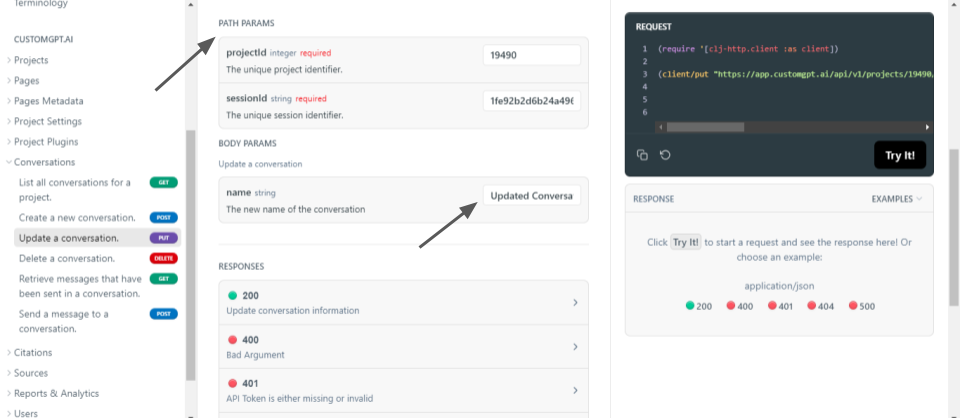
- Run the code and see the generated response.
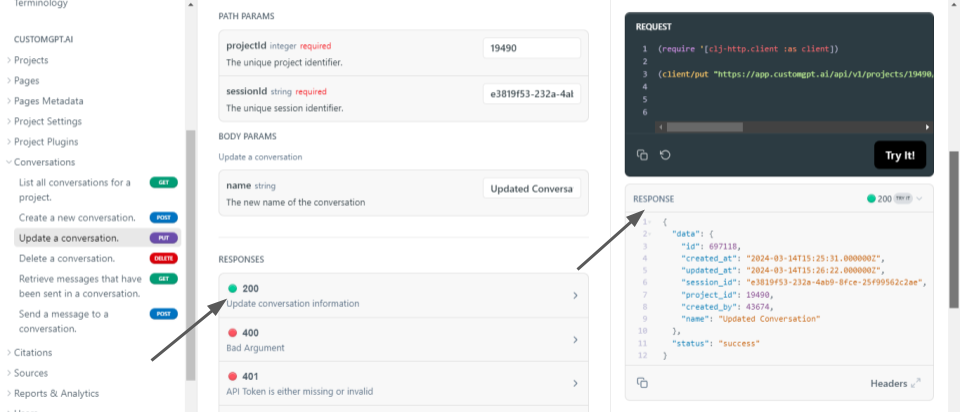
- The response “200” shows the conversation is updated successfully.
- Now we will check the updated conversation in the CustomGPT.ai interface.
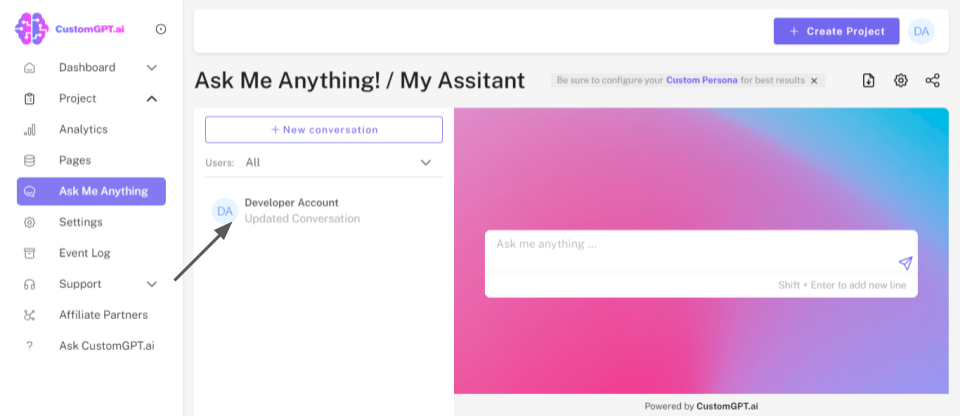
Similarly, you can perform various other operations using Clojure code from RAG API documentation and CustomGPT.ai RAG API.
Conclusion
In conclusion, integrating CustomGPT.ai with Clojure opens up exciting possibilities for building intelligent chatbots and conversational interfaces. This integration provides solutions in various domains, from customer support to knowledge management, enhancing user experiences and driving business efficiency. With Clojure’s expressive syntax and CustomGPT.ai’s advanced AI technology, developers can create sophisticated conversational applications that deliver value and intelligence to users.
Frequently Asked Questions
Do you need a native Clojure SDK to use an OpenAI-compatible RAG API?
No. You can call the OpenAI-compatible REST endpoint at /v1/chat/completions from a Clojure application over HTTP with API key authentication. The listed SDKs cover Python, Node.js, .NET, Java, Go, PHP, Ruby, and Swift, so a native Clojure SDK is optional rather than required.
How do you call the CustomGPT.ai RAG API from a Clojure application?
Send a JSON POST request from your Clojure app to /v1/chat/completions and authenticate with your API key. Because the API is OpenAI-compatible, the integration pattern is the same basic REST workflow many teams already use for chat completions. Stephanie Warlick described the broader value of connecting your own knowledge to automation this way: u0022Check out CustomGPT.ai where you can dump all your knowledge to automate proposals, customer inquiries and the knowledge base that exists in your head so your team can execute without you.u0022
How do you keep a Clojure RAG chatbot grounded in your own documents?
Use curated source material as the chatbot’s knowledge base instead of relying on general model knowledge alone. Supported sources include websites, PDFs, DOCX, TXT, CSV, HTML, XML, JSON, audio, video, and URLs, and the platform is built around retrieval-augmented generation with citation support. Elizabeth Planet explained the practical effect: u0022I added a couple of trusted sources to the chatbot and the answers improved tremendously! You can rely on the responses it gives you because it’s only pulling from curated information.u0022
How do you handle private documents securely in a Clojure RAG app?
Use API key authentication and restrict the chatbot’s knowledge base to the sources you want it to retrieve from. For sensitive use cases, the relevant documented safeguards are SOC 2 Type 2 certification, GDPR compliance, and the statement that customer data is not used for model training. Supported inputs include private documents and other content types such as URLs, audio, and video, with files up to 100 MB each.
Can you embed the chatbot on your website without making users use ChatGPT directly?
Yes. You can deploy it as an embed widget, live chat, search bar, or an API-backed experience inside your own website or application. Evan Weber summarized the practical outcome this way: u0022I just discovered CustomGPT, and I am absolutely blown away by its capabilities and affordability! This powerful platform allows you to create custom GPT-4 chatbots using your own content, transforming customer service, engagement, and operational efficiency.u0022
Should you use a hosted RAG API or build the retrieval stack yourself in Clojure?
If you want faster deployment, a hosted RAG API is usually the simpler option because ingestion, retrieval, and chat delivery are already available through a standard endpoint. If you need full control over indexing, retrieval logic, and infrastructure, building more of the stack yourself in Clojure can make sense. Brendan McSheffrey from The Kendall Project described the value of a ready-made toolkit this way: u0022We love CustomGPT.ai. It’s a fantastic Chat GPT tool kit that has allowed us to create a ‘lab’ for testing AI models. The results? High accuracy and efficiency leave people asking, ‘How did you do it?’ We’ve tested over 30 models with hundreds of iterations using CustomGPT.ai.u0022
Related Resources
These additional guides expand on working with the CustomGPT.ai API across languages and integrations.
- CustomGPT.ai API in Go — Learn how to connect Go applications to the CustomGPT.ai API for retrieval-augmented generation workflows.
- CustomGPT.ai API in Ruby — Explore a Ruby-based integration approach for building CustomGPT.ai-powered features into your app.
- Platform Integrations — Browse the full range of CustomGPT.ai integrations to connect your data sources, tools, and workflows.