
How to Make Money with AI Bots in 2026: Smart Ways to Build Passive Income Online
Imagine waking up to discover that your online business has been answering customer questions, writing emails, and even making sales — all while you were asleep.
Related: For adjacent monetization paths beyond bots, see this breakdown of ways to make money with AI.
You can make money with AI bots by selling chatbot services, automating customer support, generating leads, running affiliate sites, or offering paid subscriptions for niche assistants. In 2026, businesses increasingly pay for bots that save time and improve conversions, and platforms like CustomGPT.ai help creators build and deploy these tools efficiently.
Welcome to 2026, the year when AI bots have quietly become automated workers that run 24/7 without breaks.

Make Money With AI
Across industries, automation is no longer a luxury for big tech — it’s the new standard for anyone who wants to build income streams that run on autopilot.
From content creators to small e-commerce brands, people are learning how to make money with AI bots that handle tasks once thought to need a full team.
The opportunity is simple but powerful: use AI to automate value creation. Whether it’s recommending products, responding to customers, or creating personalized content, these bots are working nonstop — turning creativity and strategy into income.
In this guide, you’ll discover exactly how to harness AI to build smart, scalable revenue systems and why 2026 might be the best time in history to let technology start earning for you.
Understanding AI Bots: The Digital Workforce That Never Sleeps
Before you can make money with AI bots, it helps to understand what they actually are — and why they’ve become such powerful tools for modern entrepreneurs.
At their core, AI bots are software programs designed to perform tasks that once required human effort — from answering customer questions to generating marketing content. What makes today’s bots different from the automated systems of the past is their ability to learn.
Using artificial intelligence techniques such as machine learning and natural language processing (NLP), they interpret information, recognize patterns, and improve over time.
Think of them as digital assistants that never log off. A chatbot can engage with customers on your website at 3 a.m., while a trading bot monitors markets or a content bot drafts new product descriptions — all without you lifting a finger. The result isn’t just convenience; it’s leverage.
This accessibility has made AI bots widely adopted across SaaS, support, and lead-gen workflows. Whether you’re a freelancer, business owner, or someone exploring online income for the first time, these bots give you something invaluable: time. And in the digital economy, time is the most profitable asset of all.
How AI Bots Create Passive Income
AI bots are transforming how people make money online — not through endless effort, but through systems that scale themselves. Unlike traditional digital tools that need daily management, today’s AI bots can learn, adapt, and perform continuously.
According to McKinsey’s annual State of AI report, 65% of organizations now use generative AI in at least one business function, nearly double the adoption rate from the previous year.
This acceleration isn’t just confined to corporations — independent creators and small businesses are using AI bots to build self-sustaining income streams.
What Makes Income “Passive” with Bots
Passive income from AI bots means systems that:
- Work continuously (24/7) without needing your constant attention
- Scale with minimal extra cost per additional user or interaction
- Improve over time through learning and feedback loops
- Generate revenue through recurring or automated models
Unlike traditional side hustles, bots let you decouple time from earnings: more users can mean more income without linearly more work.
Turning Automation into Earnings
When designed strategically, AI bots can perform revenue-generating tasks around the clock — a foundational requirement for passive income. Instead of trading time for money, you build systems that keep operating even when you’re not online.
For example:
- Chatbots deployed by small businesses can handle up to 50% of customer interactions that previously required human staff, freeing time and cutting costs (McKinsey, 2023). Those savings directly translate into profit or can be reinvested into growth.
- Affiliate marketing bots automate link sharing, track clicks, and optimize performance, turning a one-person affiliate operation into a 24/7 conversion engine.
- Content-generation bots produce blog posts, email sequences, or SEO content optimized for engagement, drastically reducing time spent on content pipelines.
Each bot type turns repetitive labor into a scalable system. Once trained, a chatbot or recommendation engine can handle hundreds or thousands of interactions without additional cost — this is how automation becomes income, not just efficiency.
The Scalability Advantage
Scalability is where AI bots outperform traditional “side hustles.” For instance, Shopify’s data shows that integrating AI recommendation systems can increase sales conversion rates by up to 20%, as algorithms learn from real-time customer behavior.
Similarly, SaaS platforms integrating AI chat assistants for customer service have reported measurable revenue growth within months of deployment.
This level of scalability means the same system that handles 10 customers can handle 10,000 with minimal extra cost — a scalable foundation for recurring revenue. Once you’ve built or deployed a successful bot, its marginal cost per user drops close to zero while revenue potential rises exponentially.
Why It’s Not Entirely “Hands-Off”
Despite the “passive” label, no AI system is entirely self-sufficient. Models require periodic retraining, data updates, and performance checks. Without oversight, even the most sophisticated bots can produce errors or drift from their objectives.
Maintaining profitability means monitoring performance metrics — such as engagement rates or customer satisfaction — and making small, strategic adjustments as markets evolve.
In short, AI bots can make your business run on autopilot — but every autopilot still needs a pilot.
Top 5 Proven Ways to Make Money with AI Bots
The rise of accessible AI platforms has made it easier than ever to make money with AI bots, part of the broader shift toward making money with AI, even for individuals without technical backgrounds. From personalized content tools to fully automated e-commerce assistants, the range of monetization options keeps expanding.
In 2026, the most successful income streams share two traits — scalability and adaptability. Here’s a quick overview of the most profitable ways people are monetizing AI bots this year:
| Method | How It Works | Potential Earnings Model |
| AI Chatbots for Businesses | Automate customer service, lead capture, and sales support | Subscription or setup fees |
| AI Content Creation & SEO | Generate blog posts, emails, or product descriptions | Content packages, affiliate blogs |
| Affiliate Marketing Bots | Automate link tracking and real-time offer optimization | Recurring commissions |
| AI Trading Bots | Execute algorithmic trades based on market data | Profit on trades or subscriptions |
| AI SaaS Micro-Tools | Build small apps powered by AI APIs | Subscription revenue |
1. AI Chatbots for Businesses
Chatbots built on RAG remain one of the most profitable entry points into automation. According to Salesforce’s 2024 State of Service report, nearly 60% of customer service organizations now use AI to increase response speed and cut costs by up to 30% (Salesforce, 2024).
For freelancers and solopreneurs, this presents a lucrative opportunity: creating and managing chatbots for small businesses. Once set up, these bots can operate autonomously, handling lead generation, appointment booking, or product recommendations.
Platforms like CustomGPT.ai allow users to train bots on their business knowledge base and deploy them instantly — transforming customer conversations into long-term recurring revenue.
2. AI Content Generation and SEO Automation
Content is still king, but AI has changed the rules of the game. Tools powered by generative AI — such as CustomGPT.ai or Jasper — can produce SEO-optimized blogs, ad copy, and email sequences in minutes.
Monetization options include selling AI-generated content packages, running niche content websites, or using these bots to scale affiliate marketing operations. The beauty of this model lies in compounding efficiency — the more data your bot gathers, the better its content performance becomes over time.
3. Automated Affiliate Marketing Bots
Affiliate marketing has always been one of the most reliable ways to earn online, but AI takes it to the next level. AI affiliate marketing bots can track performance across channels, analyze click-through data, and optimize offers in real time.
Using AI bots to automate campaign management reduces the manual workload while improving decision accuracy — ensuring your promotions reach the right audience at the right time.
4. AI Trading and Financial Bots
AI bots are becoming powerful tools for personal finance and trading by executing data-driven strategies with speed and precision. Algorithmic trading bots can analyze markets, detect patterns, and place trades based on predefined risk preferences, without the emotional bias that often affects human decision-making.
However, these require careful setup, risk management, and continuous monitoring to ensure compliance and avoid volatility pitfalls.
5. AI SaaS Micro-Tools
Building SaaS micro-tools using AI is emerging as one of the most sustainable paths to passive income. Entrepreneurs are using no-code or low-code platforms integrated with AI APIs to create custom tools — from writing assistants to analytics dashboards.
These solutions often operate on subscription models, meaning once the system is deployed, it continues to generate monthly income with minimal maintenance.
Make Money With AI
Step-by-Step: Building Your First AI Bot Business
Building an AI bot in 2026 doesn’t require a coding background or a massive budget. With today’s AI platforms, even solo entrepreneurs can develop functional, money-making bots in just a few days.
Here’s how to turn an idea into a profitable automation system.
Step 1: Identify a Profitable Problem
Start by defining a specific problem your bot can solve. The most profitable AI bots usually fall into these categories:
- Customer service – bots that answer FAQs or qualify leads
- E-commerce – bots that recommend products or recover abandoned carts
- Content automation – bots that write or post social media content
- Analytics & productivity – bots that summarize reports or emails
Ask yourself:
- Who benefits most from this bot?
- Can the bot save time, reduce cost, or increase sales?
- Is this something people would pay for or subscribe to monthly?
A clear use case will determine your monetization strategy later.
Step 2: Choose the Right Platform
Select a platform that matches your technical skill and goals. Here are common options:
- No-code builders: Use drag-and-drop interfaces to create chatbots or workflow bots (e.g., CustomGPT.ai, Chatfuel, Botpress).
- Low-code frameworks: Offer customization with simple scripting (e.g., Rasa, Dialogflow).
- Full-code development: Best for developers who want to build proprietary systems from scratch.
If your goal is to make money with AI bots fast, no-code solutions like CustomGPT.ai are ideal. They provide pre-built templates, analytics dashboards, and integrations, so you can focus on growth instead of infrastructure.
Step 3: Design Your Bot’s Core Functionality
Once your platform is ready, outline what your bot should actually do. Define:
- Primary tasks: What specific action(s) will generate revenue?
- Conversation flow or logic: How will it interact with users?
- Data inputs: What information does it need (FAQs, product data, content prompts)?
Tip: Keep the first version simple. A bot that performs one task extremely well is more profitable than one that tries to do everything.
Step 4: Train and Test Your Bot
Before launch, you’ll need to train your AI bot to handle real-world scenarios. That includes:
- Uploading relevant content or data sets
- Testing user interactions for clarity and tone
- Refining responses based on accuracy and engagement
Use simulated conversations or test runs with friends, clients, or a small focus group. Identify where users drop off or get confused and fix those pain points early.
Step 5: Monetize and Launch
Once your bot performs reliably, it’s time to launch and monetize. Common models include:
- Subscription fees: Offer monthly access to your AI service
- Freemium tiers: Provide basic features for free and charge for upgrades
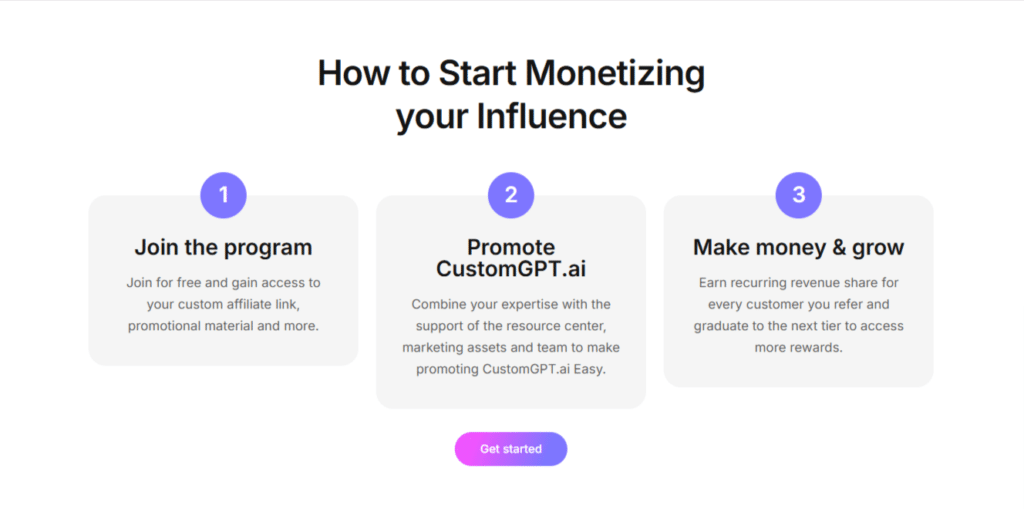
- Affiliate programs: Promote AI tools like CustomGPT.ai and earn recurring commissions
- Service-based pricing: Build and customize bots for other businesses
For visibility, promote your bot on social platforms, product directories, and forums where your target users spend time.
Step 6: Monitor, Optimize, and Scale
Even after launch, your bot needs continuous optimization. Track key metrics like:
- User engagement (message completion rate)
- Conversion or subscription rates
- Customer satisfaction or response accuracy
As performance improves, scale by automating additional workflows or deploying the same bot model across different niches.
Common Mistakes to Avoid When Making Money with AI Bots
When people start exploring how to make money with AI bots, they often fall into patterns that limit their results. Avoid these common pitfalls to build smarter, more profitable systems.
- Building overly complex bots: Many beginners try to create bots that do everything at once. This usually leads to confusion, bugs, and poor user experience. Focus on one clear, high-value task first—like answering customer questions or automating leads—and expand later.
- Ignoring data quality: AI performance depends entirely on the data it’s trained on. If your bot’s data is outdated, inconsistent, or incomplete, its responses will be inaccurate. Always use verified, relevant information and update your datasets regularly.
- Neglecting user experience: Even the most advanced AI can fail if it feels robotic or frustrating to interact with. Design your bot’s tone and flow carefully—short, friendly, and natural responses build trust and keep users engaged longer.
- Skipping analytics and optimization: Launching a bot without tracking performance is like driving blindfolded. Monitor engagement, conversation drop-offs, and conversions. Use insights to refine your bot’s behavior, tone, and triggers.
- Expecting instant or “hands-free” income: AI bots can automate most tasks, but they still need regular updates and testing. Check performance reports, refresh data sources, and adjust strategies based on feedback. True passive income with AI requires smart maintenance.
By avoiding these mistakes, you’ll shorten your learning curve and build a bot that not only works but keeps improving—turning automation into a long-term income engine instead of a short-term experiment.
Advanced Strategies: Turning Bots into Scalable Assets
As AI adoption matures in 2026, the real differentiator is not simply owning an AI bot—it’s knowing how to turn it into a scalable asset that grows revenue, saves time, and improves continuously through data feedback loops.
1. Use Data Analytics and Feedback Loops
AI bots thrive on iteration. Every user message, click, or query represents valuable data that can refine future responses. To apply this:
- Track metrics such as session length, conversion rate, and task completion.
- Use dashboards to visualize engagement patterns and detect drop-off points.
- Continuously retrain your bot with updated FAQs, customer data, and contextual examples.
2. Combine Multiple AI Tools
One powerful way to scale results is to combine AI systems—for instance, linking CustomGPT.ai with your CRM or marketing automation tools.
- Connect the bot to approved customer data sources before promising instant, context-aware answers to client data queries.
- Pair it with your approved content workflow for smarter campaign generation.
- Track bot ROI and user retention with your approved analytics workflow.
When systems communicate, each component enhances the others—creating a network effect where your AI operation becomes smarter and more profitable over time.
A verified example of this approach comes from ontop case study AI, a global payroll and HR platform that implemented a CustomGPT.ai agent named “Barry.” By integrating Barry directly into Slack, the company automated repetitive sales and legal queries.
- Response times dropped from ~20 minutes to 20 seconds.
- Their legal team saved approximately 130 hours per month.
- Internal communication efficiency increased, allowing faster deal closures.
This demonstrates how AI bots, when combined with analytics and workflow automation, can scale from a single-task assistant to a full-fledged productivity engine.
From Automation to Revenue
Once an AI bot consistently delivers results, scaling becomes straightforward:
- Offer access to your bot as a subscription service.
- License it to other businesses as a white-labeled solution.
- Expand integrations to automate upselling, lead nurturing, or personalized recommendations.
These steps transform automation from a time-saver into a long-term revenue generator, turning your AI bot into a digital asset that compounds in value over time.
The Future of AI Monetization
The landscape of AI monetization is rapidly evolving as technology becomes more accessible and adaptable. Here’s what’s shaping the next wave of earning opportunities with AI bots:
- Hyper-personalized automation: AI bots are moving beyond scripted responses. Businesses that tailor bot interactions to individual user intent will see higher engagement and recurring revenue.
- Decentralized AI marketplaces: Platforms are emerging where creators can list, rent, or sell AI bots trained for niche tasks—like tutoring, analytics, or e-commerce assistance. This turns AI creation into a tradable asset class, giving solopreneurs new income streams.
- Integration with no-code ecosystems: The rise of no-code builders (such as Zapier and Webflow) is allowing non-developers to connect AI bots with payment gateways, CRMs, and analytics—reducing setup costs and accelerating time to profit.
- Subscription-based micro-services: Expect a shift from large AI solutions to smaller, specialized bots that users pay for monthly—think AI resume writers, SEO optimizers, or virtual sales assistants. These micro-services can deliver consistent recurring income with minimal upkeep.
- AI-driven affiliate and referral programs: Companies like CustomGPT.ai now offer affiliates recurring commissions, allowing users to earn passive income simply by promoting AI-based tools they already use. This model is bridging the gap between entrepreneurship and automation.
- Ethical and sustainable monetization: As regulations tighten around data use, AI systems that prioritize transparency and consent will outperform those that cut corners. Ethical monetization—where users understand how their data fuels AI—is becoming a market differentiator, not just a compliance necessity.
Frequently Asked Questions
Can you build AI bots to sell to clients, or does each client need a separate website?
Yes. You can sell bots to multiple clients from one account; set up a separate website or separate bot instance only if a client needs distinct branding, separate billing, custom domain control, or strict data isolation. A common beginner offer is $300 to $1,000 for setup plus $100 to $500 per month for support, retraining, and lead-routing fixes, and first revenue often arrives in 2 to 6 weeks if you target local service businesses and do direct outreach. Based on pricing page analysis and documentation audit, agencies working with Manychat and Intercom usually charge per-client retainers rather than building a new site for every client. Reselling is generally allowed when you follow platform terms, secure client consent for chat data handling, sign data-processing terms, and avoid regulated medical, legal, or financial claims unless required compliance controls are in place.
How fast can a complete beginner realistically make money with AI bots?
If you are a complete beginner, a realistic timeline is this: first small payment in about 4 to 12 weeks if you pick one narrow use case and do daily outreach, then more consistent monthly income after roughly 3 to 6 months of testing and improvement. For most small-business bot projects, first revenue comes from done-for-you setup work rather than selling a standalone bot product. Charge setup fees first, then layer recurring management. You can start with three monetization paths: one-time chatbot setup, monthly bot management retainer, or renting a lead-capture bot to local businesses. A practical starter price is $300 to $1,000 for setup, plus $100 to $500 per month for maintenance. If you need cash within 30 days, treat AI bots as a medium-term channel and prioritize quick-turn service offers for existing businesses, including those choosing between Manychat and Intercom.
What is the best way to turn an AI chatbot into leads and booked calls?
You can turn a bot into pipeline with a simple 30-day flow: pick one conversion event, usually a booked 15-minute call, then ask for it within 3 turns after high-intent signals like pricing, implementation, or integration. Example: answer the question, ask one qualifier such as team size or timeline, then offer two specific time slots this week. If they are not ready to buy, offer a focused lead magnet, capture email, and follow up within 24 hours. Use this decision rule: if you sell services, route support and “how do we start” questions to a consultation; if you sell products, route fit and pricing questions to a quote form. In practice, quote prompts after high-intent questions can drive more booked calls than FAQ-only bots when the offer, follow-up, and routing are clear. A practical first target is a 5-10% chat-to-call booking rate, similar to Intercom and Drift patterns.
How do you prevent wrong AI answers from hurting sales or trust?
To protect sales and trust, run your bot with a hard control loop. Limit answers to approved pages, policy documents, and current pricing tables. Set a confidence threshold, for example 0.85. If confidence is lower, the bot should state it is escalating and route the question to a human within one business day. Add strict no-improv rules: if a question could affect pricing, refunds, warranties, compliance, or product claims, only return a verified answer that you have published first. Review your top 20 sales and support intents every week. Update source content, then track answer accuracy alongside conversion rate and complaint or chargeback rate. If accuracy drops below your target, such as 95 percent on high-risk intents, pause autonomous replies until fixed. Applying this control loop can reduce harmful escalations over time when your team reviews high-risk intents every week. Intercom Fin and Drift users often apply similar guardrails.
What bot monetization model is getting the most search demand in 2026?
Customer-support automation is a strong starting point for AI bot monetization because slow responses and missed inquiries create visible costs for service businesses. For most SMB service businesses, inquiry-loss and slow-response pain points come up more often than personalization requests — validate this in your local niche before choosing. If you need first revenue in 30 days, sell a fixed-scope missed-inquiry recovery bot to one local business at $300 to $700 per month, then prove value with booked-call lift and lower median first-response time before upselling recommendation features. Intercom and Manychat pricing pages reflect the same priority order.
Which makes more money first: affiliate bots, SEO content bots, or client chatbots?
Based on what we see across customer deployments, the speed to first revenue depends heavily on the model you choose. Client chatbots tend to generate first income the fastest — the sales cycle is short and setup is lighter than building automated traffic systems. Affiliate bots take longer because they require content, traffic, and affiliate approval before payouts begin. SEO content bots have the longest ramp: you need rankings to build before conversions follow. If speed matters, start with client work; if you can invest time upfront for compounding returns, SEO or affiliate paths reward patience. If you need cash within 30 days, you can start with client chatbots because the sales cycle is shortest and setup is lighter than Intercom or Manychat-style stacks. If you can wait 60 to 90 days, you can pick SEO first for compounding traffic, then add affiliate offers. Before scaling, confirm consent and ad disclosure rules, and isolate each client with separate data stores, API keys, and rate limits to avoid cross-client data leakage.
Should you use a no-code platform, an open-source stack, or a chat tool to monetize AI bots?
Choose by speed, control, and margin. If you need first revenue in under 30 days and can launch in 7 days with little engineering, start no-code, such as Manychat or Voiceflow. Sell one niche offer first, for example an appointment-booking bot for local clinics at $500 setup plus $300 to $800 monthly retainer. Move to API or open-source when you need custom workflows, data ownership, or lower unit cost at scale, usually once you handle 3 or more clients or 5,000 or more monthly conversations. Use chat tools alone only for lead capture or basic support, not full client deliverables. Resale is usually allowed, but check terms for white-label rights and account-sharing limits. One agency account can often manage multiple client workspaces, but client-owned billing lowers risk. Pricing page analysis and documentation audits show contact-based pricing can squeeze margins faster than usage-based API pricing. Expect about 1-2 maintenance hours weekly per no-code client versus 4-10 for API or open-source.
Conclusion: Building Your AI Income Engine
The next wave of digital entrepreneurship isn’t about manual hustle—it’s about intelligent systems that work while you rest. AI bots are reshaping how people create, sell, and scale online. From automating customer engagement to generating digital products, the possibilities expand every month.
The most successful creators aren’t just using AI—they’re designing ecosystems where automation compounds results. By combining data, feedback, and adaptability, you can turn even a small project into a self-sustaining income stream.
If you’re ready to experiment, start by building your first AI bot and learning how automation can serve your audience. Once you’ve seen the potential, explore ways to partner with platforms that reward innovation—like affiliate programs supporting AI-driven solutions that help others grow too.
The future belongs to creators who understand that passive income isn’t luck—it’s smart systems powered by AI.
Sign up for the CustomGPT.ai Affiliate Program and start turning your ROI insights into real profit.
Partner With CustomGPT.ai
Launch branded AI agents for your clients with a proven platform, partner support, and reseller-friendly workflows.
Trusted by 10,000+ customers worldwide


Related Resources
If you’re building an income stream around AI, these next reads pair well with this guide:
- The top 10 AI affiliate programs for 2026: Side-by-side comparison of commission rates, cookie windows, and payout schedules across the highest-paying AI affiliate programs.
- How to start an AI reselling business: Step-by-step playbook for buying AI capacity wholesale and reselling it to local businesses (with setup-fee + retainer pricing examples).
- Make $100/day with AI affiliate marketing: Tactical breakdown of the daily-payout affiliate model, what works, and the pitfalls beginners hit.
- The CustomGPT.ai Partner Program: Where to apply if you want to refer accounts or resell CustomGPT.ai under your own brand.
- Ways To Make Money With AI: Explore proven strategies for earning with AI, from services and automation to scalable digital products.
- Custom GPT Monetization Strategies: Explore practical ways to earn with custom GPTs, from AI services and lead generation to SaaS products and automation workflows.