

In a surprise move revealed by Microsoft journalist Paul Thurrott and then VentureBeat, Microsoft relatively quietly “killed off” its custom GPT, or custom Copilot AI, creation service for users.
It’s okay, CustomGPT.ai has your back if you’re looking to create a custom GPT quickly, easily, and cost-effectively. Even better if you want to build a custom GPT and embed it to your website for customers or a specific audience. Start your free trial today.
But why has Microsoft mothballed Copilot GPT Builder? It had only launched custom Copilot GPTs and the Copilot GPT Builder in March 2024, less than three months ago.
Microsoft Cancels Custom GPTs – What Happened?
If you’re in the business of Custom GPTs, it’s a surprise move. Microsoft reportedly announced the news in an email to those with a Copilot Pro subscription, the essential pre-requisite for building Copilot GPTs. On its support page, it says it will cease the service on July 10, 2024, and remove GPTs created by both Microsoft and customers and any related data between July 10, 2024, and July 14, 2024. In explanation, the tech giant says:
“We are shifting our focus on GPTs to Commercial and Enterprise scenarios and are stopping GPT efforts in consumer Copilot.“
VentureBeat muses this may be because some form of Copilot GPT Builder will be available. Thurott speculates the reason is more to do with low adoption. That’s something we’re certainly not seeing here at CustomGPT.ai.
CustomGPT.ai founder and CEO, Alden Do Rosario shared the development on LinkedIn, adding:
“Microsoft throws in the towel after 3 months … this is why dedicated B2B SaaS like CustomGPT.ai will continue to listen to our customers and continue to innovate.
People should NOT be building their own software using Azure or #langchain — it’s a nightmare development and maintenance scenario. The benefits of SaaS has been clear for decades now.”
One LinkedIn user aptly pointed out Microsoft’s pivot in focus explained in its official announcement. Their experience found Copilot GPT Builder relatively limited but Microsoft’s Copilot Studio more powerful, which still appears to be an option for builders.
Others speculated “GPT” was more aligned with OpenAI’s brand, or that Microsoft simply has so many product lines it can’t concentrate like CustomGPT.ai on this product.
On Twitter, per VentureBeat, University Wharton School of Business professor Ethan Mollick thinks making these GPTs enterprise only “is going to cut off an important source of innovation.”
Of course, we’re going to pitch CustomGPT.ai here, so please do check out our pricing for custom GPTs (zero coding required) Standard, Premium, or Enterprise available to individuals, small to large businesses, educators, and non-profits alike.
Custom GPTs – What are the Options, and What is RAG?
There are a few solid options for custom GPT builds without Microsoft in the main game. CustomGPT.ai, of course, then OpenAI Custom GPTs and Assistants, Google Vertex, Amazon Titan and Cohere. We’ve previously explored these Generative AI chabots as well as looked at the different types of chatbots available for businesses, individuals and organizations.
Like Microsoft and OpenAI’s GPTs, CustomGPT chatbots use retrieval-augmented generation (RAG) which leverages the generative AI large language model (LLM) and uses external user uploaded data and sources to deliver more accurate and contextually relevant answers.
RAG models usually have a two-stage process. Firstly, in the retrieval phase, a user query triggers answer retrieval from the provided knowledge sources. Techniques like keyword-based search, semantic similarity matching, or neural network-based retrieval are employed to locate pertinent information. The retrieved information typically consists of snippets or passages that align with the user’s query.
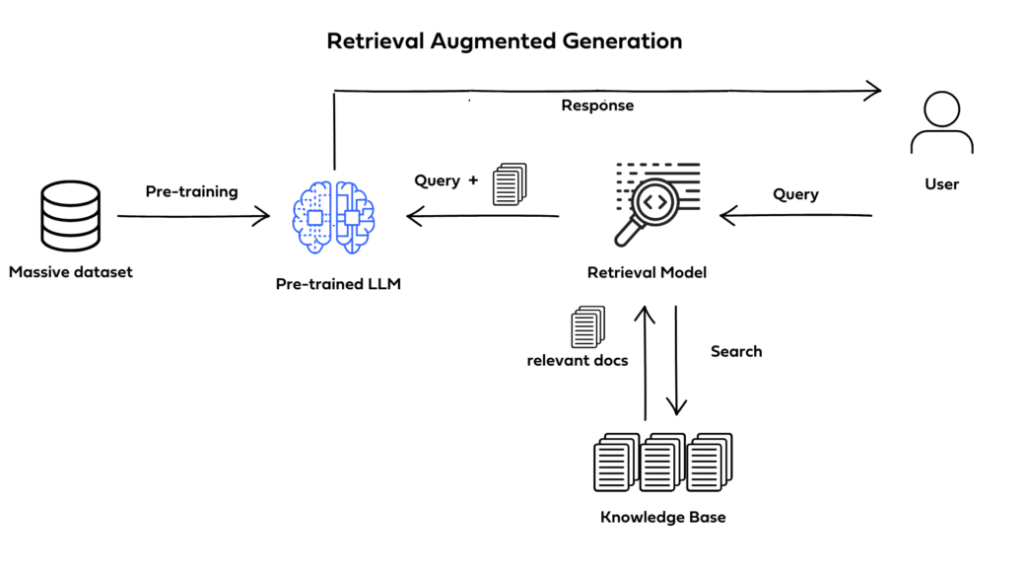
Next, in the generation phase, this relevant information is incorporated into the original user query to create an enriched prompt. This prompt is fed to the LLM, which generates a response based on the combined input that’s more accurate and more relevant to the chatbot’s audience.
Developer data solutions company Tonic recently evaluated and benchmarked chatbots, or GPTs, that use RAG using Tonic Validate, including CustomGPT.ai, which outperformed Cohere, OpenAI Assistants, Google Vertex, and Amazon Titan.
What Does CustomGPT.ai Offer?
Not only does CustomGPT.ai perform when it comes to greater accuracy, but our business-grade platform requires zero coding—that’s zero development skills. It’s custom GPT SaaS. CustomGPT.ai uses OpenAI’s GPT-4o as its base LLM with RAG to improve accuracy and relevance. A custom GPT chatbot can be built in minutes, fine-tuned with a Persona and instructions, and embedded quickly and easily into any website.
What’s more, we’re constantly looking to serve our thousands of customers better, so we’ve been rapidly rolling out upgrades and new features, including:
- Enhanced Analytics – deeper insights into bot and end-user behavior
- Website Copilot – an intelligent AI assistant for your website
- Search Generative Experience (SGE) – to revolutionize website search
If you’d like to experience the enhanced performance and increased engagement CustomGPT.ai’s latest chatbot upgrades provide for your customers or simply test out building custom GPTs for your workplace or establishment, start your free trial today.
Frequently Asked Questions
What happens to existing Copilot GPTs after Microsoft ended GPT Builder?
Microsoft said Copilot GPT Builder would stop on July 10, 2024, and that GPTs plus related data would be removed between July 10 and July 14, 2024. If you built a Copilot GPT, the practical takeaway is to preserve any prompts and source content you still need before removal deadlines and plan a rebuild on another platform.
Can I still build a custom GPT for clients if I do not have a company email?
The article states that building Copilot GPTs required a Copilot Pro subscription, but it does not define a company-email requirement for all alternatives. If you work independently, compare replacement tools based on signup requirements, sharing controls, and whether client access can be managed without enterprise IT overhead.
How can small teams reduce lock-in when moving off Copilot GPT Builder?
Microsoft said it is shifting GPT focus toward commercial and enterprise scenarios, which can leave small teams with fewer lightweight options. To reduce lock-in, keep reusable assets portable: maintain clean source documents, version your system instructions, and document retrieval settings so you can rebuild in another stack if a vendor changes direction again.
Will a replacement custom GPT automatically sync with non-Microsoft tools?
Do not assume automatic full sync. The article focuses on Copilot GPT Builder’s shutdown, not guaranteed third-party integration behavior. Before selecting a replacement, verify exactly what is supported: one-way ingestion vs. two-way sync, update frequency, and failure handling for disconnected integrations.
What access controls should I require when rebuilding a team custom GPT?
Because Microsoft’s change highlights platform volatility, teams should treat governance as a core selection criterion when rebuilding. Look for role-based permissions, workspace separation, and audit visibility so multiple contributors can update the assistant without accidental cross-team edits or data leakage.
How should I test answer quality after migrating from Copilot GPT Builder?
Use a repeatable test set from your own domain and score each platform on factual correctness, citation clarity, and behavior when information is missing. Microsoft’s quick launch-and-retire cycle (launch in March 2024, shutdown by July 2024) is a reminder to validate reliability and transparency, not just initial setup speed.