
A Savings Bank Changed What Its Assistant Does Without Ever Taking It Down
One assistant on a retail savings bank’s website has been asked 2,240 questions across thirteen months in service. Its instructions have been rewritten 127 times. Two agentic actions, page awareness and lead capture, were switched on four months into its life, on the deployment already carrying traffic.
It has been rebuilt zero times, migrated zero times and taken out of service for zero days, and in the stretch since those actions were enabled it has been asked something on 243 of 259 days. The bank shared the deployment anonymously.
A deposit account is a set of terms, and an approximate answer is a wrong one
A first-time buyer comparing notice periods at eleven at night, working out which account will hold a deposit for eight months without a penalty. A teller who can settle that question in fifteen seconds, but only between nine and four, and only for whoever is standing in front of her.
A marketing manager who can see in the analytics exactly which product page visitors give up on, and who has never had anything to put on that page that answers back.
A savings bank sells terms. Notice periods, penalty conditions, minimum balances and rate tiers are the product, and they differ between accounts that look identical from the outside.
An assistant that answers approximately, or that answers about savings accounts in general rather than about the account the visitor is actually looking at, is worse than no assistant at all. It speaks in the bank’s voice while saying something the bank never committed to in writing.
The bank was never short of information, since it publishes all of it. It was short of anyone available to read that material back at the moment a visitor is deciding.
What got built, and what it was deliberately pointed at
One assistant, on the bank’s public website, grounded in the bank’s own published deposit and lending material. The corpus is the bank’s site, crawled as it stands rather than rewritten into something friendlier for a model. That choice does more work than it looks like it does.
The bank already maintains its published terms because it has to, so grounding the assistant in that same material means the assistant’s source is kept current by work the bank was doing anyway, rather than by a second maintenance job nobody owns.
The assistant carries a declared customer support role rather than the empty default, and its instructions were written by the bank in the bank’s own words. Citations are shown on the answer, so a visitor can see which page a set of terms came from and go read it.
When the answer is a set of conditions, being able to trace it back to the page that states them is most of the value.
Two agentic actions, page awareness and lead capture, went on four months in, after the assistant had been running long enough to give the bank a record to decide from rather than an assumption.
Five things a savings bank would not compromise on
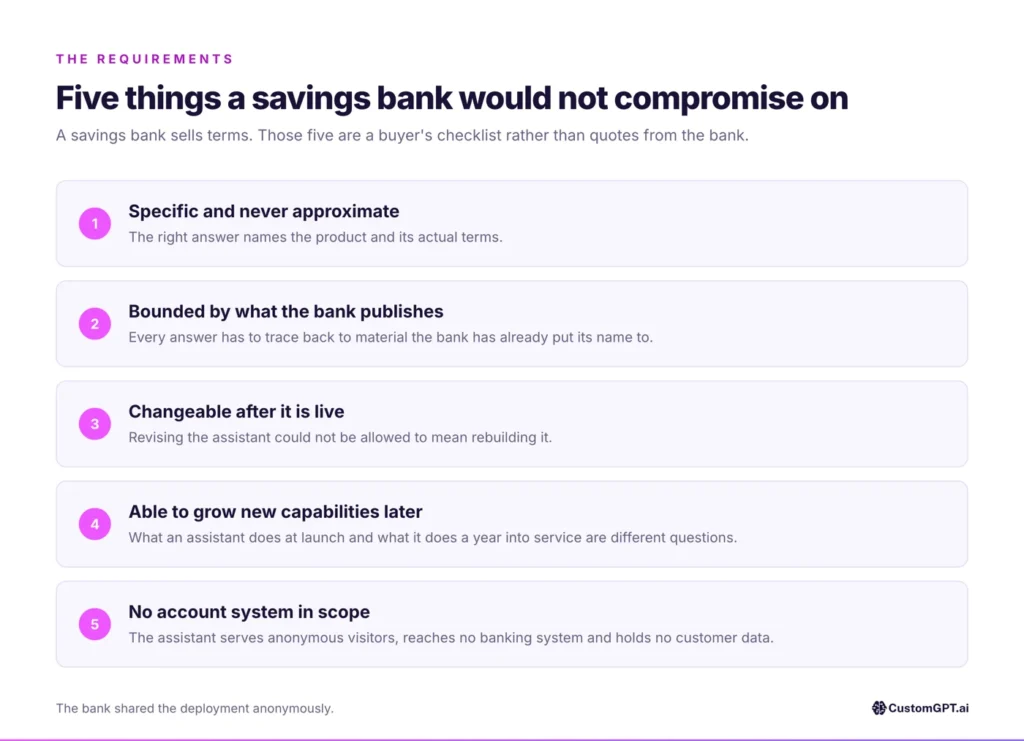
First, specific and never approximate. The right answer names the product and its actual terms, and an answer about savings accounts in general fails the only test that matters. Second, bounded by what the bank publishes. Every answer has to trace back to material the bank has already put its name to, and the visitor has to be able to see which page it came from.
Third, changeable after it is live. Nobody expected to get the wording right on the first attempt, so revising the assistant could not be allowed to mean rebuilding it.
Fourth, able to grow new capabilities later, because what an assistant does at launch and what it does a year into service are different questions and the second one could not require starting over.
Fifth, no account system in scope. The assistant serves anonymous visitors, reaches no banking system and holds no customer data.
Those five are a buyer’s checklist rather than quotes from the bank. Each one corresponds to a configuration this deployment actually carries.
The capability that decided it: changing the thing while it runs
The assistant running today is the one that launched, and it is not the product it was. Its instructions have been rewritten 127 times. Two agentic actions were switched on four months into its life. Its corpus has been recrawled as the bank’s site changed. Every one of those changes landed on the deployment already answering visitors.
None of them produced a second assistant, a migration, a reload of the assistant’s material or a day out of service. That is the difference between buying a finished thing and buying something you can keep deciding about, and it is the reason a bank of this size could start narrow without betting the whole deployment on getting the wording right the first time.
The default assistant created at sign-up took a single recorded question and was retired, so exactly one voice has ever answered for the bank.
The record, before and after the assistant was widened
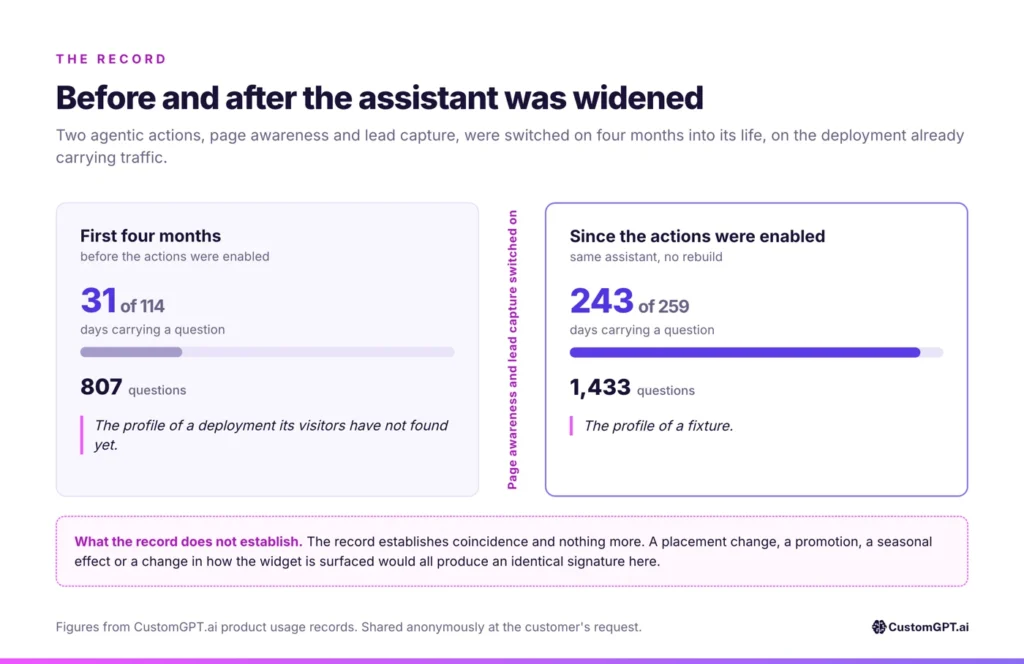
For its first four months the assistant was asked something on 31 days out of 114, which is the profile of a deployment its visitors have not found yet. Since the actions were enabled it has been asked something on 243 days out of 259, which is the profile of a fixture.
The raw volume across those two stretches went from 807 questions to 1,433. The frequency changed category entirely.
What the bank has now is a fixture on the website rather than a feature of it. It answers on nearly every day of the year, it carries two actions that move a visitor onward from the answer, and the words it uses are whatever the bank decided most recently rather than whatever was written at launch.
What the record does not establish
The two stretches sit either side of the point at which the actions were enabled, and it would be easy to read one as having caused the other. The record establishes coincidence and nothing more. A placement change, a promotion, a seasonal effect or a change in how the widget is surfaced would all produce an identical signature here.
Answer quality is not measured on this account either, so nothing here is a claim about correctness. Every claim in this study is a claim about configuration and volume, which is what the records actually hold.
What this means for you
Ask what you are still allowed to change once it is live. Editing what an assistant says and changing what it can do are two different jobs, and a platform worth buying lets you do both without a migration and without a second deployment running alongside the first.
And do not judge a deployment on its first quiet quarter. This one was asked something on roughly one day in four to begin with, and the part of the record worth reading starts after that.
The first-time buyer comparing notice periods late at night now gets the bank’s own terms and can see which page they came from. The teller keeps the conversations that need a person. The marketing manager finally has something on that product page that answers back.
| Measure | To date |
| Questions asked, raw count | 2,240 |
| Revisions to the assistant’s instructions since launch | 127 |
| Agentic actions added to a live assistant | 2 |
| Rebuilds, migrations or days out of service | 0 |
| Assistants in production | 1 |
| Time in service | 13 months |
| Questions, first four months | 807 |
| Questions, since the actions were enabled | 1,433 |
| Days carrying a question, first four months | 31 of 114 |
| Days carrying a question, since the actions were enabled | 243 of 259 |
Figures from CustomGPT.ai product usage records. Shared anonymously at the customer’s request.