
Introducing: CustomGPT OCR: Extract Knowledge From Images into Chatbot-Ready Content
Today, CustomGPT, the leading platform to create custom LLM powered chatbots with your own content, is thrilled to unveil its latest feature: Optical Character Recognition (OCR).
Included in our Premium and Enterprise plans, this addition marks a significant advancement in our platform’s capabilities and our commitment to help businesses build chatbots with ALL their business content.
This introduction of OCR demonstrates our commitment to helping businesses lower customer support costs and improve employee efficiency with cutting-edge, LLM-based tools.
Building on the advancements of Generative AI in enabling vision, hearing, and speech, CustomGPT is proud to offer businesses the ability to integrate text from images, scanned documents, and other visual sources into their custom LLM-based chatbot.
This eliminates the barriers that previously existed between visual content and digital interaction. By bridging this gap, we empower businesses to harness the vast amount of information contained in non-digital formats, bringing a new dimension of interactivity to their customer interactions.
With this feature, the power of CustomGPT.ai expands beyond textual data. It’s not just about enhancing the capabilities of chatbots—it’s about redefining what they can achieve across visual-to-verbal use cases. By enabling a seamless blend of visual and textual content, we’re making it even easier for businesses to create a comprehensive, content-rich chatbot experience that meets the evolving needs of their audiences.
Experience the OCR Advantage: Making Information Access from Images Faster and Easier
Picture a lawyer who has just received a massive scanned contract containing crucial information. Instead of diving deep into the extensive PDF, they want a quick answer to a specific query they have about the content. However, with 200+ pages of data and no tools to ingest the text on the page, the lawyer is out of luck.

Normally, the lawyer would have to manually comb through the document, painstakingly searching for the information they need. This could mean hours of reading, often leading to frustration and wasted time.
In the digital age, spending hours to locate specific pieces of information in vast documents isn’t just tedious; it’s archaic. The conventional method is time-consuming and doesn’t guarantee that they’ll find the exact information they’re looking for.
Enter CustomGPT’s OCR feature. With this, the lawyer simply feeds the scanned document into their CustomGPT chatbot, turns OCR “On,” and allows the chatbot to index the content. Within moments, they receive precise answers to their questions, all without having to read through the entire document. Our OCR feature ensures that information trapped in images becomes easily accessible, saving time and enhancing productivity.

Now, with CustomGPT, the lawyer can interact directly with the contract. Instead of combing through pages of text (or outsourcing the work to a paralegal), they can find the information they need in a matter of seconds. Whether their client has questions about the Equipment Allowance stipulated by the contract or is confused about the definition of one of the terms, CustomGPT can deliver the relevant information quickly and reliably.

How to Upload Data Using the OCR Feature:
For an Instructional Video, please check out our Youtube: https://www.youtube.com/watch?v=-R1Xf1IRxEs
Also, be sure to refer to our OCR Guide for a step-by-step guide in using the OCR feature.
Step 1: Sign in
a) Sign in to https://app.customgpt.ai/.

Step 2: Access the Data Settings
Click on Data
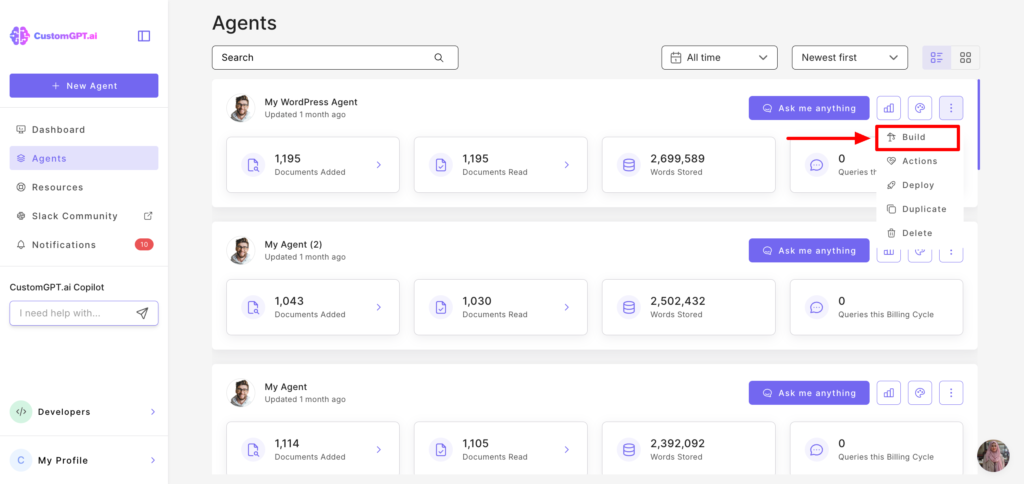
Step 3: Upload your Scanned documents or images:
On the “Upload” section, click in the middle of the box to upload your scanned documents or images.
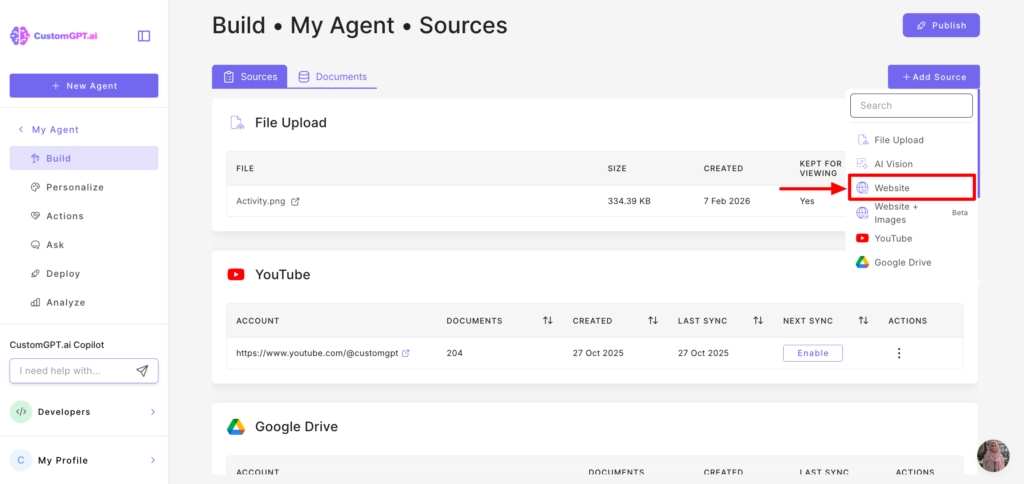
Step 4: Enable OCR (Premium plans only)
a) At the bottom of the page, look for the “OCR” feature.
b) If you have a premium plan, you will have the option to toggle the OCR feature to “ON” for a document analysis chatbot. Enabling this feature activates the OCR functionality for your uploaded data.
c) Click “Add Files”

Technical Details
The CustomGPT platform uses OCR to process your documents and images, taking care of technical issues like large document handling, mixed-content, document formats and language processing.

The extracted text is then converted into embeddings that represent the LLM (large language model) and stored in a vector database. When the user asks a question, the vector database, combined with CustomGPT’s proprietary algorithms (such as anti-hallucination, citation generation, and query relevancy) and advanced LLMs, generates a response to the user’s query.
Frequently Asked Questions
Can ChatGPT read a scanned document, or do I need OCR for a chatbot knowledge base?
For a reusable chatbot knowledge base, you typically need OCR. OCR extracts text from images and scanned documents, then a RAG system indexes that text so future questions can retrieve the right passage instead of treating the file as a one-time attachment. In a published RAG accuracy benchmark, CustomGPT.ai outperformed OpenAI, which matters when you need consistent answers from ingested documents.
What kinds of image-based files can OCR turn into chatbot-ready content?
OCR is meant for images, scanned documents, and other visual sources. In practice, that includes image-based files such as scanned PDFs, screenshots, and photos of printed pages when the text is visible enough to extract. After extraction, the text can be added to a no-code chatbot knowledge base and searched like other documents.
How reliable are answers from scanned PDFs and screenshots after OCR?
Answers are most reliable when scanned content becomes a curated, searchable source and the chatbot uses retrieval with citations. Elizabeth Planet said, “I added a couple of trusted sources to the chatbot and the answers improved tremendously! You can rely on the responses it gives you because it’s only pulling from curated information.” The practical takeaway is to OCR the file, index it, and use citation support to verify the source passage behind each answer.
Is it safe to upload sensitive scanned documents for OCR?
It can be safe if you confirm the platform’s controls before upload. Look for SOC 2 Type 2 certification, GDPR compliance, a statement that customer data is not used for model training, and document controls such as data anonymization and retention settings. Those safeguards matter when scanned files contain HR, legal, or compliance information.
If I already extract text into my own database, why use an OCR chatbot platform?
If you already extract text into a database, an OCR chatbot platform still gives you the answer layer. That includes retrieval-augmented generation, citation-backed responses, multi-source ingestion, analytics, and deployment through a widget, live chat, search bar, or API. Sebastien Laye of Aslan AI said, “From beginning to end of the project, CustomGPT was the solution. With further integration of new features, we might even abandon some tools like Bubble or ChatPDF.”
What business results can teams expect from adding OCR content to a chatbot workflow?
The main business upside is faster access to information that was previously trapped in scans, along with lower support effort and better employee efficiency. A typical flow is OCR first, then retrieval, then a source-grounded answer in seconds. Brendan McSheffrey of The Kendall Project said, “We love CustomGPT.ai. It’s a fantastic Chat GPT tool kit that has allowed us to create a ‘lab’ for testing AI models. The results? High accuracy and efficiency leave people asking, ‘How did you do it?’ We’ve tested over 30 models with hundreds of iterations using CustomGPT.ai.”
Related Resources
This guide adds useful context if you’re thinking beyond OCR and into how AI delivers answers at scale.
- AI Knowledge Delivery — Explore how CustomGPT.ai turns your content into fast, accurate responses that improve how information is shared and accessed.