
One Assistant Worked, So a Credit Union Built a Second and Then a Third
A member-owned credit union in the southeastern United States runs three grounded assistants on its own published member-facing material. Between them the three have taken 48,372 questions, carried a question on 446 of the 462 days the estate has existed, and been revised 198 times by the people who own them.
In the latest quarter, of the questions the credit union’s own material covers, 97.8% of the answers landed well. The credit union shared all of this anonymously.
A credit union answers to its members, and the members ask on Saturday
Picture a member working out on a Saturday morning whether a payment posted before the weekend, and what happens if it did not. Picture the contact center representative who has answered that same question nine times before lunch and will answer it again after.
Picture the digital banking manager who can see in the analytics that the questions arriving by phone and the questions arriving on the website are not the same questions, and who has one website to answer both with.
Member ownership raises the stake on a wrong answer. A member who is told the wrong thing about a fee, a hold or an eligibility rule is an owner who was told the wrong thing, and the recourse is a phone call that takes more attention than the original question ever did.
Scale makes that harder rather than easier. At tens of thousands of questions, a small rate of confident error reaches a large number of members.
What got built, one assistant at a time
The credit union started with a single grounded deployment on its published material. That first assistant is still the highest-volume of the three, carrying 36,781 of the 48,372 questions on its own. It ran on its own long enough to produce a record rather than an impression.
A second assistant followed, added alongside the first rather than replacing it, with its own grounding and its own actions. A third came later, narrower again and the smallest by volume at 1,480 questions.
All three were still answering members on the last day recorded. None of them reaches an account system or holds member data, which keeps the risk surface something a small team can actually govern.
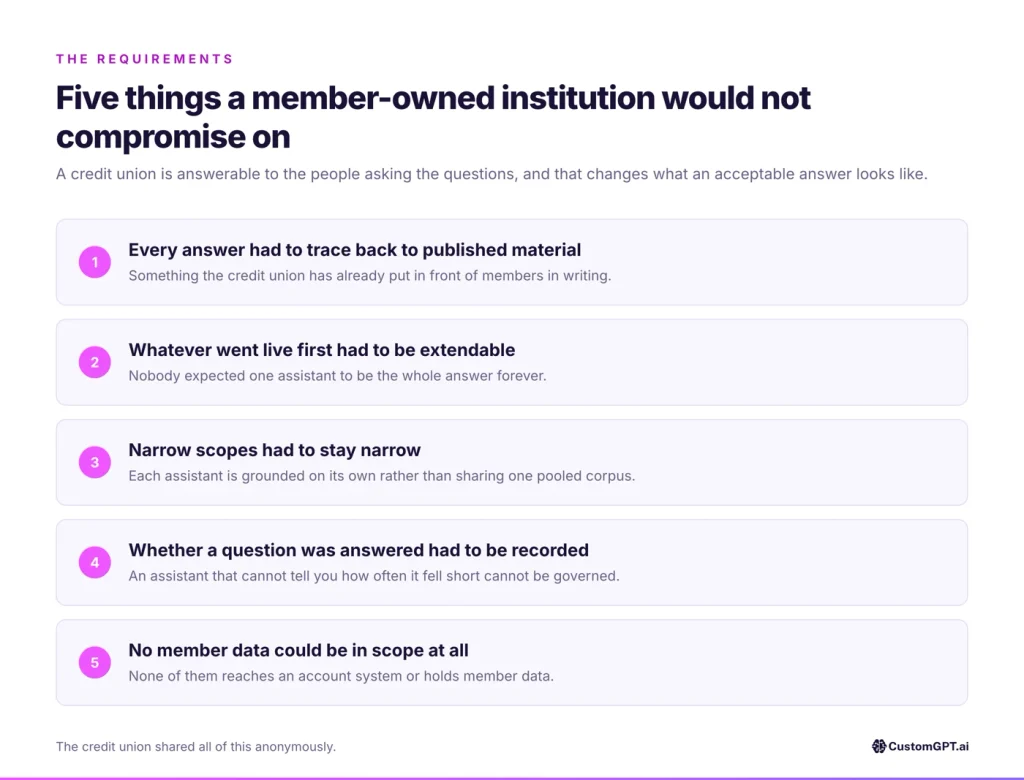
Five things a member-owned institution would not compromise on
A credit union is answerable to the people asking the questions, and that changes what an acceptable answer looks like. It also changes what an acceptable unknown looks like. Five requirements shaped everything that followed.
Every answer had to trace back to something the credit union has already put in front of members in writing. Whatever went live first had to be extendable, because nobody expected one assistant to be the whole answer forever.
Narrow scopes had to stay narrow, so each assistant is grounded on its own rather than sharing one pooled corpus. Whether a question was answered had to be recorded, because an assistant that cannot tell you how often it fell short cannot be governed. And no member data could be in scope at all.
The capability that decided it: adding an assistant is an addition, not a migration
The credit union put one assistant in production, let it run, then added a second with its own grounding while the first kept answering. The first did not lose a day of service to either addition.
Platforms that make you widen one assistant to cover a new scope force a choice between breadth and precision, and a credit union that widens its one assistant until it is vague has traded away the thing that made it safe.
Separate grounding means a narrow question gets answered from narrow material. It also means the three behave differently in the record, because they are being asked different things. That difference is visible rather than blended away, which is the whole reason the estate can be read assistant by assistant.
The results, read one row at a time
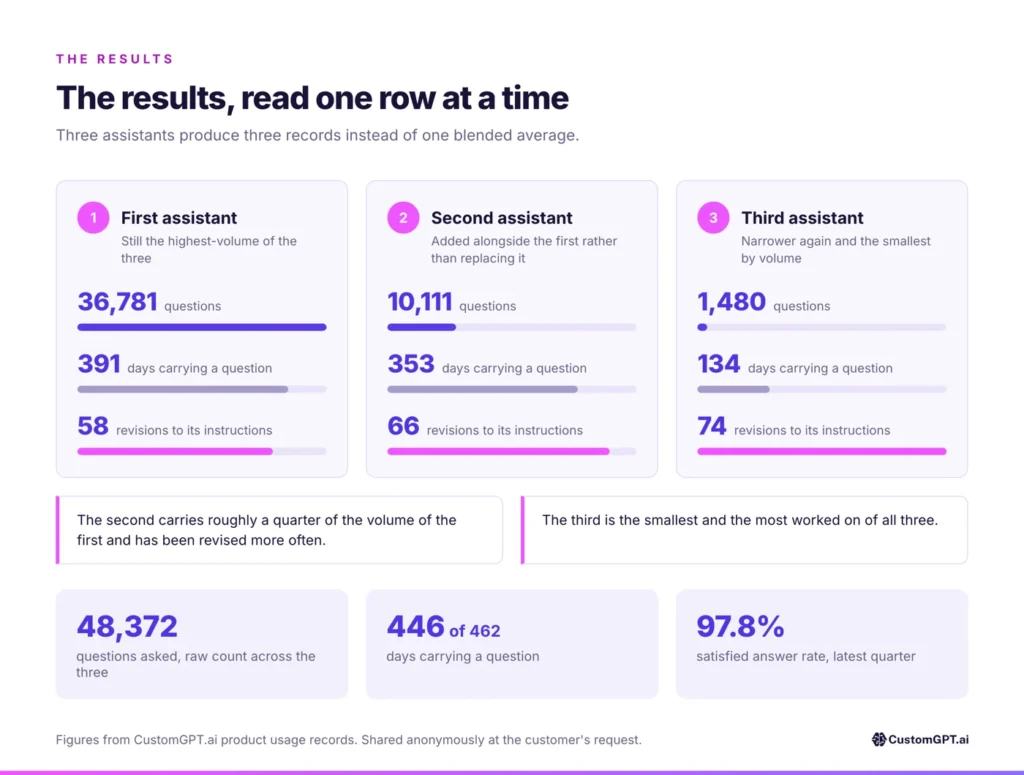
The first assistant has taken 36,781 questions over 391 days carrying a question, with 58 revisions to its instructions. The second has taken 10,111 over 353 days, with 66 revisions. The third has taken 1,480 over 134 days, with 74 revisions. Across the estate, questions arrive on 446 of the 462 days it has existed, which is the shape of a service rather than a pilot.
The second carries roughly a quarter of the volume of the first and has been revised more often, which is the signal you would expect from a narrower front door taking harder questions. The third is the smallest and the most worked on of all three.
Separately, in the latest quarter, 97.8% of the answers to questions the credit union’s own material covers landed well, measured across 7,019 in-context questions. Questions on subjects the published material does not cover are excluded from that figure rather than counted against it, and the list of them is a content roadmap rather than a verdict on the assistants.
What three separate records give you
Three assistants produce three records instead of one blended average. The credit union can see which assistant carries the volume, which one is taking the harder questions, and which one is being tuned hardest, and it can act on any of the three without disturbing the other two.
That is also why 198 revisions is a healthier number than it first looks. Each revision is someone who owns the material deciding how an answer should land and changing it, on one assistant, without a release that touches the other two.
What this means for you
Test the second assistant before you commit to the first. The question worth asking a vendor is what adding a new scope does to the one already in service, because the answer decides whether you end up widening a single assistant until it answers everything vaguely and nothing exactly.
Insist on a per-assistant record. Aggregate numbers hide the assistant that is struggling, and an estate you cannot read row by row is one you cannot fix row by row.
Ask how answer quality is recorded, and ask what happens to a question the corpus does not cover, because an honest platform treats that as a gap in your content rather than a failure to report.
The member checking on a Saturday whether a payment posted gets the credit union’s own published answer at the hour she asks. The representative answers the ninth question of the morning once instead of ten times.
The digital banking manager can finally see which questions arrive where, because each assistant keeps its own record.
| Measure | To date |
| Assistants in production, added one at a time | 3 |
| Questions asked, raw count across the three | 48,372 |
| Questions taken by the first assistant | 36,781 |
| Questions taken by the second assistant | 10,111 |
| Questions taken by the third assistant | 1,480 |
| Revisions to how the three answer | 198 |
| Days carrying a question | 446 of 462 |
| Satisfied answer rate, latest quarter | 97.8% |
| In-context questions behind that rate, latest quarter | 7,019 |
Figures from CustomGPT.ai product usage records. Shared anonymously at the customer’s request.