
A Business Bank’s AI Customer Service Chatbot Has Been Asked Something on 752 of the 791 Days It Has Existed
A community bank in the eastern United States, built around business and commercial banking and operating across several states, runs one AI customer service chatbot on its public website. It is grounded in the bank’s own published product pages, rate material and disclosures.
Across twenty-six months in production it has been asked 13,932 questions and has carried at least one question on 752 of the 791 days it has been live, which works out at 95.1% of the days it has existed. Agentic actions run on top of every reply, the wording has been revised 52 times, and the estate has stayed at one assistant throughout.
The bank shared the deployment anonymously.
Business banking questions arrive after the branch has closed
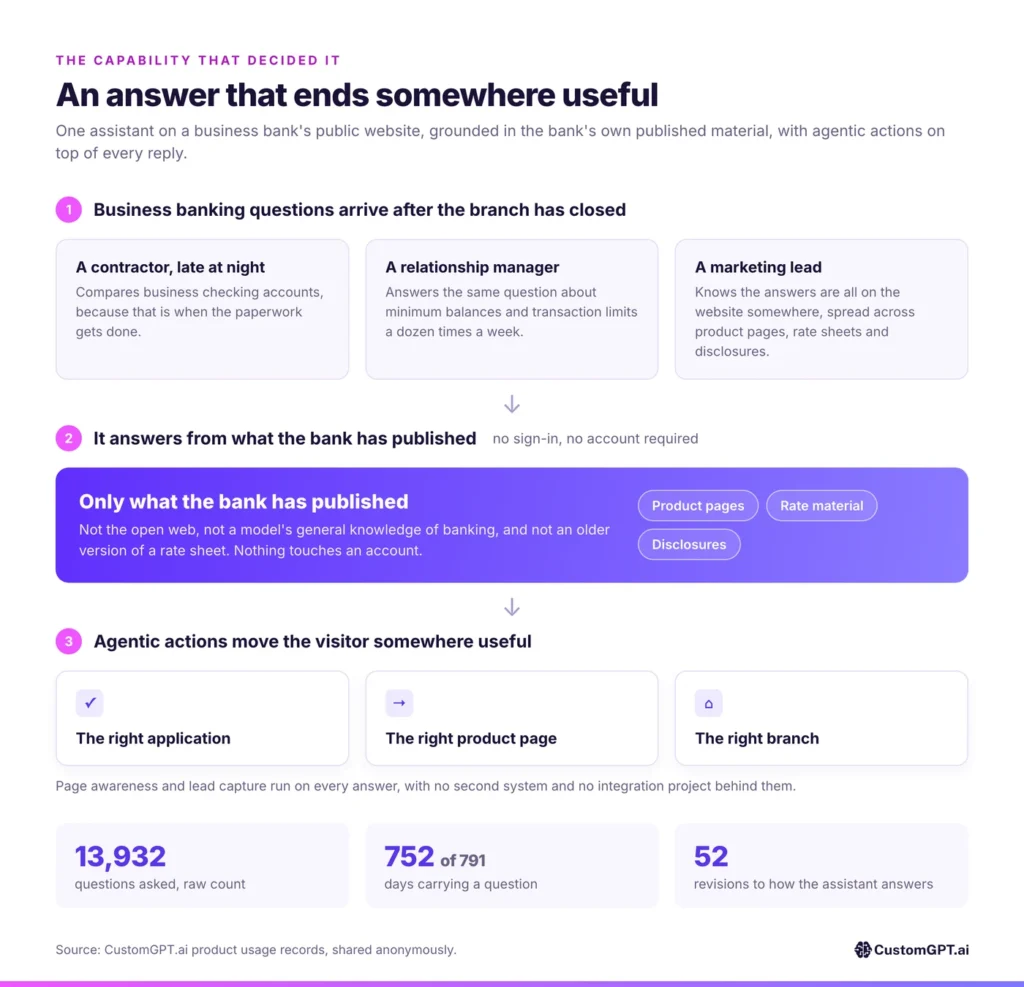
A contractor compares business checking accounts late at night, because that is when the paperwork gets done. A relationship manager answers the same question about minimum balances and transaction limits a dozen times a week, for prospects who will not become customers for another month.
A marketing lead owns the website and knows the answers are all on it somewhere, spread across product pages, rate sheets and disclosures.
The bank publishes everything it needs to. The material exists, it is accurate, and it is maintained. What it does not do is answer a question, because a rate sheet is a document rather than a reply, and a visitor with one specific question about one specific account has to find it first.
The gap was never a shortage of published material. It was the distance between a document and an answer.
What the bank built
One assistant on the public website, available to anyone who visits, with no sign-in and no account required. The corpus is the bank’s own published product pages, rate material and disclosures, which is what keeps the answer inside what the bank has actually committed to in writing.
Agentic actions are switched on, so a reply can do something rather than only say something. Page awareness and lead capture run on top of the answer, with no second system and no integration project behind them. A visitor who has just had a product explained can be moved to the right application or the right page instead of being sent back to search.
What it did not take is worth listing. No core banking integration, because the assistant answers from published material and touches no account system. No rewrite of the website, because product pages and rate sheets went in as the bank already maintains them.
No second team, because the deployment has not needed a rebuild and the count of assistants has stayed at one.
The requirements the bank would not compromise on
A bank carries an obligation a general knowledge base does not. What it tells a visitor about a rate, a fee or an eligibility rule is a statement about a regulated product, made in public, by the bank. There is no version of this where an approximately correct answer is good enough.
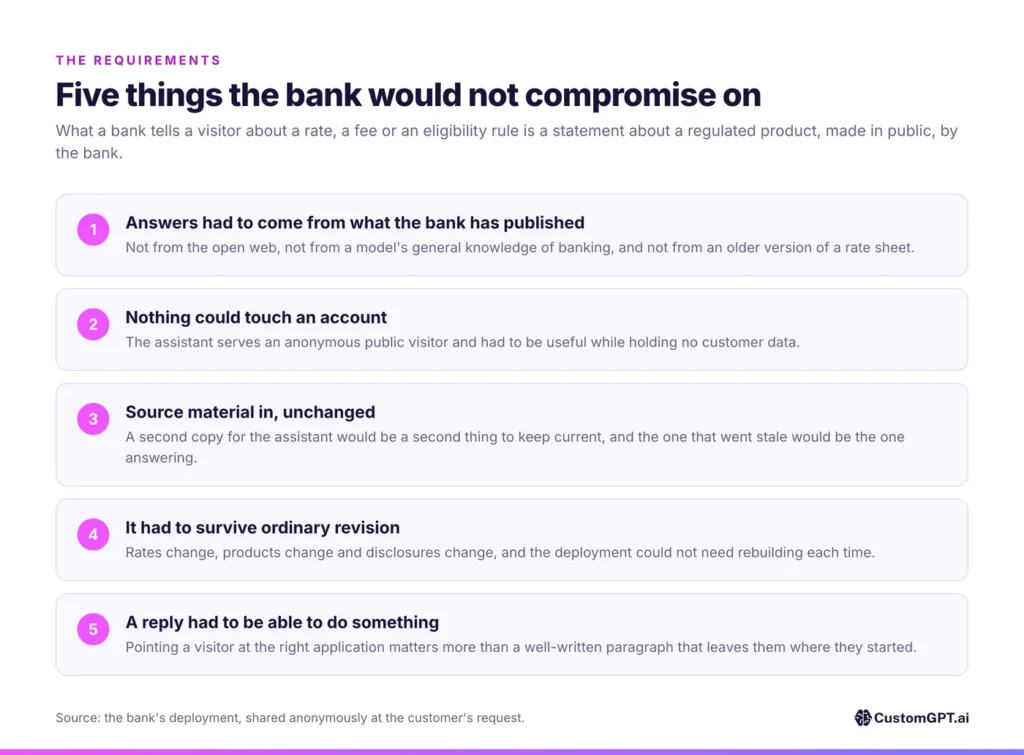
Answers had to come from what the bank has published, not from the open web, not from a model’s general knowledge of banking, and not from an older version of a rate sheet. Nothing could touch an account, since the assistant serves an anonymous public visitor and had to be useful while holding no customer data.
Source material had to go in unchanged, because a second copy for the assistant would be a second thing to keep current, and the one that went stale would be the one answering.
It had to survive ordinary revision, since rates change, products change and disclosures change, and the deployment could not need rebuilding each time.
And a reply had to be able to do something, because pointing a visitor at the right application matters more than a well-written paragraph that leaves them where they started.
The capability that decided it, which is an answer that ends somewhere useful
Agentic actions run on top of every reply, so the assistant can move a visitor to the right application, the right product page or the right branch rather than leaving them to search again.
For a bank this is the difference between a well-written paragraph and a started application late at night.
An assistant that only replies is a better-phrased version of the FAQ page, and the bank already had one of those on the website. The actions are what made the deployment worth running rather than worth admiring, and they came built in rather than arriving as an integration project of their own.
What twenty-six months of demand looks like
Read the 752 first. A launch spike shows up as a busy fortnight and a long tail of silence, and this is the opposite shape. The assistant has been asked something on 95.1% of the days it has existed, across twenty-six months, two rate cycles and the ordinary revision of a bank’s published material.
The volume is modest by design, at 13,932 questions, because this is one assistant on one website rather than an estate. Pilots end. This one is still being asked something on almost every day it has been live, and demand that survives that long has stopped being curiosity and become a habit the bank’s customers have formed.
Marketing has kept it current across that run, with 52 revisions to how the assistant answers, every one landing on a deployment already in service.
What the record does not claim
No answer-quality classification exists on this deployment, so no answer rate appears anywhere in this piece. The day counts describe how often someone asked, not how well any particular reply landed, and the two should not be read as the same thing.
Deflection, satisfaction and staff hours saved are not measured here either. The closing description of what changed for three people carries no number, because no number exists for it. The two rate cycles mentioned above describe the period’s ordinary banking conditions rather than anything the deployment did.
What this means for you
Count the days, not the launch. The number worth watching is how many days later someone is still asking, because that is the one a pilot cannot fake. A busy first fortnight tells you about your announcement. A question on almost every day for twenty-six months tells you about the product.
Decide what a reply is allowed to do. An assistant that can act is a different product from one that can only explain, and the difference shows up after hours, when there is nobody to hand the visitor to.
The contractor comparing accounts late at night gets an answer from the bank’s own rate material rather than a callback form. The relationship manager answers the question that actually needs a person. The marketing lead who owns the website now owns something on it that replies.
Every figure in this piece is set out, with the bank’s at-a-glance details and a set of frequently asked questions, in the full business bank case study.
| MEASURE | TO DATE |
| Time in production | 26 months, one assistant |
| Questions asked, raw count | 13,932 |
| Days carrying a question | 752 of 791 |
| Share of days in production carrying a question | 95.1% |
| Revisions to how the assistant answers | 52 |
| Assistants built since | None. The count has stayed at one |
Figures from CustomGPT.ai product usage records. Shared anonymously at the customer’s request.
Related reading
AI Customer Service Chatbot for a Community Bank Website: another bank’s public-site assistant, grounded only in its own published rates and terms.