
A Community Bank Has Revised Its AI Customer Service Chatbot 224 Times, and Not One of Them Was a Deployment
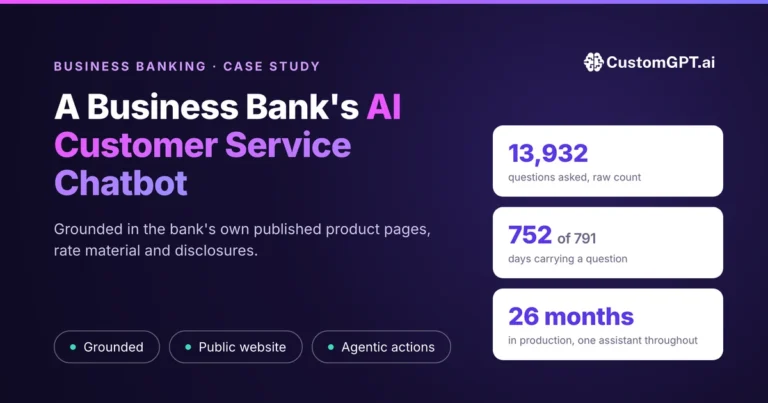
A community bank in the southeastern United States runs one AI customer service chatbot on its public website, grounded in the bank’s own published product and account material. Across twenty-eight months in production it has taken 3,723 questions, carried a question on 659 of 852 days, and carried one on 319 of the most recent 365.
The figure the bank’s own record leads with is a different one.
Its marketing team has revised the assistant’s instructions 224 times, roughly one revision every four days, and not one of those edits needed a rebuild, a release or anyone outside the bank. Three agentic actions now run on top of every answer. The bank shared the deployment anonymously.
The products move, and the answers have to move with them
A customer sits down on a weekend to work out whether a particular deposit account suits a seasonal business. A branch officer fields the same handful of product questions between appointments and would rather spend that time on the appointments. A marketing lead owns the website, reads what the assistant tells people, and wants it to sound like the bank on every answer rather than on most of them.
Rates move. Products get added and retired. Phrasing that read well against one version of a page starts to read oddly once the page has been rewritten. A bank of this size cannot run a release process to fix a sentence, so the practical question at purchase was a narrow one. When somebody reads the assistant’s answer and knows a better way to say it, how long does that take to change, and who has to be involved?
What the bank built
One assistant, on the public website, grounded in the bank’s own published product and account material. The corpus is the live site, crawled as it stands and recrawled as the bank revises it, so the material stays current as a by-product of running the site rather than as a separate task on somebody’s week.
The instructions were written in-house rather than accepted as a generic persona. Citations are shown on the answer, so a visitor can see which page a statement about a product came from. Three agentic actions run on top of the reply: page awareness, conversion and lead capture. They were not all switched on at launch. The third went on in the most recent stretch of the record, added when the case for it appeared.
What the build did not involve says as much as what it did. There is no core banking integration. The assistant reaches no account system and holds no customer data. There is no second copy of the bank’s content maintained alongside the site. And there is no release process standing between a weak sentence and a better one.
The requirements the bank would not compromise on
A bank this size buys differently from a large one. The question is rarely whether a capability is impressive on the day of the demonstration. It is what the thing will be like to live with in the second year.
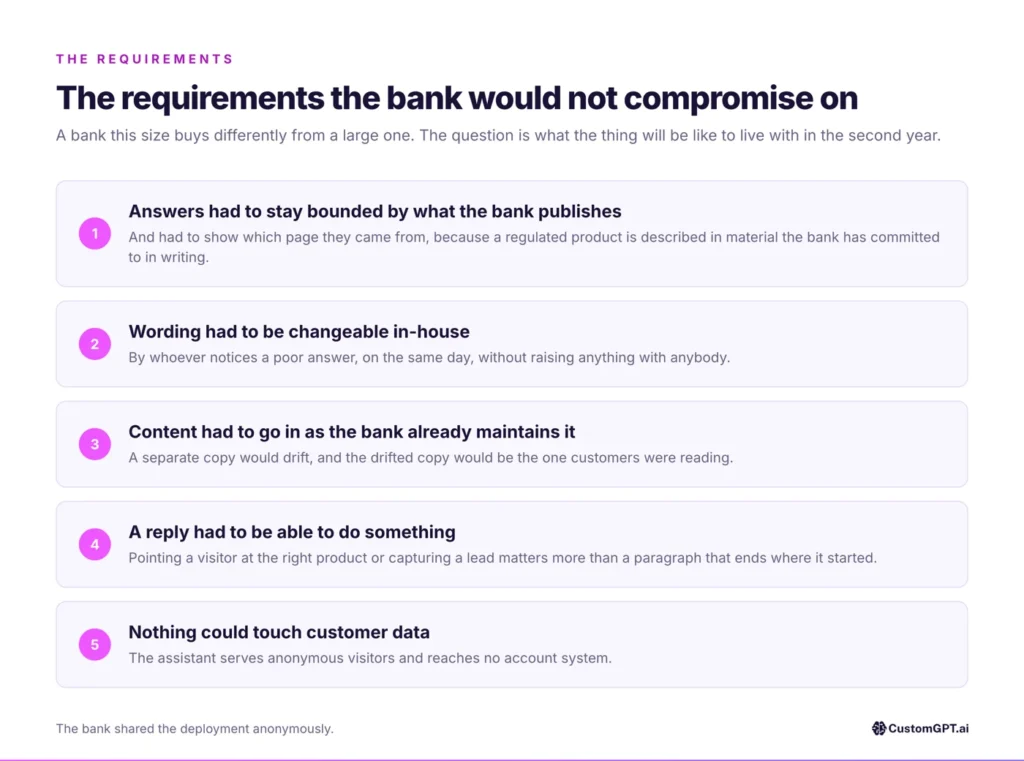
Answers had to stay bounded by what the bank publishes, and had to show which page they came from, because a regulated product is described in material the bank has committed to in writing. Wording had to be changeable in-house, by whoever notices a poor answer, on the same day, without raising anything with anybody. Content had to go in as the bank already maintains it, because a separate copy would drift, and the drifted copy would be the one customers were reading.
A reply had to be able to do something, since pointing a visitor at the right product or capturing a lead matters more than a paragraph that ends where it started. And nothing could touch customer data. The assistant serves anonymous visitors and reaches no account system, which keeps the risk surface somewhere a bank of this size can govern it.
The capability that decided it, which is that editing is not deploying
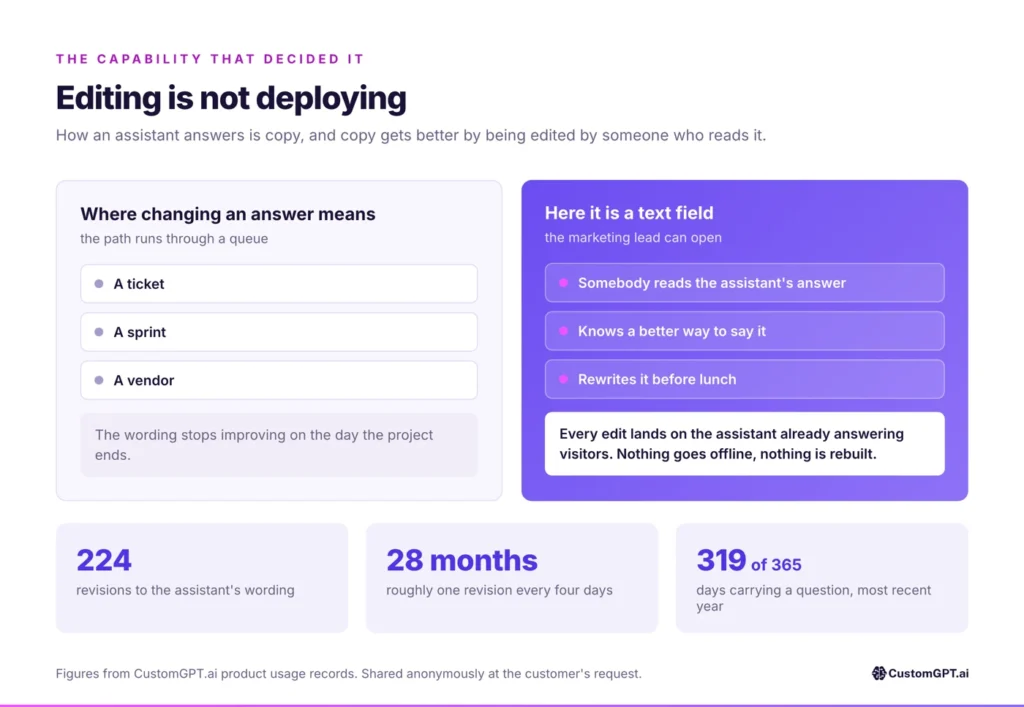
How an assistant answers is copy, and copy gets better by being edited by someone who reads it. This bank has revised its assistant’s instructions 224 times across twenty-eight months, and every one of those edits landed on the assistant that was already answering visitors. Nothing went offline, nothing was rebuilt, and nobody outside the bank was involved.
No other bank assistant in our published case studies has been revised as often. Where changing an answer means a ticket, a sprint or a vendor, the wording stops improving on the day the project ends. Here it is a text field the marketing lead can open, which is why the answers have kept pace with a bank that has not stood still either.
What the record shows
The two day counts tell the story between them. Across the whole deployment the assistant has carried a question on 659 of 852 days. In the most recent year of the record it has carried one on 319 of 365. The opening stretch was sparse, at a handful of active days a month. Every month since has run between nineteen and thirty. It found its footing and then became part of the furniture.
Volume is modest by design, at 3,723 questions, because this is one assistant on one website rather than an estate. Set the 224 revisions beside the day counts and the shape is clear enough. The bank runs this assistant rather than hosting it.
What the record does not claim
The 224 revisions are evidence of effort, not of improvement. The record shows that the bank worked on its answers steadily across twenty-eight months. It holds nothing about whether any single edit made the next answer better, and this piece does not claim that it did.
No answer-quality classification exists on this deployment, so no answer rate appears anywhere here. The revision cadence is a rate derived from two totals rather than an observed pattern, which is why it is described as roughly one every four days and is not tightened any further.
What this means for you
Put a number on the edit loop before you buy. Find out exactly what happens between someone reading a poor answer and that answer changing. If the path runs through a queue, the wording will stop improving the month after launch, and the assistant will slowly stop sounding like you.
Ground the assistant in what you already publish. Anything that needs its own copy of your content has quietly added a maintenance task to somebody’s week, and the copy nobody maintains is the one that will be answering your customers.
The weekend customer gets an answer drawn from the bank’s own material and can see the page it came from. The branch officer keeps the appointments and loses the repetition. The marketing lead reads an answer she does not like, rewrites it before lunch, and adds one more to the 224.
| MEASURE | TO DATE |
| Time in production | 28 months, one assistant |
| Questions asked, raw count | 3,723 |
| Days carrying a question | 659 of 852 |
| Days carrying a question, most recent 365 | 319 |
| Revisions to the assistant’s wording | 224 |
| Agentic actions now running | Three, added over time |
| Assistants in production | One, throughout |
Figures from CustomGPT.ai product usage records. Shared anonymously at the customer’s request.