
What 86% AI Resolution Looks Like for a SaaS Support Team (Real Numbers, Real Docs)
Most SaaS support teams ask the same question when evaluating AI: what deflection rate should I actually expect?
For vendor selection before a rollout, compare AI assistants for customer service by grounding, handoff quality, and ticket-pilot evidence.
The honest answer depends on one variable more than any other: whether your AI reads your documentation or generates from general training data. That single choice accounts for most of the gap between the 40-45% median and an 86% result.
Direct answer: The AI support ticket deflection rate a SaaS team achieves depends primarily on whether the AI reads your actual documentation or generates from general training data.
The AI integrations behind high-resolution support matter because they decide where answers, escalations, and metrics come from.
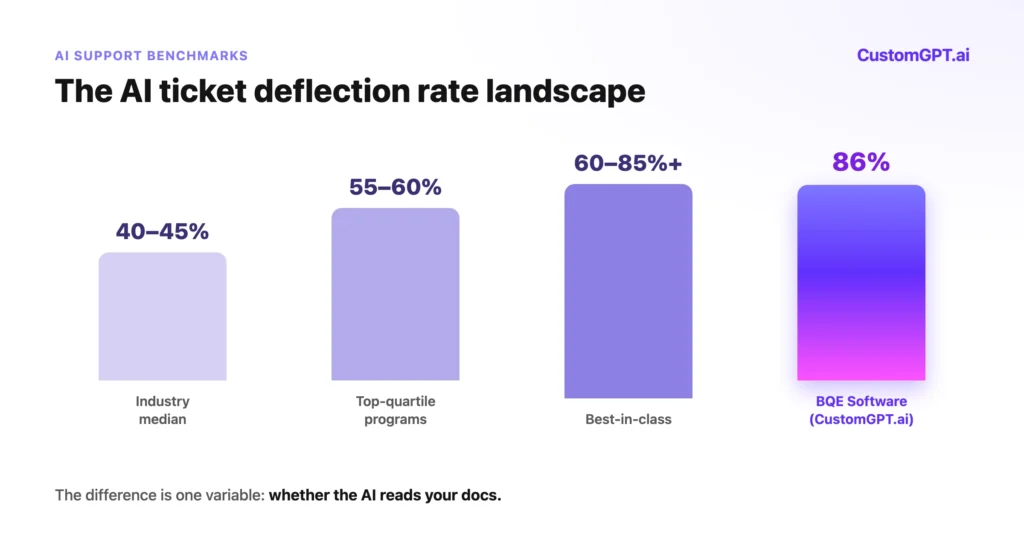
Digital Applied’s 2026 AI customer support statistics roundup puts the industry median at 40-45%, with top-quartile teams reaching 55-60%. Documentation-grounded AI consistently reaches 85%+. BQE Software achieved 86% using a documentation-grounded agent on their existing knowledge base.
What the Benchmark Landscape Actually Looks Like
Before examining BQE’s numbers, it helps to understand where they sit relative to the broader market.
Sources: [Digital Applied’s 2026 AI customer support statistics roundup]; [UsePylon 2025 benchmarks]; [Fin AI ROI data].
The gap between the 40-45% median and 86%+ is not random. It comes down to one variable more than any other: whether the AI generates answers from its general training data or reads your actual documentation.
Why Documentation-Grounded AI Outperforms General AI
The deflection rate gap between documentation-grounded AI and general AI comes down to accuracy, and accuracy comes down to data source.
General AI tools generate responses from training data scraped from billions of internet documents. For general topics, that produces plausible answers, but for SaaS support, it consistently produces wrong ones.
Your product’s behavior, your pricing tiers, your specific workflows, and your policy updates from last quarter are not in any AI’s training data. A general AI will answer confidently with information that is either outdated, approximate, or invented.
How Documentation-Grounded AI Works Differently
Documentation-grounded AI reads your actual help docs and returns what your docs say. The answer the customer gets is the answer your documentation contains, with a citation back to the source article so customers and agents can verify it.
This accuracy difference shows up directly in the customer acceptance rate, meaning the percentage of customers who accept the AI’s answer without escalating. For documentation-grounded AI, acceptance rates are measurably higher because the answer matches what customers actually see in the product. For general AI, customers recognize when the answer is wrong and escalate.
The Compounding Effect on Deflection
The deflection difference between 40% and 86% is largely the difference between these two approaches. When the AI answers from your docs, its accuracy is high enough that customers accept the answer and do not open a ticket. When the AI guesses from training data, customers escalate because the answer does not match what they see in the product.
BQE Software: What 86% Resolution Actually Means
BQE Software builds project management, billing, and time tracking tools for professional services firms, including architects, engineers, and accountants. Their support team handles product questions, billing questions, and workflow questions across a complex feature set.
What BQE deployed: A CustomGPT.ai agent connected to their existing knowledge base by URL, with no manual document uploads and no scripting.
Results from the BQE case study:
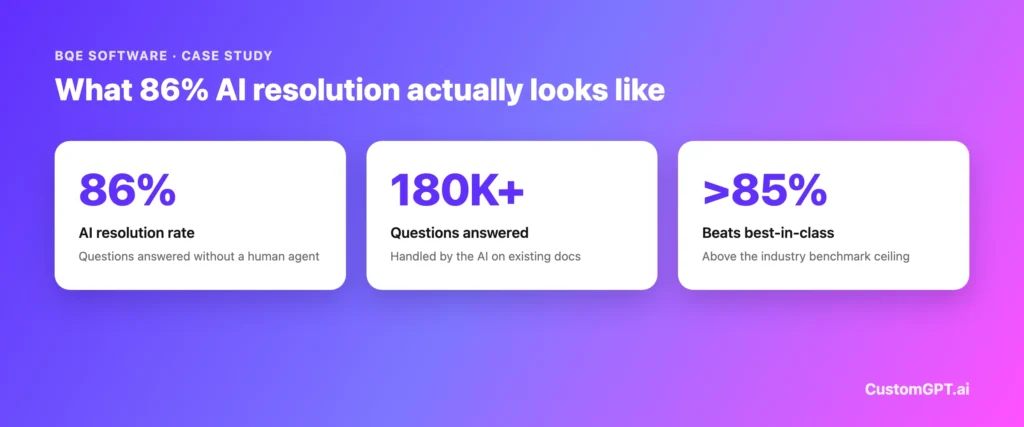
- 86% AI resolution rate, meaning questions answered without a human agent
- 180,000+ questions answered by the AI
- Resolution rate above the industry best-in-class benchmark of 85%
“CustomGPT.ai has fundamentally changed how we deliver help and support,” said Naira Yaqoob, Documentation Manager at BQE Software.
The questions the AI did not resolve (the 14% that reached a human) were the genuine edge cases: account-specific issues, billing disputes, and questions requiring access to the customer’s account data. The AI handled the volume; the agents handled the complexity.
BQE’s 86% result reflects a team with well-maintained documentation and a product that lends itself to documentation-grounded answers. Results vary based on documentation coverage and the distribution of question types a team receives.
Dlubal Software: Scale Across 130,000+ Users
For engineering software company Dlubal Software, the primary challenge was global scale, not just deflection. With 130,000+ engineers using their products across 132 countries, offering consistent support across time zones was a staffing challenge that headcount alone could not solve.
After deploying a CustomGPT.ai agent on their documentation:
- 24/7 support availability across all time zones
- 130,000+ users served by the AI agent
- Technical accuracy maintained for an engineering audience
“The assistant has enabled us to offer 24/7 support while improving accuracy,” said George Dlubal, CEO of Dlubal Software.
For a global engineering software company, the value was not just deflection; it was coverage. The AI handled the time zones where no human agent was available, without sacrificing the technical accuracy that an engineering audience demands.
What to Measure When Evaluating Your Own Results
If you are running an AI support pilot or evaluating results, three metrics provide the clearest picture of whether your deployment is working.
1. Resolution rate (deflection rate)
The percentage of incoming questions answered by the AI without human intervention. Digital Applied’s 2026 AI customer support statistics roundup puts the industry median at 40-45%; top-quartile programs reach 55-60%. If your number is low, the most common cause is that the AI is generating from training data rather than reading your docs.
2. Escalation quality
What percentage of escalations to human agents were genuinely complex, versus routine questions the AI should have answered? If agents are regularly handling questions that are clearly in your documentation, the AI is not reading your docs accurately.
3. Customer acceptance rate
What percentage of customers who get an AI response accept it without escalating? A high acceptance rate indicates the AI’s answers are accurate and trusted. A low rate typically indicates that the AI is generating from training data rather than from your documentation.
4. Security and compliance posture
If you serve enterprise customers or operate in regulated industries, verify your AI tool’s certifications before deployment. SOC 2 Type 2 is the standard baseline for B2B SaaS. Your documentation should be stored in an isolated environment, not used to train shared models or visible to other tenants.
What Is a Realistic Target for Your Team?
Most SaaS support teams starting with documentation-grounded AI see deflection improve in phases. Initial deployment captures the most common FAQ-style questions. Rates climb as the AI surfaces documentation gaps and you fill them.
A realistic starting target for most teams is the 40-45% median in the first deployment period, improving toward 55-60% as documentation gaps are identified and addressed. Teams with comprehensive, well-structured documentation (like BQE) consistently reach the best-in-class range over time.
The single fastest way to improve your deflection rate is not to change AI tools. It is to fill the gaps your AI surfaces. When an AI consistently says “I don’t have that information” for a category of questions, that is a documentation gap, not a tool limitation.
The Cost Math at Each Deflection Rate
The cost difference between deflection levels is significant at any scale.
What ticket deflection is actually worth
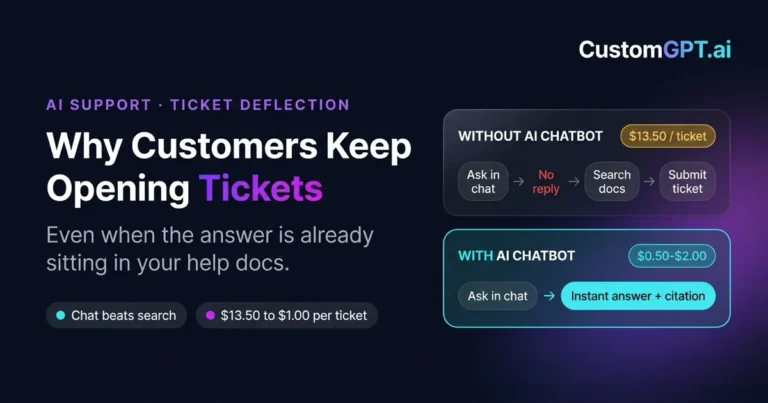
Every ticket your AI resolves on its own is one a human agent never has to touch. That saving is real, but it’s only credible if you anchor it to two honest numbers: what a human resolution costs, and what an AI resolution costs.
- Human baseline — $13.50 per ticket. This is fully-loaded cost of a live-agent interaction: wages, benefits, tooling, and management overhead, not just hourly pay.
- AI cost — $1.00 per ticket. Cross-industry benchmarks from and put AI-handled tickets at $0.50–$2.00 per resolution. We use $1.00, the midpoint of that range, as a deliberately conservative working figure.
That leaves roughly $12.50 in savings for every ticket deflected to AI instead of a person. Multiply that by your monthly volume and your deflection rate, and the math looks like this:
Three things the table makes clear:
- Deflection rate is the real lever. Going from a modest 35% to a best-in-class 86% more than doubles savings at every volume. That gap is won or lost on the quality of your knowledge base and how well the AI retrieves from it — not on ticket count.
- The AI cost here is conservative. At the low end of the benchmark range ($0.50/ticket), per-ticket savings rise another ~4%. We rounded toward caution on purpose.
- These are gross, first-order savings only. They don’t count the compounding wins: faster resolution, round-the-clock coverage, and human agents freed to handle the genuinely hard cases.
Frequently Asked Questions
What deflection rate should I expect from an AI knowledge base chatbot?
Digital Applied’s 2026 AI customer support statistics roundup reports a median AI deflection rate of 40-45% for SaaS support teams, with top-quartile programs reaching 55-60%. Documentation-grounded AI consistently reaches 85%+. The single most important variable is whether your AI reads your actual documentation or generates from general training data. Teams with well-maintained docs and documentation-grounded AI reach the higher end of this range.
What is a good AI resolution rate for SaaS customer support?
Any deflection rate above 60% is considered strong for SaaS support, according to industry benchmarks. Top-quartile teams reach 55-60% and best-in-class deployments reach 85%+. A rate below 40-45% (the current industry median) typically indicates the AI is generating from training data rather than from your documentation. If your current rate is below 50%, check the data source your AI is using before evaluating other variables.
How do I know if my AI support chatbot is actually working?
Track three metrics: resolution rate (percentage of questions answered without a human), escalation quality (are escalations genuinely complex or routine questions the AI missed?), and customer acceptance rate (what percentage accept the AI’s answer without escalating?). If escalations include questions clearly covered in your documentation, your AI is likely not reading your docs accurately.
Why does documentation-grounded AI outperform general AI for support?
General AI generates answers from training data scraped from the internet. That data does not include your specific product behavior, pricing, workflows, or recent policy updates. Documentation-grounded AI reads your actual help docs and returns what your docs say, with a citation back to the source article. The answer customers receive matches what they see in the product, which is why they accept it rather than escalating.
What happens to the 14% of questions that BQE’s AI did not resolve?
The questions BQE’s AI did not resolve were escalated to human agents. These were the genuine edge cases: account-specific issues, billing disputes, and questions requiring access to customer account data. The AI handled the high-volume, documentation-answerable questions. Agents handled the complexity that required human judgment, access, or context.
How long before a new deployment reaches BQE-level deflection?
BQE’s 86% result reflects a team with comprehensive, well-maintained documentation. Most teams see deflection improve over the first 60-90 days as the AI surfaces documentation gaps and those gaps are filled. Starting deflection rates for new deployments typically fall in the 40-55% range, improving as documentation coverage improves. There is no industry-standard timeline because it depends heavily on documentation quality at launch.
Conclusion
An 86% AI resolution rate is not a guaranteed outcome. It is what BQE Software achieved by deploying an AI agent grounded in their existing documentation, and it shows what is possible when the AI’s data source matches what customers actually ask.
The documentation already had every answer the AI delivered. It just needed a direct path to those docs.
The benchmark range for AI support deflection is 40-86%, with a median of ~40-45% for standard deployments and 85%+ for documentation-grounded implementations. Where your team lands depends almost entirely on one variable: whether your AI is reading your actual docs or generating from training data.
If you are below 50%, the first question to ask is not whether you need a better AI tool. The real question is whether your AI is reading your documentation.
Measure Your AI Support Ticket Deflection Rate
Connect your knowledge base and see how many support tickets your AI chatbot can resolve automatically.
Trusted by 10,000+ organizations worldwide