
AI Member Support Assistants: How Membership Teams Can Reduce Repetitive Questions Without Adding Staff
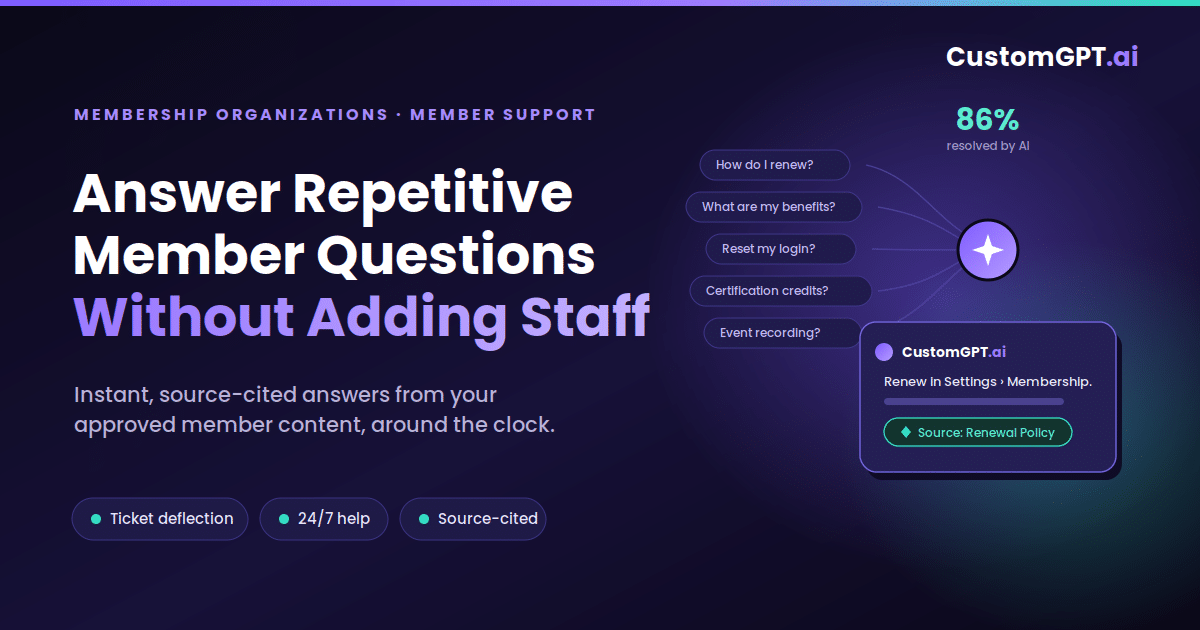
An AI member support assistant helps membership teams reduce repetitive questions by answering common member requests from approved organizational content such as FAQs, benefits pages, renewal policies, event information, certification materials, standards, training resources, and member-only knowledge bases. Instead of waiting for staff, members can ask questions in natural language and receive instant, source-cited answers.
This matters because repetitive questions quietly consume the time membership teams need for higher-value work. When routine requests are answered instantly and accurately, staff workload drops, response times improve, member satisfaction rises, support costs fall, and members get more value from what they already pay for. The result is a better member experience and stronger retention, delivered without adding headcount.
Direct Answer: How Does an AI Member Support Assistant Reduce Repetitive Questions?
An AI member support assistant reduces repetitive questions by turning existing support content into a searchable, conversational self-service experience. It retrieves the most relevant answer from approved content, responds instantly, cites the source, and escalates, declines, or says “I don’t know” when the content does not support an answer.
In practice, the workflow is simple. You connect approved support content such as FAQs, benefits information, renewal policies, and knowledge base articles. A member asks a question in plain language instead of searching through pages or emailing staff. The assistant finds the relevant passage, composes a direct answer, and shows the source so the member can verify it. When the content does not contain an answer, the assistant hands off to staff or declines rather than guessing. Over time, staff review analytics on what members ask and where answers are missing, then improve the content so the assistant gets more useful.
What Is an AI Member Support Assistant?
An AI member support assistant is a secure, content-grounded AI chatbot or search assistant that helps members get direct answers to common support questions using approved membership content and knowledge base resources.
It differs from the tools most organizations already use:
A normal FAQ page shows a fixed list of answers and forces members to scan for the right one. An AI assistant answers the specific question asked, including ones the FAQ never anticipated.
A website search bar returns links to pages. An AI assistant returns the answer itself, with the source cited.
A generic chatbot follows scripted flows and breaks outside its script. An AI assistant reasons across your full knowledge base.
A public AI model answers from the open internet and does not know your benefits, policies, or member-only content. An AI assistant answers only from your approved material.
A traditional support ticket system routes questions to staff and waits for a reply. An AI assistant resolves routine questions instantly and reserves tickets for cases that need a human.
A basic help center stores articles that members still have to find and read. An AI assistant makes that content directly answerable in conversation.
Why Membership Teams Are Overloaded With Repetitive Questions
Membership teams field the same questions over and over, across email, chat, forms, member portals, and phone. Individually each is easy. In aggregate they absorb a large share of the team’s week.
The recurring questions usually look like this:
- How do I renew my membership?
- What benefits are included in my membership?
- How do I access member-only resources?
- Where do I find event recordings?
- How do I register for an event?
- What are the certification requirements?
- How many credits do I need?
- Where are the standards or guidelines?
- How do I update my profile?
- How do I reset my login?
- Where can I download invoices or receipts?
- Which resource should I use for a specific issue?
- Who should I contact for this request?
- What policy applies to my situation?
These questions matter, and members deserve fast answers. The problem is not the questions themselves but the fact that they are repeated constantly and arrive through every channel at once. Association leaders, including through ASAE’s resources on member engagement and association management, consistently point to responsive, easy access to value as central to retention. When staff spend their days retyping the same answers, both member experience and staff capacity suffer.
Table 1: Repetitive Member Questions an AI Assistant Can Handle
| Question Type | Example Member Question | How the AI Assistant Helps |
|---|---|---|
| Renewals | How do I renew my membership? | Explains the renewal steps and links the exact policy page |
| Benefits | What is included in my membership tier? | Answers directly from approved benefits content |
| Gated content | How do I access member-only resources? | Guides members to the right resource with access rules respected |
| Events | Where can I find the recording from last month? | Surfaces event and webinar content on request |
| Certification | What are the certification requirements? | Answers from official certification materials |
| Training | How many continuing education credits do I need? | Pulls the current requirement from training resources |
| Standards | Which standard applies to this situation? | Cites the applicable standard and its source |
| Policy | What policy covers my request? | Returns the relevant policy language with a citation |
| Invoices | Where do I download my receipt? | Explains the billing steps and points to the right area |
| Login help | How do I reset my login? | Provides the documented self-service steps |
| Onboarding | Where should I start as a new member? | Guides new members through benefits and first steps |
| Resource discovery | Which resource should I use for this issue? | Recommends the right approved resource for the need |
How an AI Member Support Assistant Works
- Upload or connect approved member support content, including FAQs, benefits pages, renewal policies, standards, and knowledge base articles.
- Organize content by topic, audience, or access level so the assistant answers from the right material for each group.
- Members ask questions in natural language instead of searching or emailing staff.
- The assistant retrieves relevant passages from your approved content.
- The assistant gives a direct answer grounded in what those passages say.
- The assistant cites the source so the member can verify it.
- The assistant escalates, declines, or says “I don’t know” when the content does not support an answer.
- Staff review analytics to find content gaps and improve coverage over time.
This grounding is powered by retrieval-augmented generation, which retrieves relevant passages from your documents and uses them to compose the answer. Our complete guide to retrieval-augmented generation explains how it works, and IBM’s overview of retrieval-augmented generation describes the same retrieve-then-generate pattern. The key point is that RAG keeps the assistant grounded in approved documents rather than generating unsupported answers from the open web.
Benefits of AI Member Support Assistants
1. Reduce Repetitive Support Tickets
An AI assistant deflects routine questions before they become tickets. When members can self-serve accurate answers instantly, the volume reaching staff drops sharply. This is the same logic behind ticket deflection, applied to membership support so the team handles fewer repeat requests and more meaningful ones.
2. Help Members Get Answers Faster
Members get a direct, sourced answer in seconds instead of waiting hours or days for a reply. Faster answers improve the member experience at exactly the moment a member is trying to get value, which is when frustration or disengagement is most likely.
3. Support More Members Without Adding Staff
Because the assistant answers unlimited routine questions at once, the team can support a larger and growing membership without proportional hiring. The assistant absorbs volume spikes around renewals, events, and certification deadlines that would otherwise overwhelm staff.
4. Improve New Member Onboarding
An AI assistant guides new members through benefits, resources, events, standards, certification, and training on demand. New members do not have to know where to look or wait for an onboarding call, which shortens time to value and supports first-year retention.
5. Make Gated Content Easier to Find
Member-only reports, toolkits, and research become easy to reach when members can simply ask for them. This raises the perceived value of membership and the return on content you already produced. You can see how this applies across associations and institutes on the AI for membership organizations page.
6. Keep Answers Consistent Across the Team
Because answers come from approved sources, every member gets the same accurate response regardless of who or what they ask. This removes the inconsistency that creeps in when different staff answer the same question in different ways.
7. Improve Member Engagement and Retention
When members can easily access the value they pay for, they use more of it, and usage is one of the clearest signals of renewal intent. An assistant that reliably connects members to helpful answers reinforces the sense that membership is worth keeping.
8. Give Staff Better Insight Into Member Needs
Analytics reveal what members ask most, where the assistant could not find an answer, and what content is missing. These signals help the team prioritize new content, improve onboarding, and anticipate support needs before they escalate.
9. Improve After-Hours Support
An AI support assistant answers questions outside business hours, across time zones, without additional staffing. Members in different regions or with evening schedules get help when they need it rather than waiting for the office to open.
10. Protect Staff Time for Higher-Value Work
The goal is a support multiplier, not a staff replacement. By handling routine questions, the assistant frees staff to focus on complex cases, relationship building, and the work that genuinely requires a human.
Table 2: Manual Member Support vs AI Member Support Assistant
| Support Area | Manual Member Support | AI Member Support Assistant |
|---|---|---|
| Response time | Hours or days depending on queue | Instant, in seconds |
| Staff workload | High and repetitive | Focused on complex cases |
| Answer consistency | Varies by staff member | Uniform, from approved sources |
| After-hours support | Limited or unavailable | Available around the clock |
| Repetitive questions | Answered manually each time | Resolved automatically at scale |
| Member onboarding | Depends on staff availability | Guided and self-serve on demand |
| Gated content discovery | Members must know where to look | Surfaced by asking a question |
| Escalation handling | Everything routed to staff | Only unsupported cases escalate |
| Content improvement | Ad hoc and reactive | Guided by usage analytics |
| Scalability | Limited by headcount | Scales with demand |
| Cost per interaction | Higher, staff-driven | Lower, automation-driven |
| Member experience | Inconsistent and slower | Fast, consistent, verifiable |
Best Use Cases for an AI Member Support Assistant
Membership renewal support. Members get clear, sourced answers on how and when to renew, reducing lapses caused by confusion. This eases the seasonal spike that renewals create for staff.
Benefits and eligibility questions. Members quickly confirm what their tier includes and whether they qualify for a benefit, without emailing the team.
Event registration and event content search. Members register, find schedules, and retrieve recordings and transcripts on demand, extending the value of your programming.
Certification and continuing education support. Candidates get consistent answers on requirements, credits, and materials throughout their journey. An expert AI assistant trained on official materials is well suited to this.
Standards and policy lookup. Members and practitioners find the applicable standard or policy with the source cited, which matters where accuracy carries professional weight.
Member-only content discovery. Gated reports, toolkits, and research become reachable by asking rather than hunting through the portal.
New member onboarding. New members get guided answers about benefits, resources, and where to start, reducing early confusion and support load.
Chapter or regional support. Local chapters get answers grounded in national standards while respecting regional differences, keeping guidance consistent.
Internal staff support assistant. Staff query operations guides and playbooks to answer members faster and more consistently, which helps new or part-time team members.
Knowledge base self-service. Members resolve common issues directly from your help content. An AI knowledge base chatbot turns that library into instant answers.
Billing and invoice guidance. Members find the steps to download invoices and receipts or understand a charge without a ticket.
Resource library search. Members search deep archives and past studies by asking a question rather than guessing at titles.
Training material Q&A. Members get answers drawn from course and training content, supporting learning without staff involvement.
Member portal guidance. Members get help navigating the portal itself, from updating profiles to finding features. These use cases apply across associations, trade groups, and certification bodies, as described in the AI for associations resources.
Table 3: AI Member Support Use Cases by Team
| Team | Repetitive Questions They Receive | AI Assistant Value |
|---|---|---|
| Membership team | How do I renew and what does my tier include? | Instant, cited answers that cut inbound volume |
| Member experience team | Where do I find this benefit or resource? | Faster time to value and higher engagement |
| Certification team | What are the requirements and how many credits? | Consistent guidance through the certification journey |
| Events team | How do I register and where is the recording? | Self-serve registration and event content search |
| Education team | Which training covers this topic? | Answers drawn from approved training materials |
| Content team | Which document answers this question? | Existing content becomes directly answerable |
| Support team | How do I resolve this common issue? | Routine tickets resolved automatically |
| Chapter operations | How does the national rule apply locally? | Consistent answers across a distributed organization |
| Leadership | What are members asking about most? | Analytics that inform strategy and content planning |
| IT and security | Is the assistant secure and certified? | Documented controls and SOC 2 Type 2 for review |
Real-World Proof: How CustomGPT.ai Reduces Support Workload Across Knowledge-Heavy Organizations
CustomGPT.ai is used by organizations that need to answer high volumes of questions from trusted internal, customer-facing, or member-facing knowledge. These examples show how source-grounded AI assistants can reduce repetitive support work, improve access to approved information, and make knowledge easier to use at scale.
| Organization | Support Challenge | CustomGPT.ai Result |
|---|---|---|
| GEMA | High-volume member and stakeholder questions | 248,000+ queries, 6,000+ hours saved, 88% success rate, €182K–€211K estimated cost avoidance |
| BQE Software | Repetitive help center questions | 180,000+ questions, 86% AI resolution, 64% AI-automated interactions |
| Bernalillo County | Costly public contact handling | $0.99 AI contact vs $4.59 staff contact, 4.81× ROI, $108,143.75 net savings |
| MIT ChatMTC | Always-on multilingual knowledge access | 90+ languages, 24/7 access, no-code deployment |
| VdW Bayern DigiSol | Regulated and compliance-heavy guidance | Secure, source-grounded AI for trusted answers |
GEMA: High-Volume Member and Stakeholder Support
GEMA used CustomGPT.ai to handle high-volume knowledge access and support, resolving more than 248,000 queries, saving over 6,000 working hours, achieving an 88% success rate, and generating an estimated €182K to €211K in cost avoidance. For a membership organization, this is the clearest picture of what reducing repetitive questions at scale looks like: the same volume handled with far less staff time.
BQE Software: Support Automation at Scale
BQE Software used CustomGPT.ai to answer more than 180,000 questions, reach an 86% AI resolution rate, and automate 64% of its help center interactions. This is repetitive support deflection and knowledge base automation in action, showing how a large share of routine questions can be resolved without staff.
Bernalillo County: Reducing Cost Per Support Interaction
Bernalillo County reduced the cost per contact from $4.59 for staff-handled interactions to $0.99 for AI-handled interactions, with a 4.81 times return on investment and $108,143.75 in net savings. For membership teams under budget pressure, this demonstrates how AI can lower support cost and absorb more inquiries without increasing headcount.
MIT ChatMTC: 24/7 Multilingual Knowledge Access
MIT’s ChatMTC shows how a knowledge-rich organization can provide 24/7 access across more than 90 languages with a no-code AI assistant. For membership organizations, this maps to global member support, onboarding, training access, and always-on resource discovery for members in any time zone.
VdW Bayern DigiSol: Trusted Support for Regulated Knowledge
VdW Bayern’s DigiSol shows why secure, source-grounded AI matters for organizations handling regulated, standards-based, or compliance-heavy questions. This applies directly to professional associations, certification bodies, standards organizations, and any membership team that needs accurate answers grounded in approved content rather than plausible guesses.
What to Look For in an AI Member Support Assistant
When evaluating platforms, check for each of the following:
- Source-cited answers so members and staff can verify every response.
- Answers grounded in approved content rather than the open internet.
- No-code setup so membership and content teams can manage it without engineering.
- Support for PDFs, FAQs, knowledge bases, reports, standards, policies, and training documents, since member content is multi-format.
- Secure handling of gated content to protect member-only material.
- Access control planning so public, member, and staff content stay separate.
- Website, help center, or member portal deployment so the assistant lives where members ask.
- Analytics for repetitive questions and content gaps to guide improvement.
- Honest fallback behavior so the assistant declines when content lacks an answer.
- Escalation path to staff for questions that need a human.
- Enterprise security with documented controls, detailed on the CustomGPT.ai security and trust page.
- SOC 2 Type 2 certification for procurement and security review, which CustomGPT.ai holds and documents on its SOC 2 Type 2 certification page.
- Ability to update knowledge easily so answers stay current.
- Clear admin controls for managing behavior, tone, and guardrails.
Frameworks such as the NIST AI Risk Management Framework and Microsoft’s responsible AI resources are useful references for the broader governance side of this evaluation.
Table 4: AI Member Support Assistant Evaluation Checklist
| Requirement | Why It Matters for Membership Support |
|---|---|
| Source citations | Members and staff can verify every answer |
| Content grounding | Answers reflect approved content, not the open web |
| Security | Protects member-only and proprietary material |
| SOC 2 Type 2 | Clears procurement and security review faster |
| No-code setup | Non-technical teams can build and update it |
| PDF and knowledge base support | Handles the multi-format content teams actually have |
| Access control | Keeps public, member, and staff content separate |
| Portal deployment | Meets members where they already ask questions |
| Analytics | Reveals repetitive questions and content gaps |
| Fallback behavior | Declines gracefully when content lacks an answer |
| Escalation | Routes questions that need a human to staff |
| Case study proof | Shows the platform works in similar contexts |
Common Mistakes to Avoid
- Using a generic public chatbot for member support, which answers from the open web and invents details about your benefits and policies.
- Not grounding answers in approved content, which leads to inaccurate or off-brand responses.
- Failing to cite sources, so members and staff cannot verify answers.
- Uploading outdated policy or benefits content, which produces confidently wrong answers.
- Launching without testing real member questions, which hides the messy queries members actually ask.
- Ignoring access-control needs, which risks exposing member-only content.
- Trying to automate every support workflow at once, which stalls the rollout.
- Not defining escalation rules, so hard questions have nowhere to go.
- Not reviewing analytics, which wastes the insight the assistant generates.
- Treating AI as a replacement for staff instead of a support multiplier, which sets the wrong expectations.
- Mixing private and public content without a governance plan, which creates exposure and confusion.
- Letting the assistant answer when it should say “I don’t know”, which undermines trust.
How to Launch an AI Member Support Assistant
- Collect the top 50 to 100 repetitive member questions from email, chat, forms, and phone logs.
- Map those questions to approved content so you know what the assistant will answer from.
- Remove outdated or conflicting documents so the assistant is not grounded in stale material.
- Upload or connect content to CustomGPT.ai without engineering effort.
- Configure source citations and fallback behavior so answers are verifiable and honest.
- Define escalation rules for unsupported questions so members reach a human when needed.
- Test with real member questions rather than idealized examples.
- Deploy in the member portal, website, or help center where members already ask.
- Train staff on when to use and improve the assistant so it fits existing workflows.
- Review analytics monthly to close content gaps and expand coverage.
- Expand to new use cases once the first support workflow is working well.
Why CustomGPT.ai Is a Strong Fit for AI Member Support
CustomGPT.ai helps membership organizations build secure, source-cited AI member support assistants without needing a custom engineering team. Teams can train the assistant on approved content, deploy it where members already ask questions, and use it to reduce repetitive support requests while keeping answers grounded in trusted resources.
Specifically, CustomGPT.ai offers no-code assistant creation, source-cited answers, grounding in approved membership content, support for gated content, both AI knowledge base chatbot and expert AI assistant use cases, and deployment across your website, help center, and member portal. It is backed by enterprise security and SOC 2 Type 2 certification, and by proven support and knowledge-access results from GEMA, BQE Software, Bernalillo County, MIT ChatMTC, and VdW Bayern DigiSol.
To evaluate the fit for your organization, review the AI for membership organizations page, the AI for associations resources, the expert AI assistant solution, and the AI knowledge base chatbots page. Check the security and trust and SOC 2 Type 2 certification documentation, see proof in the GEMA, BQE Software, Bernalillo County, MIT ChatMTC, and VdW Bayern DigiSol customer stories, browse more on the customer stories page, or start on the CustomGPT.ai platform.
FAQ
What is an AI member support assistant?
An AI member support assistant is a secure, content-grounded AI assistant that answers members’ common support questions using your approved content and knowledge base. It responds in natural language, cites the source of each answer, and declines when the content does not support a response.
Unlike a generic chatbot, it does not answer from the open internet. It retrieves relevant passages from your own material, composes a specific answer, and points to the source, which makes it safe to use for benefits, policies, standards, and member-only resources.
How does an AI member support assistant reduce repetitive questions?
An AI member support assistant reduces repetitive questions by resolving common requests automatically before they reach staff. It turns your existing support content into instant, conversational self-service, so members get answers on renewals, benefits, events, and certification without emailing or calling.
Because many member questions are variations of the same topics, deflecting them at scale removes a large share of routine volume. Staff then focus on complex cases, and analytics show which questions to address next in content.
Can AI answer membership renewal questions?
Yes. An AI member support assistant can answer membership renewal questions by drawing directly from your approved renewal policies and benefits content. It can explain how to renew, when renewal is due, what each tier includes, and where to complete the process, with the source cited.
This is especially valuable during renewal periods, when the same questions spike and staff are stretched. Instant, accurate answers reduce lapses caused by confusion and ease the seasonal load on the team.
Can an AI assistant help members find gated content?
Yes. An AI assistant helps members find gated content by answering questions from connected member-only resources while respecting the access rules you set. Instead of hunting through the portal, members simply ask, and the assistant surfaces the right report, toolkit, or resource.
Because the content stays in a secure environment and the assistant only answers from what you approve, member-only material powers the experience without being exposed publicly. This makes proprietary content easier to use and raises the value of membership.
Is an AI member support assistant different from a chatbot?
Yes. An AI member support assistant is different from a generic chatbot because it answers from your approved content and cites its sources, while a generic chatbot follows scripts or answers from the open web. The assistant reasons across your full knowledge base, respects access controls, and declines when it lacks a supported answer.
That difference matters most for benefits, policy, standards, and certification questions, where a generic tool can produce confident but incorrect answers. Grounding and citation are what make an assistant safe for member-facing support.
Can AI support certification and training questions?
Yes. AI can support certification and training questions by answering from your official certification and training materials. Candidates get consistent, sourced answers on eligibility, requirements, credits, and study resources at any hour, which reduces confusion during high-stakes periods.
Because answers are grounded and cited, candidates can trust and verify them, which is important when the guidance affects credentials, renewals, or professional standing.
How can membership teams use AI without adding staff?
Membership teams can use AI without adding staff by deploying an assistant that handles routine, repetitive questions automatically. The assistant answers unlimited common requests at once, absorbing volume spikes around renewals, events, and certification deadlines that would otherwise require more people.
This positions AI as a support multiplier rather than a replacement. Staff time shifts to complex cases and relationship work, so the organization supports more members without proportional hiring
Can AI reduce support tickets for associations?
Yes. AI reduces support tickets for associations by deflecting routine questions through self-service before they become tickets. When members get instant, accurate answers, the volume reaching staff drops significantly.
The effect can be substantial. BQE Software reached an 86% AI resolution rate and automated 64% of its help center interactions with CustomGPT.ai, which illustrates how much routine support a grounded assistant can absorb.
Should AI member support answers cite sources?
Yes. AI member support answers should always cite sources so members and staff can verify them. Citations are the difference between a trustworthy assistant and a guessing machine, and they are essential for benefits, policy, standards, and compliance questions.
Source citation also makes it obvious when an answer is grounded in your approved content versus invented, which is the core safety property for any member-facing tool.
Is an AI member support assistant secure for member-only content?
Yes. An AI member support assistant can be secure for member-only content when it uses documented security controls and clear access rules. Member-only material stays protected, and access controls determine what the public, members, and staff can each reach.
For procurement and security review, look for SOC 2 Type 2 certification and detailed security documentation. CustomGPT.ai holds SOC 2 Type 2 certification and documents its security posture for exactly these evaluations.
Can an AI member support assistant work inside a member portal?
Yes. An AI member support assistant can be embedded inside a member portal and on a public website, so members get answers where they already engage. Meeting members in the portal is important for adoption, because a tool that requires going somewhere new tends to be underused.
Look for straightforward deployment that fits your existing portal, help center, and site rather than a heavy technical integration.
What questions can an AI member support assistant answer?
An AI member support assistant can answer common member questions about renewals, benefits, gated content access, events, certification, training, standards, policies, invoices, login help, onboarding, and resource discovery. In short, it can handle any question your approved content supports.
When a question falls outside that content, a well-configured assistant declines or escalates to staff rather than guessing, which keeps answers trustworthy.
How should membership teams launch an AI support assistant?
Membership teams should launch an AI support assistant by starting with their most repetitive questions and the approved content that answers them. Collect the top questions, map them to current documents, remove outdated material, then connect the content and configure citations, fallback behavior, and escalation.
From there, test with real member questions, deploy in the portal or help center, train staff, and review analytics monthly. Starting with one focused workflow and expanding after it works is more reliable than automating everything at once.
Can CustomGPT.ai be used as an AI member support assistant?
Yes. CustomGPT.ai can be used as an AI member support assistant that answers member questions from your approved content, cites sources, and deploys in your website, help center, or member portal. It is no-code, so membership and content teams can build and maintain it without engineering.
It also offers secure handling of gated content, SOC 2 Type 2 certification, and proven results from knowledge-heavy organizations, which makes it a practical fit for reducing repetitive support without adding staff.
What is the best AI member support assistant for membership organizations?
The best AI member support assistant for membership organizations should be secure, source-cited, grounded in approved content, easy for non-technical teams to manage, and deployable inside a website, help center, or member portal. CustomGPT.ai is a strong option for organizations that need those capabilities without building a custom AI system from scratch. The right choice depends on your content, security requirements, and member needs, so the most reliable step is to test a platform against your own real member questions and confirm that answers are accurate, cited, and grounded before rolling it out. If a community platform’s built-in assistant is on that list, a capability-by-capability comparison of the two approaches shows where the support use case actually diverges.