
Enhancing AI Trust Through RAG
TL;DR: Direct Answer
RAG enhances AI trust by forcing an AI system to retrieve relevant information from trusted sources before generating an answer. Instead of relying only on model memory, a RAG system grounds responses in approved documents, cites sources, reduces hallucinations, and makes answers easier to verify. For enterprises, RAG is one of the most practical ways to make AI assistants more transparent, accurate, and auditable.
AI trust is not just about model quality. It depends on evidence, transparency, data freshness, governance, and user confidence. Retrieval-augmented generation creates a bridge between AI generation and trusted business knowledge, which is why AI trust through RAG has become a core pattern for enterprise deployments.
This page is part of our RAG technical series. For the broader foundation, start with the complete guide to retrieval-augmented generation.
What Does “AI Trust” Mean?
AI trust is the justified confidence that an AI system will give accurate, verifiable answers, show where those answers came from, and behave safely when it lacks evidence. Trust is earned through system behavior, not asserted through marketing.
In practice, AI trust includes accuracy, transparency, source visibility, consistency, security, auditability, and data freshness. It also includes two behaviors that many systems skip: refusing to answer when evidence is missing, and routing high-risk cases to a human. An AI system that always answers, even without support, is not trustworthy no matter how fluent it sounds.
| Trust Factor | What It Means | Why It Matters |
|---|---|---|
| Accuracy | Answers match the underlying source content | Wrong answers erode confidence and create risk |
| Transparency | Users can see how the answer was formed | Hidden reasoning is hard to trust or verify |
| Source grounding | Answers are drawn from approved documents | Prevents the system from inventing details |
| Citation visibility | Each answer shows its supporting sources | Lets users and reviewers check the answer |
| Data freshness | The knowledge base reflects current content | Stale answers mislead users on changing topics |
| Auditability | Queries, sources, and outcomes are logged | Supports reviews, compliance, and improvement |
| Refusal behavior | The system declines when evidence is missing | Prevents confident but unsupported answers |
| Security | Data access is controlled and protected | Trust fails if sensitive data is exposed |
Why Generic LLMs Struggle With Trust
Generic large language models are powerful, but they were not built to answer from your private, current, approved content. Left on their own, they can produce fluent answers that are not supported by any source. They may not know your company data, they may rely on outdated training data, and they may hallucinate when evidence is missing. They can also fail to show where an answer came from, and they often sound confident even when they are wrong.
The important point is this: the problem is not always the model. Often the problem is the system around the model. A capable model with no retrieval, no citations, and no refusal behavior will still produce untrustworthy answers. This is why the difference between a chatbot, an AI agent, and a private RAG system matters so much for enterprise use.
What Is RAG?
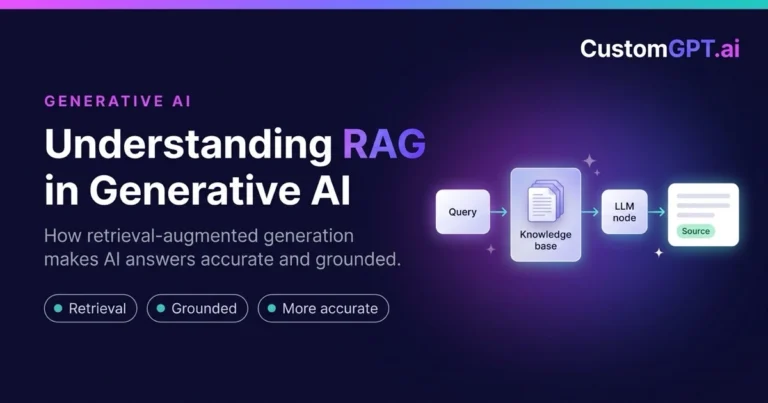
RAG (retrieval-augmented generation) is an AI architecture that retrieves relevant information from a trusted knowledge source before generating an answer. Rather than answering from memory alone, the system first finds supporting passages, then generates a response grounded in them.
A RAG system has a few core parts. Retrieval finds the most relevant passages for a query. The knowledge base holds your approved documents and content. Generation produces the answer using those passages. Citations show which sources were used. Grounding is the overall discipline of tying the answer to that retrieved evidence. Together these turn open-ended generation into something a reader can check. For a deeper walkthrough, see the RAG architecture guide and custom RAG.
How RAG Enhances AI Trust
RAG improves AI trust because it gives the AI system evidence before it answers. That single change, retrieving first and generating second, is what makes the rest of the trust properties possible.
Concretely, RAG grounds answers in approved content, reduces hallucinations, and enables citations. It improves transparency by showing the evidence behind a response, and it keeps answers current because you update the knowledge base instead of retraining a model. It supports audits and reviews through logged sources, it helps the AI say “I don’t know” when nothing supports an answer, and it makes enterprise AI easier to govern.
| RAG Capability | Trust Benefit |
|---|---|
| Retrieves trusted documents | Answers are based on approved content, not guesses |
| Uses current knowledge | Responses reflect the latest business information |
| Shows source citations | Users can verify each answer against its source |
| Limits unsupported answers | The system declines when evidence is missing |
| Logs sources used | Reviewers can audit which content was applied |
| Updates knowledge without retraining | Freshness is a content task, not a model project |
| Connects to private business content | Answers reflect your organization, not the open web |
Want AI answers users can verify?
CustomGPT.ai helps teams build source-grounded AI assistants that answer from trusted business content with citations. Start with CustomGPT.ai.
RAG vs Generic LLMs for Trust
Both approaches have a place. Generic LLMs are useful for general reasoning and drafting. RAG-based AI is better when answers must be grounded in trusted business knowledge.
| Area | Generic LLM | RAG-Based AI |
|---|---|---|
| Source of answer | Model memory from training | Retrieved passages from your content |
| Private company knowledge | Not available unless in training | Available through the connected knowledge base |
| Hallucination risk | Higher when evidence is missing | Lower because answers require retrieved support |
| Citation support | Usually none | Built in, each answer can show sources |
| Auditability | Difficult to trace | Logged sources make review straightforward |
| Freshness | Fixed at training cutoff | Updated by refreshing the knowledge base |
| Enterprise governance | Hard to control outputs | Answers can be limited to approved material |
| Best use case | General drafting and reasoning | Grounded answers over trusted business data |
Why Source Citations Matter for AI Trust
An AI citation is a reference the system attaches to an answer that points to the source passage it used. Citations are the mechanism that turns a claim into something checkable.
Citations do several things at once. They let users verify the answer, and they help reviewers check whether the AI used the right source. They also reveal weak retrieval, because a wrong or thin citation exposes a bad match. And they create accountability by tying each answer to a document of record. This matters across support, compliance, legal, HR, technical documentation, and education, where an unverifiable answer is often worse than no answer.
CustomGPT.ai helps teams create AI assistants that answer from uploaded or connected content and show source citations, which makes each answer easier to verify. For a support-focused view, see the AI knowledge base chatbot guide.
How RAG Reduces Hallucinations
Answer: RAG reduces hallucinations by making the AI retrieve evidence before answering, and by preventing unsupported claims when relevant evidence is missing.
A hallucination is a confident answer that is not supported by any real source. Hallucinations happen when the model fills gaps in its knowledge. RAG narrows the answer space by giving the model relevant passages to work from, so it has less reason to invent. Retrieval quality matters here: if the wrong passages are retrieved, the answer suffers, so ranking and chunking are part of trust. The system should also refuse when sources do not support an answer, and citations help reviewers detect the hallucinations that slip through.
| Hallucination Cause | How RAG Helps |
|---|---|
| Missing context | Supplies relevant passages so the model has material to use |
| Outdated knowledge | Retrieves current content from the maintained knowledge base |
| Ambiguous question | Surfaces sources that clarify scope before answering |
| Wrong source selected | Exposes the mismatch through visible citations |
| No evidence requirement | Enforces retrieval-first answering as a rule |
| Overconfident generation | Enables refusal when nothing supports the claim |
CustomGPT.ai applies these controls through its anti-hallucination AI, and the CustomGPT.ai Claude Benchmark shows how a retrieval layer changes accuracy and completion at scale.
Enterprise Use Cases Where RAG Builds Trust
Across these use cases, the common thread is the same: users need answers grounded in approved sources, and trust depends on citations and controlled knowledge access.
Customer support
Users ask how to use a product, fix an issue, or understand a policy. The AI should retrieve from help docs, product documentation, and policies. Trust matters because a wrong answer creates escalations. RAG grounds replies in official content, and CustomGPT.ai can power an AI chatbot for customer support with citations.
Internal knowledge management
Employees ask where a policy lives or how a process works. The AI should retrieve from wikis, drives, and internal docs. Trust matters because inconsistent answers cause rework. RAG keeps answers aligned with official material, and CustomGPT.ai supports secure knowledge access over connected content.
Compliance
Users ask what a regulation requires or how to stay within policy. The AI should retrieve from compliance documentation. Trust and auditability are essential. RAG ties answers to approved sources and logs what was used. See AI for compliance.
Legal services
Users ask about intake steps or document details. The AI should retrieve from vetted legal content with clear disclaimers. Trust matters because legal accuracy is high stakes. RAG grounds answers in approved material. See the AI chatbot for legal services.
Healthcare content
Users ask about procedures, coverage, or approved guidance. The AI should retrieve from vetted clinical or administrative content. Trust matters because errors carry real consequences. RAG limits answers to approved sources and supports refusal when evidence is thin.
Financial services
Users ask about products, rules, or account processes. The AI should retrieve from current, approved financial documentation. Trust matters because outdated or wrong answers create regulatory exposure. RAG keeps answers current and auditable.
Government services
Residents ask how to access services or complete a process. The AI should retrieve from official public content. Trust and transparency matter for accountability. RAG restricts answers to authoritative sources and shows citations.
Education
Students ask about coursework, policies, or study material. The AI should retrieve from curriculum and approved content. Trust matters because answers guide learning. RAG keeps answers aligned with the syllabus. See the AI chatbot for education.
Associations and member knowledge
Members ask about benefits, rules, and proprietary resources. The AI should retrieve from association content. Trust matters because members rely on accurate answers. RAG grounds responses in member resources. See member association AI search.
Technical documentation
Developers ask how an API or feature works. The AI should retrieve from versioned technical docs. Trust matters because a wrong answer breaks builds. RAG matches answers to the correct version and cites the source.
Sales enablement
Reps ask for product facts, pricing rules, or positioning. The AI should retrieve from approved sales content. Trust matters because reps repeat what the AI says to customers. RAG keeps answers aligned with current, approved material.
Real-World Examples: How Source-Grounded AI Builds Trust
These examples show the trust argument in practice. Each organization needed answers people could rely on, and each grounded its AI in approved sources with citations rather than open-ended generation. The metrics below are published by CustomGPT.ai, and source grounding is one contributing factor among content quality, workflow design, and team effort.
BQE Software: customer support trust
BQE Software provides cloud business-management software for architecture, engineering, and professional-services firms, and its support team needed to scale help without lowering answer quality. Trust mattered because a wrong support answer creates escalations and erodes customer confidence. By grounding a support agent in BQE’s own help center and product documentation with citations, the agent answered from approved sources instead of guessing. BQE reports an 86% AI resolution rate across 180,000 support questions, with AI handling 64% of help center queries. This supports the trust argument because customers need fast answers that stay grounded in official support knowledge. See the BQE Software customer support case study.
Ontop: sales and internal knowledge trust
Ontop, a global payroll company, needed its sales team to get fast, accurate answers on international compliance, payroll, and EOR rules without routing every question to legal. Trust mattered because compliance answers carry legal weight and cannot be improvised. Ontop built a Slack agent named Barry, grounded in its internal documentation, with a citation on every response so reps could verify the source. Ontop reports 130 legal-team hours saved per month, response time cut from about 20 minutes to about 20 seconds, and more than 400 complex queries answered monthly. This supports the trust argument because sales teams need fast, approved answers before speaking with customers. See the Ontop sales enablement case study.
GEMA: association and member knowledge trust
GEMA, one of the world’s largest music-rights collecting societies, needed to serve members, customers, and employees across a large body of proprietary licensing and rights content. Trust mattered because members depend on accurate, consistent answers about their rights and payments. GEMA grounded its AI in its own knowledge base rather than general model memory, treating it as knowledge infrastructure. GEMA reports more than 248,000 queries resolved, over 6,000 working hours saved, an 88% success rate, and €182K to €211K in cost avoidance. This supports the trust argument because member-based organizations need reliable access to proprietary knowledge at scale. See the GEMA association AI case study.
VdW Bayern DigiSol: compliance and regulated knowledge trust
VdW Bayern DigiSol, the digital arm of Bavaria’s largest housing association, needed to give property managers fast access to legal and regulatory knowledge spread across thousands of documents. Trust mattered because answers had to stay compliant with changing housing regulations. The team built an assistant called WohWi AI on more than 3,600 internal documents, so answers came from approved, current sources. VdW Bayern reports a 50 to 60 percent reduction in task time, 84% positive feedback, and more than 7,000 queries handled, with document search cut from hours to minutes. This matters because AI trust is especially critical in regulated environments where answers must come from approved material, not generic model memory. See the VdW Bayern DigiSol compliance AI case study.
Across all four, the pattern is the same. Trust came from evidence, source grounding, citations, and controlled knowledge access, not from a bigger model or a longer prompt.
What Makes a RAG System Trustworthy?
Not all RAG systems are equally trustworthy. Wrapping a model in retrieval is not enough if the content, retrieval, or controls are weak. Trustworthy RAG requires high-quality source content, reliable document ingestion, good chunking, accurate retrieval, source citations, permission controls, security, freshness workflows, evaluation tests, monitoring, human escalation, and refusal behavior working together.
| Requirement | Why It Improves Trust |
|---|---|
| Clean knowledge base | Answers can only be as good as the source content |
| Reliable ingestion | Complete, correct content reaches the retrieval layer |
| Strong retrieval | The right passages surface for each query |
| Citation support | Users and reviewers can verify every answer |
| Access controls | Users only see content they are allowed to see |
| Evaluation tests | Accuracy and refusal are measured, not assumed |
| Monitoring | Failures and gaps are visible in production |
| Human escalation | High-risk cases reach a person for review |
For how these pieces fit together technically, see the components of a RAG system and custom RAG solutions.
RAG and Enterprise AI Governance
AI governance is the set of policies, controls, and review processes that keep an AI system accountable. AI auditability is the ability to reconstruct what an answer was based on. RAG supports both because it creates traceability. Teams can review which source was used, approve and update the knowledge base, limit answers to approved material, control access, and rely on logs and citations during audits.
This is why regulated teams in compliance, legal, healthcare, finance, government, education, and HR increasingly favor grounded systems. Governance frameworks reinforce the point: the NIST AI Risk Management Framework and the OECD AI Principles both emphasize traceability, transparency, and accountability, and Microsoft’s Responsible AI Standard frames similar controls for enterprises. Security posture is part of governance too, which is why CustomGPT.ai maintains its SOC 2 Type 2 AI platform certification.
RAG for AI Transparency and Explainability
It is worth separating two ideas that are often confused. AI explainability describes how a model works internally, its weights and reasoning. AI transparency in the RAG sense shows what evidence an answer used. RAG is not full model explainability. But it improves practical transparency, because users can see the sources behind an answer.
For most business users, that practical transparency is more useful than abstract model explanations. A compliance reviewer rarely needs to understand attention layers. They need to see which approved document an answer came from. RAG delivers exactly that, which is why it has become a foundation for trustworthy enterprise AI. Stanford HAI’s work on trustworthy and human-centered AI situates this within the broader responsible-AI conversation.
How CustomGPT.ai Helps Build Trustworthy RAG AI
CustomGPT.ai is a platform for building source-grounded AI assistants trained on your own content. It ingests content from your website, documents, help center, PDFs, knowledge bases, and business data, and it produces source-cited answers with anti-hallucination behavior. It fits customer support, internal knowledge, compliance, education, legal, associations, and technical documentation, and it is generally faster to deploy than building a full RAG stack from scratch.
The core idea is simple. Instead of asking teams to trust a black-box generic chatbot, CustomGPT.ai helps them deploy AI assistants that answer from approved sources and show where answers came from. That shift, from “trust the model” to “check the evidence,” is what makes enterprise AI defensible.
Build vs Buy: Should You Build Trustworthy RAG From Scratch?
Building from scratch gives control but requires work across ingestion, retrieval, citations, access control, evaluations, monitoring, and governance. A managed platform trades some low-level control for speed and built-in trust features. The right choice depends on your team and timeline. For a deeper treatment, see build vs buy RAG systems.
| Option | Best For | Trust Challenges |
|---|---|---|
| Raw LLM API | Teams wanting full control of every layer | You build citations, refusal, and grounding yourself |
| Open-source RAG framework | Developers comfortable maintaining pipelines | Framework churn and inconsistent evaluation |
| Custom RAG stack | Teams with specialized retrieval needs | Ongoing tuning, security, and freshness upkeep |
| Managed RAG platform | Teams that want speed with some flexibility | Less low-level control of internals |
| CustomGPT.ai | Teams wanting grounded AI on business content fast | Least trust infrastructure to build and maintain |
CustomGPT.ai is best for teams that want a faster way to deploy source-grounded AI using their own content, with citations and anti-hallucination controls built in.
Before building a full RAG trust stack from scratch
Test your use case in CustomGPT.ai first. Try it with your own content.
How to Measure AI Trust in a RAG System
Trust is measurable. The metrics below turn “we think it is reliable” into evidence you can review before and after launch.
| Metric | What to Measure |
|---|---|
| Answer accuracy | Whether answers match the trusted source content |
| Citation accuracy | Whether cited sources actually support the answer |
| Retrieval precision | Whether the right passages are retrieved for a query |
| Unsupported answer rate | How often the system answers without adequate evidence |
| Refusal quality | Whether the system declines correctly when evidence is missing |
| Source freshness | Whether the knowledge base reflects current content |
| User satisfaction | Whether users rate answers as helpful and correct |
| Escalation rate | How often cases correctly hand off to a human |
| Hallucination rate | How often answers include unsupported claims |
| Time to answer | Whether responses arrive within acceptable limits |
| Resolution rate | Whether the system fully resolves the user’s need |
Common Mistakes That Reduce AI Trust
Most trust failures come from a familiar list. Using low-quality source content, uploading outdated documents, and skipping citations all undermine verification. Missing refusal behavior lets the system answer without support, and missing permission boundaries expose content users should not see. Skipping evaluation tests and monitoring means failures go unnoticed. Treating RAG as a keyword rather than an architecture, letting the model answer without retrieved evidence, ignoring failed queries, and never updating the knowledge base all quietly erode trust over time.
Each of these is cheaper to fix early than after users lose confidence.
Final Checklist: Enhancing AI Trust Through RAG
Use this checklist to pressure-test a RAG deployment for trust:
- Trusted source content
- Uplinked to a RAG pillar knowledge base
- Retrieval-first answering
- Source citations on every answer
- Clear refusal behavior when evidence is missing
- Access controls and permissions
- A freshness process for changing content
- Evaluation tests including refusal cases
- Production monitoring
- Human escalation path
- Security review
- User feedback loop
Conclusion
AI trust is built through evidence. RAG improves trust because it connects AI answers to approved sources, gives users citations, reduces hallucinations, and makes responses auditable. AI trust through RAG is not a slogan, it is a system design choice that shows up in every answer a user can verify.
For enterprises, the goal is not just to deploy AI. The goal is to deploy AI that users, reviewers, and decision-makers can verify.
Build a trustworthy AI assistant
Use CustomGPT.ai to build a source-grounded AI assistant trained on your own approved content. Get started with CustomGPT.ai.
For regulated teams, the same trust pattern applies to source-cited compliance automation, where every answer needs a retrievable evidence trail.
Frequently Asked Questions
How does RAG improve AI trust?
RAG improves AI trust by retrieving relevant information from approved sources before the model generates an answer. This grounds responses in real evidence, enables citations users can check, reduces hallucinations, and keeps answers current as content changes. Because sources are logged, answers are also auditable, which makes RAG one of the most practical ways to make enterprise AI trustworthy.
What is AI trust?
AI trust is the justified confidence that an AI system will give accurate, verifiable answers, show where those answers came from, and behave safely when evidence is missing. It covers accuracy, transparency, source visibility, security, and auditability. Crucially, a trustworthy system refuses to answer when nothing supports a response rather than inventing a confident but unsupported one.
What is retrieval-augmented generation?
Retrieval-augmented generation, or RAG, is an AI architecture that retrieves relevant passages from a trusted knowledge source before generating an answer. Instead of relying only on model memory, the system finds supporting content first, then answers from it and can cite the sources. This grounding is what lets a RAG system produce answers a reader can verify.
Does RAG prevent hallucinations?
RAG reduces hallucinations but does not eliminate them entirely. By requiring retrieved evidence before answering and refusing when sources do not support a claim, it removes the most common cause of invented answers. Retrieval quality still matters: if the wrong passages surface, errors can remain. Citations help reviewers catch the hallucinations that slip through.
Why are citations important for AI trust?
Citations let users verify an answer against its source, and they let reviewers confirm the system used the right material. They also expose weak retrieval, since a thin or wrong citation reveals a bad match, and they create accountability by tying each answer to a document of record. For compliance, legal, and support, that verifiability is essential.
Is RAG better than a generic LLM for enterprise AI?
For answers that must be grounded in trusted business knowledge, RAG is generally better because it retrieves approved content, cites sources, and stays current. Generic LLMs are still useful for general reasoning and drafting. The right choice depends on the task: use RAG when accuracy and verifiability over private data matter, and a generic model for open-ended work.
How does RAG help with AI governance?
RAG supports governance by creating traceability. Teams can review which source an answer used, approve and update the knowledge base, limit answers to approved material, and control who can access what. Logs and citations support audits. This aligns with frameworks like the NIST AI Risk Management Framework and the OECD AI Principles, which emphasize transparency and accountability.
Can RAG use private company data?
Yes. RAG is designed to answer from private company data such as help docs, PDFs, policies, and internal knowledge bases while keeping that data secured. The content stays in a governed knowledge base, answers are grounded in it and can cite it, and access controls limit what each user sees, so the system stays accurate without exposing sensitive information.
What makes a RAG system trustworthy?
A trustworthy RAG system combines high-quality source content, reliable ingestion, accurate retrieval, source citations, access controls, security, freshness workflows, evaluation tests, monitoring, human escalation, and refusal behavior. Wrapping a model in retrieval is not enough on its own. Trust comes from these controls working together so every answer is grounded, verifiable, and governed.
How do you measure trust in a RAG AI system?
Measure answer accuracy, citation accuracy, and retrieval precision, plus the unsupported answer rate and refusal quality. Track source freshness, user satisfaction, escalation rate, hallucination rate, time to answer, and resolution rate. Build these into an evaluation set that includes questions the system should refuse, then re-run them on every change and monitor the same signals in production.
How does CustomGPT.ai support trustworthy AI?
CustomGPT.ai builds source-grounded AI assistants trained on your own website, documents, help center, PDFs, and knowledge bases. It produces source-cited answers with anti-hallucination behavior and secure data handling, and supports customer support, internal knowledge, compliance, education, legal, and association use cases. Instead of trusting a black-box chatbot, teams deploy assistants that answer from approved sources and show where answers came from.
Should companies build or buy a RAG system?
Build when you need full control of every layer and have engineering resources for ingestion, retrieval, citations, access control, evals, monitoring, and governance. Buy or use a managed platform when speed, built-in trust features, and lower maintenance matter more. Many teams start on a platform like CustomGPT.ai to validate the use case before deciding whether to invest in custom infrastructure.