
How Associations Can Use AI to Increase Member Value and Reduce Churn
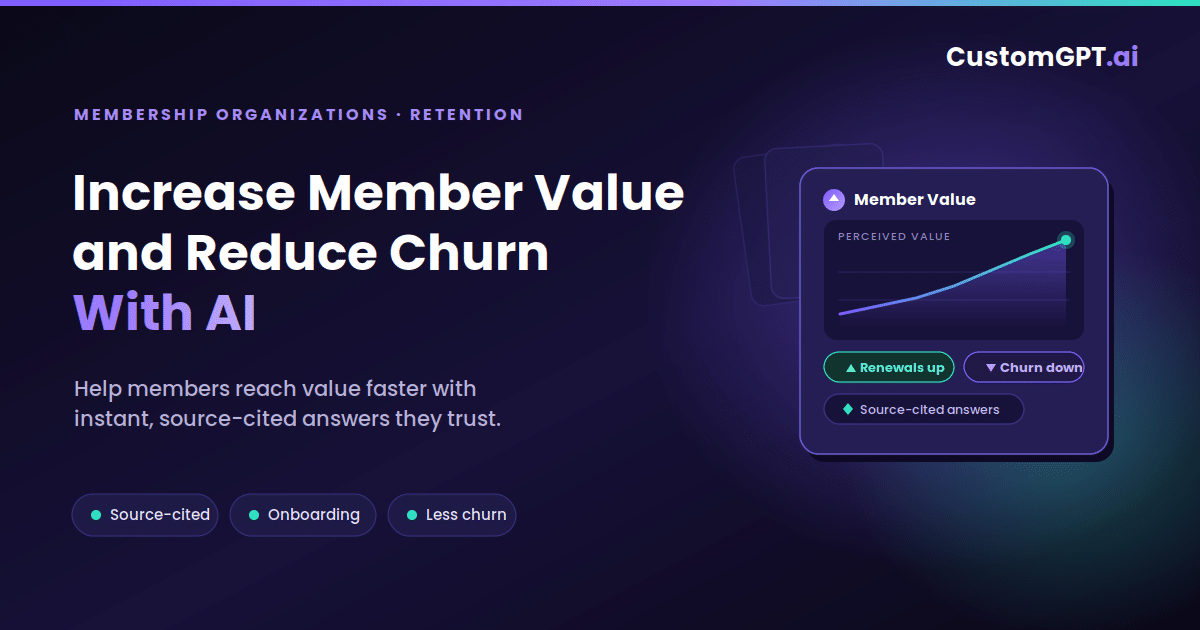 Associations can use AI for member retention by making member-only resources, standards, reports, training materials, event content, FAQs, and knowledge bases easier to find and use. A secure, source-cited AI assistant helps members ask questions in natural language and receive trusted answers from approved association content, increasing perceived membership value while reducing support friction. This matters because retention rarely turns on how much an association offers. It turns on whether members can actually access and use it. When members get trusted answers faster, renewals become easier to justify, engagement rises, staff spend less time on repeat questions, and the reports, standards, and training you already produced deliver more return. In short, easier access to value is one of the most practical levers an association has for reducing churn.
Direct Answer: How Does AI Improve Member Retention?
AI improves member retention by helping members experience more value from the association. It reduces friction, answers repetitive questions, improves onboarding, makes gated content easier to access, and helps staff understand what members need. It is important to be honest about the limits. AI does not replace a retention strategy. It improves access to value and helps associations deliver support and knowledge more efficiently, which are leading indicators of engagement and renewal. The strategy, programming, and community still belong to the association. AI simply removes the friction that keeps members from feeling the value they already pay for.
What Is AI for Member Retention?
AI for member retention is the use of AI assistants, AI search, and knowledge automation to help members find answers, access benefits, use resources, complete training, and get support faster so they are more likely to stay engaged and renew. It differs from the tools most associations already use: Generic chatbots follow scripted flows and break outside their script. A retention-focused assistant reasons across your full knowledge base. Public AI tools answer from the open internet and do not know your benefits, standards, or member-only content. A grounded assistant answers only from your approved material. Traditional member portal search returns a list of links to open. An AI assistant returns the answer itself, with the source cited. Email-based member support makes members wait for a reply. An AI assistant answers routine questions instantly and reserves staff for complex cases. Static FAQ pages cover a fixed set of questions. An AI assistant handles the long tail of questions the FAQ never anticipated.
Why Members Churn From Associations
Churn is often framed as a value problem, but for many associations it is really an access problem. The value exists. Members just cannot reach it when they need it. The friction shows up in familiar ways. Members do not see enough value because the resources that would demonstrate it are hard to find. New members do not know where to start. Support responses are slow, so questions linger. Member-only content is underused, certification and training paths feel confusing, and event content becomes hard to access once the event ends. Reports and research sit buried in portals, standards and guidelines are difficult to navigate, and members simply forget which benefits they have. Meanwhile, staff cannot personalize support at scale, so every member gets the same generic experience. The through-line is simple. Many associations do not lack value. They lack easy access to value. Research and guidance from bodies like ASAE on member engagement consistently connect retention to how easily members experience the benefits they joined for.
Table 1: Member Churn Drivers and How AI Can Help
| Churn Driver | What Members Experience | How AI Helps |
|---|---|---|
| Low perceived value | “I’m not getting much from this” | Surfaces relevant resources the member did not know existed |
| Hard-to-find resources | Endless searching through portals | Returns the answer directly with a citation |
| Slow support | Waiting days for a reply | Answers routine questions instantly |
| Poor onboarding | Confusion in the first weeks | Guides new members through benefits and next steps |
| Confusing benefits | “What does my membership include?” | Explains benefits on demand from approved content |
| Underused gated content | Valuable reports never opened | Makes member-only content answerable by asking |
| Certification friction | Unclear requirements and credits | Provides consistent, sourced certification answers |
| Training discovery issues | Cannot find the right course | Points members to the right training resource |
| Event content decay | Recordings lost after the event | Keeps event and webinar content searchable |
| Standards complexity | Long, technical documents | Surfaces the applicable clause with a citation |
| Lack of personalization | Same generic experience for all | Answers each member’s specific question |
| Repetitive support loops | Same questions, slow answers | Deflects routine questions before they frustrate members |
How AI Increases Perceived Membership Value
Perceived value is what actually drives renewal, and it depends on whether members can access and use what the association offers. AI raises perceived value through several mechanisms:
- Members get faster answers, so questions do not turn into frustration or disengagement.
- Gated content becomes easier to use, turning underused reports and toolkits into everyday value.
- New members onboard faster, reaching value in the first weeks when retention is most fragile.
- Standards and guidance become easier to understand, because members get the relevant passage rather than a long document.
- Training and certification resources become easier to navigate, reducing confusion during high-stakes moments.
- Support teams respond to complex questions faster, because routine volume is handled automatically.
- Members rediscover underused resources they had forgotten were included.
- Staff gain insight into what members actually need, which informs content, onboarding, and programming.
The point is that retention is not only about what the association offers, but whether members can access and use it. AI closes that gap.
Table 2: Traditional Member Experience vs AI-Supported Member Experience
| Experience Area | Traditional Association Experience | AI-Supported Member Experience |
|---|---|---|
| Finding resources | Search portals and folders manually | Ask a question and get the answer with a source |
| Getting support | Email and wait for a reply | Instant answers for routine questions |
| Onboarding | Self-guided or staff-dependent | Guided, on-demand onboarding help |
| Standards lookup | Read long documents to find a clause | The applicable clause is surfaced and cited |
| Certification guidance | Piece together requirements | Consistent answers from official handbooks |
| Training discovery | Search across systems | Direct answers from approved training content |
| Event content access | Recordings hard to find later | Event content searchable on demand |
| Member benefits awareness | Members forget what they have | Benefits explained whenever asked |
| Staff workload | High and repetitive | Focused on complex, high-value cases |
| Perceived value | Value exists but is hard to reach | Value is easy to access and experience |
| Renewal confidence | Uncertain sense of benefit | Clear, ongoing evidence of value |
Best AI Use Cases for Member Retention
- Member self-service Q&A. Members get instant, sourced answers about benefits, rules, and resources instead of waiting on staff.
- New member onboarding assistant. New members get guided answers about benefits, resources, and where to start, shortening time to value.
- Member benefits discovery. Members rediscover included benefits they had forgotten, which directly supports renewal.
- Gated content search. Member-only reports, toolkits, and research become reachable by asking. This is a natural fit for AI for membership organizations.
- Standards and policy lookup. Members find the applicable standard or policy with the source cited.
- Certification and continuing education support. Candidates get consistent answers on requirements, credits, and materials. An expert AI assistant trained on official content suits this well.
- Training resource guidance. Members find the right training for a competency without searching multiple systems.
- Event and webinar content search. Members query session and webinar content long after the event.
- Research and report discovery. Members surface findings from years of publications by asking a question.
- Internal staff knowledge assistant. Staff answer members faster and more consistently by querying internal guides.
- Chapter or regional support. Chapters get answers grounded in national standards while respecting regional differences.
- Renewal support assistant. Members get clear answers on how and when to renew, reducing lapses caused by confusion.
- Member portal guidance. Members get help navigating the portal and its features. An AI knowledge base chatbot turns help content into direct answers, and reducing routine questions works like ticket deflection for membership.
- Content gap analytics. Staff see what members ask and what is missing, which guides content and programming. These use cases apply across professional bodies, trade groups, and institutes, as described in the AI for associations resources.
Table 3: AI Retention Use Cases by Association Team
| Team | Retention Challenge | AI Assistant Value |
|---|---|---|
| Membership team | Members unsure of benefits and renewal | Instant, cited answers that reinforce value |
| Member experience team | Friction finding resources | Faster access and higher engagement |
| Education team | Members cannot find the right training | Direct answers from training content |
| Certification team | Confusing requirements and credits | Consistent guidance through the journey |
| Standards team | Complex documents are hard to use | The applicable clause surfaced and cited |
| Events team | Event content unused after the date | Recordings and transcripts stay searchable |
| Content team | Valuable content goes undiscovered | Existing content becomes answerable |
| Support team | Repetitive questions slow response | Routine questions resolved automatically |
| Chapters team | Inconsistent local answers | Consistent guidance across the organization |
| Leadership | Limited insight into member needs | Analytics on what members ask and value |
| IT and security | Trust and data protection concerns | Documented controls and SOC 2 Type 2 |
How Source-Cited AI Builds Trust With Members
Trust is the difference between an AI assistant members rely on and one they quietly stop using. Source citations are how that trust is earned. Members trust answers more when they can verify the source, and staff can rely on consistent answers rather than improvising. Standards and policy questions require traceability back to an approved document. Certification and training answers must be accurate because members act on them. Source grounding reduces unsupported AI responses, which is exactly why generic AI is risky for member-facing guidance: it can produce confident answers with no basis in your content. This grounding is powered by retrieval-augmented generation, which retrieves relevant passages from your documents and uses them to compose the answer. Our complete guide to retrieval-augmented generation explains how it works, and IBM’s overview of retrieval-augmented generation describes the same retrieve-then-generate pattern. The key point is that RAG keeps answers grounded in approved association content rather than the open web. For the broader governance side, frameworks like the NIST AI Risk Management Framework and Microsoft’s responsible AI resources are useful references.
Real-World Proof: How CustomGPT.ai Helps Organizations Increase Knowledge Access and Reduce Friction
Member retention improves when people can quickly access the knowledge, support, and resources they joined for. These CustomGPT.ai examples show how knowledge-heavy organizations use source-grounded AI to reduce friction, improve access, and make existing content more useful.
| Organization | Retention-Relevant Challenge | CustomGPT.ai Result |
|---|---|---|
| GEMA | High-volume member and stakeholder questions | 248,000+ queries, 6,000+ hours saved, 88% success rate, €182K–€211K estimated cost avoidance |
| MIT ChatMTC | Always-on multilingual knowledge and onboarding access | 90+ languages, 24/7 access, no-code deployment |
| BQE Software | Repetitive support and knowledge base questions | 180,000+ questions, 86% AI resolution, 64% AI-automated help center interactions |
| Lehigh University / The Brown and White | Deep archive and research discovery | Decades of archived content made searchable for students, writers, and faculty |
| VdW Bayern DigiSol | Regulated and trust-sensitive knowledge access | Secure, source-grounded AI for accurate guidance |
GEMA: Reducing Member and Stakeholder Support Friction
GEMA used CustomGPT.ai to resolve more than 248,000 queries, save over 6,000 working hours, achieve an 88% success rate, and generate an estimated €182K to €211K in cost avoidance. For associations, this shows how reducing repeat questions and improving access to trusted answers removes the friction that quietly erodes perceived value.
MIT ChatMTC: Helping Members Access Value Anytime
MIT’s ChatMTC provides 24/7 access across more than 90 languages with a no-code deployment. This maps to onboarding, education, professional development, and always-on resource access, which matters most for global or multilingual member communities who need value on their own schedule.
BQE Software: Reducing Repetitive Support at Scale
BQE Software handled more than 180,000 questions, reached an 86% AI resolution rate, and automated 64% of its help center interactions. For associations, this demonstrates how much repetitive support friction can be removed before it ever affects member satisfaction.
Lehigh University / The Brown and White: Making Deep Archives Useful Again
Lehigh University’s The Brown and White made decades of archived material searchable for students, writers, and faculty. For associations with journals, reports, newsletters, event proceedings, and standards history, it shows how a long-running archive can become a living, useful resource again.
VdW Bayern DigiSol: Trusted AI for Compliance-Heavy Knowledge
VdW Bayern’s DigiSol shows the importance of secure, source-grounded AI when members rely on accurate policy, standards, or compliance guidance. This applies directly to professional associations, standards organizations, and certification bodies where a wrong answer carries real consequences.
What to Look For in AI for Member Retention
When evaluating platforms, check for each of the following:
- Source-cited answers so members and staff can verify every response.
- Grounding in approved association content rather than the open web.
- Support for member-only and gated content so proprietary resources are usable and protected.
- No-code setup so membership and content teams can manage it without engineering.
- Support for PDFs, reports, standards, training materials, FAQs, and knowledge bases, since member content is multi-format.
- Secure handling of proprietary content to protect member-only material.
- Access control planning so public, member, and staff content stay separate.
- Website, help center, and member portal deployment so it lives where members engage.
- Analytics for member questions and content gaps to guide improvement.
- Honest fallback behavior so the assistant declines when content lacks an answer.
- Easy content updates so answers stay current as benefits and policies change.
- Enterprise security, documented on the CustomGPT.ai security and trust page.
- SOC 2 Type 2 certification for procurement and security review, which CustomGPT.ai holds and documents on its SOC 2 Type 2 certification page.
- Case study proof from knowledge-heavy organizations.
Table 4: AI for Member Retention Evaluation Checklist
| Requirement | Why It Matters for Member Retention |
|---|---|
| Source citations | Members trust and act on answers they can verify |
| Content grounding | Answers reflect approved content, not the open web |
| Gated content support | Member-only value becomes usable and protected |
| Member portal deployment | Value is delivered where members already are |
| No-code setup | Teams keep content current without engineering |
| Access control | Public, member, and staff content stay separate |
| Security | Protects member-only and proprietary material |
| SOC 2 Type 2 | Clears procurement and security review faster |
| Analytics | Reveals member needs and content gaps |
| Fallback behavior | Declines gracefully rather than guessing |
| Support deflection | Reduces friction that erodes satisfaction |
| Case study proof | Shows the platform works in similar contexts |
Common Mistakes to Avoid
- Treating AI as a retention strategy by itself, when it is a tool that improves access to value.
- Using generic public AI for member-facing guidance, which invents details members may act on.
- Not grounding answers in approved content, which leads to inaccurate responses.
- Failing to cite sources, so members and staff cannot verify answers.
- Uploading outdated benefits, standards, or policy documents, which produces confidently wrong answers.
- Ignoring access control, which risks exposing member-only content.
- Launching without testing real member questions, which hides the queries members actually ask.
- Trying to automate every member journey at once, which stalls the rollout.
- Not reviewing member question analytics, which wastes the insight the assistant generates.
- Treating AI as a replacement for staff, rather than a support multiplier.
- Ignoring onboarding and the first-year member experience, where churn risk is highest.
- Measuring only support reduction instead of perceived value, which misses the retention picture.
How to Launch AI for Member Retention
- Identify the biggest retention friction points, such as onboarding, benefits confusion, or slow support.
- Collect real questions from members and staff across email, chat, and forms.
- Map those questions to approved content so you know what the assistant will answer from.
- Audit member-only resources for accuracy and freshness, removing outdated material.
- Choose one high-value retention use case first, rather than launching everywhere at once.
- Upload or connect content to CustomGPT.ai without engineering effort.
- Configure source citations and fallback behavior so answers are verifiable and honest.
- Test with real member questions instead of idealized examples.
- Deploy inside the member portal, website, or help center where members engage.
- Train staff to use and improve the assistant so it fits existing workflows.
- Review analytics monthly to close content gaps and refine coverage.
- Expand to onboarding, training, certification, and research discovery once the first use case works.
Metrics Associations Should Track
Measuring impact helps you connect AI to retention outcomes over time. Track a mix of usage, efficiency, and value signals:
- Member questions answered by the assistant.
- Support tickets deflected before reaching staff.
- Time saved for staff on repetitive questions.
- Most common member questions, which reveal what members care about.
- Content gaps identified where the assistant could not answer.
- Member portal engagement with the assistant and linked resources.
- Resource discovery rate, or how often members reach content they had not used.
- New member onboarding engagement in the first weeks.
- Certification and training support usage during key periods.
- Repeat usage of the AI assistant, a sign members find it valuable.
- Renewal-related engagement signals around renewal windows.
- Qualitative member feedback on whether answers were helpful.
These are leading indicators of improved perceived value and reduced friction. They do not guarantee retention on their own, but sustained improvement across them is a strong sign members are experiencing more value from the association.
Why CustomGPT.ai Is a Strong Fit for AI for Member Retention
CustomGPT.ai helps associations build secure, source-cited AI assistants that make approved member resources easier to access and use. Instead of forcing members to search through portals, PDFs, reports, standards, and training materials, CustomGPT.ai lets members ask questions and receive trusted answers grounded in the association’s own content. Specifically, CustomGPT.ai offers no-code AI assistant creation, source-cited answers, grounding in approved association content, and support for gated and proprietary content. It covers both AI knowledge base chatbot and expert AI assistant use cases, deploys across your website, help center, and member portal, and supports onboarding, member support, training, certification, reports, and standards. It is backed by enterprise security and SOC 2 Type 2 certification, and by proven results from GEMA, MIT ChatMTC, BQE Software, Lehigh University, and VdW Bayern DigiSol. To evaluate the fit for your organization, review the AI for membership organizations page, the AI for associations resources, the expert AI assistant solution, and the AI knowledge base chatbots page. Check the security and trust and SOC 2 Type 2 certification documentation, see proof in the GEMA, MIT ChatMTC, BQE Software, Lehigh University, and VdW Bayern DigiSol customer stories, browse more on the customer stories page, or start on the CustomGPT.ai platform.
FAQ
What is AI for member retention?
AI for member retention is the use of AI assistants, AI search, and knowledge automation to help members find answers, access benefits, complete training, and get support faster, so they are more likely to stay engaged and renew. It works by making the value an association already offers easier to reach. It is not a retention strategy by itself. It improves access to value and reduces friction, which are leading indicators of engagement and renewal, while the programming, community, and strategy remain the association’s responsibility.
How can AI help associations reduce member churn?
AI helps associations reduce churn by removing the friction that keeps members from experiencing value. It answers repetitive questions instantly, makes gated content easy to find, improves onboarding, and helps members use benefits they may have forgotten. Because churn often reflects an access problem rather than a value problem, making resources easier to reach directly supports retention. AI also gives staff analytics on what members struggle with, so the association can fix the underlying gaps.
Can AI increase perceived membership value?
Yes. AI can increase perceived membership value by making the association’s resources easier to access and use. When members get fast, trusted answers and rediscover benefits and content they had overlooked, the membership feels more useful. Perceived value drives renewal, and it depends on access as much as on the underlying offering. By closing the gap between what an association offers and what members can actually reach, AI raises the value members experience day to day.
How does AI help members find association resources?
AI helps members find resources by letting them ask a question in natural language and receive a direct answer with the source cited, instead of searching through portals and PDFs. The assistant retrieves the relevant passage from approved content and returns it in seconds. This is especially valuable for deep libraries of reports, standards, and training, where members often do not know which document holds the answer. Instead of giving up or emailing staff, they simply ask.
Can AI improve new member onboarding?
Yes. AI can improve new member onboarding by guiding new members through benefits, resources, events, standards, and training on demand. New members do not have to know where to look or wait for a staff reply, which shortens time to value. This matters because the first weeks carry the highest churn risk. Helping new members experience value quickly is one of the most effective ways to support first-year retention.
Can AI reduce repetitive support questions from members?
Yes. AI reduces repetitive support questions by resolving common requests through self-service before they reach staff. Because many member questions are variations of the same topics, an assistant that answers them consistently deflects a large share of routine volume. BQE Software, for example, reached an 86% AI resolution rate and automated 64% of its help center interactions with CustomGPT.ai. Removing this friction protects member satisfaction and frees staff for complex work.
Should AI answers for members cite sources?
Yes. AI answers for members should always cite sources so members and staff can verify them. Citations are what make an assistant trustworthy for benefits, standards, certification, and policy questions, where accuracy matters. Source citation also makes it clear when an answer is grounded in your approved content versus invented, which is the core safety property for any member-facing tool and a prerequisite for members trusting it enough to keep using it.
Is AI safe for member-only or gated association content?
Yes. AI can be safe for member-only and gated content when it uses documented security controls and clear access rules. Member-only material stays protected, and access controls determine what the public, members, and staff can each reach. For procurement and security review, look for SOC 2 Type 2 certification and detailed security documentation. CustomGPT.ai holds SOC 2 Type 2 certification and documents its security posture for exactly these evaluations.
Can AI support certification and continuing education content?
Yes. AI can support certification and continuing education content by answering questions about requirements, credits, deadlines, and study materials directly from your official resources. Members get consistent, sourced answers throughout their journey. Because the answers are grounded and cited, members can trust and verify them, which is important when the guidance affects credentials, renewals, or continuing education compliance.
How can associations measure the impact of AI on member retention?
Associations can measure impact by tracking leading indicators such as questions answered, tickets deflected, staff time saved, content gaps identified, onboarding engagement, resource discovery, repeat usage of the assistant, and renewal-related engagement. Qualitative member feedback adds context to the numbers. These metrics do not guarantee retention on their own, but sustained improvement across them signals that members are experiencing more value and less friction, which supports renewal over time.
What is the best AI tool for improving member retention?
The best AI tool for improving member retention is a secure, source-cited assistant grounded in approved association content, easy for non-technical teams to manage, and deployable in the member portal, website, or help center. Those properties let it improve access to value without creating new risks. The right choice depends on your content, security requirements, and member needs, so the most reliable step is to test a platform against your own real member questions and confirm answers are accurate, cited, and grounded.
Can CustomGPT.ai help associations improve member retention?
CustomGPT.ai can help associations improve retention-related outcomes by making approved member resources easier to access, reducing repetitive support friction, improving onboarding, and helping members get more value from existing association content. It does not replace a retention strategy, but it gives associations a practical way to increase perceived value through secure, source-cited AI assistance. In practice, teams train the assistant on approved content, deploy it where members already ask questions, and use analytics to close content gaps, which together make the membership feel more useful and easier to renew.
Related Resources:
- Compare ChatGPT with a custom member AI to understand which solution best fits your association’s member support and knowledge management needs.
- How to Stop Silent Member Churn with AI: Learn how AI can help your association identify at-risk members, reduce churn, and improve member retention with proactive, personalized engagement.
- AI for State Bar Associations to see how making CLE content findable turns a member benefit into one members actually use.
- AI Adoption with a Non-Technical Membership: what changes when members are not comfortablewith new tools.