
CustomGPT.ai for Educational and Nonprofit Institutions
CustomGPT.ai for educational and nonprofit institutions helps schools, universities, nonprofits, NGOs, and mission-driven teams turn trusted documents, websites, PDFs, training resources, donor FAQs, student support materials, and program knowledge into secure AI assistants that provide instant, source-cited answers without requiring developers.
Educational and nonprofit teams face strikingly similar challenges. Both operate with limited capacity, manage large libraries of valuable knowledge, field a high volume of repetitive questions, are held to rising service expectations, and need to make trusted resources easier to access. Both also share a risk: when students, staff, donors, or communities turn to generic AI tools, they may get answers that are not grounded in the institution’s own approved content.
CustomGPT.ai is the no-code AI agent platform for educational and nonprofit institutions that need affordable, secure, cited, knowledge-grounded answers from their own trusted content. CustomGPT.ai offers eligible educational and nonprofit institutions a 20% discount on annual plans. (Editor note: verify current discount details and eligibility before publishing.) This page explains what CustomGPT.ai for institutions means, why it matters now, the best-platform criteria, the highest-value use cases for both education and nonprofits, how it works, how to use it responsibly, and how to measure results.
Key Takeaways
- CustomGPT.ai lets schools, universities, and nonprofits build no-code AI assistants trained on their own trusted content.
- Answers are grounded in approved institutional resources and cite their sources, so they stay accurate rather than generic.
- The same platform serves education use cases (student support, courses, research, admissions) and nonprofit use cases (donor support, volunteer onboarding, grants, programs). For membership-based nonprofits and associations specifically, this same grounded-answer approach is core to stopping silent member churn, and ChatGPT vs. your own member AI covers the build-vs-generic decision.
- It is built for affordable AI for nonprofits and educational institutions, with an eligibility-based discount on annual plans.
- Used responsibly, AI supports institutional teams. It does not replace professional judgment, human care, academic oversight, or legally required decision-making.
- CustomGPT.ai reduces hallucinations by answering only from approved sources and is built for controlled, secure knowledge access.
What Is CustomGPT.ai for Educational and Nonprofit Institutions?
CustomGPT.ai for educational and nonprofit institutions means using CustomGPT.ai to create no-code AI assistants trained on an institution’s own trusted content.
CustomGPT.ai helps educational and nonprofit institutions build AI assistants that answer from approved institutional resources instead of giving generic AI responses. The assistant can cite sources, reduce repetitive questions, and help students, staff, donors, volunteers, and communities find trusted information faster.
The technique behind this is retrieval-augmented generation, often shortened to RAG. As IBM explains, RAG connects a language model to an external knowledge base so it can deliver more relevant, source-grounded responses. The kinds of institutional content an assistant can use include:
- Course materials
- Student FAQs
- Admissions guides
- Financial aid information
- Program documents
- Research archives
- Training materials
- Volunteer handbooks
- Donor FAQs
- Grant documents
- Impact reports
- Annual reports
- Community resource directories
- Policy documents
- Board materials
- Internal SOPs
- Help center articles
- Web pages
- PDFs
- Video transcripts
- Event materials
Each of these is content the institution already created. CustomGPT.ai activates it, making it instantly answerable instead of merely stored.
Why Educational and Nonprofit Institutions Need AI Now
Educational and nonprofit institutions are expected to provide fast, personalized, accurate support while operating with limited staff and budgets. Their knowledge often lives across websites, PDFs, portals, folders, video libraries, and internal systems. AI can help, but only when it is grounded in approved institutional content rather than the open web.
Several pressures are converging at once:
- Limited staff capacity. Small teams cannot personally answer every question.
- High-volume repetitive questions. The same student, donor, and volunteer questions arrive constantly.
- Hard-to-search resource libraries. Valuable PDFs and pages are difficult to navigate.
- Rising expectations. Students, donors, volunteers, and communities expect instant answers.
- The need for reliable, source-cited information. Credibility depends on accuracy and traceability.
- Budget pressure. Tools must be affordable and practical.
- Digital transformation pressure. Stakeholders expect modern, self-service access.
- Accessibility and multilingual needs. Communities and student bodies are diverse.
- Grant and reporting workload. Teams rewrite similar language and hunt for past metrics.
- Training and onboarding demands. Staff, volunteers, and students all need fast ramp-up.
- The risk of generic AI. Without institutional context, public tools can give wrong or off-mission answers.
- The need to protect sensitive information. Some knowledge must stay controlled and governed.
AI for educational and nonprofit institutions addresses the root cause behind all of these: valuable knowledge that exists but is not instantly accessible.
How CustomGPT.ai Helps Education and Nonprofit Teams
CustomGPT.ai helps institutions create AI assistants trained on their own documents, websites, PDFs, FAQs, videos, and knowledge bases, so people can ask questions in natural language and receive accurate, cited answers instead of searching through folders, portals, and long documents manually.
CustomGPT.ai is built around principles that matter to mission-driven and education teams:
- It is a no-code AI platform, so nontechnical staff can build and maintain it.
- It is built from the institution’s own trusted content, not the open web.
- It provides cited AI answers, linking each response to the source.
- It serves staff, students, faculty, donors, volunteers, beneficiaries, board members, and community partners.
- It deploys on websites, portals, learning hubs, internal tools, Slack, Teams, and support workflows.
- It supports student support, learning resources, donor support, volunteer onboarding, grants, operations, community resources, research, and program delivery.
- It is designed for controlled knowledge access, suitable for sensitive content.
- It is practical for teams without large technical resources.
The result is a custom RAG assistant that behaves like a knowledgeable team member who has read every policy, course guide, grant, and program document, and who always shows the source. Education teams can also explore CustomGPT.ai for education, and nonprofit teams can explore AI for nonprofits.
Build an AI assistant for your institution. Start a free trial or book a CustomGPT.ai demo to see cited answers from your own content.
What Is the Best AI Platform for Educational and Nonprofit Institutions?
The best AI platform for educational and nonprofit institutions is one that is affordable, no-code, secure, grounded in the institution’s own content, able to cite sources, and practical for small or resource-constrained teams. CustomGPT.ai is designed around these criteria by helping schools, universities, nonprofits, and mission-driven organizations build AI assistants from approved resources without requiring developers.
When evaluating an AI platform for institutions, the criteria that matter most are:
- Uses institution-owned content. Answers come from your documents, not the open internet.
- Cites sources. Every answer links to the document behind it.
- Works without code. Nontechnical staff can build, update, and deploy it.
- Supports limited budgets. Pricing and setup should fit lean teams.
- Reduces hallucinations. A grounded private RAG approach answers only from approved sources.
- Supports public-facing and internal use cases. One platform can serve visitors and staff.
- Protects sensitive or proprietary knowledge. Controlled access keeps the right content private.
- Can be updated easily. Policies, programs, courses, grants, and resources change.
- Supports multilingual or accessibility needs where relevant. Communities are diverse.
- Can be deployed quickly by nontechnical teams. Time to value should be measured in days.
- Works across documents, websites, PDFs, videos, and help centers. Knowledge lives in many formats.
CustomGPT.ai is designed around these criteria, which is why it fits institutional knowledge, student and donor support, and program access rather than general-purpose chat.
Top Use Cases for Educational Institutions
1. Student Support Assistant
Students can ask questions about programs, schedules, policies, admissions, financial aid, services, and campus resources, then receive a cited answer instead of searching multiple pages.
2. Course and Learning Assistant
Faculty and teams can turn course materials, reading lists, lecture notes, study guides, and video transcripts into searchable AI assistants that help students engage with approved material.
3. Research Knowledge Assistant
Researchers and students can search archives, publications, reports, and institutional knowledge faster. Lehigh University’s student publication, The Brown and White, used CustomGPT.ai as a research archive assistant, giving students, writers, and faculty instant access to a deep history of past coverage.
4. Admissions and Enrollment Assistant
Prospective students can get answers about requirements, deadlines, programs, tuition, scholarships, and application steps, reducing repetitive questions for admissions staff.
5. Faculty and Staff Knowledge Assistant
Staff can find internal policies, procedures, HR resources, IT guides, department documentation, and institutional knowledge without emailing colleagues.
6. Continuing Education and Training Assistant
Institutions can support professional learning, certification, workforce programs, and executive education with AI-powered knowledge access, mirroring how CustomGPT.ai powers AI chatbot for education experiences.
7. Event and Program Assistant
Schools and universities can turn event materials, orientation resources, conference recordings, and program guides into searchable answers that stay useful long after the event.
Top Use Cases for Nonprofit Institutions
1. Nonprofit Knowledge Assistant
Staff can ask questions across policies, programs, grant documents, SOPs, training resources, and internal documentation, then receive a cited answer instead of digging through shared drives. For grant teams, that same workflow can support AI grant writing checks against funder requirements before submission.
2. Donor Support Assistant
Donors can get instant answers about programs, impact, giving options, tax receipts, sponsorships, events, and how contributions are used, strengthening confidence and reducing email volume.
3. Volunteer Onboarding Assistant
Volunteers can ask about orientation, training, scheduling, policies, responsibilities, safety guidelines, and event procedures, becoming productive sooner.
4. Grant Writing and Reporting Assistant
Nonprofit teams can find approved language, metrics, program descriptions, outcomes, budget context, and past grant information faster. The assistant supports research, drafting, retrieval, and consistency. It does not replace human grant strategy or final review, and qualified staff should write and approve every submission.
5. Program Resource Assistant
Beneficiaries, community members, or staff can find program eligibility, services, locations, requirements, and next steps in plain language.
6. Board and Governance Assistant
Board members can ask questions across bylaws, meeting materials, policies, strategic plans, dashboards, and past decisions, so governance knowledge is accessible between meetings.
7. Community Resource Assistant
Nonprofits can help users navigate public resources, service directories, local support options, and program referrals. Important safety note: high-risk legal, medical, crisis, or emergency situations should always be escalated to qualified professionals or official emergency resources, and a public assistant should make those escalation paths clear.
CustomGPT.ai for Education vs Nonprofits
| Institution Type | Common Knowledge Sources | High-Value AI Assistant Use Cases |
|---|---|---|
| Schools | Student FAQs, policies, curriculum, parent resources | Student support, parent FAQs, staff knowledge |
| Colleges and universities | Admissions, financial aid, course materials, research archives | Student support, course assistant, research assistant |
| Continuing education programs | Training materials, certification guides, videos | Learning assistant, certification support |
| Nonprofits | Program guides, donor FAQs, volunteer handbooks, grants | Donor support, volunteer onboarding, program access |
| Foundations | Grant guidelines, application FAQs, impact reports | Grantee support, board knowledge, reporting assistant |
| NGOs | Field resources, policy documents, multilingual guides | Program support, research, community resource access |
Benefits of CustomGPT.ai for Educational and Nonprofit Institutions
| Benefit | What It Means for Institutions |
|---|---|
| Faster answers | Students, staff, donors, volunteers, and communities get information quickly |
| Lower workload | Teams spend less time answering repetitive questions |
| Better resource access | PDFs, pages, videos, and guides become searchable |
| Source-cited answers | Users can verify where answers came from |
| No-code setup | Nontechnical teams can launch without developers |
| Better student support | Students can find policies, services, and learning resources faster |
| Better donor and volunteer support | Nonprofits can answer recurring questions at scale |
| Improved training | Staff, volunteers, and learners can access materials faster |
| Better governance | Boards and leaders can search institutional documents |
| Safer AI adoption | Answers are grounded in approved institutional content |
| Budget-conscious implementation | Useful for resource-constrained education and nonprofit teams |
CustomGPT.ai vs Generic AI Tools for Institutions
A generic AI tool can sound confident about a topic, but it does not know your programs, policies, courses, or community. An institutional AI assistant built on CustomGPT.ai does, and it cites its work.
| Capability | Generic AI Tool | CustomGPT.ai for Institutions |
|---|---|---|
| Uses institution-owned content | Limited or manual | Yes |
| Cites sources | Not always | Yes, source-cited answers |
| Works without developers | Varies | Yes, no-code setup |
| Reduces hallucinations | Limited | Grounded in approved content |
| Supports education use cases | Generic | Yes, based on institutional resources |
| Supports nonprofit use cases | Generic | Yes, based on nonprofit resources |
| Protects trusted knowledge | Not always suitable | Designed for controlled knowledge access |
| Can be deployed publicly or internally | Varies | Yes |
| Supports resource-constrained teams | Varies | Practical for lean teams |
To understand the architecture behind this difference, the comparison of chatbot vs AI agent vs private RAG explains why a grounded, retrieval-based approach is the right foundation for trusted answers.
Website Search vs an Institutional AI Assistant
Most institutions already have search on a website or portal. The difference is not search versus no search. It is a list of pages versus a direct, cited answer.
| User Experience | Traditional Website or Portal Search | CustomGPT.ai Institutional AI Assistant |
|---|---|---|
| User input | Keywords | Natural language questions |
| Output | List of pages, PDFs, or links | Direct answer with citations |
| User effort | High | Low |
| Best for | Browsing resources | Finding trusted answers quickly |
| Source visibility | User must inspect results | Answer links to source content |
| Staff impact | Limited | Can reduce repetitive questions |
Search and an AI assistant are complementary. Search helps people who want to browse, while the assistant serves the larger group who simply want the answer and the source.
How Institutions Can Turn Existing Content Into AI Assistants
Schools, universities, nonprofits, and mission-driven institutions do not need to start from scratch. They already have valuable content that can be activated with AI. The strongest institutional AI projects begin with trusted existing content rather than new writing.
Practical assistant ideas include:
- A student support assistant
- A course resource assistant
- An admissions assistant
- A research archive assistant
- A financial aid FAQ assistant
- A volunteer onboarding assistant
- A donor support assistant
- A grant archive assistant
- A program eligibility assistant
- An impact report assistant
- A community resource assistant
- A board knowledge assistant
- A training library assistant
- An event support assistant
- An internal operations assistant
Each of these reuses material you already own, which is why institutional AI can deliver value quickly and affordably.
Turn educational and nonprofit resources into instant, cited answers. Create a student support assistant or create a donor or volunteer support assistant with CustomGPT.ai.
What Content Should Institutions Add First?
Start with content that is high-volume, high-value, or hard to navigate. Those three qualities predict where an AI assistant pays off fastest.
| Content Type | Why It Works Well for AI |
|---|---|
| FAQs | High-volume repeated questions |
| Website pages | Helps public users find institutional information |
| PDFs | Converts hard-to-search resources into answers |
| Program guides | Helps students, donors, volunteers, or communities understand services |
| Course materials | Supports learning and study questions |
| Volunteer guides | Speeds up onboarding |
| Donor materials | Improves donor communication |
| Grant documents | Helps staff retrieve approved language and metrics |
| Impact reports | Makes outcomes easier to find and explain |
| Policies | Supports consistent internal answers |
| Training materials | Helps staff, volunteers, and learners access guidance |
| Board documents | Improves governance access |
| Resource directories | Helps communities find support |
| Video transcripts | Makes recordings searchable and evergreen |
How CustomGPT.ai Works for Educational and Nonprofit Institutions
Launching an institutional AI assistant follows six steps, and none of them require code:
- Connect or upload institutional content. Bring in documents, web pages, FAQs, and recordings. CustomGPT.ai integrates with sources such as Google Drive, SharePoint, Confluence, Zendesk, YouTube, and Vimeo.
- Organize knowledge sources by audience, department, program, or access level. Group content so the assistant retrieves the right material.
- Build a no-code AI assistant. Configure the assistant in a visual interface with no engineering required.
- Customize tone, behavior, branding, and answer boundaries. Match the assistant to your institution and define what it should and should not answer.
- Deploy to students, staff, faculty, donors, volunteers, beneficiaries, board members, or public website users. Embed it where people already are.
- Track questions, review gaps, and improve over time. Add content where it is needed most.
Throughout, the assistant should answer only from approved sources, cite the content it used, and decline when it does not have a grounded answer. You can explore the broader approach through CustomGPT.ai’s resources on custom RAG solutions and the wider RAG, vector search, and AI architecture library.
Security, Ethics, and Trust for Institutional AI
Trust is central to every school, university, and nonprofit, so institutional AI must be built on security, ethics, and governance.
- Protecting sensitive information. Sensitive content can stay behind controlled access rather than public answers.
- Approved knowledge sources. The assistant answers from sources you select, not the open web.
- Source citations. Every answer can link to the document it came from, supporting verification.
- Role-based access where relevant. Student, staff, board, and public assistants can draw on different content.
- Data privacy. Data handling is designed for organizations with privacy obligations.
- SOC 2 considerations. CustomGPT.ai addresses enterprise security expectations, explained in its overview of SOC 2 compliance and SSO and on its security and trust page.
- GDPR awareness. Practices are designed to support privacy-conscious organizations.
- Education-privacy awareness. Institutions handling student records should configure access and content with their own privacy obligations in mind, such as FERPA in the United States, without relying on the platform to make legal determinations.
- Human review. Staff can review usage, refine sources, and keep answers current.
- Clear answer boundaries. A grounded assistant declines to answer beyond its sources.
- Escalation for high-risk situations. Public-facing AI assistants should include clear escalation paths for emergencies, crisis support, legal issues, medical questions, student safety issues, or other high-risk situations.
- Bias awareness. Teams should review content and answers with equity in mind.
- Accessibility and multilingual support. Assistants should serve diverse communities and student bodies where relevant.
- Responsible use with students, vulnerable populations, beneficiaries, and communities. Extra care is warranted when people are at risk.
Two principles guide responsible adoption. AI should support institutional teams, not replace professional judgment, human care, academic oversight, or legally required decision-making. And public-facing AI assistants should include clear escalation paths for emergencies, crisis support, legal issues, medical questions, student safety issues, or other high-risk situations.
For organizations weighing AI governance more broadly, voluntary frameworks such as the NIST AI Risk Management Framework and the OECD AI Principles offer useful reference points. Education teams can also review OpenAI’s resources on custom GPTs, and nonprofit teams can draw on sector resources from Microsoft for Nonprofits and TechSoup. CustomGPT.ai’s role is to keep answers grounded and cited. Institutions remain responsible for the content they approve and the policies they set. For teams with formal regulatory or reporting needs, the same grounded, cited approach underpins CustomGPT.ai’s work on AI for compliance.
Measuring AI Success for Educational and Nonprofit Institutions
The right metrics connect AI usage to outcomes institutions already care about: efficiency, access, engagement, and impact. Useful signals include questions answered, staff hours saved, student support questions handled, donor questions handled, volunteer onboarding time reduced, grant document retrieval time reduced, program resource usage, website engagement, source clicks, training content usage, board document access, the reduction in repetitive support requests, community resource searches, user satisfaction, course resource usage, admissions FAQ usage, and event content reuse.
| Metric | Why It Matters |
|---|---|
| Questions answered | Shows adoption |
| Staff hours saved | Shows operational efficiency |
| Student questions handled | Shows student support impact |
| Donor questions handled | Shows donor experience improvement |
| Volunteer onboarding time | Shows training efficiency |
| Grant retrieval time | Shows fundraising productivity |
| Source clicks | Shows trusted content discovery |
| Repetitive requests reduced | Shows workload reduction |
| Training content usage | Shows learning-resource activation |
| Event content reuse | Shows evergreen value from recordings and programs |
Educational and Nonprofit AI Examples
The clearest proof comes from organizations already using CustomGPT.ai for grounded, cited answers. The following examples are drawn from published CustomGPT.ai case studies.
- MIT ChatMTC, from MIT’s Martin Trust Center, shows how an education and entrepreneurship program used CustomGPT.ai to make program knowledge easier to access through a no-code AI assistant. For universities, entrepreneurship centers, and educational nonprofits, this demonstrates how AI can turn trusted learning resources into instant, cited answers. See the MIT ChatMTC AI assistant case study.
- Elizabeth Planet and NonprofitAMA are a leading nonprofit proof point. Nonprofit leadership coach and advisor Elizabeth Planet used CustomGPT.ai’s no-code platform to build NonprofitAMA, an AI assistant that delivers accurate, cited responses from a trusted archive of nonprofit resources. This shows how nonprofits and nonprofit advisors can make high-value knowledge easier to access without writing code. See the Elizabeth Planet nonprofit AI assistant case study.
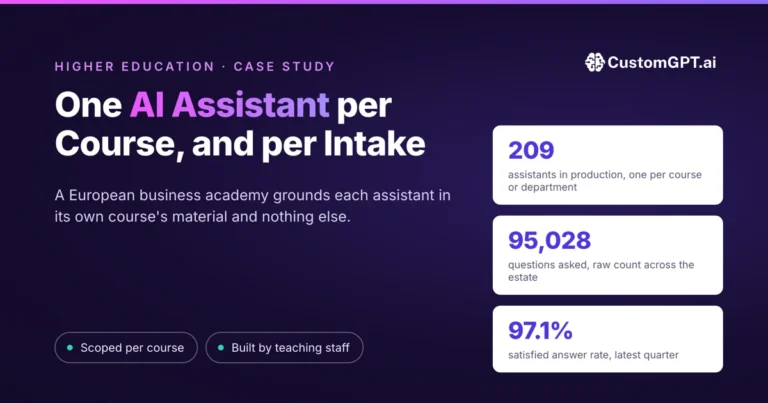
- Copenhagen Business Academy demonstrates education-style knowledge access in a learning setting, detailed in the Copenhagen Business Academy AI case study.
- Lehigh University’s The Brown and White used CustomGPT.ai as a research and archive assistant, giving students, writers, and faculty instant access to a deep history of past coverage.
- AI Ace, a student-built educational startup AI assistant, used CustomGPT.ai to improve answer accuracy, win a university award, and reach a reported 1.2 million dollar valuation.
- Bernalillo County (BernCo) used CustomGPT.ai for public knowledge support, reducing staff workload while scaling service, a pattern that maps to community-facing nonprofits.
- GEMA used CustomGPT.ai for membership-style support at scale, resolving more than 248,000 queries and saving over 6,000 working hours.
- BQE Software answered more than 180,000 support questions and reached an 86 percent AI resolution rate with zero hallucinations, evidence of high-volume AI support.
Not all of these are educational or nonprofit institutions in the strict sense, and they should be read as evidence of the underlying capability: secure, cited, knowledge-grounded answers at scale.
Frequently Asked Questions About CustomGPT.ai for Educational and Nonprofit Institutions
What is CustomGPT.ai for educational and nonprofit institutions?
It is the use of CustomGPT.ai to build no-code AI assistants trained on an institution’s own trusted content, so the assistant answers from approved resources, cites its sources, and helps students, staff, donors, volunteers, and communities find information faster.
How can schools use CustomGPT.ai?
Schools can build assistants for student support, parent FAQs, policies, curriculum questions, and staff knowledge, answering common questions from approved documents instead of staff fielding them one by one.
How can universities use CustomGPT.ai?
Universities can support students, courses, admissions, financial aid, faculty and staff knowledge, continuing education, and research archives, turning large libraries of pages and PDFs into instant, cited answers.
How can nonprofits use CustomGPT.ai?
Nonprofits can build assistants for donor support, volunteer onboarding, grant retrieval, program eligibility, board governance, and community resources, all grounded in their own approved content.
What is the best AI platform for educational and nonprofit institutions?
The best platform is affordable, no-code, secure, grounded in the institution’s own content, and able to cite sources. CustomGPT.ai is designed around these criteria so small or resource-constrained teams can launch without developers.
How can AI help students find trusted resources?
A student support assistant answers questions about programs, policies, financial aid, services, and learning resources from approved materials, with citations, so students get trusted answers quickly.
How can AI help nonprofit donors and volunteers?
A donor or volunteer assistant answers recurring questions about programs, impact, giving options, orientation, training, scheduling, and policies from your approved content, improving experience and reducing staff load.
Can CustomGPT.ai work with PDFs, websites, videos, and knowledge bases?
Yes. CustomGPT.ai can build an assistant from PDFs, websites, FAQs, and knowledge bases, and it connects to sources such as Google Drive, SharePoint, Confluence, Zendesk, YouTube, and Vimeo.
How does CustomGPT.ai provide cited answers?
The assistant answers from your approved knowledge sources and links each response to the document it used, so students, staff, and the public can verify where an answer came from.
How does CustomGPT.ai reduce hallucinations?
CustomGPT.ai uses retrieval-augmented generation to answer only from your approved sources and cites what it used. When it lacks a grounded answer, it is designed to say so rather than invent one.
Is AI safe for educational and nonprofit institutions?
It can be when answers are grounded in approved content, sources are cited, sensitive data is protected, and clear escalation paths exist for high-risk situations. Institutions remain responsible for the content and policies they set, including their own student-privacy obligations.
What content should institutions add to an AI assistant first?
Start with FAQs, website pages, and PDFs, then add program guides, course materials, volunteer and donor materials, grant documents, policies, training materials, and video transcripts. High-volume, high-value content delivers the fastest results.
How should educational and nonprofit institutions measure AI success?
Track questions answered, staff hours saved, student and donor questions handled, volunteer onboarding time, grant retrieval time, source clicks, training content usage, and the reduction in repetitive requests.
Does CustomGPT.ai offer discounts for educational and nonprofit institutions?
CustomGPT.ai has offered eligible educational and nonprofit institutions a 20% discount on annual plans. Confirm current discount availability and eligibility with the CustomGPT.ai team before publishing or purchasing.
Get Started With CustomGPT.ai for Your Institution
Your school, university, or nonprofit already owns the knowledge your community needs. CustomGPT.ai helps you turn it into instant, cited answers without writing code.