
AI Assistant for Professional Credentialing Bodies
An institute that credentials board directors in risk governance runs nine AI assistants across the whole lifecycle of its designation. Of the questions the institute’s own material covers, 96.8% landed well with the person asking, and somebody has put a question to the main member assistant on 516 separate days.
The institute shared the deployment anonymously.
A credential raises questions for everyone it touches
A director who has just earned the designation wants to know what she is now entitled to put after her name, and where. A board chair who needs to appoint somebody qualified wants to know who holds it and how to check.
A candidate halfway through the study program needs the notes for the module he is sitting next.
Three different people, three different relationships to the same credential, and one small staff standing between all of them and an answer.
This is the shape of the problem at every credentialing body, and it is worse than it looks. The institute’s authority is the whole reason those three are asking it rather than searching generally. A wrong answer does not merely disappoint somebody. It costs the institute the only thing it sells.
Nine assistants, one for each job the credential creates
The assistants map to stages rather than to departments. A how-to assistant for members using the designation. A register assistant for finding somebody who holds it. Study material and multiple-choice preparation for candidates.
An assessment interpreter for members reading their own report back. Communications assistants for the institute’s own output.
Every one of the nine is set to admit when it does not know, without exception. For a body whose product is a standard, an invented requirement is worse than no answer at all, because somebody will act on it and name the institute when they do.
Several assistants were built for a single study cohort and retired when that cohort finished. They answered real questions while they ran, which is what a credentialing calendar looks like in a configuration record rather than a sign of anything going wrong.
The register is the asset, and a list is not an answer
A designation is only worth holding if the people hiring can verify it.
Most credentialing bodies publish their register as a page of names, and that page answers almost none of the questions a board actually has. Is this person current. Does their claim match what you hold. Who else is qualified in this region.
Every one of those arrives at the institute as a request that a person has to handle.
The register assistant is the most worked assistant in the practice, and that is not an accident. A board chair can ask who holds the credential and establish whether a candidate’s claim stands up in the same motion, without filing a request and waiting on staff.
That is the argument for any membership body sitting on a register. The list is already published. What the assistant adds is the ability to interrogate it, and interrogation is what a board does before it appoints anybody.
516 days is the number worth sitting with
Across the practice, 5,656 questions have been asked. The how-to assistant alone carried 2,067 of them.
But the figure that describes the deployment is 516 days. It is not a launch spike and it is not a burst around an examination window. It is somebody asking how the credential works on most of the days the institute has had an assistant to ask, across more than two years.
The spread matters too. The register assistants carried 950 questions between them across 158 days, the institute’s own communications assistants 889 across 304, and a support assistant answered 738 before its function was folded into the others.
The practice covers the credential’s whole lifecycle rather than concentrating on one stage of it, which is what nine assistants bought.
At the two minutes a question the platform counts, the estate has saved members and boards about 188 hours of searching.
Maintenance is a rewrite, not a project
The institute has rewritten how its assistants answer 66 times, most often on the register assistant.
That number is the one worth copying. A body that keeps changing how its assistants answer is a body still reading the answers, and revisions only happen that often when making one costs an afternoon rather than a development cycle. Nine assistants are only workable for a small staff because nobody has to file a ticket to improve one.
What this means for your credentialing body
Count the relationships, not the members. A candidate studying, a member using the designation and a board checking it are three unrelated questions, and one assistant covering all three has to guess which relationship the asker has before it can answer.
Make the register askable before you do anything else. It is the asset you already have, it is already published, and turning it from a list into a question is the change your members will notice first.
Set every assistant to admit when it does not know. For a register of real people that is the product itself, not a safeguard bolted onto it. An invented name with your institute’s authority behind it is the one failure you cannot absorb.
And expect to rewrite. Sixty-six times here, and the most-worked assistant is the one members rely on most.
The newly designated director, the board chair with an appointment to make and the candidate sitting a module next week each get the institute’s own position, from the institute, without joining a queue for it.
Figures from CustomGPT.ai product usage records. Shared anonymously. We publish a customer’s name only with their written agreement.
Related Resources:
- How an Institute Turned Its Register of Designation Holders Into a Question You Can Ask: Read the full case study behind this post, with the at-a-glance table, the results and the PDF.
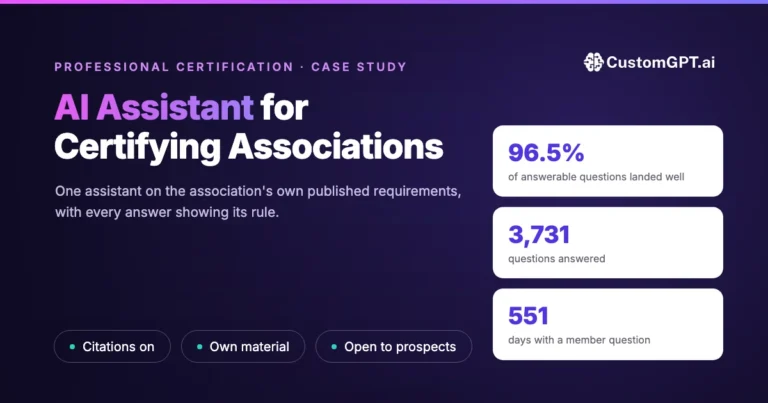
- AI Assistant for Certifying Associations: See the other side of the same problem: one assistant that shows the published rule behind every certification answer.
- AI for Healthcare Credentialing Bodies: See how the same refusal-first approach applies where a wrong answer misstates a credentialing requirement.
- Accounting Standards Research AI Tool for Professional Bodies: See how a professional body made its standards answerable for members and the employers who check their credentials.
- How to Connect Member AI to Your AMS: See how identity from your AMS decides who reaches which assistant.
- What Member Questions Reveal: AI Conversation Analytics: See how reading the questions members ask tells you what to rewrite next.